Importo totale (1 articolo articoli):
Destinazione ordine:

mundus subterraneus di kircher athanasius (30 risultati)
Vai alla pagina principale dei risultati di ricerca
Tipo di articolo
- Tutti gli articoli
- Libri (20)
- Riviste e Giornali
- Fumetti
- Spartiti
- Arte, Stampe e Poster (5)
- Fotografie
- Mappe (3)
-
Manoscritti e
Collezionismo cartaceo (2)
Condizioni
Legatura
Ulteriori caratteristiche
- Prima edizione (1)
- Copia autografata
- Sovraccoperta
- Con foto (22)
- No print on demand (19)
Spedizione gratuita
Paese del venditore
Valutazione venditore
-
Mundus subterraneus, in XII libros digestus.
Editore: Joannes Jansson and Elizeus Weyerstraet, Amsterdam, 1665
Da: Kurt Gippert Bookseller (ABAA), Chicago, IL, U.S.A.
Membro dell'associazione: ABAA ILAB MWABA
Valutazione venditore:

Libro Prima edizione
Hardcover. Condizione: Very good condition. First Edition. Two volumes bound in one. Folio: binding dimensions are approximately 391mm x 236mm. Complete with 2 engraved title pages, 2 engraved portraits, 22 engraved plates and maps of which 14 are double-page, folding or fold-outs, and 7 letterpress tables of which 6 are double page, folding or fold-outs. Additionally, in the first volume this copy contains three volvelles with all elements present and properly assembled at pages 132, 154 and 156. Additionally illustrated with dozens of engraved and wood-engraved illustrations in the text including numerous initials, and head and tail pieces. Text printed in double columns. Folio; height 39cm (15.25 inches). CONDITON: The engraved title page and the letterpress title page have had the top corner repaired with the missing text/illustration area completed in manuscript. The original vellum binding is heavily worn and soiled, with corners strengthened, and rebacked with the original spine laid down. There are dark areas of old adhesive discoloration on the spine, and the original vellum spine is chipping and lifting at the edges of the spine; protected in fitted archival mylar. Starting at page 229 of Vol. I and continuing for 130 pages, and again starting at page 407 of Vol. II there is minor staining to the fore edge, affecting only the margins. The final few pages are creased on the bottom edge, with minor worming to the lower margins of the final 40 pages. COLLATION: Vol. I: Engraved frontisportrait, engraved title page, [ii] title page, engraved portrait, xxvi, 346 pages of text, [vi] pages of index. Vol. II: Engraved title, [x], 487 pages of text, [ix] pages of index. Natural history Pre-Linnean works, volcanoes, alchemy, fireworks, metallurgy, minerals, lapidary, insects, hydraulics, mining, wind power, hydro power, distillation, grafting, herbs, poisons, etc. Includes sections on North America. Ferguson I, 467; Sabin 37967; Shirley, World Maps 436.
-
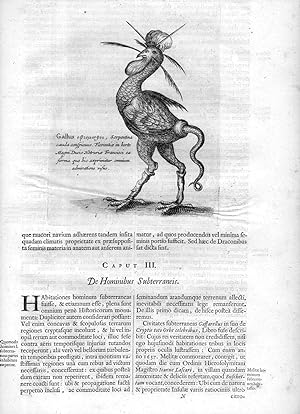
No Binding. Condizione: Very Good. KIRCHER, Athanasius. Gallus.Serpentina. Original illustration salvaged from a beyond-repair copy of the great "Athanasii Kircheri Mundus subterraneus in XII libros digestus. ", 1678. 7 x 5 inch image on a full sheet of text 14 x 8.75". VG condition. (Owing to the size of the original folio the entire sheet does not fit on my scanner--the top 1.5" and the bottom 1" or so simply are not included in the scan, though the margins are present in real life.) Deep, strong impression, and in Very Good condition.__+__ The great semi-mystifying polymath Athanasius Kircher (1602-1680) lived for a long time and filled his life with ideas and words, producing dozens of books during his time on Earth, some of which were never published even though written, some manuscripts lost forever. His was a massive output of extraordinary breadth. He wasted little time that I can see, writing on a spectacular range of subjects: enlightening people, confusing people, generating great theories and some occasional bad ideas. __+__ The image presented here comes from his Mundus Subterraenus , published in 1678, which was concerned mainly with geology and the theory of the Earth. Kircher--a product of the great Jesuit institution, the Collegio Romano--postulated the structure of the interior of the Earth, the origin of heat, the source of the tides, the composition of light, mechanics, the structure of music, linguistics, astronomy, and of course the existence of the Virgin Mary in amber. There was also a fair amount of work on one of his side interests that populated a number of his works, alchemy and the search for the organization of materials.
-
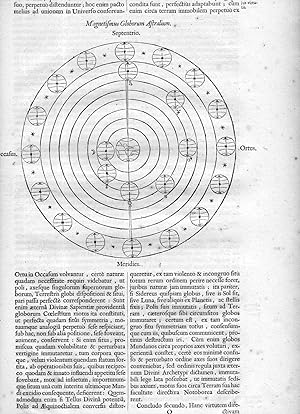
Magnetismus Globorum Astralium. Original illustration from a copy of "Athanasii Kircheri Mundus subterraneus in XII libros digestus. "
Data di pubblicazione: 1678
Mappa
No Binding. Condizione: Very Good. KIRCHER, Athanasius. Magnetismus Globorum Astralium. Original illustration salvaged from a beyond-repair copy of the great "Athanasii Kircheri Mundus subterraneus in XII libros digestus", 1678. VG condition. (Owing to the size of the original folio the entire sheet does not fit on my scanner--the top 1.5" and the bottom 1" or so simply are not included in the scan, though the margins are present in real life.) Deep, strong impression, and in Very Good condition. Magnetismus Globorum Astralium, in the chapter "Opificium Globi Terreni." Image 7 x 7 1/2", 185x190mm on a full 14 x 9 sheet of text. __+__ The great semi-mystifying polymath Athanasius Kircher (1602-1680) lived for a long time and filled his life with ideas and words, producing dozens of books during his time on Earth, some of which were never published even though written, some manuscripts lost forever. His was a massive output of extraordinary breadth. He wasted little time that I can see, writing on a spectacular range of subjects: enlightening people, confusing people, generating great theories and some occasional bad ideas. __+__ The image presented here comes from his Mundus Subterraenus , published in 1678, which was concerned mainly with geology and the theory of the Earth. Kircher--a product of the great Jesuit institution, the Collegio Romano--postulated the structure of the interior of the Earth, the origin of heat, the source of the tides, the composition of light, mechanics, the structure of music, linguistics, astronomy, and of course the existence of the Virgin Mary in amber. There was also a fair amount of work on one of his side interests that populated a number of his works, alchemy and the search for the organization of materials.
-
Original illustration from a dead copy of "Athanasii Kircheri Mundus subterraneus in XII libros digestus. " Mundus Subterraenus
Data di pubblicazione: 1678
Arte / Stampa / Poster
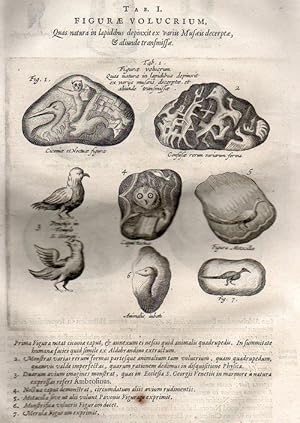
No Binding. Condizione: Very Good. KIRCHER, Athanasius. Original illustration salvaged from a beyond-repair copy of the great "Athanasii Kircheri Mundus subterraneus in XII libros digestus", 1678. Printed on a full sheet of text 14"x 8.75" . VG condition. __+__ The great semi-mystifying polymath Athanasius Kircher (1602-1680) lived for a long time and filled his life with ideas and words, producing dozens of books during his time on Earth, some of which were never published even though written, some manuscripts lost forever. His was a massive output of extraordinary breadth. He wasted little time that I can see, writing on a spectacular range of subjects: enlightening people, confusing people, generating great theories and some occasional bad ideas.__+__ The image presented here comes from his Mundus Subterraenus ("Athanasii Kircheri Mundus subterraneus in XII libros digestus. "), published in 1678, which was concerned mainly with geology and the theory of the Earth. Kircher--a product of the great Jesuit institution, the Collegio Romano--postulated the structure of the interior of the Earth, the origin of heat, the source of the tides, the composition of light, mechanics, the structure of music, linguistics, astronomy, and of course the existence of the Virgin Mary in amber. There was also a fair amount of work on one of his side interests that populated a number of his works, alchemy and the search for the organization of materials.__+__ The engraving, entitled Figure Volucrum, quas Natura in lapidibus depinxit, ex variis Museia decerpt et aliunde transmissa (or "Figures of winged creatures, painted by nature on stones, taken from various museums, and otherwise transmitted.") shows Kircher's collection of anthropomorphically based inorganic items. It is a remarkable exercise to try and place yourself within the context of the scientific world of Kircher's time, 350 years ago, and try to explain these naturally-occurring phenomena, without even the benefits of the conception of long geologic time, or of expanded time in general.__+__ The descriptive text (at the bottom of the engraving) from Kircher on these objects is translated, as follows: 1. The first figure represents a head of a Stork, together with some, but I do not know what, quadruped. At the top is something like a human face. Extracted from Aldobrandinot (see PI. XXIII. Fig. 1). 2. Shows various forms and parts of animals, winged creatures as well as quadrupeds, although very imperfect, the cause of which we give in the physical examinations (see PI. XXIII. Fig. 2). 3. Represents the figures of two birds expressed by nature on marble in the church of St. George's, at Venice, referred to by Ambrosinua (see Vol. VII. PI. II. Figs. 3, 4). 4. Shows the head of an Owl, surrounded by rudiments of other birds (see PI. XXIV. Fig. 2). 5. Represents the figure of a Wagtail, or as others prefer, of a Peacock (PI. XXIV. Fig. 3). 6. Shows the figure of a monstrous bird (Vol. VII. PI. II. Fig. 4). 7. The figure of a Merle (Vol. VII. PI. II. Fig. 5).
-
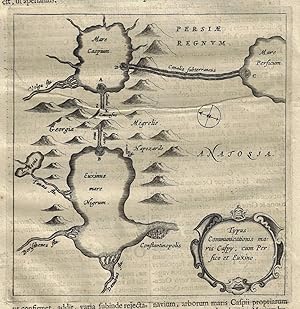
Typus Communicationis maris Caspy, cum Perscio et Euximo", being a map salvaged from a beyond-repair copy of the great Mundus Subterraneus
Data di pubblicazione: 1678
Mappa
No Binding. Condizione: Very Good. KIRCHER, Athanasius. "Typus Communicationis maris Caspy, cum Perscio et Euximo", being a map salvaged from a beyond-repair copy of the great Mundus Subterraneus, ("Athanasii Kircheri Mundus subterraneus in XII libros digestus"), 1678, from the second section, Liber Secundus Technicus , p 86. 6.5 x 6.5 on a 15 x 9 sheet. Very Good condition.__+__ This map depicts Kircher's theory for the origins and maintenance of the Capsian and Black Seas, with an involvement somehow of the Persian Gulf, all connected via underground canals. ( .map of the Pontocaspian region after Kircher (1678), who in his "Mundus Subterraneus" already envisaged that the Caspian Basin must have been connected to the open ocean to explain its relatively high salinity (> 10 ) today. The Caspian Sea is in fact an isolated long-lived lake since at least 2.6 Ma. Kircher considered a subterraneous channel to the Persian Gulf for the marine connection. The location of this marine connection is still enigmatic today. --Quaternary time scales for the Pontocaspian domain: Interbasinal connectivity and faunal evolution, Earth Science Reviews, 188 10, 1016, 2018 10 013.) __+__ The great semi-mystifying polymath Athanasius Kircher (1602-1680) lived for a long time and filled his life with ideas and words, producing dozens of books during his time on Earth, some of which were never published even though written, some manuscripts lost forever. His was a massive output of extraordinary breadth. He wasted little time that I can see, writing on a spectacular range of subjects: enlightening people, confusing people, generating great theories and some occasional bad ideas. __+__ The images presented here comes from his Mundus Subterraenus , published in 1678, which was concerned mainly with geology and the theory of the Earth. There is an enormous amount of wide-ranging thinking going on in these two volume, most of which were scientific and experimental, and some of that being flavored and coated by hermetic and religious influences, while some bits were entirely religio-speculative. A product of the great Jesuit institution, the Collegio Romano, he postulated and dove fearlessly into the structure of the interior of the Earth, the origin of heat, the source of the tides, the composition of light, mechanics, the structure of music, linguistics, astronomy, astrology, alchemy, fossils, fluid dynamics, mining, and of course the existence of anthropomorphic images in stone (for example, the Virgin Mary found in agate). There was also a fair amount of work on one of his side interests that populated a number of his works, alchemy and the search for the organization of materials. He also sought a primum mobile so to speak, a force or reckoning that was beyond what he recognized as the creator's, a cosmic pansperma, an automatic/spontaneous cosmic energy at the root of change of all things.
-
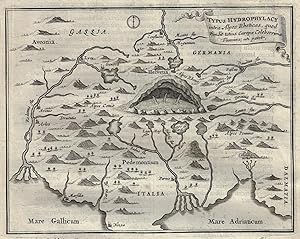
Typus Hydrophylacy intra Alpes Rheticas, quod Fundit totius Europae Celeberrima Flumina uti patet", from Mundus Subterraneus
Data di pubblicazione: 1678
Mappa
No Binding. Condizione: Very Good. KIRCHER, Athanasius. "Typus Hydrophylacy intra Alpes Rheticas, quod Fundit totius Europae Celeberrima Flumina uti patet , being a map salvaged from a beyond-repair copy of the great Mundus Subterraneus, ("Athanasii Kircheri Mundus subterraneus in XII libros digestus. "), 1678, from the second section Officium Globi Terreni , p. 71; 6" x 8" on a 15" x 9" sheet. Very Good condition. __+__ The foundations of the whole of the famous European rivers or so the title reads. __+__ The great semi-mystifying polymath Athanasius Kircher (1602-1680) lived for a long time and filled his life with ideas and words, producing dozens of books during his time on Earth, some of which were never published even though written, some manuscripts lost forever. His was a massive output of extraordinary breadth. He wasted little time that I can see, writing on a spectacular range of subjects: enlightening people, confusing people, generating great theories and some occasional bad ideas. __+__ The images presented here comes from his Mundus Subterraenus, published in 1678, which was concerned mainly with geology and the theory of the Earth. There is an enormous amount of wide-ranging thinking going on in these two volume, most of which were scientific and experimental, and some of that being flavored and coated by hermetic and religious influences, while some bits were entirely religio-speculative. A product of the great Jesuit institution, the Collegio Romano, he postulated and dove fearlessly into the structure of the interior of the Earth, the origin of heat, the source of the tides, the composition of light, mechanics, the structure of music, linguistics, astronomy, astrology, alchemy, fossils, fluid dynamics, mining, and of course the existence of anthropomorphic images in stone (for example, the Virgin Mary found in agate). There was also a fair amount of work on one of his side interests that populated a number of his works, alchemy and the search for the organization of materials. He also sought a primum mobile so to speak, a force or reckoning that was beyond what he recognized as the creator's, a cosmic pansperma, an automatic/spontaneous cosmic energy at the root of change of all things.
-
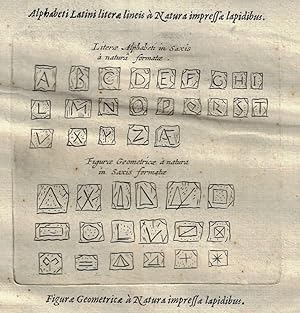
Typus Lapidem lineatorum, qui in Lapide quodam Schistorum e'genere, in Tolsensi, & Bassansi Agroreperimtur. Alphabeti Latini litera lineis a Natura impressa lapidibus", being a print salvaged from a beyond-repair copy of the great Mundus Subterraneus
Data di pubblicazione: 1668
Arte / Stampa / Poster
No Binding. Condizione: Very Good. KIRCHER, Athanasius. "Typus Lapidem lineatorum, qui in Lapide quodam Schistorum e'genere, in Tolsensi, & Bassansi Agroreperimtur. Alphabeti Latini litera lineis a Natura impressa lapidibus", being a print salvaged from a beyond-repair copy of the great Mundus Subterraneus, ("Athanasii Kircheri Mundus subterraneus in XII libros digestus"), 1678, appearing in the eighth book, section I, de Lapidibus . __+__ This image records the Latin alphabet found (naturally occurring) in stone. On the bottom section the same applies, except that the images are geometrical designs rather than letter. Kircher did not believe that finding these symbols in stone were a direct consequences of any supreme anything, recognizing that they were formed and collected by chance. He did formulate some interesting and early and sometimes-correct observations on the evolution of languages, but was entirely constrained by the authentic history as presented in the early books of the Bible. While recognizing that languages of a certain region are or could be relational, and that the Romance languages were a corruption of Latin and that there was a Semitic and Graeco-Latin connection, they were all necessarily descendants of Hebrew, which was the language given by the creator to man, mystical symbols handed down from Heaven to Adam. And so it goes. __+__ The great semi-mystifying polymath Athanasius Kircher (1602-1680) lived for a long time and filled his life with ideas and words, producing dozens of books during his time on Earth, some of which were never published even though written, some manuscripts lost forever. His was a massive output of extraordinary breadth. He wasted little time that I can see, writing on a spectacular range of subjects: enlightening people, confusing people, generating great theories and some occasional bad ideas. __+__ The images presented here comes from his Mundus Subterraenus , published in 1678, which was concerned mainly with geology and the theory of the Earth. There is an enormous amount of wide-ranging thinking going on in these two volume, most of which were scientific and experimental, and some of that being flavored and coated by hermetic and religious influences, while some bits were entirely religio-speculative. A product of the great Jesuit institution, the Collegio Romano, he postulated and dove fearlessly into the structure of the interior of the Earth, the origin of heat, the source of the tides, the composition of light, mechanics, the structure of music, linguistics, astronomy, astrology, alchemy, fossils, fluid dynamics, mining, and of course the existence of anthropomorphic images in stone (for example, the Virgin Mary found in agate). There was also a fair amount of work on one of his side interests that populated a number of his works, alchemy and the search for the organization of materials. He also sought a primum mobile so to speak, a force or reckoning that was beyond what he recognized as the creator's, a cosmic pansperma, an automatic/spontaneous cosmic energy at the root of change of all things.
-
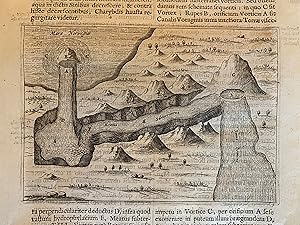
(Water, Tides) An engraved leaf from "Athanasii Kircheri Mundus subterraneus in XII libros digestus"
Data di pubblicazione: 1678
Arte / Stampa / Poster
No Binding. Condizione: Very Good. (Water, Tides) An engraved text illustration from Athanasius KIRCHER, "Athanasii Kircheri Mundus subterraneus in XII libros digestus", 1678, the section "Hydrographicus" "Liber Tertius, Sect. II", leaf 147/148, VG [++] KIRCHER, Athanasius. Original illustration salvaged from a beyond-repair copy of the great "Athanasii Kircheri Mundus subterraneus in XII libros digestus", printed in 1678. The text and image are printed on a full sheet of 14" x 8.75" with the image 4.25"x 6.75". VG condition. [++] This engraving seems to show a proposal for the flow of water/tides, pinpointing one source as "the maalstrom" in the sea of Norway (Mare Norvegiae), with the water traveling underground from the whirlpool across Norway and emerging in a pool and then fed into the Sinus Botnicus. (This version of the mechanics of tides is refuted very early on in the "Philosophical Transactions", vol 4 pg 547 in 1674.)[++] The great semi-mystifying polymath Athanasius Kircher (1602-1680) lived for a long time and filled his life with ideas and words, producing dozens of books during his time on Earth, some of which were never published even though written, some manuscripts lost forever. His was a massive output of extraordinary breadth. He wasted little time that I can see, writing on a spectacular range of subjects: enlightening people, confusing people, generating great theories and some occasional bad ideas.__+__ The image presented here comes from his "Mundus Subterraneus," published in 1678, which was concerned mainly with geology and the theory of the Earth. Kircher--a product of the great Jesuit institution, the Collegio Romano--postulated the structure of the interior of the Earth, the origin of heat, the source of the tides, the composition of light, mechanics, the structure of music, linguistics, astronomy, and of course the existence of the Virgin Mary in amber. There was also a fair amount of work on one of his side interests that populated a number of his works, alchemy and the search for the organization of materials.
-
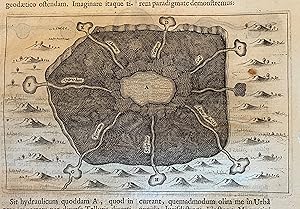
(Water, Sources of) An engraved text illustration from Athanasius KIRCHER, "Athanasii Kircheri Mundus subterraneus in XII libros digestus".
Data di pubblicazione: 1678
Arte / Stampa / Poster
No Binding. Condizione: Very Good. (Water, Sources of.) An engraved text illustration from Athanasius KIRCHER, "Athanasii Kircheri Mundus subterraneus in XII libros digestus", 1678, the section "Virtues Aquarum" Liber Quintus, Sect. II", leaf 257/258", VG [++] KIRCHER, Athanasius. Original illustration salvaged from a beyond-repair copy of the great "Athanasii Kircheri Mundus subterraneus in XII libros digestus", printed in 1678. The text and image are printed on a full sheet of 14" x 8.75" with the image 4.25"x 6.75". VG condition. __+__ It seems to me that this is a view looking down at the patterns of water/wind on a body of water. [++] The great semi-mystifying polymath Athanasius Kircher (1602-1680) lived for a long time and filled his life with ideas and words, producing dozens of books during his time on Earth, some of which were never published even though written, some manuscripts lost forever. His was a massive output of extraordinary breadth. He wasted little time that I can see, writing on a spectacular range of subjects: enlightening people, confusing people, generating great theories and some occasional bad ideas.__+__ The image presented here comes from his "Mundus Subterraneus," published in 1678, which was concerned mainly with geology and the theory of the Earth. Kircher--a product of the great Jesuit institution, the Collegio Romano--postulated the structure of the interior of the Earth, the origin of heat, the source of the tides, the composition of light, mechanics, the structure of music, linguistics, astronomy, and of course the existence of the Virgin Mary in amber. There was also a fair amount of work on one of his side interests that populated a number of his works, alchemy and the search for the organization of materials. I believe that this image shows one theory of the origin of water, revealing a cross section of an underground source of water that flows out to divergent sprints all around the Earth (".let there be a hydraulic section in every part of the earth, passing through different (diverticula) into different springs").
-

HRD. Condizione: New. New Book. Shipped from UK. Established seller since 2000.
-
Athanasii Kircheri e Soc. Jesu Mundus Subterraneus, in XII Libros Digestus, Vol. 1: Quo Divinum Subterrestris Mundi Opificium, Mira Ergasteriorum . Naturµ Majestas Et Divitiµ S (Latin Edition)
Editore: Forgotten Books, 2018
ISBN 10: 036497723XISBN 13: 9780364977231
Libro
Hardcover. Condizione: New. New. book.
-

Condizione: New. Book is in NEW condition.
-
![Immagine del venditore per Athanasii Kircheri e Soc. Jesu Mundus subterraneus : in XII libros digestus; quo divinum subterrestris mundi opificium, mira ergasteriorum naturae in eo distributio, verbo Pantamorphon [Greek work romanized] Protei regnum, universae denique naturae majestas & divitiae summa rerum varietate exponuntur, abditorum effectuum causae acri indagine inquisitae demonstrantur, cognitae per artis & naturae conjugium ad humanae vitae necessarium usum vario experimentorum apparatu, necnon novo modo & ratione applicantur. (1678) [Leatherbound] venduto da S N Books World](https://pictures.abebooks.com/inventory/md/md31378481662.jpg)
Athanasii Kircheri e Soc. Jesu Mundus subterraneus : in XII libros digestus; quo divinum subterrestris mundi opificium, mira ergasteriorum naturae in eo distributio, verbo Pantamorphon [Greek work romanized] Protei regnum, universae denique naturae majestas & divitiae summa rerum varietate exponuntur, abditorum effectuum causae acri indagine inquisitae demonstrantur, cognitae per artis & naturae conjugium ad humanae vitae necessarium usum vario experimentorum apparatu, necnon novo modo & ratione applicantur. (1678) [Leatherbound]
Data di pubblicazione: 2022
Libro Print on Demand
LeatherBound. Condizione: New. Leatherbound edition. Condition: New. Leather Binding on Spine and Corners with Golden leaf printing on spine. Bound in genuine leather with Satin ribbon page markers and Spine with raised gilt bands. A perfect gift for your loved ones. Reprinted from 1678 edition. NO changes have been made to the original text. This is NOT a retyped or an ocr'd reprint. Illustrations, Index, if any, are included in black and white. Each page is checked manually before printing. As this print on demand book is reprinted from a very old book, there could be some missing or flawed pages, but we always try to make the book as complete as possible. Fold-outs, if any, are not part of the book. If the original book was published in multiple volumes then this reprint is of only one volume, not the whole set. IF YOU WISH TO ORDER PARTICULAR VOLUME OR ALL THE VOLUMES YOU CAN CONTACT US. Resized as per current standards. Sewing binding for longer life, where the book block is actually sewn (smythe sewn/section sewn) with thread before binding which results in a more durable type of binding. Pages: 1004 Language: Latin Pages: 1004.
-
![Immagine del venditore per Athanasii Kircheri e Soc. Jesu mundus subterraneus, in XII libros digestus : quo divinum subterrestris mundi opificium, mira ergasteriorum naturae in eo distributio, verbo pantamorphou Protei regnum, universae denique naturae majestas & divitiae summa rerum varietate exponuntur : abditorum effectuum causae acri indagine inquisitae demonstrantur, cognitae per artis & naturae conjugium ad humanae vitae necessarium usum vario experimentorum apparatu, necnon novo modo, & ratione applicantur . : ad Alexandrum VII Pont. Opt. Max. (1665) Volume 1-2 [Leatherbound] venduto da S N Books World](https://pictures.abebooks.com/inventory/md/md31378555978.jpg)
Athanasii Kircheri e Soc. Jesu mundus subterraneus, in XII libros digestus : quo divinum subterrestris mundi opificium, mira ergasteriorum naturae in eo distributio, verbo pantamorphou Protei regnum, universae denique naturae majestas & divitiae summa rerum varietate exponuntur : abditorum effectuum causae acri indagine inquisitae demonstrantur, cognitae per artis & naturae conjugium ad humanae vitae necessarium usum vario experimentorum apparatu, necnon novo modo, & ratione applicantur . : ad Alexandrum VII Pont. Opt. Max. (1665) Volume 1-2 [Leatherbound]
Data di pubblicazione: 2022
Libro Print on Demand
LeatherBound. Condizione: New. Leatherbound edition. Condition: New. Leather Binding on Spine and Corners with Golden leaf printing on spine. Bound in genuine leather with Satin ribbon page markers and Spine with raised gilt bands. A perfect gift for your loved ones. Reprinted from 1665 edition. NO changes have been made to the original text. This is NOT a retyped or an ocr'd reprint. Illustrations, Index, if any, are included in black and white. Each page is checked manually before printing. As this print on demand book is reprinted from a very old book, there could be some missing or flawed pages, but we always try to make the book as complete as possible. Fold-outs, if any, are not part of the book. If the original book was published in multiple volumes then this reprint is of only one volume, not the whole set. IF YOU WISH TO ORDER PARTICULAR VOLUME OR ALL THE VOLUMES YOU CAN CONTACT US. Resized as per current standards. Sewing binding for longer life, where the book block is actually sewn (smythe sewn/section sewn) with thread before binding which results in a more durable type of binding. Pages: 996 Language: Latin Volume 1-2 Pages: 996 Volume 1-2.
-
![Immagine del venditore per Athanasii Kircheri e Soc. Jesu mundus subterraneus (1665) Volume 1-2 [LeatherBound] venduto da True World of Books](https://pictures.abebooks.com/inventory/md/md31618230107.jpg)
Athanasii Kircheri e Soc. Jesu mundus subterraneus (1665) Volume 1-2 [LeatherBound]
Data di pubblicazione: 2023
Libro Print on Demand
LeatherBound. Condizione: New. LeatherBound edition. Condition: New. Reprinted from 1665 edition. Leather Binding on Spine and Corners with Golden leaf printing on spine. Bound in genuine leather with Satin ribbon page markers and Spine with raised gilt bands. A perfect gift for your loved ones. NO changes have been made to the original text. This is NOT a retyped or an ocr'd reprint. Illustrations, Index, if any, are included in black and white. Each page is checked manually before printing. As this print on demand book is reprinted from a very old book, there could be some missing or flawed pages, but we always try to make the book as complete as possible. Fold-outs, if any, are not part of the book. If the original book was published in multiple volumes then this reprint is of only one volume, not the whole set. Sewing binding for longer life, where the book block is actually sewn (smythe sewn/section sewn) with thread before binding which results in a more durable type of binding. Pages: 996 Volume 1-2.
-
![Immagine del venditore per Mundus subterraneus, in XII libros digestus : qvo divinum subterrestris mundi opificium, mira ergasteriorum naturae in eo distributio, verbo [pantamorphon] Protei regnum, universae denique naturae majestas & divitiae summa rerum varietate exponuntur, abditorum effectuum causae acri indagine inquistae demonstrantur, cognitae per artis & naturae conjugium ad humanae vitae necessarium usum vario experimentorum apparata, necnon novo modo & ratione applicantur. Ad Alexandrum VII. pont. opt. max. Volume 2 [LeatherBound] venduto da True World of Books](https://pictures.abebooks.com/inventory/md/md31533546636.jpg)
Mundus subterraneus, in XII libros digestus : qvo divinum subterrestris mundi opificium, mira ergasteriorum naturae in eo distributio, verbo [pantamorphon] Protei regnum, universae denique naturae majestas & divitiae summa rerum varietate exponuntur, abditorum effectuum causae acri indagine inquistae demonstrantur, cognitae per artis & naturae conjugium ad humanae vitae necessarium usum vario experimentorum apparata, necnon novo modo & ratione applicantur. Ad Alexandrum VII. pont. opt. max. Volume 2 [LeatherBound]
Data di pubblicazione: 2023
Libro Print on Demand
LeatherBound. Condizione: New. LeatherBound edition. Condition: New. Reprinted from 1678 edition. Leather Binding on Spine and Corners with Golden leaf printing on spine. Bound in genuine leather with Satin ribbon page markers and Spine with raised gilt bands. A perfect gift for your loved ones. NO changes have been made to the original text. This is NOT a retyped or an ocr'd reprint. Illustrations, Index, if any, are included in black and white. Each page is checked manually before printing. As this print on demand book is reprinted from a very old book, there could be some missing or flawed pages, but we always try to make the book as complete as possible. Fold-outs, if any, are not part of the book. If the original book was published in multiple volumes then this reprint is of only one volume, not the whole set. Sewing binding for longer life, where the book block is actually sewn (smythe sewn/section sewn) with thread before binding which results in a more durable type of binding. Pages: 990 Volume 2 Language: Latin.
-
Mundus subterraneus in XII libros digestus qvo divinum subterrestris mundi opificium mira ergasteriorum naturae in eo distributio verbo pantamorphon Protei regnum universae denique naturae majestas & divitiae summa rerum varietate exponuntur abdi Volume 2 1678
Editore: Facsimile Publisher
ISBN 10: 9333411135ISBN 13: 9789333411134
Libro
Condizione: New. pp. 974.
-
![Immagine del venditore per Athanasii Kircheri . Mundus subterraneus in XII libros digestus : quo diuinum subterrestris mundi opificium, mira Ergasteriorum Naturae in eo distributio, verbo pantamorphon Protei Regnum . : Tomus I (1668) [Leatherbound] venduto da S N Books World](https://pictures.abebooks.com/inventory/md/md30637526785.jpg)
Athanasii Kircheri . Mundus subterraneus in XII libros digestus : quo diuinum subterrestris mundi opificium, mira Ergasteriorum Naturae in eo distributio, verbo pantamorphon Protei Regnum . : Tomus I (1668) [Leatherbound]
Data di pubblicazione: 2022
Libro Print on Demand
Leatherbound. Condizione: NEW. Leatherbound edition. Condition: New. Leather Binding on Spine and Corners with Golden leaf printing on spine. Bound in genuine leather with Satin ribbon page markers and Spine with raised gilt bands. A perfect gift for your loved ones. Reprinted from 1668 edition. NO changes have been made to the original text. This is NOT a retyped or an ocr'd reprint. Illustrations, Index, if any, are included in black and white. Each page is checked manually before printing. As this print on demand book is reprinted from a very old book, there could be some missing or flawed pages, but we always try to make the book as complete as possible. Fold-outs, if any, are not part of the book. If the original book was published in multiple volumes then this reprint is of only one volume, not the whole set. IF YOU WISH TO ORDER PARTICULAR VOLUME OR ALL THE VOLUMES YOU CAN CONTACT US. Resized as per current standards. Sewing binding for longer life, where the book block is actually sewn (smythe sewn/section sewn) with thread before binding which results in a more durable type of binding. Pages: 972 Language: Latin Pages: 972.
-
Mundus subterraneus in XII libros digestus qvo divinum subterrestris mundi opificium mira ergasteriorum naturae in eo distributio verbo pantamorphon Protei regnum universae denique naturae majestas & divitiae summa rerum varietate exponuntur abdi Volume 2 1678
Editore: Facsimile Publisher
ISBN 10: 9333411135ISBN 13: 9789333411134
Libro
Condizione: New. pp. 974.
-
Athanasii Kircheri e Soc Jesu Mundus Subterraneus, in XII Libros Digestus, Vol 1 Quo Divinum Subterrestris Mundi Opificium, Mira Ergasteriorum Univers Denique Natur Majestas Et Diviti S
Editore: Forgotten Books, 2018
ISBN 10: 036497723XISBN 13: 9780364977231
Libro
HRD. Condizione: New. New Book. Shipped from UK. Established seller since 2000.
-
![Immagine del venditore per Athanasii Kircheri e Soc. Jesu Mundus subterraneus in XII libros digestus , Volume 1 1678 [LeatherBound] venduto da True World of Books](https://pictures.abebooks.com/inventory/md/md31616604200.jpg)
Athanasii Kircheri e Soc. Jesu Mundus subterraneus in XII libros digestus , Volume 1 1678 [LeatherBound]
Data di pubblicazione: 2023
Libro Print on Demand
LeatherBound. Condizione: New. LeatherBound edition. Condition: New. Reprinted from , edition. Leather Binding on Spine and Corners with Golden leaf printing on spine. Bound in genuine leather with Satin ribbon page markers and Spine with raised gilt bands. A perfect gift for your loved ones. NO changes have been made to the original text. This is NOT a retyped or an ocr'd reprint. Illustrations, Index, if any, are included in black and white. Each page is checked manually before printing. As this print on demand book is reprinted from a very old book, there could be some missing or flawed pages, but we always try to make the book as complete as possible. Fold-outs, if any, are not part of the book. If the original book was published in multiple volumes then this reprint is of only one volume, not the whole set. Sewing binding for longer life, where the book block is actually sewn (smythe sewn/section sewn) with thread before binding which results in a more durable type of binding. Pages: 501.
-
![Immagine del venditore per Mundus subterraneus In XII Libros digestus : quo Divinum Subterrestris Mundi Opisicium, mira Ergasteriorum Natur in eo distributio, verbo pantamorphon Protei Regnum ; Univers denique Natur Majestas & diviti summa rerum varietate exponuntur . ; Ad Alexandrum VII. Pont. Opt. Max. In XII Libros digestus; Quo Divinum Subterrestris Mundi Opificium, mira Ergasteriorum Naturae in eo distributio, . 1678 [LeatherBound] venduto da True World of Books](https://pictures.abebooks.com/inventory/md/md31616606046.jpg)
Mundus subterraneus In XII Libros digestus : quo Divinum Subterrestris Mundi Opisicium, mira Ergasteriorum Natur in eo distributio, verbo pantamorphon Protei Regnum ; Univers denique Natur Majestas & diviti summa rerum varietate exponuntur . ; Ad Alexandrum VII. Pont. Opt. Max. In XII Libros digestus; Quo Divinum Subterrestris Mundi Opificium, mira Ergasteriorum Naturae in eo distributio, . 1678 [LeatherBound]
Data di pubblicazione: 2023
Libro Print on Demand
LeatherBound. Condizione: New. LeatherBound edition. Condition: New. Reprinted from , edition. Leather Binding on Spine and Corners with Golden leaf printing on spine. Bound in genuine leather with Satin ribbon page markers and Spine with raised gilt bands. A perfect gift for your loved ones. NO changes have been made to the original text. This is NOT a retyped or an ocr'd reprint. Illustrations, Index, if any, are included in black and white. Each page is checked manually before printing. As this print on demand book is reprinted from a very old book, there could be some missing or flawed pages, but we always try to make the book as complete as possible. Fold-outs, if any, are not part of the book. If the original book was published in multiple volumes then this reprint is of only one volume, not the whole set. Sewing binding for longer life, where the book block is actually sewn (smythe sewn/section sewn) with thread before binding which results in a more durable type of binding. Pages: 461.
-
![Immagine del venditore per Athanasii Kircheri . Mundus subterraneus, in XII libros digestus . : tomus I (1665) [Leatherbound] venduto da S N Books World](https://pictures.abebooks.com/inventory/md/md30637561255.jpg)
Athanasii Kircheri . Mundus subterraneus, in XII libros digestus . : tomus I (1665) [Leatherbound]
Data di pubblicazione: 2022
Libro Print on Demand
Leatherbound. Condizione: NEW. Leatherbound edition. Condition: New. Leather Binding on Spine and Corners with Golden leaf printing on spine. Bound in genuine leather with Satin ribbon page markers and Spine with raised gilt bands. A perfect gift for your loved ones. Reprinted from 1665 edition. NO changes have been made to the original text. This is NOT a retyped or an ocr'd reprint. Illustrations, Index, if any, are included in black and white. Each page is checked manually before printing. As this print on demand book is reprinted from a very old book, there could be some missing or flawed pages, but we always try to make the book as complete as possible. Fold-outs, if any, are not part of the book. If the original book was published in multiple volumes then this reprint is of only one volume, not the whole set. IF YOU WISH TO ORDER PARTICULAR VOLUME OR ALL THE VOLUMES YOU CAN CONTACT US. Resized as per current standards. Sewing binding for longer life, where the book block is actually sewn (smythe sewn/section sewn) with thread before binding which results in a more durable type of binding. Pages: 432 Language: Latin Pages: 432.
-
![Immagine del venditore per Athanasii Kircheri . Mundus subterraneus in XII libros digestus . tomus I. 1678 [LeatherBound] venduto da True World of Books](https://pictures.abebooks.com/inventory/md/md31617524176.jpg)
Athanasii Kircheri . Mundus subterraneus in XII libros digestus . tomus I. 1678 [LeatherBound]
Data di pubblicazione: 2023
Libro Print on Demand
LeatherBound. Condizione: New. LeatherBound edition. Condition: New. Reprinted from edition. Leather Binding on Spine and Corners with Golden leaf printing on spine. Bound in genuine leather with Satin ribbon page markers and Spine with raised gilt bands. A perfect gift for your loved ones. NO changes have been made to the original text. This is NOT a retyped or an ocr'd reprint. Illustrations, Index, if any, are included in black and white. Each page is checked manually before printing. As this print on demand book is reprinted from a very old book, there could be some missing or flawed pages, but we always try to make the book as complete as possible. Fold-outs, if any, are not part of the book. If the original book was published in multiple volumes then this reprint is of only one volume, not the whole set. Sewing binding for longer life, where the book block is actually sewn (smythe sewn/section sewn) with thread before binding which results in a more durable type of binding. Pages: 406.
-
![Immagine del venditore per Athanasii Kircheri E Soc. Jesu Mundus Subterraneus : In XII Libros digestus ; quo Divinum Subterrestris Mundi Opisicium, mira Ergasteriorum Natur ; 2 (-1678) [LeatherBound] venduto da True World of Books](https://pictures.abebooks.com/inventory/md/md31618957410.jpg)
Athanasii Kircheri E Soc. Jesu Mundus Subterraneus : In XII Libros digestus ; quo Divinum Subterrestris Mundi Opisicium, mira Ergasteriorum Natur ; 2 (-1678) [LeatherBound]
Data di pubblicazione: 2023
Libro Print on Demand
LeatherBound. Condizione: NEW. LeatherBound edition. Condition: New. Reprinted from -1678 edition. Leather Binding on Spine and Corners with Golden leaf printing on spine. Bound in genuine leather with Satin ribbon page markers and Spine with raised gilt bands. A perfect gift for your loved ones. NO changes have been made to the original text. This is NOT a retyped or an ocr'd reprint. Illustrations, Index, if any, are included in black and white. Each page is checked manually before printing. As this print on demand book is reprinted from a very old book, there could be some missing or flawed pages, but we always try to make the book as complete as possible. Fold-outs, if any, are not part of the book. If the original book was published in multiple volumes then this reprint is of only one volume, not the whole set. Sewing binding for longer life, where the book block is actually sewn (smythe sewn/section sewn) with thread before binding which results in a more durable type of binding. Pages: 564.
-
PAP. Condizione: New. New Book. Shipped from UK. Established seller since 2000.
-
Athanasii Kircheri e Soc Jesu Mundus Subterraneus, in XII Libros Digestus, Vol 1 Quo Divinum Subterrestris Mundi Opificium, Mira Ergasteriorum Univers Denique Natur Majestas Et Diviti S
Editore: Forgotten Books, 2018
ISBN 10: 0656589752ISBN 13: 9780656589753
Libro
PAP. Condizione: New. New Book. Shipped from UK. Established seller since 2000.
-
Athanasii Kircheri e Soc. Jesu Mundus Subterraneus, in XII Libros Digestus, Vol
Editore: Forgotten Books, 2018
ISBN 10: 0656589752ISBN 13: 9780656589753
Libro Print on Demand
Paperback. Condizione: New. Print on Demand. Excerpt from Athanasii Kircheri e Soc. Jesu Mundus Subterraneus, in XII Libros Digestus. About the Publisher, Forgotten Books publishes hundreds of thousands of rare and classic books. This book is a reproduction of an important historical work. Forgotten Books uses state-of-the-art technology to digitally reconstruct the work, preserving the original format whilst repairing imperfections present in the aged copy. In rare cases, an imperfection in the original, such as a blemish or missing page, may be replicated in our edition. We do, however, repair the vast majority of imperfections successfully; any imperfections that remain are intentionally left to preserve the state of such historical works. This text has been digitally restored from a historical edition. Some errors may persist, however we consider it worth publishing due to the work's historical value. The digital edition of all books may be viewed on our website before purchase. print-on-demand item.
-
Reproducción/Reproduction 15669680982: Mundus subterraneus, in XII libros digestus :. Amstelodami :apud Joannem Janssonium à Waesberge & filios,1678.
Editore: Varios 0
Manoscritto / Collezionismo cartaceo
Condizione: Nuevo. ATENCIÓN!: ES UNA REPRODUCCIÓN WARNING!: THIS IS A REPRODUCTION Reproducción impresa en cartulina respetando las proporciones originales de la imagen. Para la impresión se utiliza la imagen original de una calidad muy superior a la mostrada (1253x2101).INFORMACIÓN ADICIONAL :Classification - Mundus subterraneusCreator - Kircher, Athanasius,Description - Mundus subterraneus, in XII libros digestus :. Amstelodami :apud Joannem Janssonium à Waesberge & filios,1678. Early works to 1800GeologyNatural historyScienceTisch Library (archive.org)HistSciArtSouth Americano taxonomy neededhistorical map La imagen original ha sido cedida libre de derechos de copyright según Creative Commons ´Etiqueta de Dominio Público 1.0´. Manuscrito.
-
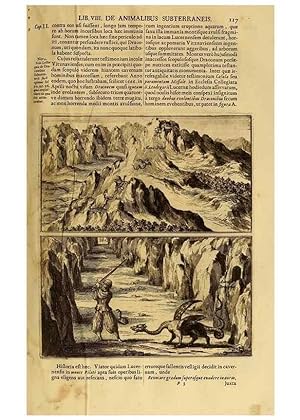
Reproducción/Reproduction 15048367824: Mundus subterraneus, in XII libros digestus :. Amstelodami :apud Joannem Janssonium à Waesberge & filios,1678.
Editore: Varios 0
Manoscritto / Collezionismo cartaceo
Condizione: Nuevo. ATENCIÓN!: ES UNA REPRODUCCIÓN WARNING!: THIS IS A REPRODUCTION Reproducción impresa en cartulina respetando las proporciones originales de la imagen. Para la impresión se utiliza la imagen original de una calidad muy superior a la mostrada (1218x2020).INFORMACIÓN ADICIONAL :Classification - DragonsClassification - Monsters Are RealClassification - Mundus subterraneusCreator - Kircher, Athanasius,Description - Mundus subterraneus, in XII libros digestus :. Amstelodami :apud Joannem Janssonium à Waesberge & filios,1678. Early works to 1800GeologyNatural historyScienceTisch Library (archive.org)dragon#bhlMonstersRreal La imagen original ha sido cedida libre de derechos de copyright según Creative Commons ´Etiqueta de Dominio Público 1.0´. Manuscrito.