
Articoli correlati a The Shadow of the Sun
Sinossi
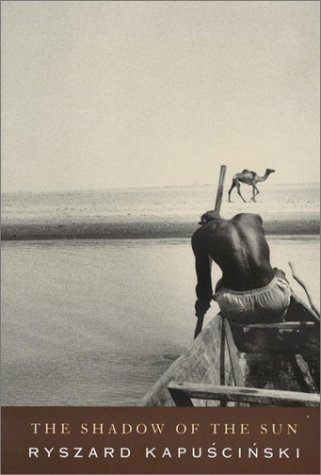
A moving portrait of Africa from Poland's most celebrated foreign correspondent - a masterpiece from a modern master.
Famous for being in the wrong places at just the right times, Ryszard Kapuscinski arrived in Africa in 1957, at the beginning of the end of colonial rule - the "sometimes dramatic and painful, sometimes enjoyable and jubilant" rebirth of a continent. The Shadow of the Sun sums up the author's experiences ("the record of a 40-year marriage") in this place that became the central obsession of his remarkable career.
From the hopeful years of independence through the bloody disintegration of places like Nigeria, Rwanda and Angola, Kapuscinski recounts great social and political changes through the prism of the ordinary African. He examines the rough-and-ready physical world and identifies the true geography of Africa: a little-understood spiritual universe, an African way of being. He looks also at Africa in the wake of two epoch-making changes: the arrival of AIDS and the definitive departure of the white man.
Kapuscinski's rare humanity invests his subjects with a grandeur and a dignity unmatched by any other writer on the Third World, and his unique ability to discern the universal in the particular has never been more powerfully displayed than in this work.
Le informazioni nella sezione "Riassunto" possono far riferimento a edizioni diverse di questo titolo.
Informazioni sull'autore
Ryszard Kapuscinski was born in 1932. During four decades reporting on Asia, Latin America and Africa, he befriended Che Guevara, Salvador Allende and Patrice Lumumba. He witnessed 27 coups and revolutions and was sentenced to death four times. His books have been translated into 19 languages.
Estratto. © Ristampato con autorizzazione. Tutti i diritti riservati.
The Beginning:
Collision, Ghana, 1958
More than anything, one is struck by the light. Light everywhere. Brightness everywhere. Everywhere, the sun. Just yesterday, an autumnal London was drenched in rain. The airplane drenched in rain. A cold wind, darkness. But here, from the morning's earliest moments, the airport is ablaze with sunlight, all of us in sunlight.
In times past, when people wandered the world on foot, rode on horseback, or sailed in ships, the journey itself accustomed them to the change. Images of the earth passed ever so slowly before their eyes, the stage revolved in a barely perceptible way. The voyage lasted weeks, months. The traveler had time to grow used to another environment, a different landscape. The climate, too, changed gradually. Before the traveler arrived from a cool Europe to the burning Equator, he already had left behind the pleasant warmth of Las Palmas, the heat of Al-Mahara, and the hell of the Cape Verde Islands.
Today, nothing remains of these gradations. Air travel tears us violently out of snow and cold and hurls us that very same day into the blaze of the tropics. Suddenly, still rubbing our eyes, we find ourselves in a humid inferno. We immediately start to sweat. If we've come from Europe in the wintertime, we discard overcoats, peel off sweaters. It's the first gesture of initiation we, the people of the North, perform upon arrival in Africa.
People of the North. Have we sufficiently considered the fact that northerners constitute a distinct minority on our planet? Canadians and Poles, Lithuanians and Scandinavians, some Americans and Germans, Russians and Scots, Laplanders and Eskimos, Evenkis and Yakuts—the list is not very long. It may amount to no more than 500 million people: less than 10 percent of the earth's population. The overwhelming majority live in hot climates, their days spent in the warmth of the sun. Mankind first came into being in the sun; the oldest traces of his existence have been found in warm climes. What was the weather like in the biblical paradise? It was eternally warm, hot even, so that Adam and Eve could go about naked and not feel chilled even in the shade of a tree.
Something else strikes the new arrival even as he descends the steps of the airplane: the smell of the tropics. Perhaps he's had intimations of it. It is the scent that permeated Mr. Kanzman's little shop, Colonial and Other Goods, on Perec Street in my hometown of Pi´nsk. Almonds, cloves, dates, and cocoa. Vanilla and laurel leaves, oranges and bananas, cardamom and saffron. And Drohobych. The interiors of Bruno Schulz's cinammon shops? Didn't their "dimly lit, dark, and solemn interiors" smell intensely of paints, lacquer, incense, the aroma of faraway countries and rare substances? Yet the actual smell of the tropics is somewhat different. We instantly recognize its weight, its sticky materiality. The smell makes us at once aware that we are at that point on earth where an exuberant and indefatigable nature labors, incessantly reproducing itself, spreading and blooming, even as it sickens, disintegrates, festers, and decays.
It is the smell of a sweating body and drying fish, of spoiling meat and roasting cassava, of fresh flowers and putrid algae—in short, of everything that is at once pleasant and irritating, that attracts and repels, seduces and disgusts. This odor will reach us from nearby palm groves, will escape from the hot soil, will waft above stagnant city sewers. It will not leave us; it is integral to the tropics.
And finally, the most important discovery—the people. The locals. How they fit this landscape, this light, these smells. How they are as one with them. How man and environment are bound in an indissoluble, complementary, and harmonious whole. I am struck by how firmly each race is grounded in the terrain in which it lives, in its climate. We shape our landscape, and it, in turn, molds our physiognomy. Among these palm trees and vines, in this bush and jungle, the white man is a sort of outlandish and unseemly intruder. Pale, weak, his shirt drenched with sweat, his hair pasted down on his head, he is continually tormented by thirst, and feels impotent, melancholic. He is ever afraid: of mosquitoes, amoebas, scorpions, snakes—everything that moves fills him with fear, terror, panic.
With their strength, grace, and endurance, the indigenous move about naturally, freely, at a tempo determined by climate and tradition, somewhat languid, unhurried, knowing one can never achieve everything in life anyway, and besides, if one did, what would be left over for others?
I've been here for a week. I am trying to get to know Accra. It is like an overgrown small town that has reproduced itself many times over, crawled out of the bush, out of the jungle, and come to a halt at the shores of the Gulf of Guinea. Accra is flat, single-storied, humble, though there are some buildings with two or more floors. No sophisticated architecture, no excess or pomp. Ordinary plaster, pastel-colored walls—pale yellow, pale green. The walls have numerous water stains. Fresh ones. After the rainy season, entire constellations of stains appear, collages, mosaics, fantastical maps, flowery flourishes. The downtown is densely built up. Traffic, crowds, bustle—life takes place out in the street. The street is a roadway delineated on both sides by an open sewer. There are no sidewalks. Cars mingle with the crowds. Everything moves in concert—pedestrians, automobiles, bicycles, carts, cows, and goats. On the sides, beyond the sewer, along the entire length of the street, domestic scenes unfold. Women are pounding manioc, baking taro bulbs over the coals, cooking dishes of one sort or another, hawking chewing gum, crackers, and aspirin, washing and drying laundry. Right out in the open, as if a decree had been issued commanding everyone to leave his home at 8 a.m. and remain in the street. In reality, there is another reason: apartments are small, cramped, stuffy. There is no ventilation, the atmosphere inside is heavy, the smells stale, there is no air to breathe. Besides, spending the day in the street enables one to participate in social life. The women talk nonstop, yell, gesticulate, laugh. Standing over a pot or a washbasin, they have an excellent vantage point. They can see their neighbors, passersby, the entire street; they can listen in on quarrels and gossip, observe accidents. All day long they are among others, in motion, and in the fresh air.
A red Ford with a speaker mounted on its roof passes through the streets. A hoarse, penetrating voice invites people to attend a meeting. The main attraction will be Kwame Nkrumah—Osagyefo, the prime minister, the leader of Ghana, of Africa, of all downtrodden peoples. There are photographs of Nkrumah everywhere—in the newspapers (every day), on posters, on flags, on ankle-length percale skirts. The energetic face of a middle-aged man, either smiling or serious, at an angle meant to suggest that he is contemplating the future.
"Nkrumah is a savior!" a young teacher named Joe Yambo tells me with rapture in his voice. "Have you heard him speak? He sounds like a prophet!"
Yes, in fact, I had heard him. He arrived at the stadium with an entourage of his ministers—young, animated, they created the impression of people who were having a good time, who were full of joy. The ceremony began with priests pouring bottles of gin over the podium—it was an offering to the gods, a way of making contact with them, a plea for their favor, their goodwill. Among the adults in the audience there were also children, from infants strapped to their mothers' backs, to babies beginning to crawl, to toddlers and school-age children. The older ones take care of the younger ones, and those older ones are taken care of by ones older still. This hierarchy of age is strictly observed, and obedience is absolute. A four-year-old has full authority over a two-year-old, a six-year-old over a four-year-old. Children take care of children, so that the adults can devote themselves to their affairs—for instance, to listening carefully to Nkrumah.
Osagyefo spoke briefly. He said that the most important thing was to gain independence—everything else would follow naturally, all that is good would emerge from the very fact of independence.
A portly fellow, given to decisive gestures, he had shapely, expressive features and large, lively eyes, which moved over the sea of dark heads with an attention so concentrated as to suggest he wanted to count each and every one of them.
After the rally, those on the podium mingled with the audience. It was loud, chaotic, and there was no visible police protection or escort. Joe, who had brought me, elbowed his way toward a young man (whom he identified as a minister) and asked him if I could come see him tomorrow. The other one, not really able to hear over the buzz and commotion what the issue was, replied, at least partially to get rid of us, "Fine! Fine!"
The next day, I found my way to the Ministry of Education and Information, a new building set amid a growth of royal palms. It was Friday. On Saturday, sitting in my small hotel, I wrote a description of the preceding day:
The way is open: neither policeman, nor secretary, nor doors.
I draw aside a patterned curtain and enter. The minister's office is warm. In semidarkness, he is standing at his desk organizing his papers: crumpling those he will throw into the wastepaper basket, smoothing out others to place in his briefcase. A thin, slight figure, in a sports shirt, short trousers, sandals, with a flowery kente cloth draped over his left shoulder; nervous gestures.
This is Kofi Baako, minister of education and information.
At thirty-two, he is the youngest minister in Ghana, in the entire British Commonwealth, and he has already had his portfolio for three years now. His office is on the third floor of the ministry building. The hierarchy of positions ...
Le informazioni nella sezione "Su questo libro" possono far riferimento a edizioni diverse di questo titolo.
Risultati della ricerca per The Shadow of the Sun

Foto dell'editore
The Shadow of the Sun
Da: ThriftBooks-Dallas, Dallas, TX, U.S.A.
Valutazione del venditore 5 su 5 stelle

Hardcover. Condizione: Good. No Jacket. Pages can have notes/highlighting. Spine may show signs of wear. ~ ThriftBooks: Read More, Spend Less. Codice articolo G0676973744I3N00
Compra usato
EUR 21,49
Spedizione gratuita
Spedito in U.S.A.
Spedito in U.S.A.
Quantità: 1 disponibili
Foto dell'editore
The Shadow of the Sun
Da: Better World Books, Mishawaka, IN, U.S.A.
Valutazione del venditore 5 su 5 stelle
Condizione: Good. Pages intact with minimal writing/highlighting. The binding may be loose and creased. Dust jackets/supplements are not included. Stock photo provided. Product includes identifying sticker. Better World Books: Buy Books. Do Good. Codice articolo 730071-6
Compra usato
EUR 22,79
Spedizione gratuita
Spedito in U.S.A.
Spedito in U.S.A.
Quantità: 2 disponibili
Foto dell'editore
The Shadow of the Sun
Editore:
Knopf Canada, 2001
ISBN 10: 0676973744
ISBN 13: 9780676973747
Antico o usato
Rilegato
Prima edizione
Da: Bingo Used Books, Vancouver, WA, U.S.A.
Valutazione del venditore 5 su 5 stelle
Hardcover. Condizione: Fine. Condizione sovraccoperta: Fine. 1st Edition. Hardback in fine condition with a fine dust jacket. 1st edition stated. Codice articolo 180088
Compra usato
EUR 20,00
Spedizione EUR 6,24
Spedito in U.S.A.
Spedito in U.S.A.
Quantità: 1 disponibili
Foto dell'editore
The Shadow of the Sun
Editore:
Knopf Canada, Toronto, 2001
ISBN 10: 0676973744
ISBN 13: 9780676973747
Antico o usato
Rilegato
Da: Edmonton Book Store, Edmonton, AB, Canada
Valutazione del venditore 4 su 5 stelle

Condizione: very good. Condizione sovraccoperta: very good. 8vo pp.325. book. Codice articolo 285838
Compra usato
EUR 15,63
Spedizione EUR 50,88
Spedito da Canada a U.S.A.
Spedito da Canada a U.S.A.
Quantità: 1 disponibili