Importo totale (1 articolo articoli):
Destinazione ordine:

brattain walter (17 risultati)
Vai alla pagina principale dei risultati di ricerca
Filtri di ricerca
Tipo di articolo
- Tutti i tipi di prodotto
- Libri (10)
- Riviste e Giornali (1)
- Fumetti (Nessun altro risultato corrispondente a questo perfezionamento)
- Spartiti (Nessun altro risultato corrispondente a questo perfezionamento)
- Arte, Stampe e Poster (Nessun altro risultato corrispondente a questo perfezionamento)
- Fotografie (1)
- Mappe (Nessun altro risultato corrispondente a questo perfezionamento)
- Manoscritti e Collezionismo cartaceo (5)
Condizioni Maggiori informazioni
- Nuovo (1)
- Come nuovo, Ottimo o Quasi ottimo (3)
- Molto buono o Buono (4)
- Discreto o Mediocre (Nessun altro risultato corrispondente a questo perfezionamento)
- Come descritto (9)
Legatura
Ulteriori caratteristiche
- Prima ed. (8)
- Copia autograf. (4)
- Sovracoperta (Nessun altro risultato corrispondente a questo perfezionamento)
- Con foto (11)
- Non Print on Demand (16)
Lingua (2)
Prezzo
- Qualsiasi prezzo
- Inferiore a EUR 20 (Nessun altro risultato corrispondente a questo perfezionamento)
- EUR 20 a EUR 45
- Superiore a EUR 45
Spedizione gratuita
Paese del venditore
Valutazione venditore
-
Physical Principles Involved in Transistor Action. WITH: The Theory of p-n Junctions in Semiconductors and p-n Junction Transistors.
Lingua: Inglese
Editore: Taylor and Francis, London, 1949
Da: Alexander Macaulay Rare Books, Toronto, ON, Canada
Valutazione del venditore 4 su 5 stelle

Prima edizione
EUR 1.189,70
EUR 15,40 shipping
Spedito da Canada a U.S.A.Quantità: 1 disponibili
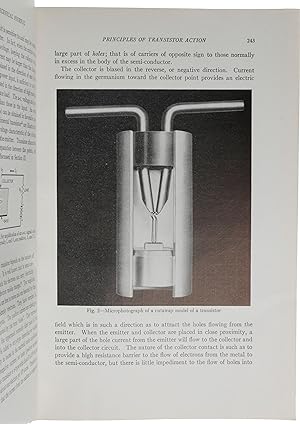
Aggiungi al carrelloFirst edition of the revolutionary transistor issue of The Bell System Technical Journal featuring the first account of the invention of the transistor, which ushered in the information age. Offered is the entire volume for 1949 (753 pages, complete with index), which also contains the July semiconductor issue dedicated to the semiconductor. Also included is Claude Shannon's Communication Theory of Secrecy Systems (pp. 656-715). New York: American Telephone and Telegraph Company, 1949. Contemporary green buckram. X-Libris but with minimal markings. Pages clean and bright. Near fine copy. Brattain, Walter H. and John Bardeen. "Physical Principles Involved in Transistor Action," Physical Principles Involved in Transistor Action. WITH: The Theory of p-n Junctions in Semiconductors and p-n Junction Transistors. Et al. Walter H. Brattain, John Bardeen, 1949. "Surface Properties of Germanium," Bell System Technical Journal 32(1), pp. 239-277. Hamming, R. W. "Error detecting and error correcting codes," The Bell System Technical Journal. 29 (1950), pp. 147-160. Shannon C. E. "Prediction and entropy of printed English," The Bell System Technical Journal. 30 (1951), pp. 50-64. Clos, Charles. "A study of non-blocking switching networks." In The Bell System Technical Journal, volume 32 (1953), 406-424.
-
The Transistor / Selected Reference Material on Characteristics & Applications / Contract DA 36-039 Sc-5589 (Task 3) (including) "The P - N Transistor Junction" By Sparks and Shockley
Lingua: Inglese
Editore: Bell Telephone Laboratories, Inc. / Western Electric Co., Inc., New York, 1951
Da: Arroyo Seco Books, Pasadena, Member IOBA, Pasadena, CA, U.S.A.
Membro dell'associazione: IOBA
Valutazione del venditore 5 su 5 stelle

Prima edizione Copia autografata
Soft cover. Condizione: Very Good. First Edition. 792 Pp. Grey Card Covers Printed In Black. First Printing. "The Material Included Herein Covers The Same Ground And Supplements The Talks Given At A Symposium On Transistors, Which Was Held At The Bell Telephone Laboratories During The Week Beginning September 17, 1951. Includes Reprints Of Important Shockley Papers Including The "The Theory Of P-N Junctions In Semiconductors And P-N Junction Transistors" From The 1949 Bell System Telephone Journal, And 33 Other Articles By Shockley And Others, Most Of Which Are First Published Here, Representing A Comprehensive Overview Of The Latest Developments In This Important Milestone In Electronics. Includes A Joint Article By Shockley And Sparks On P - N Transistor Junctions; The Junction Transistor, First Announced By Bell Labs In 1951, Was More Efficient And Consumed Far Less Power Than The Original 1947 Type, And Led To The Electronics Revolution In Small Devices; Sparks Was Later Directore Of Sandia Labs 1972-1981, And Was Involved In Plasma Research. (Note: No Articles Credited To Bardeen Or Brattain). Some Wear And Light Soiling To Covers, But All Lettering Clear On Front Cover And All Lettering Worn But Present On Spine. Internally A Clean Copy. Laid In Loosely Are Signed First Day Covers Commemorating Their Achievements, One Each Signed By Shockley, Brattain And Bardeen. Signed by Author(s).
-
![Immagine del venditore per Efficiency of excitation by electron impact and anomalous scattering in mercury vapor, by Walter Hauser Brattain. 1929 [LeatherBound] venduto da S N Books World](https://pictures.abebooks.com/inventory/md/md32213530994.jpg)
Efficiency of excitation by electron impact and anomalous scattering in mercury vapor, by Walter Hauser Brattain. 1929 [LeatherBound]
Lingua: Inglese
Data di pubblicazione: 2025
EUR 21,14
Spedizione gratuita
Spedito da India a U.S.A.Quantità: 18 disponibili
Aggiungi al carrelloLeatheBound. Condizione: New. BOOKS ARE EXEMPT FROM IMPORT DUTIES AND TARIFFS; NO EXTRA CHARGES APPLY. Leatherbound edition. Condition: New. Leather Binding on Spine and Corners with Golden leaf printing on spine. Bound in genuine leather with Satin ribbon page markers and Spine with raised gilt bands. Pages: 18. A perfect gift for your loved ones. Reprinted from 1929 edition. NO changes have been made to the original text. This is NOT a retyped or an ocr'd reprint. Illustrations, Index, if any, are included in black and white. Each page is checked manually before printing. As this print on demand book is reprinted from a very old book, there could be some missing or flawed pages, but we always try to make the book as complete as possible. Fold-outs, if any, are not part of the book. If the original book was published in multiple volumes then this reprint is of only one volume, not the whole set. IF YOU WISH TO ORDER PARTICULAR VOLUME OR ALL THE VOLUMES YOU CAN CONTACT US. Resized as per current standards. Sewing binding for longer life, where the book block is actually sewn (smythe sewn/section sewn) with thread before binding which results in a more durable type of binding. Language: English Pages: 18.
-

THE BELL SYSTEM TECHNICAL JOURNAL JANUARY 1953
Da: Collectors Cabinet, Teaneck, NJ, U.S.A.
Valutazione del venditore 4 su 5 stelle
Rivista / Giornale
Soft cover. Condizione: Very Good. Softcover, 9 by 6 inches, 163 pages. Covers have slight wear, some fading. Pages clean. Very very slight dampstain on top 1/2 inch of last ten pages. Articles include surface properties of Germanium by Brattain and Bardeen. And more.
-

Karte mit eigenh. U.
Lingua: Inglese
Da: Eberhard Köstler Autographen&Bücher oHG, Tutzing, Germania
Membro dell'associazione: ILAB VDA
Valutazione del venditore 4 su 5 stelle
Manoscritto / Collezionismo cartaceo
EUR 80,00
EUR 10,00 shipping
Spedito da Germania a U.S.A.Quantità: 1 disponibili
Aggiungi al carrelloOhne Ort, ohne Jahr, 10 x 15 cm. 1 Seite. Brattain erhielt 1956 zusammen mit William B. Shockley und John Bardeen den Nobelpreis für Physik "für ihre Untersuchungen über Halbleiter und ihre Entdeckung des Transistoreffekts". - Mit einem Foto des Ehepaars Brattain beim Tanz.
-
'Physical Principles Involved in Transistor Action,' pp. 239-77 in The Bell System Technical Journal, Vol. XXVIII, No. 2
Editore: American Telephone and Telegraph Company, New York, 1949
Da: SOPHIA RARE BOOKS, Koebenhavn V, Danimarca
Membro dell'associazione: ABF ILAB
Valutazione del venditore 5 su 5 stelle
Prima edizione
EUR 2.203,15
Spedizione gratuita
Spedito da Danimarca a U.S.A.Quantità: 1 disponibili
Aggiungi al carrelloHardcover. First edition. THE INVENTION OF THE TRANSISTOR. First edition, journal issue in original printed wrappers, of the first comprehensive report on the transistor, one of the most important inventions of the 20th Century. "In the 1930s, Bell Labs scientists were trying to use ultrahigh frequency waves for telephone communications, and needed a more reliable detection method than the vacuum tube, which proved incapable of picking up rapid vibrations . John Bardeen, Walter Brattain and William Shockley spearheaded the Bell Labs effort to develop a new means of amplification," developing, by 1948, a novel device that would effectively amplify and control electric signals. "At roughly half an inch high, the first transistor was huge by today's standards, when 7 million transistors can fit onto a single silicon chip. But it was the very first solid state device capable of doing the amplification work of a vacuum tube, earning Bardeen, Brattain and Shockley the Nobel Prize in Physics in 1956. More significantly, it spawned an entire industry and ushered in the Information Age, revolutionizing global society" (The American Physical Society). The invention of the transistor was first announced in three short letters by Bardeen, Brattain, Shockley, and Pearson, in The Physical Review (July 1948). The following year Bardeen and Brattain published the more comprehensive report 'Physical Principles Involved in Transistor Action'. This paper was simultaneously published, the same month, in The Physical Review and The Bell System Technical Journal. Offered here is the Bell printing [no priority established]. In 1956 Bardeen and Brattain shared the Nobel Prize in Physics with William Shockley "for their researches on semiconductors and their discovery of the transistor effect". In 1972 Bardeen again received the Nobel Prize in Physics for his part in the development of the theory of superconductivity (BCS-theory), and thus became the only person, until this day, to receive the Nobel Prize more than once in the same field. Provenance: Regnar Holfrid Svensson (1910-90), Swedish engineer and inventor (signature to front wrapper). "The first patent for the field-effect transistor principle was filed in Canada by Austrian-Hungarian physicist Julius Edgar Lilienfeld on October 22, 1925, but Lilienfeld published no research articles about his devices, and his work was ignored by industry. In 1934 German physicist Dr. Oskar Heil patented another field-effect transistor. There is no direct evidence that these devices were built, but later work in the 1990s show that one of Lilienfeld's designs worked as described and gave substantial gain. Legal papers from the Bell Labs patent show that William Shockley and a co-worker at Bell Labs, Gerald Pearson, had built operational versions from Lilienfeld's patents, yet they never referenced this work in any of their later research papers or historical articles. "The Bell Labs work on the transistor emerged from war-time efforts to produce extremely pure germanium 'crystal' mixer diodes, used in radar units as a frequency mixer element in microwave radar receivers. UK researchers had produced models using a tungsten filament on a germanium disk, but these were difficult to manufacture and not particularly robust. Bell's version was a single-crystal design that was both smaller and completely solid. A parallel project on germanium diodes at Purdue University succeeded in producing the good-quality germanium semiconducting crystals that were used at Bell Labs. Early tube-based circuits did not switch fast enough for this role, leading the Bell team to use solid-state diodes instead. After the war, Shockley decided to attempt the building of a triode-like semiconductor device. He secured funding and lab space, and went to work on the problem with Bardeen and Brattain. John Bardeen eventually developed a new branch of quantum mechanics known as surface physics to account for the 'odd' behavior they saw, and Bardeen and Walter Brattain eventually succeeded in building a working device. "The key to the development of the transistor was the further understanding of the process of the electron mobility in a semiconductor. It was realized that if there was some way to control the flow of the electrons from the emitter to the collector of this newly discovered diode (discovered 1874; patented 1906), one could build an amplifier. For instance, if one placed contacts on either side of a single type of crystal, the current would not flow through it. However, if a third contact could then 'inject' electrons or holes into the material, the current would flow. "Actually doing this appeared to be very difficult. If the crystal were of any reasonable size, the number of electrons (or holes) required to be injected would have to be very large, making it less useful as an amplifier because it would require a large injection current to start with. That said, the whole idea of the crystal diode was that the crystal itself could provide the electrons over a very small distance, the depletion region. The key appeared to be to place the input and output contacts very close together on the surface of the crystal on either side of this region. "Brattain started working on building such a device, and tantalizing hints of amplification continued to appear as the team worked on the problem. Sometimes the system would work, but then stop working unexpectedly. In one instance a non-working system started working when placed in water. The electrons in any one piece of the crystal would migrate about due to nearby charges. Electrons in the emitters, or the 'holes' in the collectors, would cluster at the surface of the crystal, where they could find their opposite charge 'floating around' in the air (or water). Yet they could be pushed away from the surface with the application of a small amount of charge from any other location on the crystal. Instead of needing a large supply of injected electrons, a very small number in.
-
Physical Principles Involved in Transistor Action. WITH: The Theory of p-n Junctions in Semiconductors and p-n Junction Transistors. Et al
Editore: American Telephone and Telegraph Company, New York, 1949
Da: Manhattan Rare Book Company, ABAA, ILAB, New York, NY, U.S.A.
Membro dell'associazione: ABAA ILAB
Valutazione del venditore 5 su 5 stelle
Prima edizione
Hardcover. Condizione: Fine. 1st Edition. FIRST EDITION of two landmark journals documenting the revolutionary invention of the transistor: the April 1949 issue of The Bell System Technical Journal containing the first description of the invention (published simultaneously in The Physical Review), and the famous July 1949 "Semiconductor Issue" dedicated entirely to the discuss of the transistor and semiconductor devices. The entire 1949 volume offered. "In the 1930s, Bell Labs scientists were trying to use ultrahigh frequency waves for telephone communications, and needed a more reliable detection method than the vacuum tube, which proved incapable of picking up rapid vibrations. John Bardeen, Walter Brattain and William Shockley spearheaded the Bell Labs effort to develop a new means of amplification," developing, by 1948, a novel device that would effectively amplify and control electric signals. "At roughly half an inch high, the first transistor was huge by today's standards, when 7 million transistors can fit onto a single silicon chip. But it was the very first solid state device capable of doing the amplification work of a vacuum tube, earning Bardeen, Brattain and Shockley the Nobel Prize in Physics in 1956. More significantly, it spawned an entire industry and ushered in the Information Age, revolutionizing global society" (The American Physical Society). The 1956 Nobel Prize in Physics was awarded jointly to William Shockley, John Bardeen and Walter Brattain "for their researches on semiconductors and their discovery of the transistor effect". Also included is Claude Shannon's Communication Theory of Secrecy Systems (pp. 656-715). BARDEEN, J., and BRATTAIN, W. H. Physical Principles Involved in Transistor Action. In The Bell System Technical Journal, Vol. 28, No. 2, April 1949 (pp. 239-277). WITH: BARDEEN, J., and BRATTAIN, W.H., and SHOCKLEY, W., et al. The Bell System Technical Journal, Vol. 28, No. 3. July, 1949. New York: American Telephone and Telegraph Company, 1949. Octavo, contemporary blue buckram. The whole volume with all the issues for 1949 (753 pages, complete with contents and index). Fine copy.
-
Eigenh. Unterschrift auf Albumblatt.
Editore: Tri Cities, WA, 23. II. 1978., 1978
Da: Kotte Autographs GmbH, Roßhaupten, Germania
Membro dell'associazione: ILAB VDA
Valutazione del venditore 5 su 5 stelle
Manoscritto / Collezionismo cartaceo
EUR 80,00
EUR 20,00 shipping
Spedito da Germania a U.S.A.Quantità: 1 disponibili
Aggiungi al carrelloQuer-kl.-8vo. 1 p. Postgelaufen. Brattain beschäftigte sich vorwiegend mit den Oberflächeneigenschaften von Festkörpern. Nach ersten Untersuchungen an Wolfram galt sein Interesse vor allem Oberflächeneffekten an Halbleitern wie Silicium und Germanium, zu deren besserem Verständnis er wesentliche Beiträge lieferte. Zusammen mit John Bardeen entwickelte er den Punktkontakttransistor.Brattain erhielt 1956 zusammen mit William B. Shockley und John Bardeen den Nobelpreis für Physik für ihre Untersuchungen über Halbleiter und ihre Entdeckung des Transistoreffekts".
-
SURFACE PROPERTIES OF GERMANIUM (contained in one complete issue of The Bell System Technical Journal, January 1953)
Data di pubblicazione: 1953
Da: Xerxes Fine and Rare Books and Documents, Glen Head, NY, U.S.A.
Valutazione del venditore 5 su 5 stelle
Prima edizione
Condizione: Good. NY 1953. first edition. In The Bell System Technical Journal, Volume XXXII, Number 1 January 1953 at pp. 1-41. Whole issue. Bardeen shared Nobel Prize with Shockley and Brattain for the invention of the Transistor in 1956 and won it again in 1972. Good, date stamp on front cover - no other ownership marks; some rubbing and wear on cover and slight slant to spine.
-
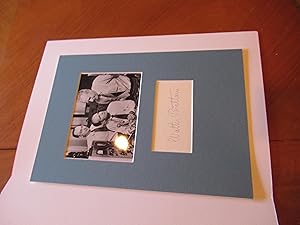
Mounted Photograph Of William Shockley, John Bardeen, And Walter H Brattain, With Signature Of Walter Brattain Mounted Below
Lingua: Inglese
Da: Arroyo Seco Books, Pasadena, Member IOBA, Pasadena, CA, U.S.A.
Membro dell'associazione: IOBA
Valutazione del venditore 5 su 5 stelle
Prima edizione Copia autografata
No Binding. Condizione: Fine. Original Photograph. Mat Board With Photograph Of Shockley, Bardeen, And Brattain, With Signature Of Brattain Mounted Below. Fine. Signed by Author(s).
-

Portraitphotographie mit eigenh. Unterschrift.
Editore: ohne Ort und Jahr
Da: Kotte Autographs GmbH, Roßhaupten, Germania
Membro dell'associazione: ILAB VDA
Valutazione del venditore 5 su 5 stelle
Manoscritto / Collezionismo cartaceo
EUR 400,00
EUR 20,00 shipping
Spedito da Germania a U.S.A.Quantità: 1 disponibili
Aggiungi al carrello125 : 177 mm. Brustbild nach 1/2-rechts. - Brattain beschäftigte sich vorwiegend mit den Oberflächeneigenschaften von Festkörpern. Nach ersten Untersuchungen an Wolfram galt sein Interesse vor allem Oberflächeneffekten an Halbleitern wie Silicium und Germanium, zu deren besserem Verständnis er wesentliche Beiträge lieferte. Zusammen mit John Bardeen entwickelte er den Punktkontakttransistor. Brattain erhielt 1956 zusammen mit William B. Shockley und John Bardeen den Nobelpreis für Physik für ihre Untersuchungen über Halbleiter und ihre Entdeckung des Transistoreffekts".
-
Portraitphotographie mit eigenh. Unterschrift.
Editore: ohne Ort und Datum
Da: Kotte Autographs GmbH, Roßhaupten, Germania
Membro dell'associazione: ILAB VDA
Valutazione del venditore 5 su 5 stelle
Manoscritto / Collezionismo cartaceo
EUR 400,00
EUR 20,00 shipping
Spedito da Germania a U.S.A.Quantità: 1 disponibili
Aggiungi al carrello130 : 180 mm. Brustbild von vorn. - Brattain beschäftigte sich vorwiegend mit den Oberflächeneigenschaften von Festkörpern. Nach ersten Untersuchungen an Wolfram galt sein Interesse vor allem Oberflächeneffekten an Halbleitern wie Silicium und Germanium, zu deren besserem Verständnis er wesentliche Beiträge lieferte. Zusammen mit John Bardeen entwickelte er den Punktkontakttransistor. Brattain erhielt 1956 zusammen mit William B. Shockley und John Bardeen den Nobelpreis für Physik für ihre Untersuchungen über Halbleiter und ihre Entdeckung des Transistoreffekts".
-

1. Physical principles involved in transistor action. 2. The theory of p-n junctions in semiconductors and p-n junction transistors. 3. Communication theory of secrecy systems
Data di pubblicazione: 1948
Da: Jeremy Norman's historyofscience, Novato, CA, U.S.A.
Membro dell'associazione: ABAA ILAB
Valutazione del venditore 5 su 5 stelle
Prima edizione
First edition. First Comprehensive Report on the Transistor, with Shannon's Foundation of Modern Cryptography (1) Bardeen, John (1908-91) and Brattain, Walter (1902-87). Physical principles involved in transistor action. In Bell System Technical Journal 28, no. 2 (April 1949): 239-77. (2) Shockley, William (1910-89). The theory of p-n junctions in semiconductors and p-n junction transistors. In ibid.: 435-89. (3) Shannon, Claude (1916-2001). Communication theory of secrecy systems. In ibid.: 656-715. Whole volume. iv, 753, [1], v-viii pp. Illustrated. 221 x 148 mm. Library buckram. Very good. Library stamps and label on endpapers. (1) First Editions. No. (1), Bardeen and Brattain's paper, is the first comprehensive report on the point-contact transistor, created in December 1947 and announced in three brief papers published in the Physical Review in 1948. The transistor gradually replaced the bulkier vacuum tube, allowing heat reduction and miniaturization of electronic devices. Transistors began to be employed on a large scale in computer manufacturing in the late 1950s; they were eventually miniaturized and incorporated into microprocessors. Bardeen and Brattain shared the 1956 Nobel Prize for physics with William Shockley (see below) for their investigations of semiconductors (the materials of which transistors are made) and for their discovery of the transistor. Origins of Cyberspace 450. No. (2) is a detailed account of the junction transistor invented by Shockley shortly after Bardeen and Brattain's invention of the point-contact transistor. Shockley's design marked a substantial improvement over the point-contact transistor, whose "delicate mechanical configuration would be difficult to manufacture in high volume with sufficient reliability" (Computer History Museum, "The silicon engine: A timeline of semiconductors in computers" [internet reference]). Shockley disagreed with Bardeen and Brattain's explanation of how the transistor worked, claiming that "positively charged holes could also penetrate through the bulk germanium material-not only trickle along a surface layer. Called 'minority carrier injection,' this phenomenon was crucial to operation of his junction transistor, a three-layer sandwich of n-type and p-type semiconductors separated by p-n junctions. This is how all 'bipolar' junction transistors work today" (ibid.). Bell Laboratories began manufacturing junction transistors in quantity in 1951; they dominated the market for many years. Magill, Nobel Prize Winners: Physics, pp. 675-704. No. (3), Shannon's discussion of cryptography from the viewpoint of information theory, "is one of the foundational treatments (arguably the foundational treatment) of modern cryptography. It is also a proof that all theoretically unbreakable ciphers must have the same requirements as the one-time pad [a secret random key used only once]" (Wikipedia). Shannon published an earlier version of his cryptography research in the classified report A Mathematical Theory of Cryptography (Memorandum MM 45-110-02, Bell Laboratories, Sept. 1, 1945). Shannon, Collected Papers, no. 25. .
-
Physical Principles Involved in Transistor Action. [In: The Bell System Technical Journal, vol. 28, pp.239-277]. - [INVENTION OF THE TRANSISTOR]
Da: Herman H. J. Lynge & Søn ILAB-ABF, Copenhagen, Danimarca
Membro dell'associazione: ABF ILAB
Valutazione del venditore 4 su 5 stelle
Prima edizione
EUR 1.378,48
Spedizione gratuita
Spedito da Danimarca a U.S.A.Quantità: 1 disponibili
Aggiungi al carrelloNew York: Bell Telephone Laboratories, 1949. 8vo. The entire April issue in original printed wrappers offered. Spine strips with some wear. Small rubberstamp on front wrapper. Otherwise fine. First edition. The first comprehensive report to describe the transistor - one of the most important inventions of the 20th Century. The invention of the transistor was first announced in three short letters by Bardeen, Brattain, Shockley, and Pearson, in The Physical Review (Number 2 Volume 74, 1948). The following year Bardeen and Brattain published the more comprehensive report "Physical Principles Involved in Transistor Action" [as offered here]. This paper was simultaneously published, the same month, in The Physical Review (Number 8 volume 75). In 1956 Bardeen and Brattain shared the Nobel Prize in Physics with William Shockley "for their researches on semiconductors and their discovery of the transistor effect". In 1972 Bardeen again received the Nobel Prize in Physics for his part in the development of the theory of superconductivity (BCS-theory), and thus became the only person, until this day, to receive the Nobel Prize more than once in the same field. Hook & Norman: Origins of Cyberspace, No. 450.
-

Walter Brattain Autograph
Da: Markus Brandes Autographs GmbH, Kesswil, TG, Svizzera
Valutazione del venditore 4 su 5 stelle
Fotografia Copia autografata
EUR 110,75
EUR 30,00 shipping
Spedito da Svizzera a U.S.A.Quantità: 1 disponibili
Aggiungi al carrelloSigned vintage photograph, shows Walter Brattain in a chest-up portrait, 3,25 x 5 inch, signed in blue ballpoint ink "Walter Brattain", with very mild signs of wear - in nearly very fine condition.
-
SURFACE PROPERTIES OF GERMANIUM (contained in one complete issue of The Bell System Technical Journal, January 1953)
Data di pubblicazione: 1953
Da: Xerxes Fine and Rare Books and Documents, Glen Head, NY, U.S.A.
Valutazione del venditore 5 su 5 stelle
Condizione: VG. NY 1953. first edition. In The Bell System Technical Journal, Volume XXXII, Number 1 January 1953 at pp. 1-41. Whole issue. Bardeen shared Nobel Prize with Shockley and Brattain for the invention of the Transistor in 1956 and he won it agin in 1972. VG plus, slight fading of spine. ownership marks. Text clean; almost no wear at all. Pictures available on request.
-

Walter Houser Brattain Autograph
Da: Markus Brandes Autographs GmbH, Kesswil, TG, Svizzera
Valutazione del venditore 4 su 5 stelle
Manoscritto / Collezionismo cartaceo Copia autografata
EUR 155,04
EUR 30,00 shipping
Spedito da Svizzera a U.S.A.Quantità: 1 disponibili
Aggiungi al carrelloPrinted scientific article signed, six page, 8,2 x 11 inch, scientific article entitled `Genesis of the Transistor` by Walter H. Brattain - reprinted from `The Physics Teacher`. March 1968, signed and dated on the first page in blue ballpoint ink "Walter Brattain - Dec 4 1979", with mild signs of wear - in fine to very fine condition.