

Importo totale (1 articolo articoli):
Destinazione ordine:

gidday jeffrey (25 risultati)
Vai alla pagina principale dei risultati di ricerca
Filtri di ricerca
Tipo di articolo
- Tutti i tipi di prodotto
- Libri (25)
- Riviste e Giornali (Nessun altro risultato corrispondente a questo perfezionamento)
- Fumetti (Nessun altro risultato corrispondente a questo perfezionamento)
- Spartiti (Nessun altro risultato corrispondente a questo perfezionamento)
- Arte, Stampe e Poster (Nessun altro risultato corrispondente a questo perfezionamento)
- Fotografie (Nessun altro risultato corrispondente a questo perfezionamento)
- Mappe (Nessun altro risultato corrispondente a questo perfezionamento)
- Manoscritti e Collezionismo cartaceo (Nessun altro risultato corrispondente a questo perfezionamento)
Condizioni Maggiori informazioni
- Nuovo (21)
- Come nuovo, Ottimo o Quasi ottimo (4)
- Molto buono o Buono (Nessun altro risultato corrispondente a questo perfezionamento)
- Discreto o Mediocre (Nessun altro risultato corrispondente a questo perfezionamento)
- Come descritto (Nessun altro risultato corrispondente a questo perfezionamento)
Legatura
Ulteriori caratteristiche
- Prima ed. (Nessun altro risultato corrispondente a questo perfezionamento)
- Copia autograf. (Nessun altro risultato corrispondente a questo perfezionamento)
- Sovracoperta (Nessun altro risultato corrispondente a questo perfezionamento)
- Con foto (12)
- Non Print on Demand (14)
Lingua (1)
Prezzo
- Qualsiasi prezzo
- Inferiore a EUR 20 (Nessun altro risultato corrispondente a questo perfezionamento)
- EUR 20 a EUR 45 (Nessun altro risultato corrispondente a questo perfezionamento)
- Superiore a EUR 45
Spedizione gratuita
Paese del venditore
Valutazione venditore
-

Innate Tolerance in the CNS : Translational Neuroprotection by Pre- and Post-conditioning
Libro 5 di 14: Springer Series in Translational Stroke ResearchDa: GreatBookPrices, Columbia, MD, U.S.A.
Valutazione del venditore 5 su 5 stelle

EUR 229,93
Spedizione EUR 2,29
Spedito in U.S.A.Quantità: Più di 20 disponibili
Aggiungi al carrelloCondizione: New.
-

Innate Tolerance in the CNS: Translational Neuroprotection by Pre- and Post-Conditioning (Springer Series in Translational Stroke Research)
Libro 5 di 14: Springer Series in Translational Stroke ResearchDa: California Books, Miami, FL, U.S.A.
Valutazione del venditore 4 su 5 stelle

EUR 232,29
Spedizione gratuita
Spedito in U.S.A.Quantità: Più di 20 disponibili
Aggiungi al carrelloCondizione: New.
-
Innate Tolerance in the CNS : Translational Neuroprotection by Pre- and Post-conditioning
Libro 5 di 14: Springer Series in Translational Stroke ResearchDa: GreatBookPricesUK, Woodford Green, Regno Unito
Valutazione del venditore 5 su 5 stelle
EUR 216,56
Spedizione EUR 17,35
Spedito da Regno Unito a U.S.A.Quantità: Più di 20 disponibili
Aggiungi al carrelloCondizione: New.
-
Innate Tolerance in the CNS: Translational Neuroprotection by Pre- and Post-Conditioning (Springer Series in Translational Stroke Research)
Libro 5 di 14: Springer Series in Translational Stroke ResearchDa: Ria Christie Collections, Uxbridge, Regno Unito
Valutazione del venditore 5 su 5 stelle
EUR 225,20
Spedizione EUR 13,86
Spedito da Regno Unito a U.S.A.Quantità: Più di 20 disponibili
Aggiungi al carrelloCondizione: New. In.
-

Innate Tolerance in the CNS: Translational Neuroprotection by Pre- and Post-Conditioning (Springer Series in Translational Stroke Research)
Libro 5 di 14: Springer Series in Translational Stroke ResearchDa: Ria Christie Collections, Uxbridge, Regno Unito
Valutazione del venditore 5 su 5 stelle
EUR 225,20
Spedizione EUR 13,86
Spedito da Regno Unito a U.S.A.Quantità: Più di 20 disponibili
Aggiungi al carrelloCondizione: New. In.
-
Innate Tolerance in the Cns: Translational Neuroprotection by Pre- and Post-conditioning
Libro 5 di 14: Springer Series in Translational Stroke ResearchDa: Books Puddle, New York, NY, U.S.A.
Valutazione del venditore 4 su 5 stelle
Condizione: New. pp. 708 Reprint edition NO-PA16APR2015-KAP.
-

Innate Tolerance in the CNS | Translational Neuroprotection by Pre- and Post-Conditioning
Libro 5 di 14: Springer Series in Translational Stroke ResearchEUR 184,85
Spedizione EUR 70,00
Spedito da Germania a U.S.A.Quantità: 5 disponibili
Aggiungi al carrelloTaschenbuch. Condizione: Neu. Innate Tolerance in the CNS | Translational Neuroprotection by Pre- and Post-Conditioning | Jeffrey M. Gidday (u. a.) | Taschenbuch | ix | Englisch | 2016 | Springer US | EAN 9781493941773 | Verantwortliche Person für die EU: Springer Verlag GmbH, Tiergartenstr. 17, 69121 Heidelberg, juergen[dot]hartmann[at]springer[dot]com | Anbieter: preigu.
-
Innate Tolerance in the CNS : Translational Neuroprotection by Pre- and Post-Conditioning
Libro 5 di 14: Springer Series in Translational Stroke ResearchEUR 163,87
Spedizione EUR 105,00
Spedito da Germania a U.S.A.Quantità: 1 disponibili
Aggiungi al carrelloCondizione: Sehr gut. Zustand: Sehr gut | Seiten: 712 | Sprache: Englisch | Produktart: Bücher | Cerebral preconditioning is a phenomenon wherein a mild insult or stress induces cellular and tissue adaptation or tolerance to a later, severe injury, therefore reflecting the efficacy of endogenous mechanisms of cerebrovascular protection. Initially identified for rapid cardiac protection, preconditioning has expanded to all aspects of CNS protection from ischemia, trauma and potentially neurodegeneration. Many different stimuli or stressors have been identified as preconditioning agents, suggesting a downstream convergence of mechanisms and underscoring the potential for translational application of preconditioning in the clinic. Moreover, the fundamental mechanisms responsible for preconditioning-induced tolerance will help in the design novel pharmacological approaches for neuroprotection. While stroke and many other brain injuries are not predictable, in some populations (e.g., metabolic syndrome, patients undergoing carotid endarterectomy, aneurysm clipping, or with recent TIAs) the risk for stroke is identifiable and significant, and preconditioning may represent a useful strategy for neuroprotection. For unpredictable injuries, post-conditioning the brain ¿ or inducing endogenous protective mechanisms after the initial injury ¿ can also abrogate the extent of injury. Finally, remote pre- and post-conditioning methods have been developed in animals, and are now being tested in clinical trials, wherein a brief, noninjurious stress to a noncerebral tissue (i.e., skeletal muscle) can provide protection to the CNS and thereby allows clinicians the opportunity to circumvent concerns regarding the direct preconditioning of neurological tissues.
-

Innate Tolerance in the CNS : Translational Neuroprotection by Pre- and Post-Conditioning
Libro 5 di 14: Springer Series in Translational Stroke ResearchLingua: Inglese
Editore: Springer New York, Springer US, 2016
ISBN 10: 1493941771 ISBN 13: 9781493941773
EUR 225,03
Spedizione EUR 65,30
Spedito da Germania a U.S.A.Quantità: 1 disponibili
Aggiungi al carrelloTaschenbuch. Condizione: Neu. Druck auf Anfrage Neuware - Printed after ordering - Cerebral preconditioning is a phenomenon wherein a mild insult or stress induces cellular and tissue adaptation or tolerance to a later, severe injury, therefore reflecting the efficacy of endogenous mechanisms of cerebrovascular protection. Initially identified for rapid cardiac protection, preconditioning has expanded to all aspects of CNS protection from ischemia, trauma and potentially neurodegeneration. Many different stimuli or stressors have been identified as preconditioning agents, suggesting a downstream convergence of mechanisms and underscoring the potential for translational application of preconditioning in the clinic. Moreover, the fundamental mechanisms responsible for preconditioning-induced tolerance will help in the design novel pharmacological approaches for neuroprotection. While stroke and many other brain injuries are not predictable, in some populations (e.g., metabolic syndrome, patients undergoing carotid endarterectomy, aneurysm clipping, or with recent TIAs) the risk for stroke is identifiable and significant, and preconditioning may represent a useful strategy for neuroprotection. For unpredictable injuries, post-conditioning the brain - or inducing endogenous protective mechanisms after the initial injury - can also abrogate the extent of injury. Finally, remote pre- and post-conditioning methods have been developed in animals, and are now being tested in clinical trials, wherein a brief, noninjurious stress to a noncerebral tissue (i.e., skeletal muscle) can provide protection to the CNS and thereby allows clinicians the opportunity to circumvent concerns regarding the direct preconditioning of neurological tissues.
-
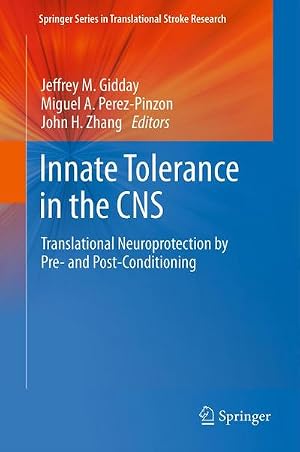
Innate Tolerance in the CNS : Translational Neuroprotection by Pre- and Post-Conditioning
Libro 5 di 14: Springer Series in Translational Stroke ResearchEUR 225,03
Spedizione EUR 66,11
Spedito da Germania a U.S.A.Quantità: 1 disponibili
Aggiungi al carrelloBuch. Condizione: Neu. Druck auf Anfrage Neuware - Printed after ordering - Cerebral preconditioning is a phenomenon wherein a mild insult or stress induces cellular and tissue adaptation or tolerance to a later, severe injury, therefore reflecting the efficacy of endogenous mechanisms of cerebrovascular protection. Initially identified for rapid cardiac protection, preconditioning has expanded to all aspects of CNS protection from ischemia, trauma and potentially neurodegeneration. Many different stimuli or stressors have been identified as preconditioning agents, suggesting a downstream convergence of mechanisms and underscoring the potential for translational application of preconditioning in the clinic. Moreover, the fundamental mechanisms responsible for preconditioning-induced tolerance will help in the design novel pharmacological approaches for neuroprotection. While stroke and many other brain injuries are not predictable, in some populations (e.g., metabolic syndrome, patients undergoing carotid endarterectomy, aneurysm clipping, or with recent TIAs) the risk for stroke is identifiable and significant, and preconditioning may represent a useful strategy for neuroprotection. For unpredictable injuries, post-conditioning the brain - or inducing endogenous protective mechanisms after the initial injury - can also abrogate the extent of injury. Finally, remote pre- and post-conditioning methods have been developed in animals, and are now being tested in clinical trials, wherein a brief, noninjurious stress to a noncerebral tissue (i.e., skeletal muscle) can provide protection to the CNS and thereby allows clinicians the opportunity to circumvent concerns regarding the direct preconditioning of neurological tissues.
-

Innate Tolerance in the CNS : Translational Neuroprotection by Pre- and Post-conditioning
Libro 5 di 14: Springer Series in Translational Stroke ResearchDa: GreatBookPricesUK, Woodford Green, Regno Unito
Valutazione del venditore 5 su 5 stelle
EUR 302,58
Spedizione EUR 17,35
Spedito da Regno Unito a U.S.A.Quantità: Più di 20 disponibili
Aggiungi al carrelloCondizione: As New. Unread book in perfect condition.
-
Innate Tolerance in the CNS: Translational Neuroprotection by Pre- and Post-Conditioning (Springer Series in Translational Stroke Research)
Libro 5 di 14: Springer Series in Translational Stroke ResearchDa: Mispah books, Redhill, SURRE, Regno Unito
Valutazione del venditore 4 su 5 stelle
EUR 293,06
Spedizione EUR 28,91
Spedito da Regno Unito a U.S.A.Quantità: 1 disponibili
Aggiungi al carrelloHardcover. Condizione: Like New. Like New. book.
-
Innate Tolerance in the CNS: Translational Neuroprotection by Pre- and Post-conditioning
Libro 5 di 14: Springer Series in Translational Stroke ResearchDa: Revaluation Books, Exeter, Regno Unito
Valutazione del venditore 5 su 5 stelle
EUR 309,83
Spedizione EUR 17,35
Spedito da Regno Unito a U.S.A.Quantità: 2 disponibili
Aggiungi al carrelloHardcover. Condizione: Brand New. 1st edition. 699 pages. 9.00x6.25x1.50 inches. In Stock.
-
Innate Tolerance in the CNS : Translational Neuroprotection by Pre- and Post-conditioning
Libro 5 di 14: Springer Series in Translational Stroke ResearchDa: GreatBookPrices, Columbia, MD, U.S.A.
Valutazione del venditore 5 su 5 stelle
EUR 329,26
Spedizione EUR 2,29
Spedito in U.S.A.Quantità: Più di 20 disponibili
Aggiungi al carrelloCondizione: As New. Unread book in perfect condition.
-
Innate Tolerance in the CNS: Translational Neuroprotection by Pre- and Post-Conditioning (eng)
Libro 5 di 14: Springer Series in Translational Stroke ResearchDa: Brook Bookstore On Demand, Napoli, NA, Italia
Valutazione del venditore 3 su 5 stelle

EUR 166,29
Spedizione EUR 11,00
Spedito da Italia a U.S.A.Quantità: Più di 20 disponibili
Aggiungi al carrelloCondizione: new. Questo è un articolo print on demand.
-

EUR 180,07
Spedizione EUR 48,99
Spedito da Germania a U.S.A.Quantità: Più di 20 disponibili
Aggiungi al carrelloCondizione: New. Dieser Artikel ist ein Print on Demand Artikel und wird nach Ihrer Bestellung fuer Sie gedruckt. This book will be the first to summarize basic mechanisms of both pre- and post-conditioning. Expand the basic science studies to date for their potential application as a clinical treatment. Critically comments on the efficacy of condition.
-

EUR 180,07
Spedizione EUR 48,99
Spedito da Germania a U.S.A.Quantità: Più di 20 disponibili
Aggiungi al carrelloCondizione: New. Dieser Artikel ist ein Print on Demand Artikel und wird nach Ihrer Bestellung fuer Sie gedruckt. This book will be the first to summarize basic mechanisms of both pre- and post-conditioning. Expand the basic science studies to date for their potential application as a clinical treatment. Critically comments on the efficacy of condition.
-

Innate Tolerance in the CNS
Libro 5 di 14: Springer Series in Translational Stroke ResearchLingua: Inglese
Editore: Springer New York Aug 2016, 2016
ISBN 10: 1493941771 ISBN 13: 9781493941773
Da: BuchWeltWeit Ludwig Meier e.K., Bergisch Gladbach, Germania
Valutazione del venditore 5 su 5 stelle
EUR 213,99
Spedizione EUR 23,00
Spedito da Germania a U.S.A.Quantità: 2 disponibili
Aggiungi al carrelloTaschenbuch. Condizione: Neu. This item is printed on demand - it takes 3-4 days longer - Neuware -Cerebral preconditioning is a phenomenon wherein a mild insult or stress induces cellular and tissue adaptation or tolerance to a later, severe injury, therefore reflecting the efficacy of endogenous mechanisms of cerebrovascular protection. Initially identified for rapid cardiac protection, preconditioning has expanded to all aspects of CNS protection from ischemia, trauma and potentially neurodegeneration. Many different stimuli or stressors have been identified as preconditioning agents, suggesting a downstream convergence of mechanisms and underscoring the potential for translational application of preconditioning in the clinic. Moreover, the fundamental mechanisms responsible for preconditioning-induced tolerance will help in the design novel pharmacological approaches for neuroprotection. While stroke and many other brain injuries are not predictable, in some populations (e.g., metabolic syndrome, patients undergoing carotid endarterectomy, aneurysm clipping, or with recent TIAs) the risk for stroke is identifiable and significant, and preconditioning may represent a useful strategy for neuroprotection. For unpredictable injuries, post-conditioning the brain - or inducing endogenous protective mechanisms after the initial injury - can also abrogate the extent of injury. Finally, remote pre- and post-conditioning methods have been developed in animals, and are now being tested in clinical trials, wherein a brief, noninjurious stress to a noncerebral tissue (i.e., skeletal muscle) can provide protection to the CNS and thereby allows clinicians the opportunity to circumvent concerns regarding the direct preconditioning of neurological tissues. 712 pp. Englisch.
-

Innate Tolerance in the CNS
Libro 5 di 14: Springer Series in Translational Stroke ResearchLingua: Inglese
Editore: Springer New York Sep 2012, 2012
ISBN 10: 144199694X ISBN 13: 9781441996947
Da: BuchWeltWeit Ludwig Meier e.K., Bergisch Gladbach, Germania
Valutazione del venditore 5 su 5 stelle
EUR 213,99
Spedizione EUR 23,00
Spedito da Germania a U.S.A.Quantità: 2 disponibili
Aggiungi al carrelloBuch. Condizione: Neu. This item is printed on demand - it takes 3-4 days longer - Neuware -Cerebral preconditioning is a phenomenon wherein a mild insult or stress induces cellular and tissue adaptation or tolerance to a later, severe injury, therefore reflecting the efficacy of endogenous mechanisms of cerebrovascular protection. Initially identified for rapid cardiac protection, preconditioning has expanded to all aspects of CNS protection from ischemia, trauma and potentially neurodegeneration. Many different stimuli or stressors have been identified as preconditioning agents, suggesting a downstream convergence of mechanisms and underscoring the potential for translational application of preconditioning in the clinic. Moreover, the fundamental mechanisms responsible for preconditioning-induced tolerance will help in the design novel pharmacological approaches for neuroprotection. While stroke and many other brain injuries are not predictable, in some populations (e.g., metabolic syndrome, patients undergoing carotid endarterectomy, aneurysm clipping, or with recent TIAs) the risk for stroke is identifiable and significant, and preconditioning may represent a useful strategy for neuroprotection. For unpredictable injuries, post-conditioning the brain - or inducing endogenous protective mechanisms after the initial injury - can also abrogate the extent of injury. Finally, remote pre- and post-conditioning methods have been developed in animals, and are now being tested in clinical trials, wherein a brief, noninjurious stress to a noncerebral tissue (i.e., skeletal muscle) can provide protection to the CNS and thereby allows clinicians the opportunity to circumvent concerns regarding the direct preconditioning of neurological tissues. 712 pp. Englisch.
-
Innate Tolerance in the CNS: Translational Neuroprotection by Pre- and Post-Conditioning (eng)
Libro 5 di 14: Springer Series in Translational Stroke ResearchDa: Brook Bookstore On Demand, Napoli, NA, Italia
Valutazione del venditore 3 su 5 stelle
EUR 166,29
Spedizione EUR 79,00
Spedito da Italia a U.S.A.Quantità: Più di 20 disponibili
Aggiungi al carrelloCondizione: new. Questo è un articolo print on demand.
-
Innate Tolerance in the CNS | Translational Neuroprotection by Pre- and Post-Conditioning
Libro 5 di 14: Springer Series in Translational Stroke ResearchEUR 186,70
Spedizione EUR 70,00
Spedito da Germania a U.S.A.Quantità: 5 disponibili
Aggiungi al carrelloBuch. Condizione: Neu. Innate Tolerance in the CNS | Translational Neuroprotection by Pre- and Post-Conditioning | Jeffrey M. Gidday (u. a.) | Buch | Springer Series in Translational Stroke Research | ix | Englisch | 2012 | Springer | EAN 9781441996947 | Verantwortliche Person für die EU: Springer Verlag GmbH, Tiergartenstr. 17, 69121 Heidelberg, juergen[dot]hartmann[at]springer[dot]com | Anbieter: preigu Print on Demand.
-
Innate Tolerance in the Cns: Translational Neuroprotection by Pre- and Post-conditioning
Libro 5 di 14: Springer Series in Translational Stroke ResearchDa: Majestic Books, Hounslow, Regno Unito
Valutazione del venditore 4 su 5 stelle
EUR 267,51
Spedizione EUR 7,52
Spedito da Regno Unito a U.S.A.Quantità: 4 disponibili
Aggiungi al carrelloCondizione: New. Print on Demand pp. 708.
-

Innate Tolerance in the CNS
Libro 5 di 14: Springer Series in Translational Stroke ResearchLingua: Inglese
Editore: Springer New York, Springer Sep 2012, 2012
ISBN 10: 144199694X ISBN 13: 9781441996947
Da: buchversandmimpf2000, Emtmannsberg, BAYE, Germania
Valutazione del venditore 5 su 5 stelle
EUR 213,99
Spedizione EUR 60,00
Spedito da Germania a U.S.A.Quantità: 1 disponibili
Aggiungi al carrelloBuch. Condizione: Neu. This item is printed on demand - Print on Demand Titel. Neuware -Cerebral preconditioning is a phenomenon wherein a mild insult or stress induces cellular and tissue adaptation or tolerance to a later, severe injury, therefore reflecting the efficacy of endogenous mechanisms of cerebrovascular protection. Initially identified for rapid cardiac protection, preconditioning has expanded to all aspects of CNS protection from ischemia, trauma and potentially neurodegeneration. Many different stimuli or stressors have been identified as preconditioning agents, suggesting a downstream convergence of mechanisms and underscoring the potential for translational application of preconditioning in the clinic. Moreover, the fundamental mechanisms responsible for preconditioning-induced tolerance will help in the design novel pharmacological approaches for neuroprotection. While stroke and many other brain injuries are not predictable, in some populations (e.g., metabolic syndrome, patients undergoing carotid endarterectomy, aneurysm clipping, or with recent TIAs) the risk for stroke is identifiable and significant, and preconditioning may represent a useful strategy for neuroprotection. For unpredictable injuries, post-conditioning the brain ¿ or inducing endogenous protective mechanisms after the initial injury ¿ can also abrogate the extent of injury. Finally, remote pre- and post-conditioning methods have been developed in animals, and are now being tested in clinical trials, wherein a brief, noninjurious stress to a noncerebral tissue (i.e., skeletal muscle) can provide protection to the CNS and thereby allows clinicians the opportunity to circumvent concerns regarding the direct preconditioning of neurological tissues.Springer-Verlag GmbH, Tiergartenstr. 17, 69121 Heidelberg 712 pp. Englisch.
-

Innate Tolerance in the CNS
Libro 5 di 14: Springer Series in Translational Stroke ResearchLingua: Inglese
Editore: Springer New York, Springer US Aug 2016, 2016
ISBN 10: 1493941771 ISBN 13: 9781493941773
Da: buchversandmimpf2000, Emtmannsberg, BAYE, Germania
Valutazione del venditore 5 su 5 stelle
EUR 213,99
Spedizione EUR 60,00
Spedito da Germania a U.S.A.Quantità: 1 disponibili
Aggiungi al carrelloTaschenbuch. Condizione: Neu. This item is printed on demand - Print on Demand Titel. Neuware -Cerebral preconditioning is a phenomenon wherein a mild insult or stress induces cellular and tissue adaptation or tolerance to a later, severe injury, therefore reflecting the efficacy of endogenous mechanisms of cerebrovascular protection. Initially identified for rapid cardiac protection, preconditioning has expanded to all aspects of CNS protection from ischemia, trauma and potentially neurodegeneration. Many different stimuli or stressors have been identified as preconditioning agents, suggesting a downstream convergence of mechanisms and underscoring the potential for translational application of preconditioning in the clinic. Moreover, the fundamental mechanisms responsible for preconditioning-induced tolerance will help in the design novel pharmacological approaches for neuroprotection. While stroke and many other brain injuries are not predictable, in some populations (e.g., metabolic syndrome, patients undergoing carotid endarterectomy, aneurysm clipping, or with recent TIAs) the risk for stroke is identifiable and significant, and preconditioning may represent a useful strategy for neuroprotection. For unpredictable injuries, post-conditioning the brain ¿ or inducing endogenous protective mechanisms after the initial injury ¿ can also abrogate the extent of injury. Finally, remote pre- and post-conditioning methods have been developed in animals, and are now being tested in clinical trials, wherein a brief, noninjurious stress to a noncerebral tissue (i.e., skeletal muscle) can provide protection to the CNS and thereby allows clinicians the opportunity to circumvent concerns regarding the direct preconditioning of neurological tissues.Springer Verlag GmbH, Tiergartenstr. 17, 69121 Heidelberg 712 pp. Englisch.
-
Innate Tolerance in the Cns: Translational Neuroprotection by Pre- and Post-conditioning
Libro 5 di 14: Springer Series in Translational Stroke ResearchDa: Biblios, Frankfurt am main, HESSE, Germania
Valutazione del venditore 4 su 5 stelle
EUR 268,85
Spedizione EUR 9,95
Spedito da Germania a U.S.A.Quantità: 4 disponibili
Aggiungi al carrelloCondizione: New. PRINT ON DEMAND pp. 708.


