

Importo totale (1 articolo articoli):
Destinazione ordine:

william fowler hoyle (4 risultati)
Vai alla pagina principale dei risultati di ricerca
Filtri di ricerca
Tipo di articolo
- Tutti i tipi di prodotto
- Libri (4)
- Riviste e Giornali (Nessun altro risultato corrispondente a questo perfezionamento)
- Fumetti (Nessun altro risultato corrispondente a questo perfezionamento)
- Spartiti (Nessun altro risultato corrispondente a questo perfezionamento)
- Arte, Stampe e Poster (Nessun altro risultato corrispondente a questo perfezionamento)
- Fotografie (Nessun altro risultato corrispondente a questo perfezionamento)
- Mappe (Nessun altro risultato corrispondente a questo perfezionamento)
- Manoscritti e Collezionismo cartaceo (Nessun altro risultato corrispondente a questo perfezionamento)
Condizioni Maggiori informazioni
- Nuovo (Nessun altro risultato corrispondente a questo perfezionamento)
- Come nuovo, Ottimo o Quasi ottimo (2)
- Molto buono o Buono (Nessun altro risultato corrispondente a questo perfezionamento)
- Discreto o Mediocre (Nessun altro risultato corrispondente a questo perfezionamento)
- Come descritto (2)
Legatura
Ulteriori caratteristiche
- Prima ed. (2)
- Copia autograf. (Nessun altro risultato corrispondente a questo perfezionamento)
- Sovracoperta (1)
- Con foto (4)
- Non Print on Demand (4)
Lingua (3)
Prezzo
- Qualsiasi prezzo
- Inferiore a EUR 20 (Nessun altro risultato corrispondente a questo perfezionamento)
- EUR 20 a EUR 45
- Superiore a EUR 45
Spedizione gratuita
- Spedizione gratuita in U.S.A. (Nessun altro risultato corrispondente a questo perfezionamento)
Paese del venditore
Valutazione venditore
-
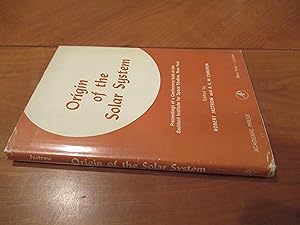
Origin Of The Solar System: Proceedings Of A Conference Held At The Goddard Institute For Space Studies, New York, January 23-24, 1962
Lingua: Inglese
Editore: Academic Press, New York City Ny, 1963
Da: Arroyo Seco Books, Pasadena, Member IOBA, Pasadena, CA, U.S.A.
Membro dell'associazione: IOBA
Valutazione del venditore 4 su 5 stelle

Prima edizione
Hardcover. Condizione: Fine. Condizione sovraccoperta: Very Good + Dust Jacket. 1st Edition. Xiii, 176 Pp.Brown Cloth, Gilt. First Printing. Fine In Lightly Worn Dust Jacket. No Marks.
-

Nucleosynthesis in Massive Stars and Supernovae
Editore: The University of Chicago Press, 1965
Da: Roland Antiquariat UG haftungsbeschränkt, Weinheim, Germania
Valutazione del venditore 5 su 5 stelle

EUR 31,50
Spedizione EUR 42,00
Spedito da Germania a U.S.A.Quantità: 1 disponibili
Aggiungi al carrelloHardcover. 148 p. Good condition. The reading pages are clean and unmarked. Slight signs of storage and use. Book is wrapped (cover made of self-adhesive film). Retired library copy with corresponding labelling. Without dust jacket. Otherwise a good copy. Sprache: Englisch Gewicht in Gramm: 1000.
-
DAS UNIVERSUM Unser Bild vom Weltall
Lingua: Tedesco
Editore: Rheinische Verlags-Anstalt, Wiesbaden
Da: Butterfly Books GmbH & Co. KG, Herzebrock-Clarholz, Germania
Valutazione del venditore 5 su 5 stelle
EUR 21,50
Spedizione EUR 60,00
Spedito da Germania a U.S.A.Quantità: 1 disponibili
Aggiungi al carrelloHardcover. Condizione: Sehr gut. 123 Seiten Elf Beiträge führender amerikanischer Wissenschaftler über das Universum und unser Weltbild. Zustand: Einband mit geringfügigen Gebrauchsspuren, insgesamt SEHR GUTER Zustand! HC1-423-4/8-00447013 Sprache: Deutsch Gewicht in Gramm: 267.
-
Synthesis of Elements in Stars. [In] Reviews of Modern Physics volume 29, number 4.
Editore: Lancaster PA & New York for the American Physical Society by the American Institute of Physics October, 1957
Da: Shapero Rare Books, London, Regno Unito
Membro dell'associazione: ABA ILAB PBFA
Valutazione del venditore 5 su 5 stelle
Prima edizione
EUR 4.470,15
Spedizione EUR 17,36
Spedito da Regno Unito a U.S.A.Quantità: 1 disponibili
Aggiungi al carrelloFirst edition, journal issue; tall quarto; 4 pages of illustrations from photographs, some light marks to the edges of the text block,minor creasing of the corners of the contents; original orange wrappers printed in black, blindstamp and withdrawn stamp of the Eckert-Mauchely Division of Remington Rand Inc. on the upper wrapper, spine a little rolled, wrappers lightly rubbed and toned with some creasing at the corners and slight loss from the spine ends, very good condition, 548-836 pp. First edition, journal issue, of one of the most revolutionary papers in modern science, presenting conclusive proof that the heavy elements which make life possible are created in the stars and distributed throughout the universe by supernovae. Lead author Margaret Burbidge (1919-2020) was to become a 'towering figure in the history of modern physics and astronomy. a key driver of three great revolutionary thrusts in the development of physics and astronomy over the last 70 years' (University of California obituary). A fresh, attractive copy in the original wrappers. By the early 1950s it was clear that the lighter elements, hydrogen, helium, and lithium, were created during the Big Bang, but there were two competing theories on the origin of the heavier elements. Physicist George Gamow believed that they were all made at the origin of the universe, but in 1954 astronomer Fred Hoyle proposed that they were instead created by the process of nuclear fusion in stars. British astronomer Margaret Burbidge was at the time working at Caltech, and she and her husband Geoffrey collaborated with Hoyle and William Fowler to investigate the hypothesis. 'Over a two-year period, 1955-56, the Burbidges and Fowler then gathered a wealth of evidence in support of Hoyle's theory. These included astronomical observations taken by Margaret of the elemental abundances, and the laboratory measurements of nuclear reactions gathered by Fowler. The results were conclusive. The paper changed our understanding of cosmic evolution, and of our connection to the vast universe. As Fowler put it: "All of us are truly and literally a little bit of stardust"', a sentiment famously echoed by Carl Sagan in 1973 (Guardian obituary, April 22, 2020). The present paper, usually referred to as 'B2FH' for its three authors, 'was undoubtedly the Burbidges' greatest scientific achievement, with far-reaching consequences for astrophysics and cosmology' (Royal Society obituary, August 25, 2021) and 'it also brokered the deep relationship between observational astronomy and nuclear physics' (University of California obituary). Burbidge and her husband went on to become leaders in the physics of quasars, and she pioneered the use of space-based astronomical instruments, most notably the Hubble Space Telescope's Faint Objects Spectrograph.


![Immagine del venditore per Synthesis of Elements in Stars. [In] Reviews of Modern Physics volume 29, number 4. venduto da Shapero Rare Books](https://pictures.abebooks.com/inventory/md/md32422925446.jpg)