

Importo totale (1 articolo articoli):
Destinazione ordine:

9783319984247 - A Life of Experimental Economics, Volume II: The Next Fifty Years di Smith, Vernon L. (30 risultati)
Vai alla pagina principale dei risultati di ricerca
Filtri di ricerca
Tipo di articolo
- Tutti i tipi di prodotto
- Libri (30)
- Riviste e Giornali (Nessun altro risultato corrispondente a questo perfezionamento)
- Fumetti (Nessun altro risultato corrispondente a questo perfezionamento)
- Spartiti (Nessun altro risultato corrispondente a questo perfezionamento)
- Arte, Stampe e Poster (Nessun altro risultato corrispondente a questo perfezionamento)
- Fotografie (Nessun altro risultato corrispondente a questo perfezionamento)
- Mappe (Nessun altro risultato corrispondente a questo perfezionamento)
- Manoscritti e Collezionismo cartaceo (Nessun altro risultato corrispondente a questo perfezionamento)
Condizioni Maggiori informazioni
- Nuovo (28)
- Come nuovo, Ottimo o Quasi ottimo (2)
- Molto buono o Buono (Nessun altro risultato corrispondente a questo perfezionamento)
- Discreto o Mediocre (Nessun altro risultato corrispondente a questo perfezionamento)
- Come descritto (Nessun altro risultato corrispondente a questo perfezionamento)
Legatura
- Tutte
- Rilegato (Nessun altro risultato corrispondente a questo perfezionamento)
- Brossura (30)
Ulteriori caratteristiche
- Prima ed. (1)
- Copia autograf. (Nessun altro risultato corrispondente a questo perfezionamento)
- Sovracoperta (Nessun altro risultato corrispondente a questo perfezionamento)
- Con foto (12)
- Non Print on Demand (24)
Lingua (1)
Spedizione gratuita
Paese del venditore
Valutazione venditore
-

Life of Experimental Economics : The Next Fifty Years
Da: GreatBookPrices, Columbia, MD, U.S.A.
Valutazione del venditore 5 su 5 stelle

EUR 19,14
Spedizione EUR 2,27
Spedito in U.S.A.Quantità: Più di 20 disponibili
Aggiungi al carrelloCondizione: New.
-
![Immagine dell'editore per A Life of Experimental Economics, Volume II: The Next Fifty Years [Paperback] Smith, Vernon L. venduto da Lakeside Books](https://pictures.abebooks.com/isbn/9783319984247-it-300.jpg)
A Life of Experimental Economics, Volume II: The Next Fifty Years [Paperback] Smith, Vernon L.
Da: Lakeside Books, Benton Harbor, MI, U.S.A.
Valutazione del venditore 5 su 5 stelle
EUR 17,95
Spedizione EUR 3,44
Spedito in U.S.A.Quantità: Più di 20 disponibili
Aggiungi al carrelloCondizione: New. Brand New! Not Overstocks or Low Quality Book Club Editions! Direct From the Publisher! We're not a giant, faceless warehouse organization! We're a small town bookstore that loves books and loves it's customers! Buy from Lakeside Books!
-
Life of Experimental Economics : The Next Fifty Years
Da: GreatBookPrices, Columbia, MD, U.S.A.
Valutazione del venditore 5 su 5 stelle
EUR 20,83
Spedizione EUR 2,27
Spedito in U.S.A.Quantità: Più di 20 disponibili
Aggiungi al carrelloCondizione: As New. Unread book in perfect condition.
-
A Life of Experimental Economics, Volume II
Da: PBShop.store US, Wood Dale, IL, U.S.A.
Valutazione del venditore 5 su 5 stelle
PAP. Condizione: New. New Book. Shipped from UK. Established seller since 2000.
-

A Life of Experimental Economics, Volume II
Lingua: Inglese
Editore: Springer International Publishing AG, CH, 2018
ISBN 10: 3319984241 ISBN 13: 9783319984247
Da: Rarewaves.com USA, London, LONDO, Regno Unito
Valutazione del venditore 5 su 5 stelle
EUR 24,93
Spedizione gratuita
Spedito da Regno Unito a U.S.A.Quantità: 1 disponibili
Aggiungi al carrelloPaperback. Condizione: New. 2018 ed. This sequel to A Life of Experimental Economics, Volume I, continues the intimate history of Vernon Smith's personal and professional maturation after a dozen years at Purdue. The scene now shifts to twenty-six transformative years at the University of Arizona, then to George Mason University, and his recognition by the Nobel Prize Committee in 2002. The book ends with his most recent decade at Chapman University. At Arizona Vernon and his students studied asset trading markets and learned how wrong it had been to suppose that price bubbles could not occur where markets were full-information transparent. Their work in computerization of the lab facilitated very complex supply and demand experiments in natural gas pipeline, communication and electricity markets that paved the way for implementing, through decentralized market processes, the liberalization of industries traditionally believed to be "natural" monopolies. The "Smart ComputerAssisted Market" was born. Smith's move to George Mason University greatly facilitated government and industry work in tandem with various public and private entities, whereas his relocation to Chapman University coincided with the Great Recession, whose similarity with the Depression was evident in his research. There he integrated two fundamental kinds of markets with laboratory experiments: Consumer non-durables, the supply and demand for which was stable in the lab and in the economy, and durable assets whose bubble tendencies made them unstable in the lab as well as in the economy-witness the great housing-mortgage market bubble run-up of 1997-2007. This book's conversational style and emphasis on the backstory of published research accomplishments allows readers an exclusive peak into how and why economists pursue their work. It's a must-read for those interested in experimental economics, the housing crisis, and economic history.
-

A Life of Experimental Economics, Volume II
Lingua: Inglese
Editore: Springer International Publishing AG, CH, 2018
ISBN 10: 3319984241 ISBN 13: 9783319984247
Paperback. Condizione: New. 2018 ed. This sequel to A Life of Experimental Economics, Volume I, continues the intimate history of Vernon Smith's personal and professional maturation after a dozen years at Purdue. The scene now shifts to twenty-six transformative years at the University of Arizona, then to George Mason University, and his recognition by the Nobel Prize Committee in 2002. The book ends with his most recent decade at Chapman University. At Arizona Vernon and his students studied asset trading markets and learned how wrong it had been to suppose that price bubbles could not occur where markets were full-information transparent. Their work in computerization of the lab facilitated very complex supply and demand experiments in natural gas pipeline, communication and electricity markets that paved the way for implementing, through decentralized market processes, the liberalization of industries traditionally believed to be "natural" monopolies. The "Smart ComputerAssisted Market" was born. Smith's move to George Mason University greatly facilitated government and industry work in tandem with various public and private entities, whereas his relocation to Chapman University coincided with the Great Recession, whose similarity with the Depression was evident in his research. There he integrated two fundamental kinds of markets with laboratory experiments: Consumer non-durables, the supply and demand for which was stable in the lab and in the economy, and durable assets whose bubble tendencies made them unstable in the lab as well as in the economy-witness the great housing-mortgage market bubble run-up of 1997-2007. This book's conversational style and emphasis on the backstory of published research accomplishments allows readers an exclusive peak into how and why economists pursue their work. It's a must-read for those interested in experimental economics, the housing crisis, and economic history.
-
A Life of Experimental Economics, Volume II
Da: PBShop.store UK, Fairford, GLOS, Regno Unito
Valutazione del venditore 5 su 5 stelle
EUR 22,36
Spedizione EUR 4,82
Spedito da Regno Unito a U.S.A.Quantità: 2 disponibili
Aggiungi al carrelloPAP. Condizione: New. New Book. Shipped from UK. Established seller since 2000.
-
A Life of Experimental Economics, Volume II (Paperback)
Lingua: Inglese
Editore: Springer International Publishing AG, Cham, 2018
ISBN 10: 3319984241 ISBN 13: 9783319984247
Da: Grand Eagle Retail, Bensenville, IL, U.S.A.
Valutazione del venditore 5 su 5 stelle
Paperback. Condizione: new. Paperback. This sequel to A Life of Experimental Economics, Volume I, continues the intimate history of Vernon Smiths personal and professional maturation after a dozen years at Purdue. The scene now shifts to twenty-six transformative years at the University of Arizona, then to George Mason University, and his recognition by the Nobel Prize Committee in 2002. The book ends with his most recent decade at Chapman University. At Arizona Vernon and his students studied asset trading markets and learned how wrong it had been to suppose that price bubbles could not occur where markets were full-information transparent. Their work in computerization of the lab facilitated very complex supply and demand experiments in natural gas pipeline, communication and electricity markets that paved the way for implementing, through decentralized market processes, the liberalization of industries traditionally believed to be natural monopolies. The Smart ComputerAssisted Market was born. Smiths move to George Mason University greatly facilitated government and industry work in tandem with various public and private entities, whereas his relocation to Chapman University coincided with the Great Recession, whose similarity with the Depression was evident in his research. There he integrated two fundamental kinds of markets with laboratory experiments: Consumer non-durables, the supply and demand for which was stable in the lab and in the economy, and durable assets whose bubble tendencies made them unstable in the lab as well as in the economywitness the great housing-mortgage market bubble run-up of 1997-2007. This books conversational style and emphasis on the backstory of published research accomplishments allows readers an exclusive peak into how and why economists pursue their work. Its a must-read for those interested in experimental economics, the housing crisis, and economic history. Shipping may be from multiple locations in the US or from the UK, depending on stock availability.
-
LIFE OF EXPERIMENTAL ECONOMICS VOLUME II
Da: Speedyhen LLC, Hialeah, FL, U.S.A.
Valutazione del venditore 3 su 5 stelle

Condizione: NEW.
-
A Life of Experimental Economics, Volume II: The Next Fifty Years
Lingua: Inglese
Editore: Palgrave Macmillan 2018-12-05, 2018
ISBN 10: 3319984241 ISBN 13: 9783319984247
Da: Chiron Media, Wallingford, Regno Unito
Valutazione del venditore 5 su 5 stelle
EUR 18,02
Spedizione EUR 17,94
Spedito da Regno Unito a U.S.A.Quantità: 2 disponibili
Aggiungi al carrelloPaperback. Condizione: New.
-
A Life of Experimental Economics, Volume II: The Next Fifty Years
Da: Ria Christie Collections, Uxbridge, Regno Unito
Valutazione del venditore 5 su 5 stelle
EUR 22,66
Spedizione EUR 13,87
Spedito da Regno Unito a U.S.A.Quantità: Più di 20 disponibili
Aggiungi al carrelloCondizione: New. In.
-

Life of Experimental Economics : The Next Fifty Years
Da: GreatBookPricesUK, Woodford Green, Regno Unito
Valutazione del venditore 5 su 5 stelle
EUR 20,98
Spedizione EUR 17,37
Spedito da Regno Unito a U.S.A.Quantità: 2 disponibili
Aggiungi al carrelloCondizione: New.
-

Life of Experimental Economics : The Next Fifty Years
Da: GreatBookPricesUK, Woodford Green, Regno Unito
Valutazione del venditore 5 su 5 stelle
EUR 24,13
Spedizione EUR 17,37
Spedito da Regno Unito a U.S.A.Quantità: 2 disponibili
Aggiungi al carrelloCondizione: As New. Unread book in perfect condition.
-
A Life of Experimental Economics, Volume II: The Next Fifty Years
Da: Kennys Bookshop and Art Galleries Ltd., Galway, GY, Irlanda
Valutazione del venditore 5 su 5 stelle
Prima edizione
EUR 30,45
Spedizione EUR 10,50
Spedito da Irlanda a U.S.A.Quantità: 2 disponibili
Aggiungi al carrelloCondizione: New. 2018. 1st ed. 2018. Paperback. . . . . .
-
A Life of Experimental Economics: The Next Fifty Years: Vol 2
Da: Revaluation Books, Exeter, Regno Unito
Valutazione del venditore 5 su 5 stelle
EUR 31,16
Spedizione EUR 11,58
Spedito da Regno Unito a U.S.A.Quantità: 2 disponibili
Aggiungi al carrelloPaperback. Condizione: Brand New. 243 pages. 9.00x6.00x0.50 inches. In Stock.
-
A Life of Experimental Economics, Volume II: The Next Fifty Years
Da: Kennys Bookstore, Olney, MD, U.S.A.
Valutazione del venditore 5 su 5 stelle
Condizione: New. 2018. 1st ed. 2018. Paperback. . . . . . Books ship from the US and Ireland.
-
A Life of Experimental Economics, Volume II: The Next Fifty Years
Lingua: Inglese
Editore: Palgrave Macmillan 2018-12-05, 2018
ISBN 10: 3319984241 ISBN 13: 9783319984247
Da: Chiron Media, Wallingford, Regno Unito
Valutazione del venditore 5 su 5 stelle
EUR 31,93
Spedizione EUR 17,94
Spedito da Regno Unito a U.S.A.Quantità: Più di 20 disponibili
Aggiungi al carrelloPaperback. Condizione: New.
-
LIFE OF EXPERIMENTAL ECONOMICS VOLUME II
Da: Speedyhen, Hertfordshire, Regno Unito
Valutazione del venditore 5 su 5 stelle
EUR 21,96
Spedizione EUR 47,47
Spedito da Regno Unito a U.S.A.Quantità: 2 disponibili
Aggiungi al carrelloCondizione: NEW.
-

A Life of Experimental Economics, Volume II
Lingua: Inglese
Editore: Springer International Publishing AG, CH, 2018
ISBN 10: 3319984241 ISBN 13: 9783319984247
Da: Rarewaves USA United, OSWEGO, IL, U.S.A.
Valutazione del venditore 5 su 5 stelle
Paperback. Condizione: New. 2018 ed. This sequel to A Life of Experimental Economics, Volume I, continues the intimate history of Vernon Smith's personal and professional maturation after a dozen years at Purdue. The scene now shifts to twenty-six transformative years at the University of Arizona, then to George Mason University, and his recognition by the Nobel Prize Committee in 2002. The book ends with his most recent decade at Chapman University. At Arizona Vernon and his students studied asset trading markets and learned how wrong it had been to suppose that price bubbles could not occur where markets were full-information transparent. Their work in computerization of the lab facilitated very complex supply and demand experiments in natural gas pipeline, communication and electricity markets that paved the way for implementing, through decentralized market processes, the liberalization of industries traditionally believed to be "natural" monopolies. The "Smart ComputerAssisted Market" was born. Smith's move to George Mason University greatly facilitated government and industry work in tandem with various public and private entities, whereas his relocation to Chapman University coincided with the Great Recession, whose similarity with the Depression was evident in his research. There he integrated two fundamental kinds of markets with laboratory experiments: Consumer non-durables, the supply and demand for which was stable in the lab and in the economy, and durable assets whose bubble tendencies made them unstable in the lab as well as in the economy-witness the great housing-mortgage market bubble run-up of 1997-2007. This book's conversational style and emphasis on the backstory of published research accomplishments allows readers an exclusive peak into how and why economists pursue their work. It's a must-read for those interested in experimental economics, the housing crisis, and economic history.
-

A Life of Experimental Economics, Volume II
Lingua: Inglese
Editore: Springer International Publishing, 2018
ISBN 10: 3319984241 ISBN 13: 9783319984247
EUR 24,42
Spedizione EUR 48,99
Spedito da Germania a U.S.A.Quantità: 2 disponibili
Aggiungi al carrelloCondizione: New.
-
A Life of Experimental Economics, Volume II (Paperback)
Lingua: Inglese
Editore: Springer International Publishing AG, Cham, 2018
ISBN 10: 3319984241 ISBN 13: 9783319984247
Da: AussieBookSeller, Truganina, VIC, Australia
Valutazione del venditore 5 su 5 stelle
EUR 43,94
Spedizione EUR 31,88
Spedito da Australia a U.S.A.Quantità: 1 disponibili
Aggiungi al carrelloPaperback. Condizione: new. Paperback. This sequel to A Life of Experimental Economics, Volume I, continues the intimate history of Vernon Smiths personal and professional maturation after a dozen years at Purdue. The scene now shifts to twenty-six transformative years at the University of Arizona, then to George Mason University, and his recognition by the Nobel Prize Committee in 2002. The book ends with his most recent decade at Chapman University. At Arizona Vernon and his students studied asset trading markets and learned how wrong it had been to suppose that price bubbles could not occur where markets were full-information transparent. Their work in computerization of the lab facilitated very complex supply and demand experiments in natural gas pipeline, communication and electricity markets that paved the way for implementing, through decentralized market processes, the liberalization of industries traditionally believed to be natural monopolies. The Smart ComputerAssisted Market was born. Smiths move to George Mason University greatly facilitated government and industry work in tandem with various public and private entities, whereas his relocation to Chapman University coincided with the Great Recession, whose similarity with the Depression was evident in his research. There he integrated two fundamental kinds of markets with laboratory experiments: Consumer non-durables, the supply and demand for which was stable in the lab and in the economy, and durable assets whose bubble tendencies made them unstable in the lab as well as in the economywitness the great housing-mortgage market bubble run-up of 1997-2007. This books conversational style and emphasis on the backstory of published research accomplishments allows readers an exclusive peak into how and why economists pursue their work. Its a must-read for those interested in experimental economics, the housing crisis, and economic history. Shipping may be from our Sydney, NSW warehouse or from our UK or US warehouse, depending on stock availability.
-

A Life of Experimental Economics, Volume II
Lingua: Inglese
Editore: Springer International Publishing AG, CH, 2018
ISBN 10: 3319984241 ISBN 13: 9783319984247
Da: Rarewaves.com UK, London, Regno Unito
Valutazione del venditore 5 su 5 stelle
EUR 22,38
Spedizione EUR 75,26
Spedito da Regno Unito a U.S.A.Quantità: 1 disponibili
Aggiungi al carrelloPaperback. Condizione: New. 2018 ed. This sequel to A Life of Experimental Economics, Volume I, continues the intimate history of Vernon Smith's personal and professional maturation after a dozen years at Purdue. The scene now shifts to twenty-six transformative years at the University of Arizona, then to George Mason University, and his recognition by the Nobel Prize Committee in 2002. The book ends with his most recent decade at Chapman University. At Arizona Vernon and his students studied asset trading markets and learned how wrong it had been to suppose that price bubbles could not occur where markets were full-information transparent. Their work in computerization of the lab facilitated very complex supply and demand experiments in natural gas pipeline, communication and electricity markets that paved the way for implementing, through decentralized market processes, the liberalization of industries traditionally believed to be "natural" monopolies. The "Smart ComputerAssisted Market" was born. Smith's move to George Mason University greatly facilitated government and industry work in tandem with various public and private entities, whereas his relocation to Chapman University coincided with the Great Recession, whose similarity with the Depression was evident in his research. There he integrated two fundamental kinds of markets with laboratory experiments: Consumer non-durables, the supply and demand for which was stable in the lab and in the economy, and durable assets whose bubble tendencies made them unstable in the lab as well as in the economy-witness the great housing-mortgage market bubble run-up of 1997-2007. This book's conversational style and emphasis on the backstory of published research accomplishments allows readers an exclusive peak into how and why economists pursue their work. It's a must-read for those interested in experimental economics, the housing crisis, and economic history.
-

A Life of Experimental Economics, Volume II : The Next Fifty Years
Lingua: Inglese
Editore: Springer International Publishing, Springer International Publishing, 2018
ISBN 10: 3319984241 ISBN 13: 9783319984247
EUR 33,43
Spedizione EUR 62,03
Spedito da Germania a U.S.A.Quantità: 1 disponibili
Aggiungi al carrelloTaschenbuch. Condizione: Neu. Druck auf Anfrage Neuware - Printed after ordering - This sequel toA Life of Experimental Economics, Volume I,continues the intimate history of Vernon Smith's personal and professional maturation after a dozen years at Purdue. The scene now shifts to twenty-six transformative years at the University of Arizona, then to George Mason University, and his recognition by the Nobel Prize Committee in 2002. The book ends with his most recent decade at Chapman University.At Arizona Vernon and his students studied asset trading markets and learned how wrong it had been to suppose that price bubbles could not occur where markets were full-information transparent. Their work in computerization of the lab facilitated very complex supply and demand experiments in natural gas pipeline, communication and electricity markets that paved the way for implementing, through decentralized market processes, the liberalization of industries traditionally believed to be 'natural' monopolies. The 'Smart ComputerAssisted Market' was born. Smith's move to George Mason University greatly facilitated government and industry work in tandem with various public and private entities, whereas his relocation to Chapman University coincided with the Great Recession, whose similarity with the Depression was evident in his research. There he integrated two fundamental kinds of markets with laboratory experiments: Consumer non-durables, the supply and demand for which was stable in the lab and in the economy, and durable assets whose bubble tendencies made them unstable in the lab as well as in the economy-witness the great housing-mortgage market bubble run-up of 1997-2007.This book's conversational style and emphasis on the backstory of published research accomplishments allows readers an exclusive peak into how and why economists pursue their work. It's a must-read for those interested in experimental economics, the housing crisis, and economic history.
-

EUR 29,10
Spedizione EUR 70,00
Spedito da Germania a U.S.A.Quantità: 5 disponibili
Aggiungi al carrelloTaschenbuch. Condizione: Neu. A Life of Experimental Economics, Volume II | The Next Fifty Years | Vernon L. Smith | Taschenbuch | xx | Englisch | 2018 | Springer | EAN 9783319984247 | Verantwortliche Person für die EU: Springer Verlag GmbH, Tiergartenstr. 17, 69121 Heidelberg, juergen[dot]hartmann[at]springer[dot]com | Anbieter: preigu.
-
A Life of Experimental Economics, Volume II (eng)
Da: Brook Bookstore On Demand, Napoli, NA, Italia
Valutazione del venditore 4 su 5 stelle

EUR 26,75
Spedizione EUR 5,50
Spedito da Italia a U.S.A.Quantità: Più di 20 disponibili
Aggiungi al carrelloCondizione: new. Questo è un articolo print on demand.
-
A Life of Experimental Economics: The Next Fifty Years: Vol 2
Da: Revaluation Books, Exeter, Regno Unito
Valutazione del venditore 5 su 5 stelle
EUR 21,29
Spedizione EUR 11,58
Spedito da Regno Unito a U.S.A.Quantità: 2 disponibili
Aggiungi al carrelloPaperback. Condizione: Brand New. 243 pages. 9.00x6.00x0.50 inches. In Stock. This item is printed on demand.
-
A Life of Experimental Economics, Volume II: The Next Fifty Years: 2
Da: Majestic Books, Hounslow, Regno Unito
Valutazione del venditore 4 su 5 stelle
EUR 45,31
Spedizione EUR 7,53
Spedito da Regno Unito a U.S.A.Quantità: 4 disponibili
Aggiungi al carrelloCondizione: New. Print on Demand.
-
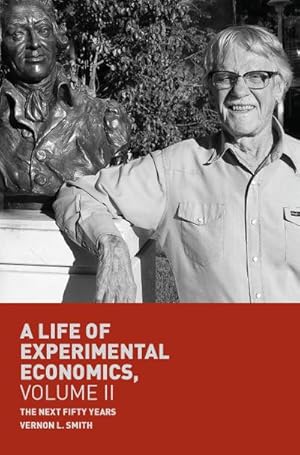
A Life of Experimental Economics, Volume II
Lingua: Inglese
Editore: Springer International Publishing Dez 2018, 2018
ISBN 10: 3319984241 ISBN 13: 9783319984247
Da: BuchWeltWeit Ludwig Meier e.K., Bergisch Gladbach, Germania
Valutazione del venditore 5 su 5 stelle
EUR 29,95
Spedizione EUR 23,00
Spedito da Germania a U.S.A.Quantità: 2 disponibili
Aggiungi al carrelloTaschenbuch. Condizione: Neu. This item is printed on demand - it takes 3-4 days longer - Neuware -This sequel toA Life of Experimental Economics, Volume I,continues the intimate history of Vernon Smith's personal and professional maturation after a dozen years at Purdue. The scene now shifts to twenty-six transformative years at the University of Arizona, then to George Mason University, and his recognition by the Nobel Prize Committee in 2002. The book ends with his most recent decade at Chapman University.At Arizona Vernon and his students studied asset trading markets and learned how wrong it had been to suppose that price bubbles could not occur where markets were full-information transparent. Their work in computerization of the lab facilitated very complex supply and demand experiments in natural gas pipeline, communication and electricity markets that paved the way for implementing, through decentralized market processes, the liberalization of industries traditionally believed to be 'natural' monopolies. The 'Smart Computer Assisted Market' was born. Smith's move to George Mason University greatly facilitated government and industry work in tandem with various public and private entities, whereas his relocation to Chapman University coincided with the Great Recession, whose similarity with the Depression was evident in his research. There he integrated two fundamental kinds of markets with laboratory experiments: Consumer non-durables, the supply and demand for which was stable in the lab and in the economy, and durable assets whose bubble tendencies made them unstable in the lab as well as in the economy-witness the great housing-mortgage market bubble run-up of 1997-2007.This book's conversational style and emphasis on the backstory of published research accomplishments allows readers an exclusive peak into how and why economists pursue their work. It's a must-read for those interested in experimental economics, the housing crisis, and economic history. 264 pp. Englisch.
-
A Life of Experimental Economics, Volume II: The Next Fifty Years: 2
Da: Biblios, Frankfurt am main, HESSE, Germania
Valutazione del venditore 4 su 5 stelle
EUR 45,77
Spedizione EUR 9,95
Spedito da Germania a U.S.A.Quantità: 4 disponibili
Aggiungi al carrelloCondizione: New. PRINT ON DEMAND.
-

A Life of Experimental Economics, Volume II
Da: buchversandmimpf2000, Emtmannsberg, BAYE, Germania
Valutazione del venditore 5 su 5 stelle
EUR 29,95
Spedizione EUR 60,00
Spedito da Germania a U.S.A.Quantità: 1 disponibili
Aggiungi al carrelloTaschenbuch. Condizione: Neu. This item is printed on demand - Print on Demand Titel. Neuware -This sequel to A Life of Experimental Economics, Volume I, continues the intimate history of Vernon Smith's personal and professional maturation after a dozen years at Purdue. The scene now shifts to twenty-six transformative years at the University of Arizona, then to George Mason University, and his recognition by the Nobel Prize Committee in 2002. The book ends with his most recent decade at Chapman University.At Arizona Vernon and his students studied asset trading markets and learned how wrong it had been to suppose that price bubbles could not occur where markets were full-information transparent. Their work in computerization of the lab facilitated very complex supply and demand experiments in natural gas pipeline, communication and electricity markets that paved the way for implementing, through decentralized market processes, the liberalization of industries traditionally believed to be 'natural' monopolies. The 'Smart ComputerAssisted Market' was born. Smith's move to George Mason University greatly facilitated government and industry work in tandem with various public and private entities, whereas his relocation to Chapman University coincided with the Great Recession, whose similarity with the Depression was evident in his research. There he integrated two fundamental kinds of markets with laboratory experiments: Consumer non-durables, the supply and demand for which was stable in the lab and in the economy, and durable assets whose bubble tendencies made them unstable in the lab as well as in the economy-witness the great housing-mortgage market bubble run-up of 1997-2007.This book's conversational style and emphasis on the backstory of published research accomplishments allows readers an exclusive peak into how and why economists pursue their work. It's a must-read for those interested in experimental economics, the housing crisis, and economic history.Springer-Verlag GmbH, Tiergartenstr. 17, 69121 Heidelberg 264 pp. Englisch.


