
Importo totale (1 articolo articoli):
Destinazione ordine:

proceedings elm2019 (23 risultati)
Vai alla pagina principale dei risultati di ricerca
Filtri di ricerca
Tipo di articolo
- Tutti i tipi di prodotto
- Libri (23)
- Riviste e Giornali (Nessun altro risultato corrispondente a questo perfezionamento)
- Fumetti (Nessun altro risultato corrispondente a questo perfezionamento)
- Spartiti (Nessun altro risultato corrispondente a questo perfezionamento)
- Arte, Stampe e Poster (Nessun altro risultato corrispondente a questo perfezionamento)
- Fotografie (Nessun altro risultato corrispondente a questo perfezionamento)
- Mappe (Nessun altro risultato corrispondente a questo perfezionamento)
- Manoscritti e Collezionismo cartaceo (Nessun altro risultato corrispondente a questo perfezionamento)
Condizioni Maggiori informazioni
- Nuovo (23)
- Come nuovo, Ottimo o Quasi ottimo (Nessun altro risultato corrispondente a questo perfezionamento)
- Molto buono o Buono (Nessun altro risultato corrispondente a questo perfezionamento)
- Discreto o Mediocre (Nessun altro risultato corrispondente a questo perfezionamento)
- Come descritto (Nessun altro risultato corrispondente a questo perfezionamento)
Legatura
Ulteriori caratteristiche
- Prima ed. (Nessun altro risultato corrispondente a questo perfezionamento)
- Copia autograf. (Nessun altro risultato corrispondente a questo perfezionamento)
- Sovracoperta (Nessun altro risultato corrispondente a questo perfezionamento)
- Con foto (10)
- Non Print on Demand (15)
Lingua (1)
Prezzo
- Qualsiasi prezzo
- Inferiore a EUR 20 (Nessun altro risultato corrispondente a questo perfezionamento)
- EUR 20 a EUR 45 (Nessun altro risultato corrispondente a questo perfezionamento)
- Superiore a EUR 45
Spedizione gratuita
Paese del venditore
Valutazione venditore
-

Proceedings of ELM2019 (Proceedings in Adaptation, Learning and Optimization)
Libro 10 di 10: Proceedings in Adaptation, Learning and OptimizationDa: Lucky's Textbooks, Dallas, TX, U.S.A.
Valutazione del venditore 5 su 5 stelle

EUR 148,88
EUR 3,44 per la spedizione in U.S.A.Quantità: Più di 20 disponibili
Aggiungi al carrelloCondizione: New.
-
Proceedings of ELM2019 (Proceedings in Adaptation, Learning and Optimization)
Libro 10 di 10: Proceedings in Adaptation, Learning and OptimizationDa: Ria Christie Collections, Uxbridge, Regno Unito
Valutazione del venditore 5 su 5 stelle
EUR 145,70
EUR 13,63 per la spedizione da Regno Unito a U.S.A.Quantità: Più di 20 disponibili
Aggiungi al carrelloCondizione: New. In.
-
EUR 132,80
EUR 70,00 per la spedizione da Germania a U.S.A.Quantità: 5 disponibili
Aggiungi al carrelloTaschenbuch. Condizione: Neu. Proceedings of ELM2019 | Jiuwen Cao (u. a.) | Taschenbuch | vi | Englisch | 2021 | Springer | EAN 9783030590499 | Verantwortliche Person für die EU: Springer Verlag GmbH, Tiergartenstr. 17, 69121 Heidelberg, juergen[dot]hartmann[at]springer[dot]com | Anbieter: preigu.
-

Proceedings of ELM2019 (Proceedings in Adaptation, Learning and Optimization, 14)
Libro 10 di 10: Proceedings in Adaptation, Learning and OptimizationDa: Lucky's Textbooks, Dallas, TX, U.S.A.
Valutazione del venditore 5 su 5 stelle
EUR 204,30
EUR 3,44 per la spedizione in U.S.A.Quantità: Più di 20 disponibili
Aggiungi al carrelloCondizione: New.
-

Proceedings of ELM2019
Libro 10 di 10: Proceedings in Adaptation, Learning and OptimizationEditore: Springer International Publishing, Springer International Publishing Sep 2021, 2021
ISBN 10: 3030590496 ISBN 13: 9783030590499
Lingua: Inglese
Da: buchversandmimpf2000, Emtmannsberg, BAYE, Germania
Valutazione del venditore 5 su 5 stelle
EUR 149,79
EUR 60,00 per la spedizione da Germania a U.S.A.Quantità: 2 disponibili
Aggiungi al carrelloTaschenbuch. Condizione: Neu. Neuware -This book contains some selected papers from the International Conference on Extreme Learning Machine 2019, which was held in Yangzhou, China, December 14¿16, 2019. Extreme Learning Machines (ELMs) aim to enable pervasive learning and pervasive intelligence. As advocated by ELM theories, it is exciting to see the convergence of machine learning and biological learning from the long-term point of view. ELM may be one of the fundamental ¿learning particles¿ filling the gaps between machine learning and biological learning (of which activation functions are even unknown). ELM represents a suite of (machine and biological) learning techniques in which hidden neurons need not be tuned: inherited from their ancestors or randomly generated. ELM learning theories show that effective learning algorithms can be derived based on randomly generated hidden neurons (biological neurons, artificial neurons, wavelets, Fourier series, etc) as long as they are nonlinear piecewise continuous, independent of training data and application environments. Increasingly, evidence from neuroscience suggests that similar principles apply in biological learning systems. ELM theories and algorithms argue that ¿random hidden neurons¿ capture an essential aspect of biological learning mechanisms as well as the intuitive sense that the efficiency of biological learning need not rely on computing power of neurons. ELM theories thus hint at possible reasons why the brain is more intelligent and effective than current computers. The main theme of ELM2019 is Hierarchical ELM, AI for IoT, Synergy of Machine Learning and Biological Learning.Springer Verlag GmbH, Tiergartenstr. 17, 69121 Heidelberg 188 pp. Englisch.
-
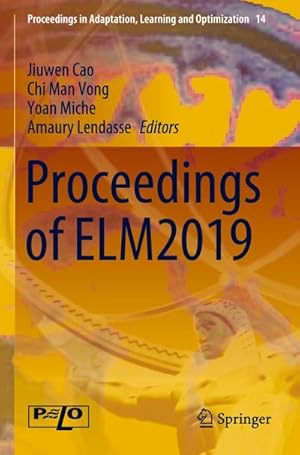
Proceedings of ELM2019
Libro 10 di 10: Proceedings in Adaptation, Learning and OptimizationEditore: Springer International Publishing, 2021
ISBN 10: 3030590496 ISBN 13: 9783030590499
Lingua: Inglese
EUR 149,79
EUR 61,48 per la spedizione da Germania a U.S.A.Quantità: 1 disponibili
Aggiungi al carrelloTaschenbuch. Condizione: Neu. Druck auf Anfrage Neuware - Printed after ordering - This book contains some selected papers from the International Conference on Extreme Learning Machine 2019, which was held in Yangzhou, China, December 14-16, 2019. Extreme Learning Machines (ELMs) aim to enable pervasive learning and pervasive intelligence. As advocated by ELM theories, it is exciting to see the convergence of machine learning and biological learning from the long-term point of view. ELM may be one of the fundamental 'learning particles' filling the gaps between machine learning and biological learning (of which activation functions are even unknown). ELM represents a suite of (machine and biological) learning techniques in which hidden neurons need not be tuned: inherited from their ancestors or randomly generated. ELM learning theories show that effective learning algorithms can be derived based on randomly generated hidden neurons (biological neurons, artificial neurons, wavelets, Fourier series, etc) as long as they are nonlinear piecewise continuous, independent of training data and application environments. Increasingly, evidence from neuroscience suggests that similar principles apply in biological learning systems. ELM theories and algorithms argue that 'random hidden neurons' capture an essential aspect of biological learning mechanisms as well as the intuitive sense that the efficiency of biological learning need not rely on computing power of neurons. ELM theories thus hint at possible reasons why the brain is more intelligent and effective than current computers. The main theme of ELM2019 is Hierarchical ELM, AI for IoT, Synergy of Machine Learning and Biological Learning.This conference provides a forum for academics, researchers and engineers to share and exchange R&D experience on both theoretical studies and practical applications of the ELM technique and brain learning.This book covers theories, algorithms and applications of ELM. It gives readers a glance of the most recent advances of ELM.
-
Proceedings of Elm2019
Libro 10 di 10: Proceedings in Adaptation, Learning and OptimizationDa: Revaluation Books, Exeter, Regno Unito
Valutazione del venditore 5 su 5 stelle
EUR 217,17
EUR 11,38 per la spedizione da Regno Unito a U.S.A.Quantità: 2 disponibili
Aggiungi al carrelloPaperback. Condizione: Brand New. 188 pages. 9.25x6.10x0.45 inches. In Stock.
-
Proceedings of ELM2019 (Proceedings in Adaptation, Learning and Optimization, 14)
Libro 10 di 10: Proceedings in Adaptation, Learning and OptimizationDa: Ria Christie Collections, Uxbridge, Regno Unito
Valutazione del venditore 5 su 5 stelle
EUR 216,03
EUR 13,63 per la spedizione da Regno Unito a U.S.A.Quantità: Più di 20 disponibili
Aggiungi al carrelloCondizione: New. In.
-

Proceedings of ELM2019
Libro 10 di 10: Proceedings in Adaptation, Learning and OptimizationEditore: Springer International Publishing, 2020
ISBN 10: 3030589889 ISBN 13: 9783030589882
Lingua: Inglese
EUR 180,07
EUR 48,99 per la spedizione da Germania a U.S.A.Quantità: Più di 20 disponibili
Aggiungi al carrelloCondizione: New.
-

Proceedings of ELM2019
Libro 10 di 10: Proceedings in Adaptation, Learning and OptimizationEditore: Springer International Publishing, 2020
ISBN 10: 3030589889 ISBN 13: 9783030589882
Lingua: Inglese
EUR 171,19
EUR 62,27 per la spedizione da Germania a U.S.A.Quantità: 1 disponibili
Aggiungi al carrelloBuch. Condizione: Neu. Druck auf Anfrage Neuware - Printed after ordering - This book contains some selected papers from the International Conference on Extreme Learning Machine 2019, which was held in Yangzhou, China, December 14-16, 2019. Extreme Learning Machines (ELMs) aim to enable pervasive learning and pervasive intelligence. As advocated by ELM theories, it is exciting to see the convergence of machine learning and biological learning from the long-term point of view. ELM may be one of the fundamental 'learning particles' filling the gaps between machine learning and biological learning (of which activation functions are even unknown). ELM represents a suite of (machine and biological) learning techniques in which hidden neurons need not be tuned: inherited from their ancestors or randomly generated. ELM learning theories show that effective learning algorithms can be derived based on randomly generated hidden neurons (biological neurons, artificial neurons, wavelets, Fourier series, etc) as long as they are nonlinear piecewise continuous, independent of training data and application environments. Increasingly, evidence from neuroscience suggests that similar principles apply in biological learning systems. ELM theories and algorithms argue that 'random hidden neurons' capture an essential aspect of biological learning mechanisms as well as the intuitive sense that the efficiency of biological learning need not rely on computing power of neurons. ELM theories thus hint at possible reasons why the brain is more intelligent and effective than current computers. The main theme of ELM2019 is Hierarchical ELM, AI for IoT, Synergy of Machine Learning and Biological Learning.This conference provides a forum for academics, researchers and engineers to share and exchange R&D experience on both theoretical studies and practical applications of the ELM technique and brain learning.This book covers theories, algorithms and applications of ELM. It gives readers a glance of the most recent advances of ELM.
-
Proceedings of ELM2019 (Proceedings in Adaptation, Learning and Optimization, 14)
Libro 10 di 10: Proceedings in Adaptation, Learning and OptimizationDa: California Books, Miami, FL, U.S.A.
Valutazione del venditore 5 su 5 stelle
Condizione: New.
-
Proceedings of ELM2019
Libro 10 di 10: Proceedings in Adaptation, Learning and OptimizationDa: Books Puddle, New York, NY, U.S.A.
Valutazione del venditore 4 su 5 stelle

Condizione: New. pp. VI, 182 79 illus., 66 illus. in color. 1 Edition NO-PA16APR2015-KAP.
-
Proceedings of ELM2019 (Proceedings in Adaptation, Learning and Optimization)
Libro 10 di 10: Proceedings in Adaptation, Learning and OptimizationDa: Books Puddle, New York, NY, U.S.A.
Valutazione del venditore 4 su 5 stelle
Condizione: New. pp. 300.
-

Proceedings of ELM2019
Libro 10 di 10: Proceedings in Adaptation, Learning and OptimizationEditore: Springer International Publishing, Springer International Publishing Sep 2020, 2020
ISBN 10: 3030589889 ISBN 13: 9783030589882
Lingua: Inglese
Da: buchversandmimpf2000, Emtmannsberg, BAYE, Germania
Valutazione del venditore 5 su 5 stelle
EUR 213,99
EUR 60,00 per la spedizione da Germania a U.S.A.Quantità: 2 disponibili
Aggiungi al carrelloBuch. Condizione: Neu. Neuware -This book contains some selected papers from the International Conference on Extreme Learning Machine 2019, which was held in Yangzhou, China, December 14¿16, 2019. Extreme Learning Machines (ELMs) aim to enable pervasive learning and pervasive intelligence. As advocated by ELM theories, it is exciting to see the convergence of machine learning and biological learning from the long-term point of view. ELM may be one of the fundamental ¿learning particles¿ filling the gaps between machine learning and biological learning (of which activation functions are even unknown). ELM represents a suite of (machine and biological) learning techniques in which hidden neurons need not be tuned: inherited from their ancestors or randomly generated. ELM learning theories show that effective learning algorithms can be derived based on randomly generated hidden neurons (biological neurons, artificial neurons, wavelets, Fourier series, etc) as long as they are nonlinear piecewise continuous, independent of training data and application environments. Increasingly, evidence from neuroscience suggests that similar principles apply in biological learning systems. ELM theories and algorithms argue that ¿random hidden neurons¿ capture an essential aspect of biological learning mechanisms as well as the intuitive sense that the efficiency of biological learning need not rely on computing power of neurons. ELM theories thus hint at possible reasons why the brain is more intelligent and effective than current computers. The main theme of ELM2019 is Hierarchical ELM, AI for IoT, Synergy of Machine Learning and Biological Learning.Springer Verlag GmbH, Tiergartenstr. 17, 69121 Heidelberg 188 pp. Englisch.
-
Proceedings of ELM2019
Libro 10 di 10: Proceedings in Adaptation, Learning and OptimizationDa: Revaluation Books, Exeter, Regno Unito
Valutazione del venditore 5 su 5 stelle
EUR 299,42
EUR 11,38 per la spedizione da Regno Unito a U.S.A.Quantità: 2 disponibili
Aggiungi al carrelloHardcover. Condizione: Brand New. 188 pages. 9.25x6.10x0.67 inches. In Stock.
-

Proceedings of ELM2019
Libro 10 di 10: Proceedings in Adaptation, Learning and OptimizationEditore: Springer International Publishing Sep 2021, 2021
ISBN 10: 3030590496 ISBN 13: 9783030590499
Lingua: Inglese
Da: BuchWeltWeit Ludwig Meier e.K., Bergisch Gladbach, Germania
Valutazione del venditore 5 su 5 stelle
EUR 149,79
EUR 23,00 per la spedizione da Germania a U.S.A.Quantità: 2 disponibili
Aggiungi al carrelloTaschenbuch. Condizione: Neu. This item is printed on demand - it takes 3-4 days longer - Neuware -This book contains some selected papers from the International Conference on Extreme Learning Machine 2019, which was held in Yangzhou, China, December 14-16, 2019. Extreme Learning Machines (ELMs) aim to enable pervasive learning and pervasive intelligence. As advocated by ELM theories, it is exciting to see the convergence of machine learning and biological learning from the long-term point of view. ELM may be one of the fundamental 'learning particles' filling the gaps between machine learning and biological learning (of which activation functions are even unknown). ELM represents a suite of (machine and biological) learning techniques in which hidden neurons need not be tuned: inherited from their ancestors or randomly generated. ELM learning theories show that effective learning algorithms can be derived based on randomly generated hidden neurons (biological neurons, artificial neurons, wavelets, Fourier series, etc) as long as they are nonlinear piecewise continuous, independent of training data and application environments. Increasingly, evidence from neuroscience suggests that similar principles apply in biological learning systems. ELM theories and algorithms argue that 'random hidden neurons' capture an essential aspect of biological learning mechanisms as well as the intuitive sense that the efficiency of biological learning need not rely on computing power of neurons. ELM theories thus hint at possible reasons why the brain is more intelligent and effective than current computers. The main theme of ELM2019 is Hierarchical ELM, AI for IoT, Synergy of Machine Learning and Biological Learning.This conference provides a forum for academics, researchers and engineers to share and exchange R&D experience on both theoretical studies and practical applications of the ELM technique and brain learning.This book covers theories, algorithms and applications of ELM. It gives readers a glance of the most recent advances of ELM. 188 pp. Englisch.
-

Proceedings of ELM2019
Libro 10 di 10: Proceedings in Adaptation, Learning and OptimizationEditore: Springer, Berlin|Springer International Publishing|Springer, 2021
ISBN 10: 3030590496 ISBN 13: 9783030590499
Lingua: Inglese
EUR 127,40
EUR 48,99 per la spedizione da Germania a U.S.A.Quantità: Più di 20 disponibili
Aggiungi al carrelloKartoniert / Broschiert. Condizione: New. Dieser Artikel ist ein Print on Demand Artikel und wird nach Ihrer Bestellung fuer Sie gedruckt. This book contains some selected papers from the International Conference on Extreme Learning Machine 2019, which was held in Yangzhou, China, December 14-16, 2019. Extreme Learning Machines (ELMs) aim to enable pervasive learning and pervasive intellige.
-

Proceedings of ELM2019
Libro 10 di 10: Proceedings in Adaptation, Learning and OptimizationEditore: Springer International Publishing Sep 2020, 2020
ISBN 10: 3030589889 ISBN 13: 9783030589882
Lingua: Inglese
Da: BuchWeltWeit Ludwig Meier e.K., Bergisch Gladbach, Germania
Valutazione del venditore 5 su 5 stelle
EUR 171,19
EUR 23,00 per la spedizione da Germania a U.S.A.Quantità: 2 disponibili
Aggiungi al carrelloBuch. Condizione: Neu. This item is printed on demand - it takes 3-4 days longer - Neuware -This book contains some selected papers from the International Conference on Extreme Learning Machine 2019, which was held in Yangzhou, China, December 14-16, 2019. Extreme Learning Machines (ELMs) aim to enable pervasive learning and pervasive intelligence. As advocated by ELM theories, it is exciting to see the convergence of machine learning and biological learning from the long-term point of view. ELM may be one of the fundamental 'learning particles' filling the gaps between machine learning and biological learning (of which activation functions are even unknown). ELM represents a suite of (machine and biological) learning techniques in which hidden neurons need not be tuned: inherited from their ancestors or randomly generated. ELM learning theories show that effective learning algorithms can be derived based on randomly generated hidden neurons (biological neurons, artificial neurons, wavelets, Fourier series, etc) as long as they are nonlinear piecewise continuous, independent of training data and application environments. Increasingly, evidence from neuroscience suggests that similar principles apply in biological learning systems. ELM theories and algorithms argue that 'random hidden neurons' capture an essential aspect of biological learning mechanisms as well as the intuitive sense that the efficiency of biological learning need not rely on computing power of neurons. ELM theories thus hint at possible reasons why the brain is more intelligent and effective than current computers. The main theme of ELM2019 is Hierarchical ELM, AI for IoT, Synergy of Machine Learning and Biological Learning.This conference provides a forum for academics, researchers and engineers to share and exchange R&D experience on both theoretical studies and practical applications of the ELM technique and brain learning.This book covers theories, algorithms and applications of ELM. It gives readers a glance of the most recent advances of ELM. 188 pp. Englisch.
-
EUR 187,40
EUR 70,00 per la spedizione da Germania a U.S.A.Quantità: 5 disponibili
Aggiungi al carrelloBuch. Condizione: Neu. Proceedings of ELM2019 | Jiuwen Cao (u. a.) | Buch | vi | Englisch | 2020 | Springer | EAN 9783030589882 | Verantwortliche Person für die EU: Springer Verlag GmbH, Tiergartenstr. 17, 69121 Heidelberg, juergen[dot]hartmann[at]springer[dot]com | Anbieter: preigu Print on Demand.
-
Proceedings of ELM2019
Libro 10 di 10: Proceedings in Adaptation, Learning and OptimizationDa: Majestic Books, Hounslow, Regno Unito
Valutazione del venditore 4 su 5 stelle
EUR 291,45
EUR 7,40 per la spedizione da Regno Unito a U.S.A.Quantità: 4 disponibili
Aggiungi al carrelloCondizione: New. Print on Demand pp. VI, 182 79 illus., 66 illus. in color.
-
Proceedings of ELM2019 (Proceedings in Adaptation, Learning and Optimization)
Libro 10 di 10: Proceedings in Adaptation, Learning and OptimizationDa: Majestic Books, Hounslow, Regno Unito
Valutazione del venditore 4 su 5 stelle
EUR 293,06
EUR 7,40 per la spedizione da Regno Unito a U.S.A.Quantità: 4 disponibili
Aggiungi al carrelloCondizione: New. Print on Demand pp. 300.
-
Proceedings of ELM2019
Libro 10 di 10: Proceedings in Adaptation, Learning and OptimizationDa: Biblios, Frankfurt am main, HESSE, Germania
Valutazione del venditore 4 su 5 stelle
EUR 292,09
EUR 9,95 per la spedizione da Germania a U.S.A.Quantità: 4 disponibili
Aggiungi al carrelloCondizione: New. PRINT ON DEMAND pp. VI, 182 79 illus., 66 illus. in color.
-
Proceedings of ELM2019 (Proceedings in Adaptation, Learning and Optimization)
Libro 10 di 10: Proceedings in Adaptation, Learning and OptimizationDa: Biblios, Frankfurt am main, HESSE, Germania
Valutazione del venditore 4 su 5 stelle
EUR 293,66
EUR 9,95 per la spedizione da Germania a U.S.A.Quantità: 4 disponibili
Aggiungi al carrelloCondizione: New. PRINT ON DEMAND pp. 300.


