
Articoli correlati a The Last Alchemist: Count Cagliostro, Master of Magic...
Sinossi
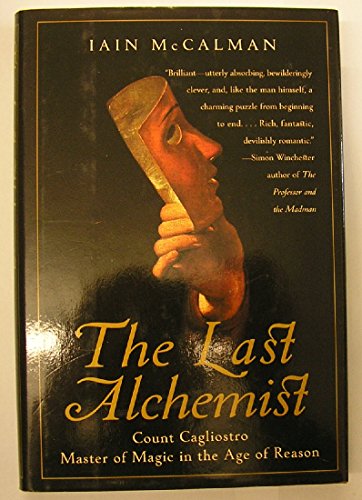
Who was the mysterious Count Cagliostro? Depending on whom you ask, he was either a great healer and mystic or a dangerous charlatan whose revolutionary notions and influences threatened to undermine the monarchies of France and Russia. Whatever else he was, Count Alessandro di Cagliostro, the leader of an exotic brand of Freemasonry, was indisputably one of the most influential and notorious figures of the latter eighteenth century, overcoming poverty and an ignoble birth to become the darling -- and bane -- of upper-crust Europe.
Internationally acclaimed historian Iain McCalman has not written a work of biography in the strictest sense; rather, he uses seven key "episodes" in Cagliostro's political and spiritual evolution to provide a dazzling panoramic portrait of eighteenth-century European culture and history. McCalman documents how Cagliostro crossed paths -- and often swords -- with the likes of Catherine the Great, Marie Antoinette, and Pope Pius VI. He was a muse to William Blake and the inspiration for both Mozart's The Magic Flute and Goethe's Faust. LouisXVI had him thrown into the Bastille for his alleged involvement in what would come to be known as "the affair of the necklace." Yet in London, Warsaw, and St. Petersburg, he established "healing clinics" for the poorest of the poor, a radical notion at that time; and his dexterity in the worlds of alchemy and spiritualism won him acclaim among the nobility across Europe.
But it was his progress through the rites of Egyptian Freemasonry -- including the Illuminati, a genuinely conspiratorial secret society dedicated to the overthrow of established religion and monarchy -- that was both his highest achievement and his undoing. In 1791, on the order of Pope Pius VI, Cagliostro was arrested for heresy. He spent the last five years of his life in solitary confinement in an Italian prison, where he died in 1795.
Le informazioni nella sezione "Riassunto" possono far riferimento a edizioni diverse di questo titolo.
Informazioni sull'autore
Iain McCalman was born in Nyasaland (now Malawi) in Africa in 1947. Although a third-generation African - his family is descended in part from Australians who fought with the Australian Light Horse in the Boer War - McCalman grew up knowing he would eventually have to leave Africa. His father, a Kenyan-raised British civil servant, "was very liberal for his time", says McCalman. "He always told us European colonials were caretakers, not owners, and we'd have to go one day. It really irritated my sister and me. Africa was our home. But he never bought property, always prepared us to leave."
At around the age of sixteen he began writing: "My first publication was an article in the Rhodesia Herald on early Portuguese exploration of the lands that now include Zimbabwe." McCalman says he grew up in Africa "in a context where people around me believed in magic, and I felt sympathy with that without it penetrating my own beliefs". This, he believes, was an advantage in writing about Cagliostro's life and work.
He migrated to Australia, where he completed his BA Hons in History and MA at Canberra's Australian National University, and his PhD at Melbourne's Monash University. He has worked in many Australian and overseas universities, and has received awards for his teaching and scholarship, most recently the Federation Centenary medal in 2002. Currently President of the Australian Academy of the Humanities, McCalman became a Professor in History in 1994 and Director of the Humanities Research Centre at ANU a year later. He is currently a Federation Fellow at the ANU - one of the few humanities recipients - and will use the fellowship to research a multi-media project on the "moving picture spectacles" of 18th-century painter (and key Cagliostro enemy) Philip de Loutherborg, and a history of the impact of spectacular Australian landscapes on scientists in Darwin's age.
Iain McCalman specializes in eighteenth-century and early-nineteenth British and European cultural history and has a particular interest in popular culture and "low life".
Along with his many academic achievements, McCalman has developed an interest in the uses of other media for history and has been active in developing collaborative projects linking university-based research to the work of other cultural institutions, and recently was a historical consultant for and participant in the television series The Ship, a re-enactment of Cook's Endeavour voyage. "I had to snatch my reading during occasional interludes between climbing 140 feet up the rigging, sleeping like a fruit bat in a hammock, and crunching on hard tack biscuits and sauerkraut," he says of the journey, and admits it was a little bit "Big Brother at sea".
He is also writing a travel-book cum political memoir called The Gun in the Lake, based on his early life and experiences in Nyasaland.
Dalla quarta di copertina
Who was the mysterious Count Cagliostro? Depending on whom you ask, he was either a great healer and mystic or a dangerous charlatan whose revolutionary notions and influences threatened to undermine the monarchies of France and Russia. Whatever else he was, Count Alessandro di Cagliostro, the leader of an exotic brand of Freemasonry, was indisputably one of the most influential and notorious figures of the latter eighteenth century, overcoming poverty and an ignoble birth to become the darling -- and bane -- of upper-crust Europe.
Internationally acclaimed historian Iain McCalman has not written a work of biography in the strictest sense; rather, he uses seven key "episodes" in Cagliostro's political and spiritual evolution to provide a dazzling panoramic portrait of eighteenth-century European culture and history. McCalman documents how Cagliostro crossed paths -- and often swords -- with the likes of Catherine the Great, Marie Antoinette, and Pope Pius VI. He was a muse to William Blake and the inspiration for both Mozart's The Magic Flute and Goethe's Faust. LouisXVI had him thrown into the Bastille for his alleged involvement in what would come to be known as "the affair of the necklace." Yet in London, Warsaw, and St. Petersburg, he established "healing clinics" for the poorest of the poor, a radical notion at that time; and his dexterity in the worlds of alchemy and spiritualism won him acclaim among the nobility across Europe.
But it was his progress through the rites of Egyptian Freemasonry -- including the Illuminati, a genuinely conspiratorial secret society dedicated to the overthrow of established religion and monarchy -- that was both his highest achievement and his undoing. In 1791, on the order of Pope Pius VI, Cagliostro was arrested for heresy. He spent the last five years of his life in solitary confinement in an Italian prison, where he died in 1795.
Le informazioni nella sezione "Su questo libro" possono far riferimento a edizioni diverse di questo titolo.
Risultati della ricerca per The Last Alchemist: Count Cagliostro, Master of Magic...

Foto dell'editore
The Last Alchemist: The Seven Extraordinary Lives of Count Cagliostro, Eighteenth-century Enchanter
Editore:
HarperCollins Publishers Inc, 2003
ISBN 10: 0060006900
ISBN 13: 9780060006907
Antico o usato
Rilegato
Da: World of Books (was SecondSale), Montgomery, IL, U.S.A.
Valutazione del venditore 5 su 5 stelle

Hardback. Condizione: Very Good. Who was the mysterious Count Cagliostro? Depending on whom you ask, he was either a great healer and mystic or a dangerous charlatan whose revolutionary notions and influences threatened to undermine the monarchies of France and Russia. Whatever else he was, Count Alessandro di Cagliostro, the leader of an exotic brand of Freemasonry, was indisputably one of the most influential and notorious figures of the latter eighteenth century, overcoming poverty and an ignoble birth to become the darling -- and bane -- of upper-crust Europe. Internationally acclaimed historian Iain McCalman has not written a work of biography in the strictest sense; rather, he uses seven key "episodes" in Cagliostro's political and spiritual evolution to provide a dazzling panoramic portrait of eighteenth-century European culture and history. McCalman documents how Cagliostro crossed paths -- and often swords -- with the likes of Catherine the Great, Marie Antoinette, and Pope Pius VI. He was a muse to William Blake and the inspiration for both Mozart's The Magic Flute and Goethe's Faust. LouisXVI had him thrown into the Bastille for his alleged involvement in what would come to be known as "the affair of the necklace." Yet in London, Warsaw, and St. Petersburg, he established "healing clinics" for the poorest of the poor, a radical notion at that time; and his dexterity in the worlds of alchemy and spiritualism won him acclaim among the nobility across Europe. But it was his progress through the rites of Egyptian Freemasonry -- including the Illuminati, a genuinely conspiratorial secret society dedicated to the overthrow of established religion and monarchy -- that was both his highest achievement and his undoing. In 1791, on the order of Pope Pius VI, Cagliostro was arrested for heresy. He spent the last five years of his life in solitary confinement in an Italian prison, where he died in 1795. Codice articolo 00106604015
Compra usato
EUR 5,01
Spedizione gratuita
Spedito in U.S.A.
Spedito in U.S.A.
Quantità: 1 disponibili
Foto dell'editore
The Last Alchemist: The Seven Extraordinary Lives of Count Cagliostro, Eighteenth-century Enchanter
Editore:
HarperCollins Publishers Inc, 2003
ISBN 10: 0060006900
ISBN 13: 9780060006907
Antico o usato
Rilegato
Da: World of Books (was SecondSale), Montgomery, IL, U.S.A.
Valutazione del venditore 5 su 5 stelle
Hardback. Condizione: Fair. Who was the mysterious Count Cagliostro? Depending on whom you ask, he was either a great healer and mystic or a dangerous charlatan whose revolutionary notions and influences threatened to undermine the monarchies of France and Russia. Whatever else he was, Count Alessandro di Cagliostro, the leader of an exotic brand of Freemasonry, was indisputably one of the most influential and notorious figures of the latter eighteenth century, overcoming poverty and an ignoble birth to become the darling -- and bane -- of upper-crust Europe. Internationally acclaimed historian Iain McCalman has not written a work of biography in the strictest sense; rather, he uses seven key "episodes" in Cagliostro's political and spiritual evolution to provide a dazzling panoramic portrait of eighteenth-century European culture and history. McCalman documents how Cagliostro crossed paths -- and often swords -- with the likes of Catherine the Great, Marie Antoinette, and Pope Pius VI. He was a muse to William Blake and the inspiration for both Mozart's The Magic Flute and Goethe's Faust. LouisXVI had him thrown into the Bastille for his alleged involvement in what would come to be known as "the affair of the necklace." Yet in London, Warsaw, and St. Petersburg, he established "healing clinics" for the poorest of the poor, a radical notion at that time; and his dexterity in the worlds of alchemy and spiritualism won him acclaim among the nobility across Europe. But it was his progress through the rites of Egyptian Freemasonry -- including the Illuminati, a genuinely conspiratorial secret society dedicated to the overthrow of established religion and monarchy -- that was both his highest achievement and his undoing. In 1791, on the order of Pope Pius VI, Cagliostro was arrested for heresy. He spent the last five years of his life in solitary confinement in an Italian prison, where he died in 1795. Codice articolo 00107324946
Compra usato
EUR 5,01
Spedizione gratuita
Spedito in U.S.A.
Spedito in U.S.A.
Quantità: 1 disponibili
Foto dell'editore
The Last Alchemist: The Seven Extraordinary Lives of Count Cagliostro, Eighteenth-century Enchanter
Editore:
HarperCollins Publishers Inc, 2003
ISBN 10: 0060006900
ISBN 13: 9780060006907
Antico o usato
Rilegato
Da: World of Books (was SecondSale), Montgomery, IL, U.S.A.
Valutazione del venditore 5 su 5 stelle
Hardback. Condizione: Good. Who was the mysterious Count Cagliostro? Depending on whom you ask, he was either a great healer and mystic or a dangerous charlatan whose revolutionary notions and influences threatened to undermine the monarchies of France and Russia. Whatever else he was, Count Alessandro di Cagliostro, the leader of an exotic brand of Freemasonry, was indisputably one of the most influential and notorious figures of the latter eighteenth century, overcoming poverty and an ignoble birth to become the darling -- and bane -- of upper-crust Europe. Internationally acclaimed historian Iain McCalman has not written a work of biography in the strictest sense; rather, he uses seven key "episodes" in Cagliostro's political and spiritual evolution to provide a dazzling panoramic portrait of eighteenth-century European culture and history. McCalman documents how Cagliostro crossed paths -- and often swords -- with the likes of Catherine the Great, Marie Antoinette, and Pope Pius VI. He was a muse to William Blake and the inspiration for both Mozart's The Magic Flute and Goethe's Faust. LouisXVI had him thrown into the Bastille for his alleged involvement in what would come to be known as "the affair of the necklace." Yet in London, Warsaw, and St. Petersburg, he established "healing clinics" for the poorest of the poor, a radical notion at that time; and his dexterity in the worlds of alchemy and spiritualism won him acclaim among the nobility across Europe. But it was his progress through the rites of Egyptian Freemasonry -- including the Illuminati, a genuinely conspiratorial secret society dedicated to the overthrow of established religion and monarchy -- that was both his highest achievement and his undoing. In 1791, on the order of Pope Pius VI, Cagliostro was arrested for heresy. He spent the last five years of his life in solitary confinement in an Italian prison, where he died in 1795. Codice articolo 00107567108
Compra usato
EUR 5,01
Spedizione gratuita
Spedito in U.S.A.
Spedito in U.S.A.
Quantità: 1 disponibili
Immagini fornite dal venditore
The Last Alchemist: Count Cagliostro, Master of Magic in the Age of Reason
Da: Bay State Book Company, North Smithfield, RI, U.S.A.
Valutazione del venditore 5 su 5 stelle
Condizione: good. The book is in good condition with all pages and cover intact, including the dust jacket if originally issued. The spine may show light wear. Pages may contain some notes or highlighting, and there might be a "From the library of" label. Boxed set packaging, shrink wrap, or included media like CDs may be missing. Codice articolo BSM.1BE04
Compra usato
EUR 5,47
Spedizione gratuita
Spedito in U.S.A.
Spedito in U.S.A.
Quantità: 1 disponibili
Foto dell'editore
The Last Alchemist : Count Cagliostro, Master of Magic in the Age of Reason
Editore:
HarperCollins Publishers, 2003
ISBN 10: 0060006900
ISBN 13: 9780060006907
Antico o usato
Rilegato
Prima edizione
Da: Better World Books, Mishawaka, IN, U.S.A.
Valutazione del venditore 5 su 5 stelle
Condizione: Good. 1st Edition. Former library copy. Pages intact with minimal writing/highlighting. The binding may be loose and creased. Dust jackets/supplements are not included. Includes library markings. Stock photo provided. Product includes identifying sticker. Better World Books: Buy Books. Do Good. Codice articolo 2184275-6
Compra usato
EUR 6,73
Spedizione gratuita
Spedito in U.S.A.
Spedito in U.S.A.
Quantità: 1 disponibili
Foto dell'editore
The Last Alchemist : Count Cagliostro, Master of Magic in the Age of Reason
Editore:
HarperCollins Publishers, 2003
ISBN 10: 0060006900
ISBN 13: 9780060006907
Antico o usato
Rilegato
Prima edizione
Da: Better World Books: West, Reno, NV, U.S.A.
Valutazione del venditore 5 su 5 stelle
Condizione: Very Good. 1st Edition. Former library copy. Pages intact with possible writing/highlighting. Binding strong with minor wear. Dust jackets/supplements may not be included. Includes library markings. Stock photo provided. Product includes identifying sticker. Better World Books: Buy Books. Do Good. Codice articolo 9217291-75
Compra usato
EUR 6,73
Spedizione gratuita
Spedito in U.S.A.
Spedito in U.S.A.
Quantità: 1 disponibili
Foto dell'editore
The Last Alchemist : Count Cagliostro, Master of Magic in the Age of Reason
Editore:
HarperCollins Publishers, 2003
ISBN 10: 0060006900
ISBN 13: 9780060006907
Antico o usato
Rilegato
Prima edizione
Da: Better World Books, Mishawaka, IN, U.S.A.
Valutazione del venditore 5 su 5 stelle
Condizione: Very Good. 1st Edition. Former library copy. Pages intact with possible writing/highlighting. Binding strong with minor wear. Dust jackets/supplements may not be included. Includes library markings. Stock photo provided. Product includes identifying sticker. Better World Books: Buy Books. Do Good. Codice articolo 9217291-75
Compra usato
EUR 6,73
Spedizione gratuita
Spedito in U.S.A.
Spedito in U.S.A.
Quantità: 1 disponibili
Foto dell'editore
The Last Alchemist: The Seven Extraordinary Lives of Count Cagliostro, Eighteenth-century Enchanter
Editore:
HarperCollins Publishers Inc, 2003
ISBN 10: 0060006900
ISBN 13: 9780060006907
Antico o usato
Rilegato
Da: World of Books Inc, Montgomery, IL, U.S.A.
Valutazione del venditore 4 su 5 stelle

Hardback. Condizione: Good. Who was the mysterious Count Cagliostro? Depending on whom you ask, he was either a great healer and mystic or a dangerous charlatan whose revolutionary notions and influences threatened to undermine the monarchies of France and Russia. Whatever else he was, Count Alessandro di Cagliostro, the leader of an exotic brand of Freemasonry, was indisputably one of the most influential and notorious figures of the latter eighteenth century, overcoming poverty and an ignoble birth to become the darling -- and bane -- of upper-crust Europe. Internationally acclaimed historian Iain McCalman has not written a work of biography in the strictest sense; rather, he uses seven key "episodes" in Cagliostro's political and spiritual evolution to provide a dazzling panoramic portrait of eighteenth-century European culture and history. McCalman documents how Cagliostro crossed paths -- and often swords -- with the likes of Catherine the Great, Marie Antoinette, and Pope Pius VI. He was a muse to William Blake and the inspiration for both Mozart's The Magic Flute and Goethe's Faust. LouisXVI had him thrown into the Bastille for his alleged involvement in what would come to be known as "the affair of the necklace." Yet in London, Warsaw, and St. Petersburg, he established "healing clinics" for the poorest of the poor, a radical notion at that time; and his dexterity in the worlds of alchemy and spiritualism won him acclaim among the nobility across Europe. But it was his progress through the rites of Egyptian Freemasonry -- including the Illuminati, a genuinely conspiratorial secret society dedicated to the overthrow of established religion and monarchy -- that was both his highest achievement and his undoing. In 1791, on the order of Pope Pius VI, Cagliostro was arrested for heresy. He spent the last five years of his life in solitary confinement in an Italian prison, where he died in 1795. Codice articolo CIN0060006900G
Compra usato
EUR 6,84
Spedizione gratuita
Spedito in U.S.A.
Spedito in U.S.A.
Quantità: 1 disponibili
Foto dell'editore
The Last Alchemist: The Seven Extraordinary Lives of Count Cagliostro, Eighteenth-century Enchanter
Editore:
HarperCollins Publishers Inc, 2003
ISBN 10: 0060006900
ISBN 13: 9780060006907
Antico o usato
Rilegato
Da: World of Books Inc, Montgomery, IL, U.S.A.
Valutazione del venditore 4 su 5 stelle
Hardback. Condizione: Fair. Who was the mysterious Count Cagliostro? Depending on whom you ask, he was either a great healer and mystic or a dangerous charlatan whose revolutionary notions and influences threatened to undermine the monarchies of France and Russia. Whatever else he was, Count Alessandro di Cagliostro, the leader of an exotic brand of Freemasonry, was indisputably one of the most influential and notorious figures of the latter eighteenth century, overcoming poverty and an ignoble birth to become the darling -- and bane -- of upper-crust Europe. Internationally acclaimed historian Iain McCalman has not written a work of biography in the strictest sense; rather, he uses seven key "episodes" in Cagliostro's political and spiritual evolution to provide a dazzling panoramic portrait of eighteenth-century European culture and history. McCalman documents how Cagliostro crossed paths -- and often swords -- with the likes of Catherine the Great, Marie Antoinette, and Pope Pius VI. He was a muse to William Blake and the inspiration for both Mozart's The Magic Flute and Goethe's Faust. LouisXVI had him thrown into the Bastille for his alleged involvement in what would come to be known as "the affair of the necklace." Yet in London, Warsaw, and St. Petersburg, he established "healing clinics" for the poorest of the poor, a radical notion at that time; and his dexterity in the worlds of alchemy and spiritualism won him acclaim among the nobility across Europe. But it was his progress through the rites of Egyptian Freemasonry -- including the Illuminati, a genuinely conspiratorial secret society dedicated to the overthrow of established religion and monarchy -- that was both his highest achievement and his undoing. In 1791, on the order of Pope Pius VI, Cagliostro was arrested for heresy. He spent the last five years of his life in solitary confinement in an Italian prison, where he died in 1795. Codice articolo CIN0060006900A
Compra usato
EUR 6,84
Spedizione gratuita
Spedito in U.S.A.
Spedito in U.S.A.
Quantità: 1 disponibili
Foto dell'editore
The Last Alchemist: The Seven Extraordinary Lives of Count Cagliostro, Eighteenth-century Enchanter
Editore:
HarperCollins Publishers Inc, 2003
ISBN 10: 0060006900
ISBN 13: 9780060006907
Antico o usato
Rilegato
Da: World of Books Inc, Montgomery, IL, U.S.A.
Valutazione del venditore 4 su 5 stelle
Hardback. Condizione: Very Good. Who was the mysterious Count Cagliostro? Depending on whom you ask, he was either a great healer and mystic or a dangerous charlatan whose revolutionary notions and influences threatened to undermine the monarchies of France and Russia. Whatever else he was, Count Alessandro di Cagliostro, the leader of an exotic brand of Freemasonry, was indisputably one of the most influential and notorious figures of the latter eighteenth century, overcoming poverty and an ignoble birth to become the darling -- and bane -- of upper-crust Europe. Internationally acclaimed historian Iain McCalman has not written a work of biography in the strictest sense; rather, he uses seven key "episodes" in Cagliostro's political and spiritual evolution to provide a dazzling panoramic portrait of eighteenth-century European culture and history. McCalman documents how Cagliostro crossed paths -- and often swords -- with the likes of Catherine the Great, Marie Antoinette, and Pope Pius VI. He was a muse to William Blake and the inspiration for both Mozart's The Magic Flute and Goethe's Faust. LouisXVI had him thrown into the Bastille for his alleged involvement in what would come to be known as "the affair of the necklace." Yet in London, Warsaw, and St. Petersburg, he established "healing clinics" for the poorest of the poor, a radical notion at that time; and his dexterity in the worlds of alchemy and spiritualism won him acclaim among the nobility across Europe. But it was his progress through the rites of Egyptian Freemasonry -- including the Illuminati, a genuinely conspiratorial secret society dedicated to the overthrow of established religion and monarchy -- that was both his highest achievement and his undoing. In 1791, on the order of Pope Pius VI, Cagliostro was arrested for heresy. He spent the last five years of his life in solitary confinement in an Italian prison, where he died in 1795. Codice articolo CIN0060006900VG
Compra usato
EUR 6,84
Spedizione gratuita
Spedito in U.S.A.
Spedito in U.S.A.
Quantità: 1 disponibili