
Articoli correlati a Self-Editing for Fiction Writers, Second Edition: How...
Sinossi
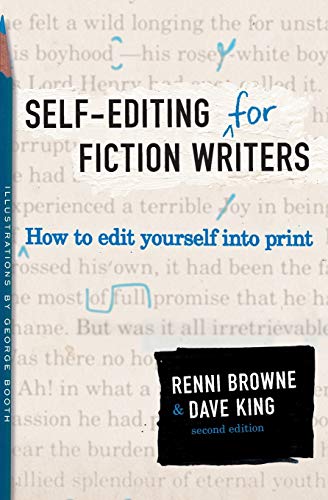
Hundreds of books have been written on the art of writing. Here at last is a book by two professional editors to teach writers the techniques of the editing trade that turn promising manuscripts into published novels and short stories.
In this completely revised and updated second edition, Renni Browne and Dave King teach you, the writer, how to apply the editing techniques they have developed to your own work. Chapters on dialogue, exposition, point of view, interior monologue, and other techniques take you through the same processes an expert editor would go through to perfect your manuscript. Each point is illustrated with examples, many drawn from the hundreds of books Browne and King have edited.
Le informazioni nella sezione "Riassunto" possono far riferimento a edizioni diverse di questo titolo.
Informazioni sugli autori
Renni Browne, once senior editor for William Morrow and other companies, left mainstream publishing in 1980 to found The Editorial Department, a national book-editing company.
Dave King is a contributing editor at Writer's Digest. He also works as an independent editor in his home in rural Ashfield, Massachusetts.
Dalla quarta di copertina
Hundreds of books have been written on the art of writing. Here at last is a book by two professional editors to teach writers the techniques of the editing trade that turn promising manuscripts into published novels and short stories.
In this completely revised and updated second edition, Renni Browne and Dave King teach you, the writer, how to apply the editing techniques they have developed to your own work. Chapters on dialogue, exposition, point of view, interior monologue, and other techniques take you through the same processes an expert editor would go through to perfect your manuscript. Each point is illustrated with examples, many drawn from the hundreds of books Browne and King have edited.
Estratto. © Ristampato con autorizzazione. Tutti i diritti riservati.
Self-Editing for Fiction Writers, Second Edition
By Browne, RenniHarperResource
ISBN: 0060545690Chapter One
Show and Tell
What's wrong with this paragraph?:
The conversation was barely begun before I discovered that our host was more than simply a stranger to most of his guests. He was an enigma, a mystery. And this was a crowd that doted on mysteries. In the space of no more than five minutes, I heard several different people put forth theirtheories -- all equally probable or preposterous -- as to who and what he was. Each theory was argued with the conviction that can only come from a lack of evidence, and it seemed that, for many of the guests, these arguments were the main reason toattend his parties.
In a sense, of course, there's nothing wrong. The paragraphis grammatically impeccable, and it describes the mystery surrounding the party's host clearly, efficiently, andwith a sense of style.
Now look at the same passage as it actually appeared inF. Scott Fitzgerald's The Great Gatsby:
"I like to come," Lucille said. "I never care what Ido, so I always have a good time. When I was here last,I tore my gown on a chair, and he asked me my nameand address -- within a week I got a package fromCroirier's with a new evening gown in it."
"Did you keep it?" asked Jordan.
"Sure I did. I was going to wear it tonight, but itwas too big in the bust and had to be altered. It was gasblue with lavender beads. Two hundred and sixty-fivedollars."
"There's something funny about a fellow that'll do athing like that," said the other girl eagerly. "He doesn'twant any trouble with anybody."
"Who doesn't?" I inquired.
"Gatsby. Somebody told me -- "
The two girls and Jordan leaned togetherconfidentially.
"Somebody told me they thought he killed a man."A thrill passed over all of us. The three Mr.Mumbles bent forward and listened eagerly.
"I don't think it's so much that," argued Lucilleskeptically; "it's more that he was a German spy duringthe war."
One of the men nodded in confirmation.
"I heard that from a man who knew all about him, grew up with him in Germany," he assured uspositively.
"Oh, no," said the first girl, "it couldn't be that,because he was in the American army during the war."As our credulity switched back to her, she leanedforward with enthusiasm. "You look at him sometimeswhen he thinks nobody's looking at him. I'll bet hekilled a man."
What's the difference between these two examples? Toput it simply, it's a matter of showing and telling. The firstversion is narrative summary, with no specific settings orcharacters. We are simply told about the guests' love of mystery,the weakness of their arguments, the conviction of thearguers. In the second version we actually get to see thebreathless partygoers putting forth their theories and canalmost taste the eagerness of their audience. The first versionis a secondhand report. The second is an immediatescene.
What, exactly, makes a scene a scene? For one thing ittakes place in real time. Your readers watch events as theyunfold, whether those events are a group discussion of themerits of Woody Allen films, a lone man running from anassassin, or a woman lying in a field pondering the meaningof life. In scenes, events are seen as they happen rather thandescribed after the fact. Even flashbacks show events as theyunfold, although they have unfolded in the past within thecontext of the story.
Scenes usually have settings as well, specific locations thereaders can picture. In Victorian novels these settings were"I heard that from a man who knew all about him, often described in exhaustive (and exhausting) detail.Nowadays literature is leaner and meaner, and it's often agood idea to give your readers just enough detail to jumpstarttheir imaginations so they can picture your settings forthemselves.
Scenes also contain some action, something that happens.Mary kills Harry, or Harry and Mary beat each otherup. More often than not, what happens is dialogue betweenone or more characters. Though even in dialogue scenes it'sa good idea to include a little physical action from time totime -- what we call "beats" -- to remind your readers ofwhere your characters are and what they're doing. We'll betalking about beats at length in chapter 8.
Of course, anything that can go into a scene can also benarrated. And since scenes are usually harder to write thannarration, many writers rely too heavily on narrative summaryto tell their stories. The result is often page after page,sometimes chapter after chapter, of writing that reads theway the first passage quoted above reads: clearly, perhapseven stylishly, but with no specific setting, no specific characters,no dialogue.
A century or so ago this sort of writing would have beenfine. It was the norm, in fact -- Henry James wrote at leastone entire novel composed largely of narrative summary.But thanks to the influence of movies and television, readerstoday have become accustomed to seeing a story as a seriesof immediate scenes. Narrative summary no longer engagesreaders the way it once did.
Since engagement is exactly what a fiction writer wantsto accomplish, you're well advised to rely heavily on imme-diate scenes to put your story across. You want to draw yourreaders into the world you've created, make them feel a partof it, make them forget where they are. And you can't dothis effectively if you tell your readers about your world secondhand. You have to take them there.
We once worked on a novel featuring a law firm in whichone of the new associates led a rebellion against the seniorpartners. The writer introduced the new associate and twoof his colleagues in the first chapter by describing their jobinterviews with senior partners. The interviews were given asnarrative summary -- she simply told her readers what thelaw firm was looking for in a new associate ...
Continues...Excerpted from Self-Editing for Fiction Writers, Second Editionby Browne, Renni Excerpted by permission.
All rights reserved. No part of this excerpt may be reproduced or reprinted without permission in writing from the publisher.
Excerpts are provided by Dial-A-Book Inc. solely for the personal use of visitors to this web site.
Le informazioni nella sezione "Su questo libro" possono far riferimento a edizioni diverse di questo titolo.
Risultati della ricerca per Self-Editing for Fiction Writers, Second Edition: How...

Foto dell'editore
Self-Editing for Fiction Writers, Second Edition: How to Edit Yourself Into Print â A Professional Writing Guide on "Show, Don't Tell"
Editore:
William Morrow Paperbacks (edition Subsequent), 2004
ISBN 10: 0060545690
ISBN 13: 9780060545697
Antico o usato
Paperback
Da: BooksRun, Philadelphia, PA, U.S.A.
Valutazione del venditore 5 su 5 stelle

Paperback. Condizione: Fair. Subsequent. The item might be beaten up but readable. May contain markings or highlighting, as well as stains, bent corners, or any other major defect, but the text is not obscured in any way. Codice articolo 0060545690-7-1-13
Compra usato
EUR 6,20
Spedizione gratuita
Spedito in U.S.A.
Spedito in U.S.A.
Quantità: 1 disponibili
Immagini fornite dal venditore
Self-Editing for Fiction Writers, Second Edition: How to Edit Yourself Into Print â A Professional Writing Guide on "Show, Don't Tell"
Editore:
William Morrow Paperbacks, 2004
ISBN 10: 0060545690
ISBN 13: 9780060545697
Antico o usato
Brossura
Da: Zoom Books East, Glendale Heights, IL, U.S.A.
Valutazione del venditore 5 su 5 stelle
Condizione: very_good. Book is in very good condition and may include minimal underlining highlighting. The book can also include "From the library of" labels. May not contain miscellaneous items toys, dvds, etc. . We offer 100% money back guarantee and 24 7 customer service. Codice articolo ZEV.0060545690.VG
Compra usato
EUR 6,89
Spedizione gratuita
Spedito in U.S.A.
Spedito in U.S.A.
Quantità: 1 disponibili
Immagini fornite dal venditore
Self-Editing for Fiction Writers, Second Edition: How to Edit Yourself Into Print â A Professional Writing Guide on "Show, Don't Tell"
Editore:
William Morrow Paperbacks, 2004
ISBN 10: 0060545690
ISBN 13: 9780060545697
Antico o usato
Brossura
Da: Zoom Books Company, Lynden, WA, U.S.A.
Valutazione del venditore 5 su 5 stelle
Condizione: very_good. Book is in very good condition and may include minimal underlining highlighting. The book can also include "From the library of" labels. May not contain miscellaneous items toys, dvds, etc. . We offer 100% money back guarantee and 24 7 customer service. Codice articolo ZBV.0060545690.VG
Compra usato
EUR 6,93
Spedizione gratuita
Spedito in U.S.A.
Spedito in U.S.A.
Quantità: 2 disponibili
Foto dell'editore
Self-Editing for Fiction Writers, Second Edition: How to Edit Yourself Into Print
Editore:
William Morrow Paperbacks, 2004
ISBN 10: 0060545690
ISBN 13: 9780060545697
Antico o usato
Paperback
Da: Half Price Books Inc., Dallas, TX, U.S.A.
Valutazione del venditore 5 su 5 stelle
Paperback. Condizione: Very Good. Connecting readers with great books since 1972! Used books may not include companion materials, and may have some shelf wear or limited writing. We ship orders daily and Customer Service is our top priority! Codice articolo S_465757074
Compra usato
EUR 4,09
Spedizione EUR 2,99
Spedito in U.S.A.
Spedito in U.S.A.
Quantità: 1 disponibili
Immagini fornite dal venditore
Self-Editing for Fiction Writers, Second Edition: How to Edit Yourself Into Print â A Professional Writing Guide on "Show, Don't Tell"
Editore:
William Morrow Paperbacks, 2004
ISBN 10: 0060545690
ISBN 13: 9780060545697
Antico o usato
Brossura
Da: Greenworld Books, Arlington, TX, U.S.A.
Valutazione del venditore 5 su 5 stelle
Condizione: good. Fast Free Shipping â" Good condition. It may show normal signs of use, such as light writing, highlighting, or library markings, but all pages are intact and the book is fully readable. A solid, complete copy that's ready to enjoy. Codice articolo GWV.0060545690.G
Compra usato
EUR 7,08
Spedizione gratuita
Spedito in U.S.A.
Spedito in U.S.A.
Quantità: 1 disponibili
Foto dell'editore
Self-Editing for Fiction Writers, Second Edition: How to Edit Yourself Into Print
Editore:
William Morrow Paperbacks, 2004
ISBN 10: 0060545690
ISBN 13: 9780060545697
Antico o usato
Paperback
Da: HPB-Diamond, Dallas, TX, U.S.A.
Valutazione del venditore 5 su 5 stelle
Paperback. Condizione: Very Good. Connecting readers with great books since 1972! Used books may not include companion materials, and may have some shelf wear or limited writing. We ship orders daily and Customer Service is our top priority! Codice articolo S_462710493
Compra usato
EUR 4,09
Spedizione EUR 3,21
Spedito in U.S.A.
Spedito in U.S.A.
Quantità: 1 disponibili
Foto dell'editore
Self-Editing for Fiction Writers, Second Edition: How to Edit Yourself Into Print
Editore:
William Morrow Paperbacks, 2004
ISBN 10: 0060545690
ISBN 13: 9780060545697
Antico o usato
Paperback
Da: HPB-Ruby, Dallas, TX, U.S.A.
Valutazione del venditore 5 su 5 stelle
Paperback. Condizione: Very Good. Connecting readers with great books since 1972! Used books may not include companion materials, and may have some shelf wear or limited writing. We ship orders daily and Customer Service is our top priority! Codice articolo S_457696998
Compra usato
EUR 4,09
Spedizione EUR 3,21
Spedito in U.S.A.
Spedito in U.S.A.
Quantità: 1 disponibili
Foto dell'editore
Self-Editing for Fiction Writers, Second Edition: How to Edit Yourself Into Print
Editore:
William Morrow Paperbacks, 2004
ISBN 10: 0060545690
ISBN 13: 9780060545697
Antico o usato
Paperback
Da: HPB-Emerald, Dallas, TX, U.S.A.
Valutazione del venditore 5 su 5 stelle
Paperback. Condizione: Very Good. Connecting readers with great books since 1972! Used books may not include companion materials, and may have some shelf wear or limited writing. We ship orders daily and Customer Service is our top priority! Codice articolo S_477019116
Compra usato
EUR 4,22
Spedizione EUR 3,21
Spedito in U.S.A.
Spedito in U.S.A.
Quantità: 1 disponibili
Foto dell'editore
Self-Editing for Fiction Writers, Second Edition: How to Edit Yourself Into Print
Editore:
William Morrow Paperbacks, 2004
ISBN 10: 0060545690
ISBN 13: 9780060545697
Antico o usato
Paperback
Da: HPB Inc., Dallas, TX, U.S.A.
Valutazione del venditore 5 su 5 stelle
Paperback. Condizione: Very Good. Connecting readers with great books since 1972! Used books may not include companion materials, and may have some shelf wear or limited writing. We ship orders daily and Customer Service is our top priority! Codice articolo S_469836944
Compra usato
EUR 4,23
Spedizione EUR 3,21
Spedito in U.S.A.
Spedito in U.S.A.
Quantità: 1 disponibili
Foto dell'editore
Self-Editing for Fiction Writers, Second Edition: How to Edit Yourself Into Print ? A Professional Writing Guide on "Show, Don't Tell"
Editore:
William Morrow Paperbacks, 2004
ISBN 10: 0060545690
ISBN 13: 9780060545697
Antico o usato
Brossura
Da: Idaho Youth Ranch Books, Boise, ID, U.S.A.
Valutazione del venditore 5 su 5 stelle
Condizione: Acceptable. A readable copy. All pages are intact, and the cover is intact (However the dust cover may be missing). Pages can include considerable notes--in pen or highlighter--but the notes cannot obscure the text. Book may be a price cutter or have a remainder mark. Codice articolo 10-A-1-5823
Compra usato
EUR 4,09
Spedizione EUR 3,42
Spedito in U.S.A.
Spedito in U.S.A.
Quantità: 1 disponibili