
Sinossi
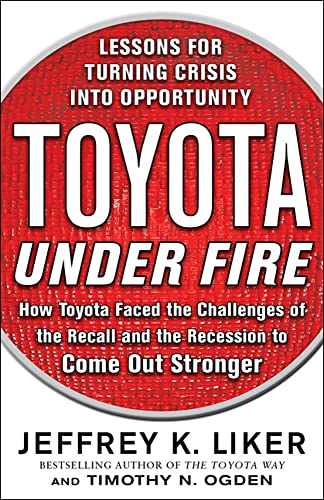
The definitive inside account of Toyota's greatest crisis—and lessons you can apply to your own company
"Those who write off Toyota in the current climate of second guessing and speculation are making a profound mistake and need to read this book to get the facts. Toyota is a company that will channel the current challenges to push themselves to even more relentless continuous improvement."
—Charles Baker, former Chief Engineer and Vice President for R&D, Honda of America
"Toyota Under Fire is a superb book and should prove very helpful to American industry's understanding of the problems faced and how any company can prevent similar occurrences in the future."
—Norman Bodek, author, founder of Productivity Press, and inductee in 2010 Industry Week Manufacturing Hall of Fame
"As a former automotive supplier executive and student of Toyota, I was concerned to see the many negative reports and investigations into the quality and safety of its vehicles. Toyota Under Fire tells the story of how this great company is growing wiser and stronger by living its culture and values."
—Michael Fisher, CEO, Cincinnati Children's Hospital Medical Center
"Just as Toyota has put itself through excruciating soul-searching in order to understand what went wrong, so should we all take advantage of the opportunity for learning presented to us by Toyota's misfortune. In these pages, you will find that the actual circumstances were far more complex, nuanced, and uncertain than you saw reported in the news."
—John Y. Shook, Chairman and CEO, Lean Enterprise Institute
"The most comprehensive and detailed review to date of the circumstances that led to the crisis, and the events and contexts that caused it to escalate.”
—Strategy & Business
About the Book
For decades, Toyota has been setting standards that are the envy—and goal—of organizations worldwide. Its legendary management principles and business philosophy, first documented by Jeffrey K. Liker in his influential book The Toyota Way, changed the business world's approach to operational excellence.
Granted unprecedented access to Toyota's facilities worldwide, Liker, along with Timothy N. Ogden, investigated the inside story of how Toyota faced the challenges of the recession and the recall crisis of 2009–2010. In both cases, the company was caught off guard—and found that a root cause of the challenges it faced was its failure to live up to its own principles. But the fundamentals were still there, and the company has ultimately come out of the most challenging years of its postwar existence even stronger than before.
Toyota Under Fire chronicles all the events of the recession and the recall crisis in detail, providing valuable lessons any business leader can use to survive and thrive in a crisis, no matter how large:
- Crisis response must start by building a strong culture long before the crisis hits.
- Culture matters far more than decisions made by top executives.
- Investing in people, even in the depths of a recession, is the surest path to long-term profitability.
Because it had founded its culture on such principles, Toyota didn’t need to amass an army of public relations, marketing, and legal experts to "put out the fire"; instead, it redoubled efforts to live up to its founding tenet, going "back to basics." Toyota began solving this crisis more than 70 years ago, when its organizational culture was first established.
Apply the lessons of Toyota Under Fire to your company, and you'll meet any future management challenge calmly, responsibly, and effectively—the Toyota Way.
Le informazioni nella sezione "Riassunto" possono far riferimento a edizioni diverse di questo titolo.
Informazioni sull?autore
Jeffrey K. Liker, Ph.D., author of the bestselling The Toyota Way, is Professor of Industrial and Operations Engineering at the University of Michigan and coowner of lean consulting firm Optiprise, Inc. His Shingo-Prize winning work has appeared in The Harvard Business Review, Sloan Management Review, and other leading publications.
Estratto. © Ristampato con autorizzazione. Tutti i diritti riservati.
TOYOTA UNDER FIRE
LESSONS FOR TURNING CRISIS INTO OPPORTUNITY
By JEFFREY K. LIKER, TIMOTHY N. OGDENThe McGraw-Hill Companies, Inc.
Copyright © 2011 Jeffrey K. Liker and Timothy N. Ogden
All rights reserved.
ISBN: 978-0-07-176299-1All rights reserved.
Contents
| Foreword Ángel Cabrera, President, Thunderbird School of Global Management | |
| Preface | |
| Acknowledgments | |
| ONE The Most Admired Company in the World | |
| TWO The Oil Crisis and the Great Recession | |
| THREE The Recall Crisis | |
| FOUR Response and the Road to Recovery | |
| FIVE Lessons | |
| Index |
Excerpt
CHAPTER 1
The Most Admired Company in the World
It is essential that our global leadership team embrace the concepts of theToyota Way as we achieve our business goals in host countries which have a widevariety of customs, traditions, and business practices.
—Then President Fujio Cho in the Preamble to The Toyota Way 2001
As 2007 ended, it would be no exaggeration to say that Toyota was on top of theworld. While you could argue whether it was the largest car company in theworld, depending on what measurements you used, there was no question that itwas the dominant car company globally. Toyota was the firm that all othersbenchmarked themselves against. It was far more profitable than its majorAmerican competitors. In fact, it had been continuously profitable for almost 50years, a record that rivaled that of any global 1000 firm and was unheard of inmanufacturing industries.
Its growth and profitability were driven by its extraordinary record of qualityand customer satisfaction. It dominated annual quality awards and value-for-moneyrankings. Toyota's vehicles held their value much better than itscompetitors' products. Customer loyalty was tops in the industry. The companywas profitable in every vehicle segment, from small cars to massive SUVs. It hadeven made the Prius—the world's first mass-productionhybrid—profitable, a feat that, when the vehicle was launched, industryobservers had claimed could never happen.
But Toyota's position was more dominant than even these impressive figures mightsuggest. Toyota had literally revolutionized manufacturing, process engineering,and quality, setting new standards for operational excellence that had becomegoals for companies in many industries. Toyota changed the way a large portionof the world thinks about quality and how to continuously improve any process.Today, almost every large organization, regardless of its sector or country, atleast speaks the jargon of built-in quality, lean, and just-in-time operation,although only a select few have carried the concepts to anything approaching thelevel that Toyota has.
At the end of 2007, it seemed that everyone loved Toyota, even such diverseconstituencies as Wall Street investors and hard-core environmentalists.Millions of books explaining Toyota's approach were sold, not least TheToyota Way, and companies were spending billions of dollars trying tounderstand, learn from, and replicate the Toyota model.
It's Toyota's overwhelming success that makes it hard to believe today thatthere was a time when "Made in Japan" was a synonym for junk rather than highquality, or when American car companies had a stranglehold on the global carbusiness. Or that Toyota Motor Corporation began with a single self-taughtinventor tinkering with looms in an obscure rural village outside Nagoya, Japan,in the late 1800s.
So how did Toyota rise from the rural rice fields of a backward,unindustrialized country to the top of the world, the vantage point that madeits fall from grace so shocking? That history is not just a curiosity. Indeed,understanding the underpinnings of Toyota's success is critical to understandingwhat happened at Toyota from 2008 to 2010 and how it acted and reacted underfire.
From Humble Beginnings
Toyota was born out of the tinkering of Sakichi Toyoda, who grew up the son of apoor carpenter in a region of rice farmers. In the late 1800s, as Japan wastrying to catch up to the industrialized nations after over 200 years of beingclosed to the outside world, the Japanese government encouraged the growth ofsmall-scale manufacturing across the country. This included village and evenhome-based mills. The women of Toyoda's family were involved withweaving—at the time a difficult, labor-intensive process undertaken withmanual looms, using technology that had not changed much in a century.
Just like the inventor-heroes of Western lore, such as Alexander Graham Bell,Charles Babbage, James Watt, Guglielmo Marconi, Louis Pasteur, and ThomasEdison, Sakichi Toyoda tinkered in his workshop for decades, refining his loomdesigns by trial and error, hoping to ease the manual labor of his femalerelatives. His first manual wooden loom in 1891 immediately reduced that burdenby using gravity and a foot pedal to move the loom's shuttle back and forth,doubling productivity. Over the next few years, he made a number of otherimprovements to his looms, and by 1896 he had produced a steam-driven power loomthat quadrupled productivity. Toyoda's tinkering not only led him to automaticloom design, but necessarily also took him into engine design—after all,the automatic looms needed a power source. But his best-known innovation, aninnovation that set the pattern for all of Toyota's future history, was a way ofeliminating common mistakes in the weaving process.
Using a manual loom, it was easy to spot mistakes and quality problems—theprocess was quite slow, allowing the weaver to closely inspect the clothcontinuously. But the faster rate of automatic looms meant that defects orproblems were harder to spot. And when an error occurred—the most commonproblem was a thread breaking—the loom could keep running long after theproduct was ruined. For a cottage weaving shop, this was potentially disastrous.Such a shop couldn't afford to waste materials, so people were stationed at the"automatic" looms to shut them down in case there were problems.
Of course, that defeated a lot of the benefit of automation. In response,Sakichi Toyoda invented a mechanism that would stop the loom automatically assoon as a thread broke. As he put it, he "freed the person from the machine" sothat people could spend their time doing value-added work instead of simplymonitoring the machine. This and other innovations were so groundbreaking thatPlatt Brothers of England, the world's dominant loom maker, eventually boughtthe rights to one of Toyoda's most popular looms. The proceeds from the salefunded the start-up of Toyota Motor Corporation. Now referred to in Japan as the"king of inventors," Sakichi Toyoda also is credited as being a leader infueling Japan's industrial revolution.
The Toyota Production System and Toyota Business Practices
Those with at least a passing knowledge of Toyota's approach to manufacturingwill recognize the origin of the now famous andon cord in SakichiToyoda's "mistake-proof" loom. The andon cord is pulled by a worker in aproduction plant to stop the assembly line as soon as an error is detected (allof Toyota's automated equipment also has built-in error detection that will shutdown the machine automatically). The basic philosophy of immediately identifyingand eliminating mistakes and waste has been a core pillar of the company fromthe very beginning.
The shift from looms to motor vehicles was driven by Sakichi Toyoda's sonKiichiro, on the advice of his father. Sakichi believed that the firm needed toexpand into other areas of manufacturing. In 1929, Kiichiro began traveling tothe United States and Britain regularly, ostensibly to negotiate licensing termsfor the company's loom technology. In reality, he was also learning all he couldabout automobile and machine tool factories to help guide him in setting up theautomobile division at Toyoda Loom Works, which he did in 1933. By 1937, ToyotaMotor Company (today known as Toyota Motor Corporation or TMC), was the centerof the business.
It was Kiichiro Toyoda who, in a key document in the late 1930s laying outToyota's operating philosophy, first penned the words "just-in-time," describinga continuous flow of materials from raw materials to the customer. The theorywas put into practice under the leadership of another iconic figure in Toyota'shistory, Taiichi Ohno, who tried his first "pull system," building in responseto customer pull, in 1948 and who first put into a plant, by 1953, what some nowcall a "supermarket."
Ohno's supermarket idea was inspired by a conversation with a friend who hadrecently visited the United States and described the American self-servicesupermarket. Before the widespread availability of refrigeration, inventorycontrol in the grocery business was critical. Food spoiled quickly, and sogrocers needed to keep a close eye on their inventory, keeping only enough onhand to meet a few days' demand. In modern terminology, supermarkets neededjust-in-time inventory management, and that's exactly what they had.
The nascent Toyota Motor Company had a problem similar to that of supermarkets.While there was no danger of Toyota's inventory spoiling, the company simplydidn't have the funds to keep inventory on hand. As a small outfit, it needed toconserve its very limited working capital as much as possible. Like Americansupermarkets, where goods like milk are put up on the shelf only in the quantityneeded to replace what the customers take away, Toyota factories wouldeventually have internal "supermarkets" that replenished parts on the assemblyline as they were needed.
The combination of Sakichi Toyoda's emphasis on eliminating mistakes andKiichiro Toyoda's emphasis on and Taiichi Ohno's innovations in just-in-timeinventory formed the basis of what has become known as the Toyota ProductionSystem (TPS). TPS, as it evolved and was refined over the course of the next 80years, is the blueprint that guides Toyota's operations from suppliers tomanufacturing to delivery of automobiles and service parts to dealerships. Aboveall, it focuses on the relentless pursuit of quality and the elimination ofwaste through continuous improvement by all workers and managers. That soundslike common sense today, but it was and is revolutionary. The dominant model ofmanufacturing systems before Toyota's rise as a global leader was the pursuit ofeconomies of scale. This approach focused on driving down the cost of productionby increasing the amount that was produced at every step of the process.Inevitably this caused a buildup of inventory, but that was perceived as a goodthing. Quality problems could be tolerated because there were always more partsto pull from inventory. The belief was that reducing defects was far moreexpensive than maximizing efficiency and throwing away the flawed parts.
Toyota proved that the opposite was true. If you eliminated waste and qualityproblems, you could operate far more cheaply—and keep customers muchhappier. The process for eliminating waste and errors that Toyota has developedis founded on the insights of Taiichi Ohno. Ohno saw that if the company was tomaintain Sakichi's commitment to catching and fixing problems and Kiichiro'scommitment to just-in-time operation, it had to have a systematic way of solvingproblems throughout the company. His focus was on drilling down to the rootcause of the problem by asking why five times.
The problem-solving process that Ohno started was later enhanced by ideas froman American who was dispatched to Japan by the U.S. government to assist in therebuilding of Japan after World War II, Dr. W. Edwards Deming. Deming's ideasare the foundation of the modern quality movement. He taught Japanese managersabout the importance of quality and a way of thinking about how to achieve it.Central to Deming's approach was a radical expansion of the definition of theword customer. Historically, customers were considered to be the endusers of a product. Deming taught that "the customer" is also the next stage ofa process. Thus, serving the customer in a manufacturing environment meantproviding the next step in the assembly line with exactly what it needed, interms of both quality and volume, at the exact time it was needed. When problemswith serving customers were encountered, Deming advocated a highly systematicapproach to solving them, known as the Plan-Do-Check-Act (PDCA) cycle.
The PDCA cycle is fairly intuitive. Before you attempt to fix a problem, youneed to make sure that you have a plan that is likely to succeed basedon thorough study of the root cause of the problem, not just its symptoms. Onceyou have a plan for fixing the root cause, you do the solution in a testenvironment, check that the solution works, then act based on what youlearn from the test environment, either improving the plan or moving on toanother area that is in need of improvement. Thus, the PDCA cycle neverends—the final step always points to opportunities for furtherimprovement.
The Toyota problem-solving process, known first as "practical problem solving,"has evolved to today's version, called Toyota Business Practices (TBP). It isToyota's approach to solving problems, from eliminating errors in individualjobs to setting the global strategy of the company
In summary, the TBP process begins with a statement of the problem, includingthe gap between the actual and the ideal conditions. This gap is then brokendown into the most important problems that can be acted upon. These specificsubproblems are then analyzed by asking "why?" until the root cause, not asurface cause, is found. Within Toyota, this is known as the Five Whys—the belief that to find the root cause of a problem, you have to ask "why" atleast five times. Countermeasures are then identified, tried, and monitored,with further adjustments being made until the gap is eliminated and the nextchallenge identified.
The eight steps of TBP are
Plan
1. Define the problem relative to the ideal.
2. Break down the problem into manageable pieces.
3. Identify the root cause.
4. Develop alternative solutions.
5. Evaluate and select the best solution based on what is known.
Do
6. Implement the solution (on a trial basis if possible).
Check
7. Check the impact of the solution.
Act
8. Adjust, standardize, and spread based on what has been learned.
While TPS is mostly a system for manufacturing and repetitive processes, TBPtakes the philosophy of TPS and applies it broadly to the entire enterprise,from manufacturing to engineering to sales, and even to strategic decisionmaking. Toyota believes that this problem-solving process is essential toleadership—every leader, no matter what his role or department, isexpected to be a master of TBP. Mastering this process allows even a leader witha background in finance or human resources, for instance, to contributemeaningfully on the shop floor, and also to view his own department's work as aset of processes that can be improved.
Another major contribution from Ohno was the development of standardized work.This is the concept that every job on the production line needs to be tightlydefined and performed in the exact same way by every worker who is doing thatjob. Solving problems on the production line and continually improvingperformance simply couldn't be done without standardized work—it would bevirtually impossible to isolate and correct any factors that were contributingto a defect or underperformance with the added variation of the same job beingdone in different ways. Many Westerners initially find the concept ofstandardized work distasteful, imagining a system that treats people like cogsor robots. On the contrary, standardized work allows line workers to think aboutwhat they are doing, why they are doing it, and how to improve it. Think of itthis way: no one thinks of great actors like Sean Penn or Meryl Streep as dronesor cogs. But they can't bring their creativity and insight to a role untilthey've memorized the script. Standardized work is like an actor's script. It'sthe basis on which a production worker can apply her skills to continuouslyimprove a process. Without standardized work, TPS and TBP would be impossible.
Building on a Firm Cultural Foundation
The Toyota Production System is the foundation that is often credited withallowing Toyota to emerge from the small, devastated market of Japan in the1950s and become the world's largest carmaker. Along the way, Toyotadramatically changed perspectives of what was possible in terms of the qualityand productivity of design and manufacturing operations. But as any student ofindustrial organization or psychology, or even anyone familiar with the historyof any large company, will tell you, processes and procedures are never enoughto ensure excellence.
As management thinkers like Peter Drucker, Tom Peters, Jim Collins, and PeterSenge have demonstrated in their research and writing over the years, achievingconsistent excellence is extraordinarily difficult and rare. Excellence, whereit does occur, is a result of culture rather than just processes. Every companyand every process is subject to the laws of entropy—things simply degradeover time. That can happen because people grow complacent or becausecircumstances change and yesterday's solutions no longer apply in today'scontext. For many companies, performance declines as a company grows beyond itsfounders and their passion.
The only way to combat the pervasive disease of entropy isculture—building an organization that constantly renews its commitment toexcellence and to its core principles, an organization that can instill thoseprinciples and the founders' passion in each new generation of employees andleaders.
As demonstrated by its remarkably consistent growth and profitability, Toyotahas built a culture that does exactly that. For most of Toyota's history, thatculture was not formally codified or given an official name. It was simplyhanded down from employee to employee—a process that was possible becauseall of Toyota's leaders had spent their entire careers at the company. The modelfor training was the master-apprentice relationship. As Toyota grew globally,though, spreading the culture one-on-one with daily mentoring was not enough.There simply were not enough master trainers who had grown up in the cultureavailable for all the new hires. In 2001, then president Fujio Cho, a student ofOhno and the first president of Toyota's Georgetown, Kentucky, plant, introducedthe document formally defining the Toyota Way. This wasn't a new direction forToyota; it was a codification of the culture that had been created by Sakichiand Kiichiro Toyoda and extended by leaders like Taiichi Ohno.
The Toyota Way 2001, as it is still called, is defined as a house withtwo pillars—respect for people and continuous improvement. Respect forpeople extends from the team members on the shop floor to every one of Toyota'svast network of partners and out to its customers and to the communities inwhich Toyota does business. Continuous improvement literally means continuallyimproving products, processes, and even people at all levels of theorganization. Some versions of the model show respect for people as thefoundation of continuous improvement, since only highly developed people whocare passionately about their work and about the company will put in the effortneeded for continuous improvement. The twin pillars of respect for people andcontinuous improvement rest on a foundation of five core values that wesummarize here.
Spirit of Challenge
Toyota was founded on the willingness to tackle tough problems and work at themuntil they were solved. That was Sakichi Toyoda's approach to looms and KiichiroToyoda's approach to building a car company from scratch. Like the two foundingToyodas, every Toyota employee is expected not just to excel in his currentrole, but to take on the challenges of making needed improvements withenthusiasm. As The Toyota Way 2001 puts it, "We accept challenges with acreative spirit and the courage to realize our own dreams without losing driveor energy."
(Continues...)
(Continues...)
Excerpted from TOYOTA UNDER FIRE by JEFFREY K. LIKER. Copyright © 2011 by Jeffrey K. Liker and Timothy N. Ogden. Excerpted by permission of The McGraw-Hill Companies, Inc..
All rights reserved. No part of this excerpt may be reproduced or reprinted without permission in writing from the publisher.
Excerpts are provided by Dial-A-Book Inc. solely for the personal use of visitors to this web site.
Le informazioni nella sezione "Su questo libro" possono far riferimento a edizioni diverse di questo titolo.
Altre edizioni note dello stesso titolo

Risultati della ricerca per Toyota Under Fire: Lessons for Turning Crisis into...

Foto dell'editore
Toyota Under Fire: Lessons for Turning Crisis into Opportunity
Da: Housing Works Online Bookstore, New York, NY, U.S.A.
Valutazione del venditore 5 su 5 stelle

Condizione: Very Good. Minimal wear to cover. Pages clean and binding tight. shelf wear. bumped edges. Hardcover. Codice articolo FH2-01252
Compra usato
EUR 4,39
Spedizione EUR 3,40
Spedito in U.S.A.
Spedito in U.S.A.
Quantità: 1 disponibili
Foto dell'editore
Toyota Under Fire: Lessons for Turning Crisis into Opportunity
Da: Orion Tech, Kingwood, TX, U.S.A.
Valutazione del venditore 5 su 5 stelle
hardcover. Condizione: Good. Codice articolo 007176299X-3-30936301
Compra usato
EUR 7,84
Spedizione gratuita
Spedito in U.S.A.
Spedito in U.S.A.
Quantità: 1 disponibili
Foto dell'editore
Toyota Under Fire: Lessons for Turning Crisis Into Opportunity
Editore:
McGraw-Hill Companies, 2011
ISBN 10: 007176299X
ISBN 13: 9780071762991
Antico o usato
Rilegato
Da: ThriftBooks-Dallas, Dallas, TX, U.S.A.
Valutazione del venditore 5 su 5 stelle
Hardcover. Condizione: As New. No Jacket. Pages are clean and are not marred by notes or folds of any kind. ~ ThriftBooks: Read More, Spend Less. Codice articolo G007176299XI2N00
Compra usato
EUR 7,85
Spedizione gratuita
Spedito in U.S.A.
Spedito in U.S.A.
Quantità: 1 disponibili
Foto dell'editore
Toyota Under Fire: Lessons for Turning Crisis Into Opportunity
Editore:
McGraw-Hill Companies, 2011
ISBN 10: 007176299X
ISBN 13: 9780071762991
Antico o usato
Rilegato
Da: ThriftBooks-Atlanta, AUSTELL, GA, U.S.A.
Valutazione del venditore 5 su 5 stelle
Hardcover. Condizione: As New. No Jacket. Pages are clean and are not marred by notes or folds of any kind. ~ ThriftBooks: Read More, Spend Less. Codice articolo G007176299XI2N00
Compra usato
EUR 7,85
Spedizione gratuita
Spedito in U.S.A.
Spedito in U.S.A.
Quantità: 1 disponibili
Foto dell'editore
Toyota under Fire: Lessons for Turning Crisis into Opportunity
Editore:
McGraw-Hill Education, 2011
ISBN 10: 007176299X
ISBN 13: 9780071762991
Antico o usato
Rilegato
Prima edizione
Da: Better World Books, Mishawaka, IN, U.S.A.
Valutazione del venditore 5 su 5 stelle
Condizione: Very Good. 1st Edition. Former library copy. Pages intact with possible writing/highlighting. Binding strong with minor wear. Dust jackets/supplements may not be included. Includes library markings. Stock photo provided. Product includes identifying sticker. Better World Books: Buy Books. Do Good. Codice articolo 4414282-6
Compra usato
EUR 9,01
Spedizione gratuita
Spedito in U.S.A.
Spedito in U.S.A.
Quantità: 1 disponibili
Foto dell'editore
Toyota Under Fire: Lessons for Turning Crisis into Opportunity (MGMT & LEADERSHIP)
Da: WorldofBooks, Goring-By-Sea, WS, Regno Unito
Valutazione del venditore 5 su 5 stelle
Hardback. Condizione: Very Good. The book has been read, but is in excellent condition. Pages are intact and not marred by notes or highlighting. The spine remains undamaged. Codice articolo GOR004482159
Compra usato
EUR 3,32
Spedizione EUR 6,69
Spedito da Regno Unito a U.S.A.
Spedito da Regno Unito a U.S.A.
Quantità: 1 disponibili
Foto dell'editore
Toyota under Fire: Lessons for Turning Crisis into Opportunity
Editore:
McGraw-Hill Education, 2011
ISBN 10: 007176299X
ISBN 13: 9780071762991
Antico o usato
Rilegato
Prima edizione
Da: Better World Books Ltd, Dunfermline, Regno Unito
Valutazione del venditore 5 su 5 stelle
Condizione: Good. 1st Edition. Former library copy. Pages intact with minimal writing/highlighting. The binding may be loose and creased. Dust jackets/supplements are not included. Includes library markings. Stock photo provided. Product includes identifying sticker. Better World Books: Buy Books. Do Good. Codice articolo 3096836-6
Compra usato
EUR 5,99
Spedizione EUR 5,77
Spedito da Regno Unito a U.S.A.
Spedito da Regno Unito a U.S.A.
Quantità: 1 disponibili
Immagini fornite dal venditore
Toyota Under Fire: Lessons for Turning Crisis into Opportunity (MGMT and LEADERSHIP)
Da: BoundlessBookstore, Wallingford, Regno Unito
Valutazione del venditore 5 su 5 stelle
Hardcover. Condizione: Good. VG condition book with dust jacket. DJ is clean, has fresh colours and has little wear to edges. Book has clean and bright contents. Codice articolo 9999-999100679422
Compra usato
EUR 5,94
Spedizione EUR 8,06
Spedito da Regno Unito a U.S.A.
Spedito da Regno Unito a U.S.A.
Quantità: 1 disponibili
Foto dell'editore
Toyota Under Fire: Lessons for Turning Crisis Into Opportunity
Da: Anybook.com, Lincoln, Regno Unito
Valutazione del venditore 5 su 5 stelle
Condizione: Good. This is an ex-library book and may have the usual library/used-book markings inside.This book has hardback covers. Clean from markings In good all round condition. Dust jacket in good condition. Please note the Image in this listing is a stock photo and may not match the covers of the actual item,550grams, ISBN:9780071762991. Codice articolo 9516712
Compra usato
EUR 2,98
Spedizione EUR 15,70
Spedito da Regno Unito a U.S.A.
Spedito da Regno Unito a U.S.A.
Quantità: 1 disponibili
Foto dell'editore
Toyota Under Fire: Lessons for Turning Crisis Into Opportunity
Da: Anybook.com, Lincoln, Regno Unito
Valutazione del venditore 5 su 5 stelle
Condizione: Fair. This is an ex-library book and may have the usual library/used-book markings inside.This book has hardback covers. Book contains pencil markings. In fair condition, suitable as a study copy. Dust jacket in good condition. Library sticker on front cover. Please note the Image in this listing is a stock photo and may not match the covers of the actual item,550grams, ISBN:9780071762991. Codice articolo 9997103
Compra usato
EUR 3,31
Spedizione EUR 15,70
Spedito da Regno Unito a U.S.A.
Spedito da Regno Unito a U.S.A.
Quantità: 1 disponibili