
Articoli correlati a Some Lie and Some Die
Sinossi
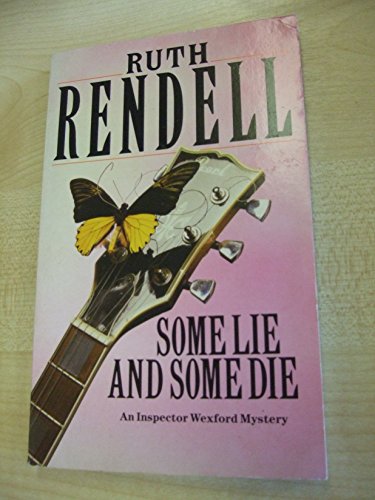
An Inspector Wexford mystery. Kingsmarkham doesn't have too many complaints about its first annual rock festival, but then in a nearby quarry two lovers find a body that makes even Reg Wexford's stomach lurch. All he can discover is that there is a strange connection with the star of the festival.
Le informazioni nella sezione "Riassunto" possono far riferimento a edizioni diverse di questo titolo.
Informazioni sull'autore
RUTH RENDELL has won many awards for her writing, including the Crime Writers' Association Gold Dagger, the Sunday Times Literary Award, and the Crime Writers' Association Cartier Diamond Dagger.
From the Trade Paperback edition.
Estratto. © Ristampato con autorizzazione. Tutti i diritti riservati.
1
'But why here? Why do they have to come here? There must be thousands of places all over this country where they could go without doing anyone any harm. The Highlands for instance. Dartmoor. I don't see why they have to come here.'
Detective Inspector Michael Burden had made these remarks, or remarks very much like them, every day for the past month. But this time his voice held a note which had not been there before, a note of bitter bewilderment. The prospect had been bad enough. The reality was now unreeling itself some thirty feet below him in Kingsmarkham High Street and he opened the window to get a better—or a more devastating—look.
'There must be thousands of them, all coming up from Station Road. And this is only a small percentage when you consider how many more will be using other means of transport. It's an invasion. God, there's a dirty-looking great big one coming now. You know what it reminds me of? That poem my Pat was doing at school. Something about a pied piper. If "pied" means what I think it does, that customer's pied all right. You should see his coat.'
The only other occupant of the room had so far made no reply to this tirade. He was a big, heavy man, the inspector's senior by two decades, being at that time of life when people hesitated to describe him as middle-aged and considered 'elderly' as the more apt epithet. His face had never been handsome. Age and a very nearly total loss of hair had not improved its pouchy outlines, but an expression that was not so much easy-going as tolerant of everything but intolerance, redeemed it and made it almost attractive. He was sitting at his rosewood desk, trying to compose a directive on crime prevention, and now, giving an impatient shake of his head, he threw down his pen.
'Anyone not in the know,' said Chief Inspector Wexford, 'would think you were talking about rats.' He pushed back his chair and got up. 'A plague of rats,' he said. 'Why can't you expand your mind a bit? They're only a bunch of kids come to enjoy themselves.'
'You'll tell a different tale when we get car-burning and shop-lifting and decent, citizens beaten up and—and Hell's Angels!
'Maybe. Wait till the time comes. Here, let me have a look.'
Burden shifted grudgingly from his point of vantage and allowed Wexford a few inches of window. It was early afternoon of a perfect summer's day, June the tenth. The High Street was busy as it always was on a Friday, cars pulling into and out of parking places, women pushing prams. Striped shop awnings were down to protect shoppers from an almost Mediterranean sun, and outside the Dragon workmen sat on benches drinking beer. But it was not these people who had attracted Burden's attention. They watched the influx as avidly as he and in some cases with as much hostility.
They were pouring across the road towards the bus stop by the Baptist church, a stream of boys and girls with packs on their backs and transistors swinging from their hands. Cars, which had pulled up at the zebra crossing to let them pass, hooted in protest, but they were as ineffectual as the waves of the Red Sea against the Children of Israel. On they came, not thousands perhaps, but a couple of hundred, laughing and jostling each other, singing. One of them, a boy in a tee-shirt printed with the face of Che Guevara, poked out his tongue at an angry motorist and raised two fingers.
Mostly they wore jeans. Not long since they had been at school—some still were—and they had protested hotly at the enforced wearing of uniforms. And yet now they had their own, voluntarily assumed, the uniform of denims and shirts, long hair and, in some cases, bare feet. But there were those among them making a total bid for freedom from conventional clothes, the girl in red bikini top and dirty ankle-length satin skirt, her companion sweating but happy in black leather. Towering above the rest walked the boy Burden had particularly singled out. He was a magnificent tall Negro whose hair was a burnished black bush and who had covered his bronze body from neck to ankles in a black and white pony-skin coat.
'And that's only the beginning, sir,' said Burden when he thought Wexford had had time enough to take it all in. 'They'll be coming all night and all tomorrow. Why are you looking like that? As if you'd—well, lost something?'
'I have. My youth. I'd like to be one of them. I'd like to be swinging along out there, off to the pop festival. Wouldn't you?'
'No, frankly, I wouldn't. I'm sure I never would have. Those young people are going to cause a lot of trouble, make a hell of a noise and ruin the weekend for a those unfortunate citizens who live on the Sundays estate. Heaven help them, that's all I can say.' Like most people who make that remark, Burden had a lot more to say and said it. 'My parents brought me up to be considerate of the feelings of others and I'm very glad they did. A trip to the local hop on a Saturday night, maybe, and a few drinks, but to take over God knows how many acres of parkland just to indulge my tastes at the expense of others! I wouldn't have wanted it. I'd have thought I hadn't achieved enough to deserve it.'
Wexford made the noise the Victorians wrote as 'Pshaw!' 'Just because you're so bloody virtuous it doesn't mean there aren't going to be any more cakes and ale. I suppose you'll stop that boy of yours going up there?'
'I've told him he can go to Sundays tomorrow evening for two hours just to hear this Zeno Vedast, but he's got to be in by eleven. I'm not having him camp there. He's only just fifteen. Zeno Vedast! That's not the name his godfathers and godmothers gave him at his baptism, you can bet your life. Jim Bloggs, more like. He comes from round here, they say. Thank God he didn't stay. I don't understand this craze for pop music. Why can't John play classical records?'
'Like his dad, eh? Sit at home getting a kick out of Mahler? Oh, come off it, Mike.'
Burden said sulkily, 'Well, I admit music's not my style. None of this is.'
'Your scene, Mike, your scene. Let's get the jargon right. We're pigs and fuzz as it is. We don't have to be square as well. Anyway, I'm sick of being an onlooker. Shall we get up there?'
'What, now? We'll have to be there tomorrow when the fighting and the burning starts.'
'I'm going now. You do as you like. Just one thing, Mike. Remember the words of another Puritan—"Bethink ye, bethink ye, in the bowels of Christ, that ye may be mistaken.'"
Where the Regency mansion now stands a house called Sundays has stood since the Norman Conquest. Why Sundays? No one knows. Probably the name has nothing to do with the Sabbath Day; probably—and this is the general belief—it derives from the name of the man who built the first house, Sir Geffroy Beauvoir de Saint Dieu.
Once the Sundays lands extended from Kingsmarkham to Forby and beyond, but gradually fields and woodlands were sold off, and now the house has only a small garden and a park of a few acres. In the eyes of the preservationists Sundays is irretrievably spoilt. Its tall cedars remain and its avenue of hornbeams, the overgrown quarry is still untouched, but the Italian garden is gone, Martin Silk, the present owner, grows mushrooms in the orangery, and the view is ruined by the newly built Sundays estate.
The Forby road skirts the park and bisects the estate. It is along here that the Forby bus runs four times a day, halting at the Sundays request stop which is outside the park gates. Wexford and Burden pulled in to a lay-by and watched the first of the young pilgrims tumble out of the two-thirty bus and hump their baggage over to the gates. These were open and on the lodge steps stood Martin Silk with half a dozen helpers ready to examine tickets. Wexford got out of...
Le informazioni nella sezione "Su questo libro" possono far riferimento a edizioni diverse di questo titolo.
Risultati della ricerca per Some Lie and Some Die

Foto dell'editore
Some Lie and Some Die
Da: Half Price Books Inc., Dallas, TX, U.S.A.
Valutazione del venditore 5 su 5 stelle

paperback. Condizione: Very Good. Connecting readers with great books since 1972! Used books may not include companion materials, and may have some shelf wear or limited writing. We ship orders daily and Customer Service is our top priority! Codice articolo S_472829571
Compra usato
EUR 2,56
Spedizione EUR 3,35
Spedito in U.S.A.
Spedito in U.S.A.
Quantità: 1 disponibili
Foto dell'editore
Some Lie and Some Die
Da: World of Books (was SecondSale), Montgomery, IL, U.S.A.
Valutazione del venditore 5 su 5 stelle
Condizione: Very Good. Item in very good condition! Textbooks may not include supplemental items i.e. CDs, access codes etc. Codice articolo 00104525936
Compra usato
EUR 6,01
Spedizione gratuita
Spedito in U.S.A.
Spedito in U.S.A.
Quantità: 1 disponibili
Foto dell'editore
Some Lie and Some Die
Da: World of Books (was SecondSale), Montgomery, IL, U.S.A.
Valutazione del venditore 5 su 5 stelle
Condizione: Acceptable. Item in acceptable condition! Textbooks may not include supplemental items i.e. CDs, access codes etc. Codice articolo 00104558468
Compra usato
EUR 6,01
Spedizione gratuita
Spedito in U.S.A.
Spedito in U.S.A.
Quantità: 1 disponibili
Foto dell'editore
Some Lie and Some Die
Editore:
Penguin Random House, 1995
ISBN 10: 0099092808
ISBN 13: 9780099092803
Antico o usato
Brossura
Da: Better World Books, Mishawaka, IN, U.S.A.
Valutazione del venditore 5 su 5 stelle
Condizione: Good. Pages intact with minimal writing/highlighting. The binding may be loose and creased. Dust jackets/supplements are not included. Stock photo provided. Product includes identifying sticker. Better World Books: Buy Books. Do Good. Codice articolo GRP8113198
Compra usato
EUR 6,57
Spedizione gratuita
Spedito in U.S.A.
Spedito in U.S.A.
Quantità: 1 disponibili
Foto dell'editore
Some Lie and Some Die
Editore:
Penguin Random House, 1995
ISBN 10: 0099092808
ISBN 13: 9780099092803
Antico o usato
Brossura
Da: Better World Books, Mishawaka, IN, U.S.A.
Valutazione del venditore 5 su 5 stelle
Condizione: Very Good. Pages intact with possible writing/highlighting. Binding strong with minor wear. Dust jackets/supplements may not be included. Stock photo provided. Product includes identifying sticker. Better World Books: Buy Books. Do Good. Codice articolo 13010162-6
Compra usato
EUR 6,57
Spedizione gratuita
Spedito in U.S.A.
Spedito in U.S.A.
Quantità: 1 disponibili
Foto dell'editore
Some Lie And Some Die: (A Wexford Case)
Da: AwesomeBooks, Wallingford, Regno Unito
Valutazione del venditore 5 su 5 stelle
Paperback. Condizione: Very Good. Some Lie And Some Die: (A Wexford Case) This book is in very good condition and will be shipped within 24 hours of ordering. The cover may have some limited signs of wear but the pages are clean, intact and the spine remains undamaged. This book has clearly been well maintained and looked after thus far. Money back guarantee if you are not satisfied. See all our books here, order more than 1 book and get discounted shipping. Codice articolo 7719-9780099092803
Compra usato
EUR 2,89
Spedizione EUR 4,92
Spedito da Regno Unito a U.S.A.
Spedito da Regno Unito a U.S.A.
Quantità: 2 disponibili
Foto dell'editore
Some Lie and Some Die
Da: World of Books Inc, Montgomery, IL, U.S.A.
Valutazione del venditore 4 su 5 stelle

Paperback. Condizione: Fair. An Inspector Wexford mystery. Kingsmarkham doesn't have too many complaints about its first annual rock festival, but then in a nearby quarry two lovers find a body that makes even Reg Wexford's stomach lurch. All he can discover is that there is a strange connection with the star of the festival. Codice articolo CIN0099092808A
Compra usato
EUR 7,85
Spedizione gratuita
Spedito in U.S.A.
Spedito in U.S.A.
Quantità: 1 disponibili
Foto dell'editore
Some Lie and Some Die
Da: World of Books Inc, Montgomery, IL, U.S.A.
Valutazione del venditore 4 su 5 stelle
Paperback. Condizione: Very Good. An Inspector Wexford mystery. Kingsmarkham doesn't have too many complaints about its first annual rock festival, but then in a nearby quarry two lovers find a body that makes even Reg Wexford's stomach lurch. All he can discover is that there is a strange connection with the star of the festival. Codice articolo CIN0099092808VG
Compra usato
EUR 7,85
Spedizione gratuita
Spedito in U.S.A.
Spedito in U.S.A.
Quantità: 1 disponibili
Foto dell'editore
Some Lie And Some Die: (A Wexford Case)
Da: Bahamut Media, Reading, Regno Unito
Valutazione del venditore 4 su 5 stelle
Paperback. Condizione: Very Good. This book is in very good condition and will be shipped within 24 hours of ordering. The cover may have some limited signs of wear but the pages are clean, intact and the spine remains undamaged. This book has clearly been well maintained and looked after thus far. Money back guarantee if you are not satisfied. See all our books here, order more than 1 book and get discounted shipping. Codice articolo 6545-9780099092803
Compra usato
EUR 3,15
Spedizione EUR 8,33
Spedito da Regno Unito a U.S.A.
Spedito da Regno Unito a U.S.A.
Quantità: 2 disponibili
Foto dell'editore
Some Lie and Some Die
Editore:
Penguin Random House, 1995
ISBN 10: 0099092808
ISBN 13: 9780099092803
Antico o usato
Brossura
Da: Better World Books Ltd, Dunfermline, Regno Unito
Valutazione del venditore 5 su 5 stelle
Condizione: Good. Pages intact with minimal writing/highlighting. The binding may be loose and creased. Dust jackets/supplements are not included. Stock photo provided. Product includes identifying sticker. Better World Books: Buy Books. Do Good. Codice articolo GRP8113198
Compra usato
EUR 5,77
Spedizione EUR 5,97
Spedito da Regno Unito a U.S.A.
Spedito da Regno Unito a U.S.A.
Quantità: 1 disponibili