
Articoli correlati a The Vanquished: Why the First World War Failed to End,...
Sinossi
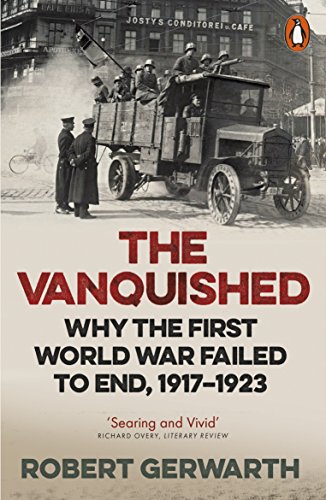
Un panorama mozzafiato e magistrale, che racconta la storia epica dell'anarchia del dopoguerra, degli imperi morenti e degli stati nazionali in ascesa. Ci fa riconsiderare la nostra comprensione del ventesimo secolo europeo. David motadel, the times literary supplement per gli alleati occidentali, l'11 novembre 1918 è sempre stata una data solenne: la fine dei combattimenti che avevano distrutto una generazione, e anche la rivendicazione di un sacrificio terribile con il crollo totale dei loro principali nemici: l'impero tedesco, l'austria-ungheria e l'impero ottomano. Ma per gran parte del resto d'europa questo fu un giorno senza significato, poiché una serie continua e da incubo di conflitti travolse un paese dopo l'altro. In questo libro altamente originale e avvincente, robert gerwarth ci chiede di ripensare alla vera eredità della prima guerra mondiale. "lucido, incisivo e ricco di dettagli affascinanti" financial times, libri dell'anno "importante e tempestivo.. Ci obbliga a riconsiderare un periodo e un fronte di battaglia che sono stati troppo spesso trascurati" margaret macmillan, the new york times review of books "questa narrazione del caos continentale svolge un prezioso servizio raccontando i tumulti del dopoguerra in europa.. Ci aiuta a capire perché poche guerre giungono a conclusioni ordinate" max hastings, sunday times "ci ricorda, con dettagli vividi e spesso scioccanti, che solo in alcuni paesi le uccisioni hanno avuto fine l'undicesimo giorno dell'undicesimo mese.. Lascia un senso di presentimento per i nostri tempi" robert tombs, the times
Le informazioni nella sezione "Riassunto" possono far riferimento a edizioni diverse di questo titolo.
Recensione
This narrative of continent-wide chaos makes it easier to understand why order came to seem a supremely desirable objective in 1930s Europe, trumping freedom ... it helps us understand why few wars reach tidy conclusions: once a society has suspended its instinctive, social and legal prejudice against killing, it often proves hard to restore. (Max Hastings The Sunday Times)
Pulls together a complex narrative about the uneasy peace of the late Twenties and shine a piercing light into darkened corners of history ... an unnerving reminder of how stubbornly some geopolitical fault-lines endure (Sinclair McKay The Telegraph)
A mixture of fast-paced narrative and fluent analysis ... Gerwarth demonstrates with an impressive concentration of detail that in central, eastern and south-eastern Europe the carnage of the first world war by no means came to an end, as it did for the British and French, in late 1918. (Tony Barber Financial Times)
Combining a big-picture overview with close-up detail - we hear the voices of soldiers, politicians, civilians - Gerwarth has written a vivid if disturbing account (Matthew Price National)
Searing and vivid ... a timely reminder that the roots of century-long violence can be traced back to the cataclysmic end of the Great War (Richard Overy Literary Review)
A thorough explanation for the rise of the nationalist and fascist groups who set the stage for World War II. (Kirkus Reviews)
Gerwarth's fascinating and finely crafted book is a rich combination of military, political, cultural and social history. He makes good use of literary sources and witness testimony to bring the events he narrates to life ... an impressive work of highly accessible scholarship (Geoffrey Roberts Irish Times)
This is an important and compelling book with a fascinating and chilling narrative ... Gerwarth reveals how the forgotten postwar violence comprised a key step on Europe's descent into darkness. (Alexander Watson BBC History Magazine)
While Gerwarth's warfare theories are cogent and convincing, he never loses sight of the human dimension. He skillfully avoids the danger of getting bogged down in a mass of detail, livening up his narrative by using contemporary quotes from politicians, soldiers and writers. One mark of a good history book is that it allows the reader to see familiar events from a new perspective. In this respect, The Vanquished is an exceptional history book. (Andrew Lynch Sunday Post Business Magazine)
[Gerwarth] shines a light on what is, from a western European point of view, a somewhat obscure and relatively short period of time ... from the layman's vantage point, it is so well written that it reads like a novel. Tragically, for the people killed, wounded and forced to flee from their homes, it is not. This book is well worth the read. (Frank MacGabhann Irish Independent)
L'autore
Robert Gerwarth is Professor of Modern History at University College Dublin and Director of its Centre for War Studies. He is the author of The Bismarck Myth and a biography of Reinhard Heydrich. He has studied and taught in the United States, the United Kingdom, Germany and France.
Le informazioni nella sezione "Su questo libro" possono far riferimento a edizioni diverse di questo titolo.
Risultati della ricerca per The Vanquished: Why the First World War Failed to End,...

Foto dell'editore
The Vanquished: Why the First World War Failed to End, 1917-1923
Da: WorldofBooks, Goring-By-Sea, WS, Regno Unito
Valutazione del venditore 5 su 5 stelle

Paperback. Condizione: Very Good. The book has been read, but is in excellent condition. Pages are intact and not marred by notes or highlighting. The spine remains undamaged. Codice articolo GOR008842534
Compra usato
EUR 2,95
Spedizione EUR 6,52
Spedito da Regno Unito a U.S.A.
Spedito da Regno Unito a U.S.A.
Quantità: 2 disponibili
Foto dell'editore
The Vanquished: Why the First World War Failed to End, 1917-1923
Da: AwesomeBooks, Wallingford, Regno Unito
Valutazione del venditore 5 su 5 stelle
Paperback. Condizione: Very Good. The Vanquished: Why the First World War Failed to End, 1917-1923 This book is in very good condition and will be shipped within 24 hours of ordering. The cover may have some limited signs of wear but the pages are clean, intact and the spine remains undamaged. This book has clearly been well maintained and looked after thus far. Money back guarantee if you are not satisfied. See all our books here, order more than 1 book and get discounted shipping. . Codice articolo 7719-9780141976372
Compra usato
EUR 5,14
Spedizione EUR 4,80
Spedito da Regno Unito a U.S.A.
Spedito da Regno Unito a U.S.A.
Quantità: 1 disponibili
Immagini fornite dal venditore
The Vanquished
Da: Bay State Book Company, North Smithfield, RI, U.S.A.
Valutazione del venditore 5 su 5 stelle
Condizione: good. The book is in good condition with all pages and cover intact, including the dust jacket if originally issued. The spine may show light wear. Pages may contain some notes or highlighting, and there might be a "From the library of" label. Boxed set packaging, shrink wrap, or included media like CDs may be missing. Codice articolo BSM.198KZ
Compra usato
EUR 11,23
Spedizione gratuita
Spedito in U.S.A.
Spedito in U.S.A.
Quantità: 1 disponibili
Foto dell'editore
The Vanquished : Why the First World War Failed to End, 1917-1923
Editore:
Penguin Books, Limited, 2017
ISBN 10: 0141976373
ISBN 13: 9780141976372
Antico o usato
Brossura
Da: Better World Books Ltd, Dunfermline, Regno Unito
Valutazione del venditore 5 su 5 stelle
Condizione: Good. Pages intact with minimal writing/highlighting. The binding may be loose and creased. Dust jackets/supplements are not included. Stock photo provided. Product includes identifying sticker. Better World Books: Buy Books. Do Good. Codice articolo 40514764-75
Compra usato
EUR 5,60
Spedizione EUR 5,83
Spedito da Regno Unito a U.S.A.
Spedito da Regno Unito a U.S.A.
Quantità: 2 disponibili
Foto dell'editore
The Vanquished: Why the First World War Failed to End, 1917-1923
Da: Bahamut Media, Reading, Regno Unito
Valutazione del venditore 5 su 5 stelle
paperback. Condizione: Very Good. This book is in very good condition and will be shipped within 24 hours of ordering. The cover may have some limited signs of wear but the pages are clean, intact and the spine remains undamaged. This book has clearly been well maintained and looked after thus far. Money back guarantee if you are not satisfied. See all our books here, order more than 1 book and get discounted shipping. Codice articolo 6545-9780141976372
Compra usato
EUR 4,08
Spedizione EUR 8,13
Spedito da Regno Unito a U.S.A.
Spedito da Regno Unito a U.S.A.
Quantità: 2 disponibili
Foto dell'editore
The Vanquished: Why the First World War Failed to End, 1917-1923
Da: Chiron Media, Wallingford, Regno Unito
Valutazione del venditore 5 su 5 stelle
paperback. Condizione: New. Brand new book, sourced directly from publisher. Dispatch time is 24-48 hours from our warehouse. Book will be sent in robust, secure packaging to ensure it reaches you securely. Codice articolo 6666-GRD-9780141976372
Compra nuovo
EUR 13,75
Spedizione EUR 2,90
Spedito da Regno Unito a U.S.A.
Spedito da Regno Unito a U.S.A.
Quantità: 2 disponibili
Foto dell'editore
The Vanquished
Da: PBShop.store UK, Fairford, GLOS, Regno Unito
Valutazione del venditore 5 su 5 stelle
PAP. Condizione: New. New Book. Shipped from UK. Established seller since 2000. Codice articolo DB-9780141976372
Compra nuovo
EUR 16,59
Spedizione EUR 4,85
Spedito da Regno Unito a U.S.A.
Spedito da Regno Unito a U.S.A.
Quantità: 3 disponibili
Immagini fornite dal venditore
The Vanquished
Da: Rarewaves.com USA, London, LONDO, Regno Unito
Valutazione del venditore 5 su 5 stelle
Paperback. Condizione: New. 'A breathtaking, magisterial panorama, telling the epic story of post-war anarchy, dying empires and rising nation states. It makes us rethink our understanding of Europe's twentieth century' David Motadel, The Times Literary SupplementFor the Western allies 11 November 1918 has always been a solemn date - the end of fighting which had destroyed a generation, and also a vindication of a terrible sacrifice with the total collapse of their principal enemies: the German Empire, Austria-Hungary and the Ottoman Empire. But for much of the rest of Europe this was a day with no meaning, as a continuing, nightmarish series of conflicts engulfed country after country. In this highly original, gripping book Robert Gerwarth asks us to think again about the true legacy of the First World War. 'Lucid, incisive and packed with fascinating details' Financial Times, Books of the Year 'Important and timely . obliges us to reconsider a period and a battlefront that has too often been neglected' Margaret MacMillan, The New York Times Review of Books'This narrative of continent-wide chaos performs a valuable service by chronicling the postwar turmoil of Europe . helps us understand why few wars reach tidy conclusions' Max Hastings, Sunday Times 'Reminds us, in vivid and often shocking detail, that only some countries saw killing end on the 11th day of the 11th month . leaves a sense of foreboding for our own time' Robert Tombs, The Times. Codice articolo LU-9780141976372
Compra nuovo
EUR 21,99
Spedizione gratuita
Spedito da Regno Unito a U.S.A.
Spedito da Regno Unito a U.S.A.
Quantità: 2 disponibili
Immagini fornite dal venditore
The Vanquished (Paperback)
Da: Grand Eagle Retail, Bensenville, IL, U.S.A.
Valutazione del venditore 5 su 5 stelle
Paperback. Condizione: new. Paperback. A gripping work of history in the tradition of Christopher Clark's The SleepwalkersIn this highly original and gripping book Robert Gerwarth asks us to think again about the true legacy of the First World War. In large part it was not the fighting on the Western front which proved so ruinous to Europe's future, but the devastating aftermath, as countries on both sides of the original conflict were wrecked by revolution, pogroms, mass expulsions and further major military clashes. Everywhere there were vengeful people, their lives racked by a murderous sense of injustice, and looking for the opportunity to revenge themselves on enemies real and imaginary. Only a decade later, the rise of the Third Reich and other totalitarian states provided them with the opportunity they had been looking for. Shipping may be from multiple locations in the US or from the UK, depending on stock availability. Codice articolo 9780141976372
Compra nuovo
EUR 22,01
Spedizione gratuita
Spedito in U.S.A.
Spedito in U.S.A.
Quantità: 1 disponibili
Foto dell'editore
The Vanquished: Why the First World War Failed to End, 1917-1923
Da: Anybook.com, Lincoln, Regno Unito
Valutazione del venditore 5 su 5 stelle
Condizione: Fair. This is an ex-library book and may have the usual library/used-book markings inside.This book has soft covers. In fair condition, suitable as a study copy. Please note the Image in this listing is a stock photo and may not match the covers of the actual item,450grams, ISBN:9780141976372. Codice articolo 2279602
Compra usato
EUR 8,63
Spedizione EUR 15,84
Spedito da Regno Unito a U.S.A.
Spedito da Regno Unito a U.S.A.
Quantità: 1 disponibili