
Articoli correlati a The History of Time: A Very Short Introduction
Sinossi
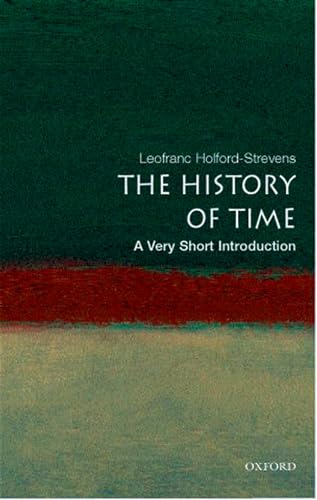
Why do we measure time in the way that we do? Why is a week seven days long? At what point did minutes and seconds come into being? Why are some calendars lunar and some solar?
The organisation of time into hours, days, months and years seems immutable and universal, but is actually far more artificial than most people realise. The French Revolution resulted in a restructuring of the French calendar, and the Soviet Union experimented with five and then six-day weeks. Leofranc Holford-Strevens explores these questions using a range of fascinating examples from Ancient Rome and Julius Caesar's imposition of the Leap Year, to the 1920s' project for a fixed Easter.
ABOUT THE SERIES: The Very Short Introductions series from Oxford University Press contains hundreds of titles in almost every subject area. These pocket-sized books are the perfect way to get ahead in a new subject quickly. Our expert authors combine facts, analysis, perspective, new ideas, and enthusiasm to make interesting and challenging topics highly readable.
Le informazioni nella sezione "Riassunto" possono far riferimento a edizioni diverse di questo titolo.
Informazioni sull'autore
Leofranc Holford-Strevens, a classicist, received a D.Phil from Oxford University in 1971. The author of Aulus Gellius (1988), and co-author of The Oxford Companion to the Year (OUP 1999), he is a desk-editor with Oxford University Press. He has a long-standing interest in calendars, chronologies, and the calculation of time.
Le informazioni nella sezione "Su questo libro" possono far riferimento a edizioni diverse di questo titolo.
Risultati della ricerca per The History of Time: A Very Short Introduction

Foto dell'editore
The History of Time: A Very Short Introduction
Editore:
Oxford University Press, 2005
ISBN 10: 0192804995
ISBN 13: 9780192804990
Antico o usato
Paperback
Da: World of Books (was SecondSale), Montgomery, IL, U.S.A.
Valutazione del venditore 5 su 5 stelle

Paperback. Condizione: Very Good. Why do we measure time in the way that we do? Why is a week seven days long? At what point did minutes and seconds come into being? Why are some calendars lunar and some solar?The organisation of time into hours, days, months and years seems immutable and universal, but is actually far more artificial than most people realise. The French Revolution resulted in a restructuring of the French calendar, and the Soviet Union experimented with five and then six-day weeks. Leofranc Holford-Strevens explores these questions using a range of fascinating examples from Ancient Rome and Julius Caesar's imposition of the Leap Year, to the 1920s' project for a fixed Easter. Codice articolo CIN0192804995VG
Compra usato
EUR 8,34
Spedizione gratuita
Spedito in U.S.A.
Spedito in U.S.A.
Quantità: 1 disponibili
Foto dell'editore
The History of Time : A Very Short Introduction
Editore:
Oxford University Press, Incorporated, 2005
ISBN 10: 0192804995
ISBN 13: 9780192804990
Antico o usato
Brossura
Da: Better World Books, Mishawaka, IN, U.S.A.
Valutazione del venditore 5 su 5 stelle
Condizione: Good. Pages intact with minimal writing/highlighting. The binding may be loose and creased. Dust jackets/supplements are not included. Stock photo provided. Product includes identifying sticker. Better World Books: Buy Books. Do Good. Codice articolo 9575740-75
Compra usato
EUR 8,35
Spedizione gratuita
Spedito in U.S.A.
Spedito in U.S.A.
Quantità: 2 disponibili
Foto dell'editore
The History of Time: A Very Short Introduction
Editore:
Oxford University Press, 2005
ISBN 10: 0192804995
ISBN 13: 9780192804990
Antico o usato
Paperback
Da: ThriftBooks-Reno, Reno, NV, U.S.A.
Valutazione del venditore 5 su 5 stelle
Paperback. Condizione: Very Good. No Jacket. May have limited writing in cover pages. Pages are unmarked. ~ ThriftBooks: Read More, Spend Less. Codice articolo G0192804995I4N00
Compra usato
EUR 9,23
Spedizione gratuita
Spedito in U.S.A.
Spedito in U.S.A.
Quantità: 1 disponibili
Foto dell'editore
The History of Time: A Very Short Introduction
Editore:
Oxford University Press, 2005
ISBN 10: 0192804995
ISBN 13: 9780192804990
Antico o usato
Paperback
Da: ThriftBooks-Atlanta, AUSTELL, GA, U.S.A.
Valutazione del venditore 5 su 5 stelle
Paperback. Condizione: Very Good. No Jacket. May have limited writing in cover pages. Pages are unmarked. ~ ThriftBooks: Read More, Spend Less. Codice articolo G0192804995I4N00
Compra usato
EUR 9,23
Spedizione gratuita
Spedito in U.S.A.
Spedito in U.S.A.
Quantità: 1 disponibili
Foto dell'editore
The History of Time: A Very Short Introduction
Editore:
Oxford University Press, 2005
ISBN 10: 0192804995
ISBN 13: 9780192804990
Antico o usato
Paperback
Da: ThriftBooks-Dallas, Dallas, TX, U.S.A.
Valutazione del venditore 5 su 5 stelle
Paperback. Condizione: Good. No Jacket. Pages can have notes/highlighting. Spine may show signs of wear. ~ ThriftBooks: Read More, Spend Less. Codice articolo G0192804995I3N00
Compra usato
EUR 9,23
Spedizione gratuita
Spedito in U.S.A.
Spedito in U.S.A.
Quantità: 1 disponibili
Foto dell'editore
The History of Time: A Very Short Introduction
Editore:
Oxford University Press, 2005
ISBN 10: 0192804995
ISBN 13: 9780192804990
Antico o usato
Paperback
Da: ThriftBooks-Dallas, Dallas, TX, U.S.A.
Valutazione del venditore 5 su 5 stelle
Paperback. Condizione: Very Good. No Jacket. May have limited writing in cover pages. Pages are unmarked. ~ ThriftBooks: Read More, Spend Less. Codice articolo G0192804995I4N00
Compra usato
EUR 9,23
Spedizione gratuita
Spedito in U.S.A.
Spedito in U.S.A.
Quantità: 1 disponibili
Foto dell'editore
The History of Time: A Very Short Introduction
Editore:
Oxford University Press, 2005
ISBN 10: 0192804995
ISBN 13: 9780192804990
Antico o usato
Paperback
Da: World of Books Inc, Montgomery, IL, U.S.A.
Valutazione del venditore 4 su 5 stelle

Paperback. Condizione: Very Good. Why do we measure time in the way that we do? Why is a week seven days long? At what point did minutes and seconds come into being? Why are some calendars lunar and some solar?The organisation of time into hours, days, months and years seems immutable and universal, but is actually far more artificial than most people realise. The French Revolution resulted in a restructuring of the French calendar, and the Soviet Union experimented with five and then six-day weeks. Leofranc Holford-Strevens explores these questions using a range of fascinating examples from Ancient Rome and Julius Caesar's imposition of the Leap Year, to the 1920s' project for a fixed Easter. Codice articolo CIN0192804995VG
Compra usato
EUR 10,17
Spedizione gratuita
Spedito in U.S.A.
Spedito in U.S.A.
Quantità: 1 disponibili
Foto dell'editore
The History of Time: A Very Short Introduction
Da: Books Liquidation, Sacramento, CA, U.S.A.
Valutazione del venditore 5 su 5 stelle
paperback. Condizione: New. Codice articolo mon0000027234
Compra nuovo
EUR 8,27
Spedizione EUR 3,56
Spedito in U.S.A.
Spedito in U.S.A.
Quantità: 1 disponibili
Immagini fornite dal venditore
History of Time : A Very Short Introduction
Da: GreatBookPrices, Columbia, MD, U.S.A.
Valutazione del venditore 5 su 5 stelle
Condizione: New. Codice articolo 3385915-n
Compra nuovo
EUR 9,51
Spedizione EUR 2,36
Spedito in U.S.A.
Spedito in U.S.A.
Quantità: 1 disponibili
Immagini fornite dal venditore
History of Time : A Very Short Introduction
Editore:
Oxford University Press, 2005
ISBN 10: 0192804995
ISBN 13: 9780192804990
Antico o usato
Brossura
Da: GreatBookPrices, Columbia, MD, U.S.A.
Valutazione del venditore 5 su 5 stelle
Condizione: As New. Unread book in perfect condition. Codice articolo 3385915
Compra usato
EUR 9,78
Spedizione EUR 2,36
Spedito in U.S.A.
Spedito in U.S.A.
Quantità: 1 disponibili