
Articoli correlati a COPELAND:ESSENTIAL TURING PAPER: Seminal Writings in...
COPELAND:ESSENTIAL TURING PAPER: Seminal Writings in Computing, Logic, Philosophy, Artificial Intelligence, and Artificial Life plus The Secrets of Enigma - Brossura
Sinossi
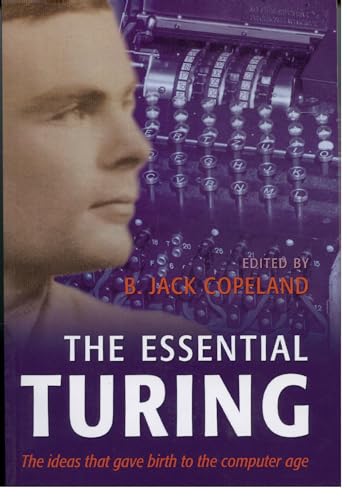
Alan Turing was one of the most influential thinkers of the 20th century. In 1935, aged 22, he developed the mathematical theory upon which all subsequent stored-program digital computers are modeled. At the outbreak of hostilities with Germany in September 1939, he joined the Goverment Codebreaking team at Bletchley Park, Buckinghamshire and played a crucial role in deciphering Engima, the code used by the German armed forces to protect their radio communications. Turing's work on the version of Enigma used by the German navy was vital to the battle for supremacy in the North Atlantic. He also contributed to the attack on the cyphers known as 'Fish' which were used by the German High Command for the encryption of signals during the latter part of the war. His contribution helped to shorten the war in Europe by an estimated two years. After the war, his theoretical work led to the development of Britain's first computers at the National Physical Laboratory and the Royal Society Computing Machine Laboratory at Manchester University. Turing was also a founding father of modern cognitive science, theorizing that the cortex at birth is an 'unorganized machine' which through 'training' becomes organized 'into a universal machine or something like it' He went on to develop the use of computers to model biological growth, launching the discipline now referred to as Artificial Life. The papers in this book are the key works for understanding Turing's phenomenal contribution across all these fields. The collection includes Turing's declassified wartime 'Treatise on the Enigma'; letters from Turing to Churchill and to codebreakers; lectures, papers, and broadcasts which opened up the concept of AI and its implications; and the paper which formed the genesis of the investigation of Artifical Life.
Le informazioni nella sezione "Riassunto" possono far riferimento a edizioni diverse di questo titolo.
Informazioni sull'autore
B. J. Copeland is Reader in Philosophy at the University of Canterbury, New Zealand.
Le informazioni nella sezione "Su questo libro" possono far riferimento a edizioni diverse di questo titolo.
Risultati della ricerca per COPELAND:ESSENTIAL TURING PAPER: Seminal Writings in...

Foto dell'editore
The Essential Turing: Seminal Writings in Computing, Logic, Philosophy, Artificial Intelligence, and Artificial Life plus The Secrets of Enigma
Da: HPB-Red, Dallas, TX, U.S.A.
Valutazione del venditore 5 su 5 stelle

Paperback. Condizione: Acceptable. Connecting readers with great books since 1972. Used textbooks may not include companion materials such as access codes, etc. May have condition issues including wear and notes/highlighting. We ship orders daily and Customer Service is our top priority! Codice articolo S_486014176
Compra usato
EUR 10,74
Spedizione EUR 3,35
Spedito in U.S.A.
Spedito in U.S.A.
Quantità: 1 disponibili
Foto dell'editore
The Essential Turing: Seminal Writings in Computing, Logic, Philosophy, Artificial Intelligence, and Artificial Life plus The Secrets of Enigma
Editore:
Clarendon Press, New York, NY, 2004
ISBN 10: 0198250800
ISBN 13: 9780198250807
Antico o usato
Soft cover
Prima edizione
Da: Conover Books, Martinsville, VA, U.S.A.
Valutazione del venditore 5 su 5 stelle
Soft cover. Condizione: Good. 1st Edition. Minor edge and corner wear; lightly scuffed and scratched; spine is gently creased; some light shelf wear; ex-library with the usual library markings; overall a nice used copy! Full-color illustrated wrapper with red and white lettering. 613 historical and informative pages nicely enhanced by black and white photographs and illustrations! "Alan Turing was one of the most influential thinkers of the 20th century. In 1935, aged 22, he developed the mathematical theory upon which all subsequent stored-program digital computers are modeled. At the outbreak of hostilities with Germany in September 1939, he joined the Goverment Codebreaking team at Bletchley Park, Buckinghamshire and played a crucial role in deciphering Enigma, the code used by the German armed forces to protect their radio communications. Turing's work on the version of Enigma used by the German navy was vital to the battle for supremacy in the North Atlantic. He also contributed to the attack on the cyphers known as 'Fish' which were used by the German High Command for the encryption of signals during the latter part of the war. His contribution helped to shorten the war in Europe by an estimated two years. After the war, his theoretical work led to the development of Britain's first computers at the National Physical Laboratory and the Royal Society Computing Machine Laboratory at Manchester University. Turing was also a founding father of modern cognitive science, theorizing that the cortex at birth is an 'unorganized machine' which through 'training' becomes organized 'into a universal machine or something like it' He went on to develop the use of computers to model biological growth, launching the discipline now referred to as Artificial Life. The papers in this book are the key works for understanding Turing's phenomenal contribution across all these fields. The collection includes Turing's declassified wartime 'Treatise on the Enigma'; letters from Turing to Churchill and to codebreakers; lectures, papers, and broadcasts which opened up the concept of AI and its implications; and the paper which formed the genesis of the investigation of Artificial Life.". Codice articolo 053312
Compra usato
EUR 27,58
Spedizione EUR 4,45
Spedito in U.S.A.
Spedito in U.S.A.
Quantità: 1 disponibili
Immagini fornite dal venditore
The Essential Turing
Editore:
Oxford University Press, 2013
ISBN 10: 0198250800
ISBN 13: 9780198250807
Antico o usato
Paperback
Da: Crappy Old Books, Barry, Regno Unito
Valutazione del venditore 5 su 5 stelle
Paperback. Condizione: Fine. Two listing notes: this is principally a collection of writings by Alan Turing , edited and introduced by B. Jack Copeland , rather than a book solely by Copeland. Also, Oxford records ISBN 9780198250807 as the paperback edition first published in 2004 ; your copy may be a 2013 reprint, so the impression page should settle the date. Alan Turing helped invent theoretical computer science before electronic computers properly existed, played a decisive role in breaking German codes during the Second World War, designed an early stored-program computer, helped establish artificial intelligence and proposed a mathematical explanation for patterns in living organisms. He accomplished this before dying at forty-one, leaving subsequent generations the comparatively modest task of building the world he had already imagined. The Essential Turing brings together his most important writings across mathematics, logic, computing, philosophy, codebreaking, artificial intelligence and artificial life. Edited by leading Turing scholar B. Jack Copeland, it allows readers to encounter Turing?s ideas in his own words, assisted by introductions and explanatory guides for those who do not ordinarily begin the day contemplating the limits of computability. The collection includes Turing?s celebrated 1936 paper on computable numbers. In addressing a difficult problem in mathematical logic, he imagined an abstract machine that reads and writes symbols according to precise rules. The ?Turing machine? was not a physical device awaiting a manufacturer; it was a conceptual model showing what computation itself means. Modern computers are vastly more colourful, expensive and prone to requesting software updates, but the underlying principle remains recognisably his. His universal machine introduced the idea that one machine could perform any computational task if supplied with the correct instructions. Hardware and program could therefore be separated, allowing the same machine to calculate, process text, play games or display advertisements for items discussed privately five minutes earlier. Turing supplied the profound intellectual foundation; commercial civilisation attended to the refinements. The book does not avoid the more demanding mathematics. Papers on logic, ordinal systems and computability show Turing working at the frontiers of formal thought, asking what can be calculated and whether some problems lie permanently beyond mechanical solution. Copeland?s commentary provides routes into this material, although readers may still occasionally discover that Turing has crossed an intellectual mountain while they are checking the map legend. A major section concerns Enigma and Turing?s secret wartime work at Bletchley Park. As a leading member of Hut 8, he developed methods for attacking German naval Enigma communications and helped design procedures used with the cryptanalytic bombe machines. The battle of the Atlantic was fought by ships and submarines, but also by mathematicians examining letter patterns in Buckinghamshire. Included are declassified materials relating to Enigma, together with correspondence and accounts of the codebreaking campaign. These reveal that breaking a cipher was not a single dramatic moment after which every German message became politely readable. Keys changed, procedures varied and analysts had to exploit repeated habits, technical weaknesses and the occasional assistance of an operator who had become bored with following instructions. The volume also presents Turing?s post-war work on electronic computing. His design for the Automatic Computing Engine anticipated important features of high-speed stored-program computers. Government committees responded with the timeless institutional method of recognising a revolutionary proposal and then discussing it until somebody elsewhere built something. Turing?s 1950 paper ?Computing Machinery and Intelligence? asks whether machines can think. Rather than becoming trapped in de. Codice articolo 7033
Compra usato
EUR 15,38
Spedizione EUR 23,94
Spedito da Regno Unito a U.S.A.
Spedito da Regno Unito a U.S.A.
Quantità: 1 disponibili
Immagini fornite dal venditore
Essential Turing : Seminal Writings in Computing, Logic, Philosophy, Artificial Intellegence, And Artificial Life; Plus The Secrets Of Enigma
Da: GreatBookPrices, Columbia, MD, U.S.A.
Valutazione del venditore 5 su 5 stelle
Condizione: New. Codice articolo 71101-n
Compra nuovo
EUR 47,63
Spedizione EUR 2,36
Spedito in U.S.A.
Spedito in U.S.A.
Quantità: Più di 20 disponibili
Immagini fornite dal venditore
The Essential Turing: Seminal Writings in Computing, Logic, Philosophy, Artificial Intelligence, and Artificial Life Plus the Secrets of Eni (Paperback or Softback)
Editore:
Oxford University Press (UK) 6/24/2013, 2013
ISBN 10: 0198250800
ISBN 13: 9780198250807
Nuovo
Paperback or Softback
Da: BargainBookStores, Grand Rapids, MI, U.S.A.
Valutazione del venditore 5 su 5 stelle
Paperback or Softback. Condizione: New. The Essential Turing: Seminal Writings in Computing, Logic, Philosophy, Artificial Intelligence, and Artificial Life Plus the Secrets of Eni. Book. Codice articolo BBS-9780198250807
Compra nuovo
EUR 50,07
Spedizione gratuita
Spedito in U.S.A.
Spedito in U.S.A.
Quantità: 5 disponibili
Foto dell'editore
The Essential Turing: Seminal Writings in Computing, Logic, Philosophy, Artificial Intelligence, and Artificial Life Plus the Secrets of Eni
Editore:
Oxford University Press(UK) 2013-06, 2013
ISBN 10: 0198250800
ISBN 13: 9780198250807
Nuovo
PF
Da: Chiron Media, Wallingford, Regno Unito
Valutazione del venditore 5 su 5 stelle
PF. Condizione: New. This item is printed on demand. Brand new book, sourced directly from publisher. Dispatch time is 6-7 days from our warehouse. Book will be sent in robust, secure packaging to ensure it reaches you securely. Codice articolo 6666-IUK-9780198250807
Compra nuovo
EUR 42,35
Spedizione EUR 7,75
Spedito da Regno Unito a U.S.A.
Spedito da Regno Unito a U.S.A.
Quantità: 20 disponibili
Foto dell'editore
The Essential Turing (eng)
Print on DemandDa: Brook Bookstore On Demand, Napoli, NA, Italia
Valutazione del venditore 5 su 5 stelle
Condizione: new. Questo è un articolo print on demand. Codice articolo 8810b29158a89ddf2b34a80e0468a514
Compra nuovo
EUR 39,30
Spedizione EUR 11,00
Spedito da Italia a U.S.A.
Spedito da Italia a U.S.A.
Quantità: Più di 20 disponibili
Foto dell'editore
The Essential Turing
Print on DemandDa: PBShop.store US, Wood Dale, IL, U.S.A.
Valutazione del venditore 5 su 5 stelle
PAP. Condizione: New. New Book. Shipped from UK. THIS BOOK IS PRINTED ON DEMAND. Established seller since 2000. Codice articolo L0-9780198250807
Compra nuovo
EUR 52,02
Spedizione gratuita
Spedito in U.S.A.
Spedito in U.S.A.
Quantità: Più di 20 disponibili
Immagini fornite dal venditore
Essential Turing : Seminal Writings in Computing, Logic, Philosophy, Artificial Intellegence, And Artificial Life; Plus The Secrets Of Enigma
Editore:
Oxford University Press, 2004
ISBN 10: 0198250800
ISBN 13: 9780198250807
Antico o usato
Brossura
Da: GreatBookPrices, Columbia, MD, U.S.A.
Valutazione del venditore 5 su 5 stelle
Condizione: As New. Unread book in perfect condition. Codice articolo 71101
Compra usato
EUR 50,03
Spedizione EUR 2,36
Spedito in U.S.A.
Spedito in U.S.A.
Quantità: Più di 20 disponibili
Foto dell'editore
The Essential Turing
Print on DemandDa: PBShop.store UK, Fairford, GLOS, Regno Unito
Valutazione del venditore 5 su 5 stelle
PAP. Condizione: New. New Book. Delivered from our UK warehouse in 4 to 14 business days. THIS BOOK IS PRINTED ON DEMAND. Established seller since 2000. Codice articolo L0-9780198250807
Compra nuovo
EUR 46,48
Spedizione EUR 7,01
Spedito da Regno Unito a U.S.A.
Spedito da Regno Unito a U.S.A.
Quantità: Più di 20 disponibili