
Articoli correlati a Plotinus or the Simplicity of Vision
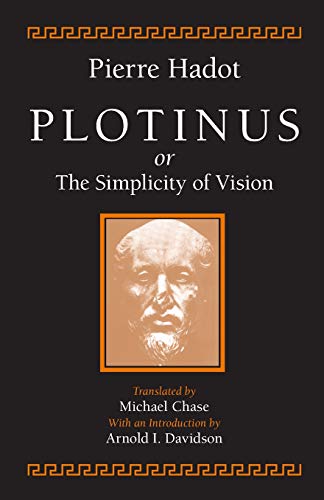
Sinossi
The most penetrating and thorough account available of the work of ancient philosopher Plotinus, from the world's leading expert on his thought
Pierre Hadot's lively philosophical portrait of Plotinus is the preeminent introduction to the man and his thought. Michael Chase's lucid translation—complete with a useful chronology and analytical bibliography—at last makes this book available to the English-speaking world.
Hadot carefully examines Plotinus's views on the self, existence, love, virtue, gentleness, and solitude. He shows that Plotinus, like other philosophers of his day, believed that Plato and Aristotle had already articulated the essential truths; for him, the purpose of practicing philosophy was not to profess new truths but to engage in spiritual exercises so as to live philosophically. Seen in this light, Plotinus's counsel against fixation on the body and all earthly matters stemmed not from disgust or fear, but rather from his awareness of the negative effect that bodily preoccupation and material concern could have on spiritual exercises.
Le informazioni nella sezione "Riassunto" possono far riferimento a edizioni diverse di questo titolo.
Product Description
Book by Hadot Pierre
Le informazioni nella sezione "Su questo libro" possono far riferimento a edizioni diverse di questo titolo.
Risultati della ricerca per Plotinus or the Simplicity of Vision

Foto dell'editore
Plotinus or the Simplicity of Vision
Editore:
The University of Chicago Press, 1998
ISBN 10: 0226311945
ISBN 13: 9780226311944
Antico o usato
Paperback
Da: World of Books (was SecondSale), Montgomery, IL, U.S.A.
Valutazione del venditore 5 su 5 stelle

Paperback. Condizione: Fair. Since its original publication in France in 1963, Pierre Hadot's lively philosophical portrait of Plotinus remains the preeminent introduction to the man and his thought. Michael Chase's lucid translation--complete with a useful chronology and analytical bibliography--at last makes this book available to the English-speaking world. Hadot carefully examines Plotinus's views on the self, existence, love, virtue, gentleness, and solitude. He shows that Plotinus, like other philosophers of his day, believed that Plato and Aristotle had already articulated the essential truths; for him, the purpose of practicing philosophy was not to profess new truths but to engage in spiritual exercises so as to live philosophically. Seen in this light, Plotinus's counsel against fixation on the body and all earthly matters stemmed not from disgust or fear, but rather from his awareness of the negative effect that bodily preoccupation and material concern could have on spiritual exercises. Codice articolo 00109366916
Compra usato
EUR 19,27
Spedizione gratuita
Spedito in U.S.A.
Spedito in U.S.A.
Quantità: 1 disponibili
Foto dell'editore
Plotinus or the Simplicity of Vision
Editore:
The University of Chicago Press, 1998
ISBN 10: 0226311945
ISBN 13: 9780226311944
Antico o usato
Paperback
Da: World of Books Inc, Montgomery, IL, U.S.A.
Valutazione del venditore 4 su 5 stelle

Paperback. Condizione: Fair. Since its original publication in France in 1963, Pierre Hadot's lively philosophical portrait of Plotinus remains the preeminent introduction to the man and his thought. Michael Chase's lucid translation--complete with a useful chronology and analytical bibliography--at last makes this book available to the English-speaking world. Hadot carefully examines Plotinus's views on the self, existence, love, virtue, gentleness, and solitude. He shows that Plotinus, like other philosophers of his day, believed that Plato and Aristotle had already articulated the essential truths; for him, the purpose of practicing philosophy was not to profess new truths but to engage in spiritual exercises so as to live philosophically. Seen in this light, Plotinus's counsel against fixation on the body and all earthly matters stemmed not from disgust or fear, but rather from his awareness of the negative effect that bodily preoccupation and material concern could have on spiritual exercises. Codice articolo CIN0226311945A
Compra usato
EUR 21,11
Spedizione gratuita
Spedito in U.S.A.
Spedito in U.S.A.
Quantità: 1 disponibili
Foto dell'editore
Plotinus or the Simplicity of Vision
Editore:
The University of Chicago Press, 1998
ISBN 10: 0226311945
ISBN 13: 9780226311944
Antico o usato
Paperback
Da: World of Books (was SecondSale), Montgomery, IL, U.S.A.
Valutazione del venditore 5 su 5 stelle
Paperback. Condizione: Very Good. Since its original publication in France in 1963, Pierre Hadot's lively philosophical portrait of Plotinus remains the preeminent introduction to the man and his thought. Michael Chase's lucid translation--complete with a useful chronology and analytical bibliography--at last makes this book available to the English-speaking world. Hadot carefully examines Plotinus's views on the self, existence, love, virtue, gentleness, and solitude. He shows that Plotinus, like other philosophers of his day, believed that Plato and Aristotle had already articulated the essential truths; for him, the purpose of practicing philosophy was not to profess new truths but to engage in spiritual exercises so as to live philosophically. Seen in this light, Plotinus's counsel against fixation on the body and all earthly matters stemmed not from disgust or fear, but rather from his awareness of the negative effect that bodily preoccupation and material concern could have on spiritual exercises. Codice articolo CIN0226311945VG
Compra usato
EUR 21,13
Spedizione gratuita
Spedito in U.S.A.
Spedito in U.S.A.
Quantità: 1 disponibili
Foto dell'editore
Plotinus or the Simplicity of Vision
Editore:
The University of Chicago Press, 1998
ISBN 10: 0226311945
ISBN 13: 9780226311944
Antico o usato
Paperback
Da: World of Books Inc, Montgomery, IL, U.S.A.
Valutazione del venditore 4 su 5 stelle
Paperback. Condizione: Very Good. Since its original publication in France in 1963, Pierre Hadot's lively philosophical portrait of Plotinus remains the preeminent introduction to the man and his thought. Michael Chase's lucid translation--complete with a useful chronology and analytical bibliography--at last makes this book available to the English-speaking world. Hadot carefully examines Plotinus's views on the self, existence, love, virtue, gentleness, and solitude. He shows that Plotinus, like other philosophers of his day, believed that Plato and Aristotle had already articulated the essential truths; for him, the purpose of practicing philosophy was not to profess new truths but to engage in spiritual exercises so as to live philosophically. Seen in this light, Plotinus's counsel against fixation on the body and all earthly matters stemmed not from disgust or fear, but rather from his awareness of the negative effect that bodily preoccupation and material concern could have on spiritual exercises. Codice articolo CIN0226311945VG
Compra usato
EUR 22,96
Spedizione gratuita
Spedito in U.S.A.
Spedito in U.S.A.
Quantità: 1 disponibili
Foto dell'editore
Plotinus or the Simplicity of Vision
Editore:
University of Chicago Press, 1998
ISBN 10: 0226311945
ISBN 13: 9780226311944
Antico o usato
Soft cover
Da: Unique Books, Lexington, KY, U.S.A.
Valutazione del venditore 5 su 5 stelle
Soft cover. Condizione: Fine. No Jacket. Codice articolo b-491-13-jn
Compra usato
EUR 20,21
Spedizione EUR 4,91
Spedito in U.S.A.
Spedito in U.S.A.
Quantità: 1 disponibili
Foto dell'editore
Plotinus or the Simplicity of Vision
Editore:
University of Chicago Press, 1998
ISBN 10: 0226311945
ISBN 13: 9780226311944
Antico o usato
Soft cover
Da: Gastown Bookwurm, Vancouver, BC, Canada
Valutazione del venditore 5 su 5 stelle
Soft cover. Condizione: Near Fine. 1998. Later reprint. Very Good+ book with some smalls signs of handling. Pages are clean, bright, & unmarked. Binding is firm & square, with some small shelf and hand wear to edges & corners. Traslated by Michael Chase. With an Introduction by Arnold I. Davidson. Codice articolo 001105
Compra usato
EUR 12,94
Spedizione EUR 17,84
Spedito da Canada a U.S.A.
Spedito da Canada a U.S.A.
Quantità: 1 disponibili
Immagini fornite dal venditore
Plotinus or the Simplicity of Vision (Paperback)
Editore:
The University of Chicago Press, Chicago, IL, 1998
ISBN 10: 0226311945
ISBN 13: 9780226311944
Nuovo
Paperback
Da: Grand Eagle Retail, Bensenville, IL, U.S.A.
Valutazione del venditore 5 su 5 stelle
Paperback. Condizione: new. Paperback. Since its original publication in France in 1963, Pierre Hadot's lively philosophical portrait of Plotinus remains the preeminent introduction to the man and his thought. Michael Chase's lucid translationcomplete with a useful chronology and analytical bibliographyat last makes this book available to the English-speaking world.Hadot carefully examines Plotinus's views on the self, existence, love, virtue, gentleness, and solitude. He shows that Plotinus, like other philosophers of his day, believed that Plato and Aristotle had already articulated the essential truths; for him, the purpose of practicing philosophy was not to profess new truths but to engage in spiritual exercises so as to live philosophically. Seen in this light, Plotinus's counsel against fixation on the body and all earthly matters stemmed not from disgust or fear, but rather from his awareness of the negative effect that bodily preoccupation and material concern could have on spiritual exercises. In this work, Hadot examines Plotinus' views on the self, existence, love, virtue, gentleness and solitude. He shows that Plotinus, like other philosophers of his day, believed that Plato and Aristotle had already articulated the essential truths, and so his purpose was to live philosophically. Shipping may be from multiple locations in the US or from the UK, depending on stock availability. Codice articolo 9780226311944
Compra nuovo
EUR 32,04
Spedizione gratuita
Spedito in U.S.A.
Spedito in U.S.A.
Quantità: 1 disponibili
Immagini fornite dal venditore
Plotinus or the Simplicity of Vision
Editore:
University of Chicago Press, 1998
ISBN 10: 0226311945
ISBN 13: 9780226311944
Nuovo
Brossura
Da: GreatBookPrices, Columbia, MD, U.S.A.
Valutazione del venditore 5 su 5 stelle
Condizione: New. Codice articolo 590258-n
Compra nuovo
EUR 31,89
Spedizione EUR 2,35
Spedito in U.S.A.
Spedito in U.S.A.
Quantità: Più di 20 disponibili
Foto dell'editore
Plotinus or the Simplicity of Vision Format: Paperback
Editore:
University of Chicago press, 1998
ISBN 10: 0226311945
ISBN 13: 9780226311944
Nuovo
Brossura
Da: INDOO, Avenel, NJ, U.S.A.
Valutazione del venditore 5 su 5 stelle
Condizione: New. Brand New. Codice articolo 9780226311944
Compra nuovo
EUR 34,33
Spedizione gratuita
Spedito in U.S.A.
Spedito in U.S.A.
Quantità: Più di 20 disponibili
Foto dell'editore
Plotinus or the Simplicity of Vision (eng)
Editore:
University of Chicago Press, 1998
ISBN 10: 0226311945
ISBN 13: 9780226311944
Nuovo
Brossura
Da: Brook Bookstore On Demand, Napoli, NA, Italia
Valutazione del venditore 5 su 5 stelle
Condizione: new. Codice articolo 97bab28a981a0577cdb33393f8998478
Compra nuovo
EUR 30,85
Spedizione EUR 4,00
Spedito da Italia a U.S.A.
Spedito da Italia a U.S.A.
Quantità: Più di 20 disponibili