
Articoli correlati a The Laws of Simplicity
Sinossi
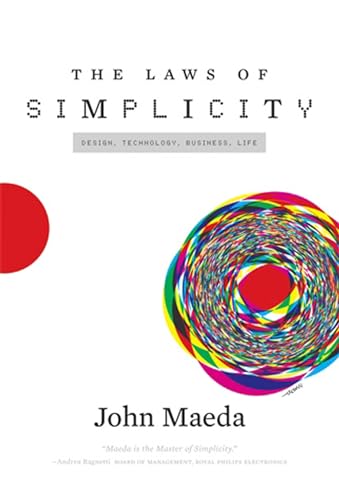
Ten laws of simplicity for business, technology, and design that teach us how to need less but get more.
Finally, we are learning that simplicity equals sanity. We're rebelling against technology that's too complicated, DVD players with too many menus, and software accompanied by 75-megabyte "read me" manuals. The iPod's clean gadgetry has made simplicity hip. But sometimes we find ourselves caught up in the simplicity paradox: we want something that's simple and easy to use, but also does all the complex things we might ever want it to do. In The Laws of Simplicity, John Maeda offers ten laws for balancing simplicity and complexity in business, technology, and design—guidelines for needing less and actually getting more.
Maeda—a professor in MIT's Media Lab and a world-renowned graphic designer—explores the question of how we can redefine the notion of "improved" so that it doesn't always mean something more, something added on.
Maeda's first law of simplicity is "Reduce." It's not necessarily beneficial to add technology features just because we can. And the features that we do have must be organized (Law 2) in a sensible hierarchy so users aren't distracted by features and functions they don't need. But simplicity is not less just for the sake of less. Skip ahead to Law 9: "Failure: Accept the fact that some things can never be made simple." Maeda's concise guide to simplicity in the digital age shows us how this idea can be a cornerstone of organizations and their products—how it can drive both business and technology. We can learn to simplify without sacrificing comfort and meaning, and we can achieve the balance described in Law 10. This law, which Maeda calls "The One," tells us: "Simplicity is about subtracting the obvious, and adding the meaningful."
Le informazioni nella sezione "Riassunto" possono far riferimento a edizioni diverse di questo titolo.
Informazioni sull'autore
An internationally recognized leader at the intersection of design and technology, John Maeda is Executive Vice President/Chief Experience Officer at Publicis Sapient. He was the 16th President of the Rhode Island School of Design (RISD). He is the author of Design by Numbers, The Laws of Simplicity, and Redesigning Leadership, all published by The MIT Press.
Le informazioni nella sezione "Su questo libro" possono far riferimento a edizioni diverse di questo titolo.
Risultati della ricerca per The Laws of Simplicity

Foto dell'editore
The Laws of Simplicity
Da: World of Books (was SecondSale), Montgomery, IL, U.S.A.
Valutazione del venditore 5 su 5 stelle

Hardback. Condizione: Fair. Ten laws of simplicity for business, technology, and design that teach us how to need less but get more.Finally, we are learning that simplicity equals sanity. We're rebelling against technology that's too complicated, DVD players with too many menus, and software accompanied by 75-megabyte read me manuals. The iPod's clean gadgetry has made simplicity hip. But sometimes we find ourselves caught up in the simplicity paradox: we want something that's simple and easy to use, but also does all the complex things we might ever want it to do. In The Laws of Simplicity, John Maeda offers ten laws for balancing simplicity and complexity in business, technology, and design--guidelines for needing less and actually getting more.Maeda--a professor in MIT's Media Lab and a world-renowned graphic designer--explores the question of how we can redefine the notion of improved so that it doesn't always mean something more, something added on.Maeda's first law of simplicity is Reduce. It's not necessarily beneficial to add technology features just because we can. And the features that we do have must be organized (Law 2) in a sensible hierarchy so users aren't distracted by features and functions they don't need. But simplicity is not less just for the sake of less. Skip ahead to Law 9: Failure: Accept the fact that some things can never be made simple. Maeda's concise guide to simplicity in the digital age shows us how this idea can be a cornerstone of organizations and their products--how it can drive both business and technology. We can learn to simplify without sacrificing comfort and meaning, and we can achieve the balance described in Law 10. This law, which Maeda calls The One, tells us: Simplicity is about subtracting the obvious, and adding the meaningful. Codice articolo 00108645542
Compra usato
EUR 4,12
Spedizione gratuita
Spedito in U.S.A.
Spedito in U.S.A.
Quantità: 1 disponibili
Foto dell'editore
The Laws of Simplicity
Da: World of Books (was SecondSale), Montgomery, IL, U.S.A.
Valutazione del venditore 5 su 5 stelle
Hardback. Condizione: Very Good. Ten laws of simplicity for business, technology, and design that teach us how to need less but get more.Finally, we are learning that simplicity equals sanity. We're rebelling against technology that's too complicated, DVD players with too many menus, and software accompanied by 75-megabyte read me manuals. The iPod's clean gadgetry has made simplicity hip. But sometimes we find ourselves caught up in the simplicity paradox: we want something that's simple and easy to use, but also does all the complex things we might ever want it to do. In The Laws of Simplicity, John Maeda offers ten laws for balancing simplicity and complexity in business, technology, and design--guidelines for needing less and actually getting more.Maeda--a professor in MIT's Media Lab and a world-renowned graphic designer--explores the question of how we can redefine the notion of improved so that it doesn't always mean something more, something added on.Maeda's first law of simplicity is Reduce. It's not necessarily beneficial to add technology features just because we can. And the features that we do have must be organized (Law 2) in a sensible hierarchy so users aren't distracted by features and functions they don't need. But simplicity is not less just for the sake of less. Skip ahead to Law 9: Failure: Accept the fact that some things can never be made simple. Maeda's concise guide to simplicity in the digital age shows us how this idea can be a cornerstone of organizations and their products--how it can drive both business and technology. We can learn to simplify without sacrificing comfort and meaning, and we can achieve the balance described in Law 10. This law, which Maeda calls The One, tells us: Simplicity is about subtracting the obvious, and adding the meaningful. Codice articolo 00105081234
Compra usato
EUR 4,12
Spedizione gratuita
Spedito in U.S.A.
Spedito in U.S.A.
Quantità: 8 disponibili
Foto dell'editore
The Laws of Simplicity
Da: World of Books (was SecondSale), Montgomery, IL, U.S.A.
Valutazione del venditore 5 su 5 stelle
Hardback. Condizione: Good. Ten laws of simplicity for business, technology, and design that teach us how to need less but get more.Finally, we are learning that simplicity equals sanity. We're rebelling against technology that's too complicated, DVD players with too many menus, and software accompanied by 75-megabyte read me manuals. The iPod's clean gadgetry has made simplicity hip. But sometimes we find ourselves caught up in the simplicity paradox: we want something that's simple and easy to use, but also does all the complex things we might ever want it to do. In The Laws of Simplicity, John Maeda offers ten laws for balancing simplicity and complexity in business, technology, and design--guidelines for needing less and actually getting more.Maeda--a professor in MIT's Media Lab and a world-renowned graphic designer--explores the question of how we can redefine the notion of improved so that it doesn't always mean something more, something added on.Maeda's first law of simplicity is Reduce. It's not necessarily beneficial to add technology features just because we can. And the features that we do have must be organized (Law 2) in a sensible hierarchy so users aren't distracted by features and functions they don't need. But simplicity is not less just for the sake of less. Skip ahead to Law 9: Failure: Accept the fact that some things can never be made simple. Maeda's concise guide to simplicity in the digital age shows us how this idea can be a cornerstone of organizations and their products--how it can drive both business and technology. We can learn to simplify without sacrificing comfort and meaning, and we can achieve the balance described in Law 10. This law, which Maeda calls The One, tells us: Simplicity is about subtracting the obvious, and adding the meaningful. Codice articolo 00103674666
Compra usato
EUR 4,12
Spedizione gratuita
Spedito in U.S.A.
Spedito in U.S.A.
Quantità: 14 disponibili
Immagini fornite dal venditore
The Laws of Simplicity (Simplicity: Design, Technology, Business, Life)
Da: Zoom Books East, Glendale Heights, IL, U.S.A.
Valutazione del venditore 5 su 5 stelle
Condizione: very_good. Book is in very good condition and may include minimal underlining highlighting. The book can also include "From the library of" labels. May not contain miscellaneous items toys, dvds, etc. . We offer 100% money back guarantee and 24 7 customer service. Codice articolo ZEV.0262134721.VG
Compra usato
EUR 4,13
Spedizione gratuita
Spedito in U.S.A.
Spedito in U.S.A.
Quantità: 1 disponibili
Immagini fornite dal venditore
The Laws of Simplicity (Simplicity: Design, Technology, Business, Life)
Da: Zoom Books East, Glendale Heights, IL, U.S.A.
Valutazione del venditore 5 su 5 stelle
Condizione: acceptable. Book is in acceptable condition and shows signs of wear. Book may also include underlining highlighting. The book can also include "From the library of" labels. May not contain miscellaneous items toys, dvds, etc. . We offer 100% money back guarantee and 24 7 customer service. Codice articolo ZEV.0262134721.A
Compra usato
EUR 4,13
Spedizione gratuita
Spedito in U.S.A.
Spedito in U.S.A.
Quantità: 2 disponibili
Immagini fornite dal venditore
The Laws of Simplicity (Simplicity: Design, Technology, Business, Life)
Da: 3Brothers Bookstore, Egg harbor township, NJ, U.S.A.
Valutazione del venditore 5 su 5 stelle
Condizione: very_good. Cover may have light wear, pages in very good condition and binding is sturdy; may have other light shelf wear or creases. May have notes or highlighting. Codice articolo EVV.0262134721.VG
Compra usato
EUR 4,18
Spedizione gratuita
Spedito in U.S.A.
Spedito in U.S.A.
Quantità: 1 disponibili
Foto dell'editore
The Laws of Simplicity (Simplicity: Design, Technology, Business, Life)
Da: More Than Words, Waltham, MA, U.S.A.
Valutazione del venditore 5 su 5 stelle
Condizione: Good. A sound copy with only light wear. Overall a solid copy at a great price! Codice articolo BOS-X-13e-01548
Compra usato
EUR 1,25
Spedizione EUR 3,62
Spedito in U.S.A.
Spedito in U.S.A.
Quantità: 1 disponibili
Foto dell'editore
The Laws of Simplicity (Simplicity: Design, Technology, Business, Life)
Da: AwesomeBooks, Wallingford, Regno Unito
Valutazione del venditore 5 su 5 stelle
Hardcover. Condizione: Very Good. The Laws of Simplicity (Simplicity: Design, Technology, Business, Life) This book is in very good condition and will be shipped within 24 hours of ordering. The cover may have some limited signs of wear but the pages are clean, intact and the spine remains undamaged. This book has clearly been well maintained and looked after thus far. Money back guarantee if you are not satisfied. See all our books here, order more than 1 book and get discounted shipping. . Codice articolo 7719-9780262134729
Compra usato
EUR 3,10
Spedizione EUR 2,39
Spedito da Regno Unito a U.S.A.
Spedito da Regno Unito a U.S.A.
Quantità: 1 disponibili
Foto dell'editore
The Laws of Simplicity (Simplicity: Design, Technology, Business, Life)
Editore:
The MIT Press (edition Later prt.), 2006
ISBN 10: 0262134721
ISBN 13: 9780262134729
Antico o usato
Rilegato
Da: BooksRun, Philadelphia, PA, U.S.A.
Valutazione del venditore 5 su 5 stelle
Hardcover. Condizione: Very Good. Later prt. It's a well-cared-for item that has seen limited use. The item may show minor signs of wear. All the text is legible, with all pages included. It may have slight markings and/or highlighting. Codice articolo 0262134721-11-6
Compra usato
EUR 5,98
Spedizione gratuita
Spedito in U.S.A.
Spedito in U.S.A.
Quantità: 1 disponibili
Foto dell'editore
The Laws of Simplicity
Da: World of Books Inc, Montgomery, IL, U.S.A.
Valutazione del venditore 4 su 5 stelle

Hardback. Condizione: Fair. Ten laws of simplicity for business, technology, and design that teach us how to need less but get more.Finally, we are learning that simplicity equals sanity. We're rebelling against technology that's too complicated, DVD players with too many menus, and software accompanied by 75-megabyte read me manuals. The iPod's clean gadgetry has made simplicity hip. But sometimes we find ourselves caught up in the simplicity paradox: we want something that's simple and easy to use, but also does all the complex things we might ever want it to do. In The Laws of Simplicity, John Maeda offers ten laws for balancing simplicity and complexity in business, technology, and design--guidelines for needing less and actually getting more.Maeda--a professor in MIT's Media Lab and a world-renowned graphic designer--explores the question of how we can redefine the notion of improved so that it doesn't always mean something more, something added on.Maeda's first law of simplicity is Reduce. It's not necessarily beneficial to add technology features just because we can. And the features that we do have must be organized (Law 2) in a sensible hierarchy so users aren't distracted by features and functions they don't need. But simplicity is not less just for the sake of less. Skip ahead to Law 9: Failure: Accept the fact that some things can never be made simple. Maeda's concise guide to simplicity in the digital age shows us how this idea can be a cornerstone of organizations and their products--how it can drive both business and technology. We can learn to simplify without sacrificing comfort and meaning, and we can achieve the balance described in Law 10. This law, which Maeda calls The One, tells us: Simplicity is about subtracting the obvious, and adding the meaningful. Codice articolo CIN0262134721A
Compra usato
EUR 5,99
Spedizione gratuita
Spedito in U.S.A.
Spedito in U.S.A.
Quantità: 1 disponibili