
Articoli correlati a Epideictic Rhetoric: Questioning the Stakes of Ancient...
Epideictic Rhetoric: Questioning the Stakes of Ancient Praise - Rilegato
Libro 6 di 11: Ashley and Peter Larkin Series in Greek and Roman Culture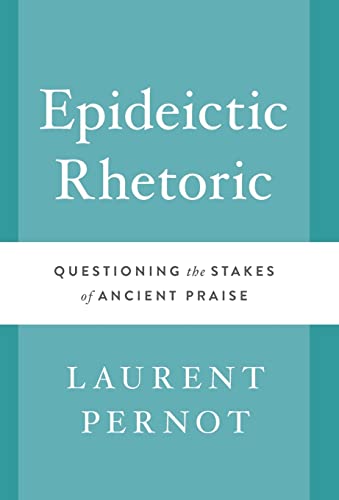
Sinossi
Speeches of praise and blame constituted a form of oratory put to brilliant and creative use in the classical Greek period (fifth to fourth century BC) and the Roman imperial period (first to fourth century AD), and they have influenced public speakers through all the succeeding ages. Yet unlike the other classical genres of rhetoric, epideictic rhetoric remains something of a mystery. It was the least important genre at the start of Greek oratory, but its role grew exponentially in subsequent periods, even though epideictic orations were not meant to elicit any action on the part of the listener, as judicial and deliberative speeches attempted to do. So why did the ancients value the oratory of praise so highly?
In Epideictic Rhetoric, Laurent Pernot offers an authoritative overview of the genre that surveys its history in ancient Greece and Rome, its technical aspects, and its social function. He begins by defining epideictic rhetoric and tracing its evolution from its first realizations in classical Greece to its eloquent triumph in the Greco-Roman world. No longer were speeches limited to tribunals, assemblies, and courts—they now involved ceremonies as well, which changed the political and social implications of public speaking. Pernot analyzes the techniques of praise, both as stipulated by theoreticians and as practiced by orators. He describes how epideictic rhetoric functioned to give shape to the representations and common beliefs of a group, render explicit and justify accepted values, and offer lessons on new values. Finally, Pernot incorporates current research about rhetoric into the analysis of praise.
Le informazioni nella sezione "Riassunto" possono far riferimento a edizioni diverse di questo titolo.
Informazioni sull'autore
Laurent Pernot is Professor and Chair of the Department of Greek at the University of Strasbourg, Director of the Center for the Analysis of the Religious Rhetorics of Antiquity, Member of the Institut de France (Académie des Inscriptions et Belles-Lettres), and former President of the International Society for the History of Rhetoric (ISHR). His many publications include Rhetoric in Antiquity and New Chapters in the History of Rhetoric.
Le informazioni nella sezione "Su questo libro" possono far riferimento a edizioni diverse di questo titolo.
Risultati della ricerca per Epideictic Rhetoric: Questioning the Stakes of Ancient...

Foto dell'editore
Epideictic Rhetoric: Questioning the Stakes of Ancient Praise (Ashley and Peter Larkin Series in Greek and Roman Culture)
Editore:
University of Texas Press, 2015
ISBN 10: 0292768206
ISBN 13: 9780292768208
Antico o usato
Rilegato
Prima edizione
Da: Saint Georges English Bookshop, Berlin, Germania
Valutazione del venditore 5 su 5 stelle

Hardcover. Condizione: Very Good. Condizione sovraccoperta: Very Good. 1st Edition. Excellent used condition, light edge wear, unmarked text, unclipped jacket, Ships airmail from Berlin Bookshop bxn5357. Codice articolo 10000903
Compra usato
EUR 40,00
Spedizione EUR 16,00
Spedito da Germania a U.S.A.
Spedito da Germania a U.S.A.
Quantità: 1 disponibili
Foto dell'editore
Epideictic Rhetoric
Editore:
MU - University of Texas Press, 2015
ISBN 10: 0292768206
ISBN 13: 9780292768208
Nuovo
Rilegato
Da: PBShop.store UK, Fairford, GLOS, Regno Unito
Valutazione del venditore 5 su 5 stelle
HRD. Condizione: New. New Book. Shipped from UK. Established seller since 2000. Codice articolo FW-9780292768208
Compra nuovo
EUR 51,38
Spedizione EUR 4,91
Spedito da Regno Unito a U.S.A.
Spedito da Regno Unito a U.S.A.
Quantità: 15 disponibili
Immagini fornite dal venditore
Epideictic Rhetoric : Questioning the Stakes of Ancient Praise
Da: GreatBookPrices, Columbia, MD, U.S.A.
Valutazione del venditore 5 su 5 stelle
Condizione: New. Codice articolo 23258062-n
Compra nuovo
EUR 55,37
Spedizione EUR 2,35
Spedito in U.S.A.
Spedito in U.S.A.
Quantità: 17 disponibili
Foto dell'editore
Epideictic Rhetoric (Hardcover)
Editore:
University of Texas Press, Austin, TX, 2015
ISBN 10: 0292768206
ISBN 13: 9780292768208
Nuovo
Rilegato
Da: Grand Eagle Retail, Bensenville, IL, U.S.A.
Valutazione del venditore 5 su 5 stelle
Hardcover. Condizione: new. Hardcover. Speeches of praise and blame constituted a form of oratory put to brilliant and creative use in the classical Greek period (fifth to fourth century BC) and the Roman imperial period (first to fourth century AD), and they have influenced public speakers through all the succeeding ages. Yet unlike the other classical genres of rhetoric, epideictic rhetoric remains something of a mystery. It was the least important genre at the start of Greek oratory, but its role grew exponentially in subsequent periods, even though epideictic orations were not meant to elicit any action on the part of the listener, as judicial and deliberative speeches attempted to do. So why did the ancients value the oratory of praise so highly?In Epideictic Rhetoric, Laurent Pernot offers an authoritative overview of the genre that surveys its history in ancient Greece and Rome, its technical aspects, and its social function. He begins by defining epideictic rhetoric and tracing its evolution from its first realizations in classical Greece to its eloquent triumph in the Greco-Roman world. No longer were speeches limited to tribunals, assemblies, and courts-they now involved ceremonies as well, which changed the political and social implications of public speaking. Pernot analyzes the techniques of praise, both as stipulated by theoreticians and as practiced by orators. He describes how epideictic rhetoric functioned to give shape to the representations and common beliefs of a group, render explicit and justify accepted values, and offer lessons on new values. Finally, Pernot incorporates current research about rhetoric into the analysis of praise. An internationally recognized expert on ancient Greek rhetoric provides the definitive history and analysis of the oratory of praise and its social function in the Greco-Roman world. Shipping may be from multiple locations in the US or from the UK, depending on stock availability. Codice articolo 9780292768208
Compra nuovo
EUR 57,80
Spedizione gratuita
Spedito in U.S.A.
Spedito in U.S.A.
Quantità: 1 disponibili
Immagini fornite dal venditore
Epideictic Rhetoric : Questioning the Stakes of Ancient Praise
Editore:
University of Texas Press, 2015
ISBN 10: 0292768206
ISBN 13: 9780292768208
Antico o usato
Rilegato
Da: GreatBookPrices, Columbia, MD, U.S.A.
Valutazione del venditore 5 su 5 stelle
Condizione: As New. Unread book in perfect condition. Codice articolo 23258062
Compra usato
EUR 57,88
Spedizione EUR 2,35
Spedito in U.S.A.
Spedito in U.S.A.
Quantità: 17 disponibili
Immagini fornite dal venditore
Epideictic Rhetoric
Editore:
University of Texas Press, US, 2015
ISBN 10: 0292768206
ISBN 13: 9780292768208
Nuovo
Rilegato
Da: Rarewaves.com USA, London, LONDO, Regno Unito
Valutazione del venditore 5 su 5 stelle
Hardback. Condizione: New. Speeches of praise and blame constituted a form of oratory put to brilliant and creative use in the classical Greek period (fifth to fourth century BC) and the Roman imperial period (first to fourth century AD), and they have influenced public speakers through all the succeeding ages. Yet unlike the other classical genres of rhetoric, epideictic rhetoric remains something of a mystery. It was the least important genre at the start of Greek oratory, but its role grew exponentially in subsequent periods, even though epideictic orations were not meant to elicit any action on the part of the listener, as judicial and deliberative speeches attempted to do. So why did the ancients value the oratory of praise so highly?In Epideictic Rhetoric, Laurent Pernot offers an authoritative overview of the genre that surveys its history in ancient Greece and Rome, its technical aspects, and its social function. He begins by defining epideictic rhetoric and tracing its evolution from its first realizations in classical Greece to its eloquent triumph in the Greco-Roman world. No longer were speeches limited to tribunals, assemblies, and courts-they now involved ceremonies as well, which changed the political and social implications of public speaking. Pernot analyzes the techniques of praise, both as stipulated by theoreticians and as practiced by orators. He describes how epideictic rhetoric functioned to give shape to the representations and common beliefs of a group, render explicit and justify accepted values, and offer lessons on new values. Finally, Pernot incorporates current research about rhetoric into the analysis of praise. Codice articolo LU-9780292768208
Compra nuovo
EUR 60,34
Spedizione gratuita
Spedito da Regno Unito a U.S.A.
Spedito da Regno Unito a U.S.A.
Quantità: 9 disponibili
Foto dell'editore
Epideictic Rhetoric: Questioning the Stakes of Ancient Praise (eng)
Da: Brook Bookstore On Demand, Napoli, NA, Italia
Valutazione del venditore 5 su 5 stelle
Condizione: new. Codice articolo cdf3b0bfb28b618ccb0d82b5416ce4a2
Compra nuovo
EUR 55,93
Spedizione EUR 5,50
Spedito da Italia a U.S.A.
Spedito da Italia a U.S.A.
Quantità: 17 disponibili
Foto dell'editore
Epideictic Rhetoric: Questioning the Stakes of Ancient Praise (Ashley and Peter Larkin Series in Greek and Roman Culture)
Da: Majestic Books, Hounslow, Regno Unito
Valutazione del venditore 4 su 5 stelle

Condizione: New. Codice articolo 374956491
Compra nuovo
EUR 59,10
Spedizione EUR 7,67
Spedito da Regno Unito a U.S.A.
Spedito da Regno Unito a U.S.A.
Quantità: 3 disponibili
Foto dell'editore
Epideictic Rhetoric: Questioning the Stakes of Ancient Praise
Da: THE SAINT BOOKSTORE, Southport, Regno Unito
Valutazione del venditore 5 su 5 stelle
Hardback. Condizione: New. New copy - Usually dispatched within 4 working days. Codice articolo B9780292768208
Compra nuovo
EUR 51,19
Spedizione EUR 17,64
Spedito da Regno Unito a U.S.A.
Spedito da Regno Unito a U.S.A.
Quantità: 17 disponibili
Immagini fornite dal venditore
Epideictic Rhetoric : Questioning the Stakes of Ancient Praise
Da: GreatBookPricesUK, Woodford Green, Regno Unito
Valutazione del venditore 5 su 5 stelle
Condizione: New. Codice articolo 23258062-n
Compra nuovo
EUR 51,18
Spedizione EUR 17,70
Spedito da Regno Unito a U.S.A.
Spedito da Regno Unito a U.S.A.
Quantità: 17 disponibili