
Articoli correlati a Human-Centered Artificial Intelligence: Research and...
Sinossi
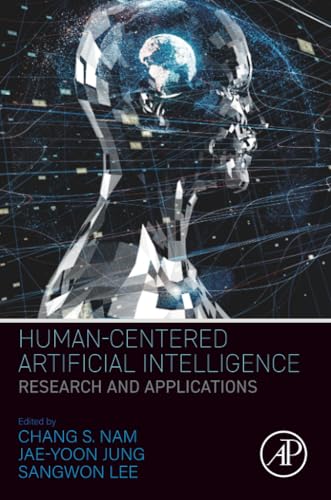
Human-Centered Artificial Intelligence: Research and Applications presents current theories, fundamentals, techniques and diverse applications of human-centered AI. Sections address the question, "are AI models explainable, interpretable and understandable?, introduce readers to the design and development process, including mind perception and human interfaces, explore various applications of human-centered AI, including human-robot interaction, healthcare and decision-making, and more. As human-centered AI aims to push the boundaries of previously limited AI solutions to bridge the gap between machine and human, this book is an ideal update on the latest advances.
Le informazioni nella sezione "Riassunto" possono far riferimento a edizioni diverse di questo titolo.
Informazioni sugli autori
Chang S. Nam is currently a Professor of Industrial and Systems Engineering at North Carolina State University (NCSU), USA. He is also an associated faculty in the UNC/NCSU Joint Department of Biomedical Engineering, Department of Psychology, and Brain Research Imaging Center (BRIC) at UNC. He received a PhD at Virginia Tech. His research interests center around brain-computer interfaces, computational neuroscience, neuroergonomics, and human-AI/Robot/Automation interaction. He is the editor of “Brain-Computer Interfaces Handbook: Technological and Theoretical Advances” (with Drs. Nijholt and Lotte, CRC Press), “Neuroergonomics: Principles and Practices (Springer), “Mobile Brain-Body Imaging and the Neuroscience of Art, Innovation and Creativity (with Contreras-Vidal et al., Springer), “Trust in Human-Robot Interaction: Research and Applications” (with Lyons, Elsevier), and “Human-centered AI: Research and Applications” (with Jung & Lee, Elsevier). Currently, Nam serves as the Editor-in-Chief of the journal Brain-Computer Interfaces.
Jae-Yoon Jung is a professor in the department of industrial and management systems engineering (IE) at Kyung Hee University (KHU), Korea, and also an adjunct professor of the department of the department of software convergence (SWCon), KHU. He is currently the director of Graduate Program, IE and Smart Factory Program at KHU. He is leading Industrial AI Lab at KHU. He received the Ph.D., M.S., and B.S. degrees in Industrial Engineering at Seoul National University (SNU), in 2005, 2001, and 1999, respectively. In SNU, he was supervised by prof. Suk-Ho Kang and Yeongho Kim in Intelligent Manufacturing Systems Lab.
After that, he visited the Process Mining Group at Eindhoven University of Technology (TU/e) in the Netherland, supervised by prof. Wil van der Aalst. Before joining in KHU, he worked for u-Computing Innovation Center (uCIC), directed by Prof. Jinwoo Park, and he also studied in the Information Management Lab. at SNU, supervised by prof. Jonghun Park.
Sangwon Lee is an Associate Professor in Department of Interaction Science and Department of Applied Artificial Intelligence at Sugnkyunkwan University. He is also the director of ID square lab (Interaction Design and Development Laboratory). He received his BS degree from Korea University, and his MS degree and PhD degree from the Pennsylvania State University. His research interests lie in human-AI interaction, user experience, affective computing, user modelling, and explainable artificial intelligence.
Dalla quarta di copertina
Human-centered Artificial Intelligence (AI) are systems that continuously improve with human input while providing an effective experience between human and systems. Human-centered AI aim to push the boundaries of previously limited AI solutions to bridge the gap between machine and human, leading to be better understand human language, cognition, emotion and behavior. Human-Centered Artificial Intelligence: Research and Applications presents the current theories, fundamentals, techniques and diverse applications of human-centered AI. This book begins with addressing the question: Are AI models Explainable, Interpretable, and Understandable? Next, readers are introduced to the design and development process including mind perception and human interfaces. Explores various applications of human-centered AI including human-robot interaction, healthcare and decision making.
Le informazioni nella sezione "Su questo libro" possono far riferimento a edizioni diverse di questo titolo.
Risultati della ricerca per Human-Centered Artificial Intelligence: Research and...

Foto dell'editore
Human-Centered Artificial Intelligence: Research and Applications
Print on DemandDa: Brook Bookstore On Demand, Napoli, NA, Italia
Valutazione del venditore 5 su 5 stelle

Condizione: new. Questo è un articolo print on demand. Codice articolo 503a7612ea6aa1bda792d673f00cbf8b
Compra nuovo
EUR 118,06
Spedizione EUR 6,80
Spedito da Italia a U.S.A.
Spedito da Italia a U.S.A.
Quantità: Più di 20 disponibili
Foto dell'editore
Human-centered Artificial Intelligence: Research and Applications
Print on DemandDa: Revaluation Books, Exeter, Regno Unito
Valutazione del venditore 5 su 5 stelle
Paperback. Condizione: Brand New. 350 pages. 9.00x6.00x0.39 inches. In Stock. This item is printed on demand. Codice articolo __0323856489
Compra nuovo
EUR 134,19
Spedizione EUR 11,66
Spedito da Regno Unito a U.S.A.
Spedito da Regno Unito a U.S.A.
Quantità: 2 disponibili
Foto dell'editore
Human-centered Artificial Intelligence : Research and Applications
Da: GreatBookPrices, Columbia, MD, U.S.A.
Valutazione del venditore 5 su 5 stelle
Condizione: New. Codice articolo 44260797-n
Compra nuovo
EUR 147,85
Spedizione EUR 2,30
Spedito in U.S.A.
Spedito in U.S.A.
Quantità: 5 disponibili
Immagini fornite dal venditore
Human-Centered Artificial Intelligence
Editore:
Elsevier Science & Technology, Academic Press, 2022
ISBN 10: 0323856489
ISBN 13: 9780323856485
Nuovo
Taschenbuch
Da: BuchWeltWeit Ludwig Meier e.K., Bergisch Gladbach, Germania
Valutazione del venditore 5 su 5 stelle
Taschenbuch. Condizione: Neu. This item is printed on demand - it takes 3-4 days longer - Neuware -Human-Centered Artificial Intelligence: Research and Applications presents current theories, fundamentals, techniques and diverse applications of human-centered AI. Sections address the question, 'are AI models explainable, interpretable and understandable , introduce readers to the design and development process, including mind perception and human interfaces, explore various applications of human-centered AI, including human-robot interaction, healthcare and decision-making, and more. As human-centered AI aims to push the boundaries of previously limited AI solutions to bridge the gap between machine and human, this book is an ideal update on the latest advances. Englisch. Codice articolo 9780323856485
Compra nuovo
EUR 131,00
Spedizione EUR 23,00
Spedito da Germania a U.S.A.
Spedito da Germania a U.S.A.
Quantità: 2 disponibili
Foto dell'editore
Human-Centered Artificial Intelligence
Editore:
Elsevier Science & Technology, 2022
ISBN 10: 0323856489
ISBN 13: 9780323856485
Nuovo
Paperback / softback
Da: THE SAINT BOOKSTORE, Southport, Regno Unito
Valutazione del venditore 5 su 5 stelle
Paperback / softback. Condizione: New. New copy - Usually dispatched within 4 working days. Codice articolo B9780323856485
Compra nuovo
EUR 146,25
Spedizione EUR 18,60
Spedito da Regno Unito a U.S.A.
Spedito da Regno Unito a U.S.A.
Quantità: Più di 20 disponibili
Immagini fornite dal venditore
Human-centered Artificial Intelligence : Research and Applications
Da: GreatBookPrices, Columbia, MD, U.S.A.
Valutazione del venditore 5 su 5 stelle
Condizione: As New. Unread book in perfect condition. Codice articolo 44260797
Compra usato
EUR 169,81
Spedizione EUR 2,30
Spedito in U.S.A.
Spedito in U.S.A.
Quantità: Più di 20 disponibili
Foto dell'editore
Human-centered Artificial Intelligence : Research and Applications
Da: GreatBookPricesUK, Woodford Green, Regno Unito
Valutazione del venditore 5 su 5 stelle
Condizione: New. Codice articolo 44260797-n
Compra nuovo
EUR 164,80
Spedizione EUR 17,49
Spedito da Regno Unito a U.S.A.
Spedito da Regno Unito a U.S.A.
Quantità: Più di 20 disponibili
Immagini fornite dal venditore
Human-Centered Artificial Intelligence | Research and Applications
Da: preigu, Osnabrück, Germania
Valutazione del venditore 5 su 5 stelle
Taschenbuch. Condizione: Neu. Human-Centered Artificial Intelligence | Research and Applications | Chang S. Nam (u. a.) | Taschenbuch | Englisch | 2022 | Elsevier Inc | EAN 9780323856485 | Verantwortliche Person für die EU: Kolibri 360 GmbH, Ettore-Bugatti-Str. 6-14, 51149 Köln, produktsicherheit[at]kolibri360[dot]de | Anbieter: preigu. Codice articolo 121082994
Compra nuovo
EUR 124,20
Spedizione EUR 70,00
Spedito da Germania a U.S.A.
Spedito da Germania a U.S.A.
Quantità: 5 disponibili
Foto dell'editore
Human-Centered Artificial Intelligence: Research and Applications
Da: Ria Christie Collections, Uxbridge, Regno Unito
Valutazione del venditore 5 su 5 stelle
Condizione: New. In English. Codice articolo ria9780323856485_new
Compra nuovo
EUR 181,52
Spedizione EUR 13,17
Spedito da Regno Unito a U.S.A.
Spedito da Regno Unito a U.S.A.
Quantità: Più di 20 disponibili
Foto dell'editore
Human-centered Artificial Intelligence : Research and Applications
Da: GreatBookPricesUK, Woodford Green, Regno Unito
Valutazione del venditore 5 su 5 stelle
Condizione: As New. Unread book in perfect condition. Codice articolo 44260797
Compra usato
EUR 182,14
Spedizione EUR 17,49
Spedito da Regno Unito a U.S.A.
Spedito da Regno Unito a U.S.A.
Quantità: Più di 20 disponibili