Sinossi
Nuclear physics began one century ago during the “miraculous decade” - tween 1895 and 1905 when the foundations of practically all modern physics were established. The period started with two unexpected spino?s of the Crooke’s vacuum tube: Roentgen’s X-rays (1895) and Thomson’s electron (1897), the ?rst elementary particle to be discovered. Lorentz and Zeemann developed the the theory of the electron and the in?uence of magnetism on radiation. Quantum phenomenology began in December, 1900 with the - pearance of Planck’s constant followed by Einstein’s 1905 proposal of what is now called the photon. In 1905, Einstein also published the theories of relativity and of Brownian motion, the ultimate triumph of Boltzman’s s- tistical theory, a year before his tragic death. For nuclear physics, the critical discovery was that of radioactivity by Becquerel in 1896. By analyzing the history of science, one can be convinced that there is some rationale in the fact that all of these discoveries came nearly sim- taneously, after the scienti?cally triumphant 19th century. The exception is radioactivity, an unexpected baby whose discovery could have happened s- eral decades earlier. Talentedscientists,theCuries,Rutherford,andmanyothers,tookthe- servationofradioactivityandconstructedtheideasthatarethesubjectofthis book. Of course, the discovery of radioactivity and nuclear physics is of much broader importance. It lead directly to quantum mechanics via Rutherford’s planetary atomic model and Bohr’s interpretation of the hydrogen spectrum. This in turn led to atomic physics, solid state physics, and material science.
Le informazioni nella sezione "Riassunto" possono far riferimento a edizioni diverse di questo titolo.
Dalla quarta di copertina
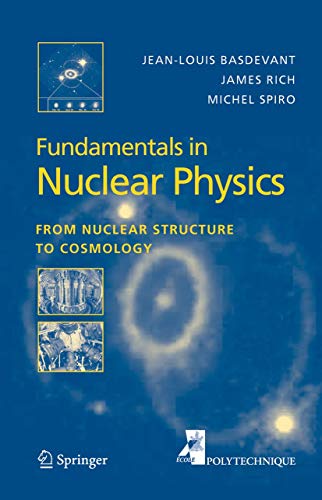
This course explores nuclear physics and its applications ranging from the structure of nuclei and their reactions, to astrophysics and cosmology. The physics is introduced with arguments based on simple ideas such as the empirical structure of nuclear forces and its interplay with the Pauli principle and Coulomb repulsion. The book then develops elementary nuclear models and illustrates nuclear systematics with experimental data. Reactions and decays are discussed both phenomenologically and from the point of view of fundamental electro-weak interaction theory. The discussions of fission and fusion emphasize nuclear energy production. This leads directly into nuclear astrophysics and nucleosynthesis. The book ends with a presentation of the latest ideas about cosmology. As a primer this course will lay the foundations for more specialized subjects within the vast domain of nuclear physics as a whole.
This book emerged from a series of topical courses the authors delivered at the Ecole Polytechnique and will be useful for advanced undergraduates and for scientists in a variety of fields.
Le informazioni nella sezione "Su questo libro" possono far riferimento a edizioni diverse di questo titolo.
Altre edizioni note dello stesso titolo

Risultati della ricerca per Fundamentals in Nuclear Physics: From Nuclear Structure...

Foto dell'editore
Fundamentals in Nuclear Physics: From Nuclear Structure to Cosmology (Advanced Texts in Physics S)
Da: HPB-Red, Dallas, TX, U.S.A.
Valutazione del venditore 5 su 5 stelle

hardcover. Condizione: Good. Connecting readers with great books since 1972! Used textbooks may not include companion materials such as access codes, etc. May have some wear or writing/highlighting. We ship orders daily and Customer Service is our top priority! Codice articolo S_422556215
Compra usato
EUR 75,86
EUR 3,20 shipping
Spedito in U.S.A.
Spedito in U.S.A.
Quantità: 1 disponibili
Foto dell'editore
Fundamentals in Nuclear Physics: From Nuclear Structure to Cosmology (Advanced Texts in Physics S)
Da: Buchmarie, Darmstadt, Germania
Valutazione del venditore 5 su 5 stelle
Condizione: Good. Codice articolo 3775581_ad0
Compra usato
EUR 58,15
EUR 42,00 shipping
Spedito da Germania a U.S.A.
Spedito da Germania a U.S.A.
Quantità: 1 disponibili
Foto dell'editore
Fundamentals in Nuclear Physics
Da: Books Puddle, New York, NY, U.S.A.
Valutazione del venditore 4 su 5 stelle

Condizione: New. pp. 532. Codice articolo 26280667
Compra nuovo
EUR 100,51
EUR 3,41 shipping
Spedito in U.S.A.
Spedito in U.S.A.
Quantità: 1 disponibili
Immagini fornite dal venditore
Fundamentals in Nuclear Physics; From Nuclear Structure to Cosmology
Da: Burton Lysecki Books, ABAC/ILAB, Winnipeg, MB, Canada
Valutazione del venditore 4 su 5 stelle
[0-387-01672-4] 2004. (Hardcover) Near fine, no dust jacket. 515pp. Illustrations, tables, formulas, references, index. (Science, Nuclear Physics, Physics, Science). Codice articolo 159955
Compra usato
EUR 83,12
EUR 21,35 shipping
Spedito da Canada a U.S.A.
Spedito da Canada a U.S.A.
Quantità: 1 disponibili
Foto dell'editore
Fundamentals in Nuclear Physics
Da: Majestic Books, Hounslow, Regno Unito
Valutazione del venditore 4 su 5 stelle
Condizione: New. pp. 532 Illus. Codice articolo 7600004
Compra nuovo
EUR 103,46
EUR 7,43 shipping
Spedito da Regno Unito a U.S.A.
Spedito da Regno Unito a U.S.A.
Quantità: 1 disponibili
Immagini fornite dal venditore
Fundamentals In Nuclear Physics : From Nuclear Structure to Cosmology
Da: GreatBookPrices, Columbia, MD, U.S.A.
Valutazione del venditore 5 su 5 stelle
Condizione: New. Codice articolo 3189291-n
Compra nuovo
EUR 108,78
EUR 2,25 shipping
Spedito in U.S.A.
Spedito in U.S.A.
Quantità: Più di 20 disponibili
Foto dell'editore
Fundamentals in Nuclear Physics: From Nuclear Structure to Cosmology (Advanced Texts in Physics S)
Da: Lucky's Textbooks, Dallas, TX, U.S.A.
Valutazione del venditore 5 su 5 stelle
Condizione: New. Codice articolo ABLIING23Feb2215580170581
Compra nuovo
EUR 112,18
EUR 3,41 shipping
Spedito in U.S.A.
Spedito in U.S.A.
Quantità: Più di 20 disponibili
Foto dell'editore
Fundamentals in Nuclear Physics: From Nuclear Structure to Cosmology (Advanced Texts in Physics S)
Da: California Books, Miami, FL, U.S.A.
Valutazione del venditore 5 su 5 stelle
Condizione: New. Codice articolo I-9780387016726
Compra nuovo
EUR 125,78
Spedizione gratuita
Spedito in U.S.A.
Spedito in U.S.A.
Quantità: Più di 20 disponibili
Immagini fornite dal venditore
Fundamentals In Nuclear Physics : From Nuclear Structure to Cosmology
Da: GreatBookPricesUK, Woodford Green, Regno Unito
Valutazione del venditore 5 su 5 stelle
Condizione: New. Codice articolo 3189291-n
Compra nuovo
EUR 110,50
EUR 17,14 shipping
Spedito da Regno Unito a U.S.A.
Spedito da Regno Unito a U.S.A.
Quantità: Più di 20 disponibili
Foto dell'editore
Fundamentals in Nuclear Physics: From Nuclear Structure to Cosmology
Editore:
Springer-Verlag New York Inc., 2005
ISBN 10: 0387016724
ISBN 13: 9780387016726
Nuovo
Rilegato
Da: THE SAINT BOOKSTORE, Southport, Regno Unito
Valutazione del venditore 5 su 5 stelle
Hardback. Condizione: New. This item is printed on demand. New copy - Usually dispatched within 5-9 working days 890. Codice articolo C9780387016726
Compra nuovo
EUR 136,02
EUR 22,45 shipping
Spedito da Regno Unito a U.S.A.
Spedito da Regno Unito a U.S.A.
Quantità: Più di 20 disponibili