
Articoli correlati a Measure Theory: 143
Sinossi
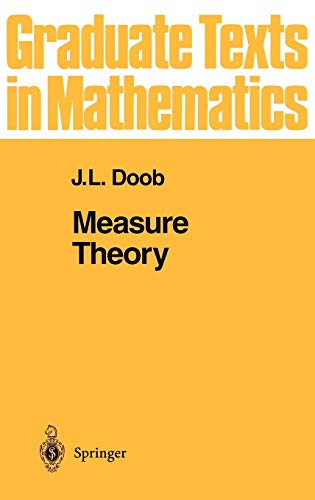
This book was planned originally not as a work to be published, but as an excuse to buy a computer, incidentally to give me a chance to organize my own ideas ~n what measure theory every would-be analyst should learn, and to detail my approach to the subject. When it turned out that Springer-Verlag thought that the point of view in the book had general interest and offered to publish it, I was forced to try to write more clearly and search for errors. The search was productive. Readers will observe the stress on the following points. The application of pseudometric spaces. Pseudo metric, rather than metric spaces, are applied to obviate the artificial replacement of functions by equivalence classes, a replacement that makes the use of "almost everywhere" either improper or artificial. The words "function" and "the set on which a function has values at least E" can be taken literally in this book. Pseudometric space properties are applied in many contexts. For example, outer measures are used to pseudometrize classes of sets and the extension of a finite measure from an algebra to a 0" algebra is thereby reduced to finding the closure of a subset of a pseudo metric space.
Le informazioni nella sezione "Riassunto" possono far riferimento a edizioni diverse di questo titolo.
Contenuti
0. Conventions and Notation.- 1. Notation: Euclidean space.- 2. Operations involving ±?.- 3. Inequalities and inclusions.- 4. A space and its subsets.- 5. Notation: generation of classes of sets.- 6. Product sets.- 7. Dot notation for an index set.- 8. Notation: sets defined by conditions on functions.- 9. Notation: open and closed sets.- 10. Limit of a function at a point.- 11. Metric spaces.- 12. Standard metric space theorems.- 13. Pseudometric spaces.- I. Operations on Sets.- 1. Unions and intersections.- 2. The symmetric difference operator ?.- 3. Limit operations on set sequences.- 4. Probabilistic interpretation of sets and operations on them.- II. Classes of Subsets of a Space.- 1. Set algebras.- 2. Examples.- 3. The generation of set algebras.- 4. The Borel sets of a metric space.- 5. Products of set algebras.- 6. Monotone classes of sets.- III. Set Functions.- 1. Set function definitions.- 2. Extension of a finitely additive set function.- 3. Products of set functions.- 4. Heuristics on a algebras and integration.- 5. Measures and integrals on a countable space.- 6. Independence and conditional probability (preliminary discussion).- 7. Dependence examples.- 8. Inferior and superior limits of sequences of measurable sets.- 9. Mathematical counterparts of coin tossing.- 10. Setwise convergence of measure sequences.- 11. Outer measure.- 12. Outer measures of countable subsets of R.- 13. Distance on a set algebra defined by a subadditive set function.- 14. The pseudometric space defined by an outer measure.- 15. Nonadditive set functions.- IV. Measure Spaces.- 1. Completion of a measure space (S, S,?).- 2. Generalization of length on R.- 3. A general extension problem.- 4. Extension of a measure defined on a set algebra.- 5. Application to Borel measures.- 6. Strengthening of Theorem 5 when the metric space S is complete and separable.- 7. Continuity properties of monotone functions.- 8. The correspondence between monotone increasing functions on R and measures on B(R).- 9. Discrete and continuous distributions on R.- 10. Lebesgue-Stieltjes measures on RN and their corresponding monotone functions.- 11. Product measures.- 12. Examples of measures on RN.- 13. Marginal measures.- 14. Coin tossing.- 15. The Carathéodory measurability criterion.- 16. Measure hulls.- V. Measurable Functions.- 1. Function measurability.- 2. Function measurability properties.- 3. Measurability and sequential convergence.- 4. Baire functions.- 5. Joint distributions.- 6. Measures on function (coordinate) space.- 7. Applications of coordinate space measures.- 8. Mutually independent random variables on a probability space.- 9. Application of independence: the 0-1 law.- 10. Applications of the 0-1 law.- 11. A pseudometric for real valued measurable functions on a measure space.- 12. Convergence in measure.- 13. Convergence in measure vs. almost everywhere convergence.- 14. Almost everywhere convergence vs. uniform convergence.- 15. Function measurability vs. continuity.- 16. Measurable functions as approximated by continuous functions.- 17. Essential supremum and infimum of a measurable function.- 18. Essential supremum and infimum of a collection of measurable functions.- VI. Integration.- 1. The integral of a positive step function on a measure space (S, S,?,).- 2. The integral of a positive function.- 3. Integration to the limit for monotone increasing sequences of positive functions.- 4. Final definition of the integral.- 5. An elementary application of integration.- 6. Set functions defined by integrals.- 7. Uniform integrability test functions.- 8. Integration to the limit for positive integrands.- 9. The dominated convergence theorem.- 10. Integration over product measures.- 11. Jensen’s inequality.- 12. Conjugate spaces and Hölder’s inequality.- 13. Minkowski’s inequality.- 14. The LP spaces as normed linear spaces.- 15. Approximation of LP functions.- 16. Uniform integrability.- 17. Uniform integrability in terms of uniform integrability test functions.- 18. L1 convergence and uniform integrability.- 19. The coordinate space context.- 20. The Riemann integral.- 21. Measure theory vs. premeasure theory analysis.- VII. Hilbert Space.- 1. Analysis of L2.- 2. Hilbert space.- 3. The distance from a subspace.- 4. Projections.- 5. Bounded linear functionals on h.- 6. Fourier series.- 7. Fourier series properties.- 8. Orthogonalization (Erhardt Schmidt procedure).- 9. Fourier trigonometric series.- 10. Two trigonometric integrals.- 11. Heuristic approach to the Fourier transform via Fourier series.- 12. The Fourier-Plancherel theorem.- 13. Ergodic theorems.- VIII. Convergence of Measure Sequences.- 1. Definition of convergence of a measure sequence.- 2. Linear functionals on subsets of ?(S).- 3. Generation of positive linear functionals by measures (S compact metric)..- 4. ?(5) convergence of sequences in M(S) (S compact metric).- 5. Metrization of M(s) to match ?(s) convergence; compactness of Mc(S) (S compact metric).- 6. Properties of the function ???[f], from M(S), in the dM metric into R (S compact metric).- 7. Generation of positive linear functionals on ?0(S) by measures (S a locally compact but not compact separable metric space).- 8. ?0(S)and?00(S)convergence of sequences in M(s) (S a locally compact but not compact separable metric space).- 9. Metrization of M(s) to match ?0(S) convergence; compactness of Mc(S) (S a locally compact but not compact separable metric space, c a strictly positive number).- 10. Properties of the function ???[f], from M(S) in the d0M metric into R (S a locally compact but not compact separable metric space).- 11. Stable?0(S) convergence of sequences in M (S) (S a locally compact but not compact separable metric space).- 12. Metrization of M(s) to match stable ?0(S) convergence (S a locally compact but not compact separable metric space).- 13. Properties of the function ???[f], from M(S) in the dM metric into R (S a locally compact but not compact separable metric space).- 14. Application to analytic and harmonic functions.- IX. Signed Measures.- 1. Range of values of a signed measure.- 2. Positive and negative components of a signed measure.- 3. Lattice property of the class of signed measures.- 4. Absolute continuity and singularity of a signed measure.- 5. Decomposition of a signed measure relative to a measure.- 6. A basic preparatory result on singularity.- 7. Integral representation of an absolutely continuous measure.- 8. Bounded linear functionals on L1.- 9. Sequences of signed measures.- 10. Vitali-Hahn-Saks theorem (continued).- 11. Theorem 10 for signed measures.- X. Measures and Functions of Bounded Variation on R.- 1. Introduction.- 2. Covering lemma.- 3. Vitali covering of a set.- 4. Derivation of Lebesgue-Stieltjes measures and of monotone functions.- 5. Functions of bounded variation.- 6. Functions of bounded variation vs. signed measures.- 7. Absolute continuity and singularity of a function of bounded variation.- 8. The convergence set of a sequence of monotone functions.- 9. Helly’s compactness theorem for sequences of monotone functions.- 10. Intervals of uniform convergence of a convergent sequence of monotone functions.- 11. ?(I) convergence of measure sequences on a compact interval I.- 12. ?0(R) convergence of a measure sequence.- 13. Stable ?0(R) convergence of a measure sequence.- 14. The characteristic function of a measure.- 15. Stable ?0(R) convergence of a sequence of probability distributions.- 16. Application to a stable ?0(R) metrization of M(R).- 17. General approach to derivation.- 18. A ratio limit lemma.- 19. Application to the boundary limits of harmonic functions.- XI. Conditional Expectations ; Martingale Theory.- 1. Stochastic processes.- 2. Conditional probability and expectation.- 3 Conditional expectation properties.- 4. Filtrations and adapted families of functions.- 5. Martingale theory definitions.- 6. Martingale examples.- 7. Elementary properties of (sub- super-) martingales.- 8. Optional times.- 9. Optional time properties.- 10. The optional sampling theorem.- 11. The maximal submartingale inequality.- 12. Upcrossings and convergence.- 13. The submartingale upcrossing inequality.- 14. Forward (sub- super-) martingale convergence.- 15. Backward martingale convergence.- 16. Backward supermartingale convergence.- 17. Application of martingale theory to derivation.- 18. Application of martingale theory to the 0-1 law.- 19. Application of martingale theory to the strong law of large numbers.- 20. Application of martingale theory to the convergence of infinite series.- 21. Application of martingale theory to the boundary limits of harmonic functions.- Notation.
Product Description
Book by Doob JL
Le informazioni nella sezione "Su questo libro" possono far riferimento a edizioni diverse di questo titolo.
Risultati della ricerca per Measure Theory: 143

Foto dell'editore
Measure Theory (Graduate Texts in Mathematics, 143)
Da: A Squared Books (Don Dewhirst), South Lyon, MI, U.S.A.
Valutazione del venditore 5 su 5 stelle

hardcover. Condizione: Very Good. New York, 1993; yellow and white cloth covered boards; mild corner and spine edge wear; 8vo - over 7 3/4" to 9 3/4" tall; Interior is clean and unmarked; 210 pages. Codice articolo SKU1179183
Compra usato
EUR 37,96
Spedizione EUR 5,78
Spedito in U.S.A.
Spedito in U.S.A.
Quantità: 1 disponibili
Foto dell'editore
Measure Theory (Graduate Texts in Mathematics)
Da: Books From California, Simi Valley, CA, U.S.A.
Valutazione del venditore 4 su 5 stelle

Hardcover. Condizione: Very Good. Codice articolo mon0004259391
Compra usato
EUR 39,95
Spedizione EUR 4,44
Spedito in U.S.A.
Spedito in U.S.A.
Quantità: 1 disponibili
Foto dell'editore
Measure Theory (Graduate Texts in Mathematics, 143)
Da: HPB-Red, Dallas, TX, U.S.A.
Valutazione del venditore 5 su 5 stelle
Hardcover. Condizione: Good. Connecting readers with great books since 1972! Used textbooks may not include companion materials such as access codes, etc. May have some wear or writing/highlighting. We ship orders daily and Customer Service is our top priority! Codice articolo S_439494667
Compra usato
EUR 41,18
Spedizione EUR 3,34
Spedito in U.S.A.
Spedito in U.S.A.
Quantità: 1 disponibili
Immagini fornite dal venditore
Measure Theory
Da: GreatBookPrices, Columbia, MD, U.S.A.
Valutazione del venditore 5 su 5 stelle
Condizione: New. Codice articolo 671386-n
Compra nuovo
EUR 79,07
Spedizione EUR 2,35
Spedito in U.S.A.
Spedito in U.S.A.
Quantità: Più di 20 disponibili
Foto dell'editore
Measure Theory (Hardcover)
Editore:
Springer-Verlag New York Inc., New York, NY, 1993
ISBN 10: 0387940553
ISBN 13: 9780387940557
Nuovo
Rilegato
Da: Grand Eagle Retail, Bensenville, IL, U.S.A.
Valutazione del venditore 5 su 5 stelle
Hardcover. Condizione: new. Hardcover. This book was planned originally not as a work to be published, but as an excuse to buy a computer, incidentally to give me a chance to organize my own ideas ~n what measure theory every would-be analyst should learn, and to detail my approach to the subject. When it turned out that Springer-Verlag thought that the point of view in the book had general interest and offered to publish it, I was forced to try to write more clearly and search for errors. The search was productive. Readers will observe the stress on the following points. The application of pseudometric spaces. Pseudo metric, rather than metric spaces, are applied to obviate the artificial replacement of functions by equivalence classes, a replacement that makes the use of "almost everywhere" either improper or artificial. The words "function" and "the set on which a function has values at least E" can be taken literally in this book. Pseudometric space properties are applied in many contexts. For example, outer measures are used to pseudometrize classes of sets and the extension of a finite measure from an algebra to a 0" algebra is thereby reduced to finding the closure of a subset of a pseudo metric space. This book was planned originally not as a work to be published, but as an excuse to buy a computer, incidentally to give me a chance to organize my own ideas ~n what measure theory every would-be analyst should learn, and to detail my approach to the subject. Shipping may be from multiple locations in the US or from the UK, depending on stock availability. Codice articolo 9780387940557
Compra nuovo
EUR 81,50
Spedizione gratuita
Spedito in U.S.A.
Spedito in U.S.A.
Quantità: 1 disponibili
Immagini fornite dal venditore
Measure Theory
Da: GreatBookPrices, Columbia, MD, U.S.A.
Valutazione del venditore 5 su 5 stelle
Condizione: As New. Unread book in perfect condition. Codice articolo 671386
Compra usato
EUR 87,05
Spedizione EUR 2,35
Spedito in U.S.A.
Spedito in U.S.A.
Quantità: Più di 20 disponibili
Foto dell'editore
Measure Theory (Graduate Texts in Mathematics, 143)
Da: Ria Christie Collections, Uxbridge, Regno Unito
Valutazione del venditore 5 su 5 stelle
Condizione: New. In English. Codice articolo ria9780387940557_new
Compra nuovo
EUR 89,16
Spedizione EUR 13,41
Spedito da Regno Unito a U.S.A.
Spedito da Regno Unito a U.S.A.
Quantità: Più di 20 disponibili
Foto dell'editore
Measure Theory (Graduate Texts in Mathematics, 143)
Da: GoldBooks, Denver, CO, U.S.A.
Valutazione del venditore 5 su 5 stelle
Hardcover. Condizione: new. New Copy. Customer Service Guaranteed. Codice articolo 41Q34_21_0387940553
Compra nuovo
EUR 98,25
Spedizione EUR 4,90
Spedito in U.S.A.
Spedito in U.S.A.
Quantità: 1 disponibili
Immagini fornite dal venditore
Measure Theory
Print on DemandDa: BuchWeltWeit Ludwig Meier e.K., Bergisch Gladbach, Germania
Valutazione del venditore 5 su 5 stelle
Buch. Condizione: Neu. This item is printed on demand - it takes 3-4 days longer - Neuware -This book was planned originally not as a work to be published, but as an excuse to buy a computer, incidentally to give me a chance to organize my own ideas ~n what measure theory every would-be analyst should learn, and to detail my approach to the subject. When it turned out that Springer-Verlag thought that the point of view in the book had general interest and offered to publish it, I was forced to try to write more clearly and search for errors. The search was productive. Readers will observe the stress on the following points. The application of pseudometric spaces. Pseudo metric, rather than metric spaces, are applied to obviate the artificial replacement of functions by equivalence classes, a replacement that makes the use of 'almost everywhere' either improper or artificial. The words 'function' and 'the set on which a function has values at least E' can be taken literally in this book. Pseudometric space properties are applied in many contexts. For example, outer measures are used to pseudometrize classes of sets and the extension of a finite measure from an algebra to a 0' algebra is thereby reduced to finding the closure of a subset of a pseudo metric space. 228 pp. Englisch. Codice articolo 9780387940557
Compra nuovo
EUR 80,24
Spedizione EUR 23,00
Spedito da Germania a U.S.A.
Spedito da Germania a U.S.A.
Quantità: 1 disponibili
Foto dell'editore
Measure Theory (Graduate Texts in Mathematics, 143)
Da: California Books, Miami, FL, U.S.A.
Valutazione del venditore 5 su 5 stelle
Condizione: New. Codice articolo I-9780387940557
Compra nuovo
EUR 106,43
Spedizione gratuita
Spedito in U.S.A.
Spedito in U.S.A.
Quantità: Più di 20 disponibili