
Articoli correlati a Integration of Robots into CIM
Sinossi
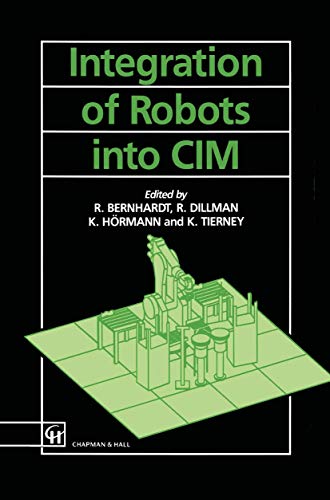
Information techniques have initiated a structural change of the manufacturing industry. Productivity, flexibility, quality, and reliability will attain a level which cannot be realized on the basis of conventional production structures. The differentiated technological requirements to products lead to an increased product variation and a quick product substitution. These alterations of the market situation demand automation of the highest flexibility and productivity. This can be reached by computer integrated, automated and flexible manufacturing, whereby information techniques take over a key function. In production technology it was comprehended at a very early stage that computers are important components. Stations of these developments were the NC technique, CNC controls up to the development of FMS with robots. In this context it can be stated that robots play an important role as the most flexible automation components.
Le informazioni nella sezione "Riassunto" possono far riferimento a edizioni diverse di questo titolo.
Recensione
This work is expected to influence standards set up to describe assembly tasks and factory layouts. - Professional Engineering
Contenuti
Section I Survey of the project.- 1 Robots in CIM.- 2 Objectives, approaches and main benefits.- 3 Introduction and role of the partners.- 4 Structure of the book.- Section II Systems-planning.- 5 Procedure for a computer-aided planning process.- 6 Task sequence planning.- 7 Component selection and layout planning.- 8 Process planning.- 9 Layout optimization.- 10 Conclusion to system planning.- Section III Programming.- 11 Introduction to programming methods.- 12 Robot motion execution planning.- 13 Robot program generation.- 14 Process execution simulation.- 15 Program execution.- 16 Task-level programming.- 17 Exception handling.- 18 Conclusions.- Section IV Information system.- 19 Introduction.- 20 Design management system.- 21 Design of a knowledge-based information system.- 22 Conclusions.- Section V Applications of the system.- 23 Introduction.- 24 Planning and programming of a dot matrix printer assembly.- 25 Programming of the Cranfield assembly benchmark.- 26 Industrial application of the planning and interactive programming system.- 27 Applications at FIAR.- 28 Applications at KUKA and benefits.- 29 Applications at the IPK Berlin.- 30 Conclusions.- Section VI Summary.- 31 Major achievements.- 32 Exploitation of results.- 33 Standardization aspects.- 34 The future of robots in CIM.
Le informazioni nella sezione "Su questo libro" possono far riferimento a edizioni diverse di questo titolo.
Risultati della ricerca per Integration of Robots into CIM

Immagini fornite dal venditore
Integration of Robots into CIM
Da: -OnTimeBooks-, Phoenix, AZ, U.S.A.
Valutazione del venditore 5 su 5 stelle

Condizione: good. A copy that has been read, remains in good condition. All pages are intact, and the cover is intact. The spine and cover show signs of wear. Pages can include notes and highlighting and show signs of wear, and the copy can include "From the library of" labels or previous owner inscriptions. 100% GUARANTEE! Shipped with delivery confirmation, if you're not satisfied with purchase please return item! Ships via media mail. Codice articolo OTV.0412371405.G
Compra usato
EUR 58,02
Spedizione gratuita
Spedito in U.S.A.
Spedito in U.S.A.
Quantità: 2 disponibili
Immagini fornite dal venditore
Integration of Robots into CIM
Editore:
Springer Netherlands Dez 1991, 1991
ISBN 10: 0412371405
ISBN 13: 9780412371400
Nuovo
Rilegato
Da: BuchWeltWeit Ludwig Meier e.K., Bergisch Gladbach, Germania
Valutazione del venditore 5 su 5 stelle
Buch. Condizione: Neu. This item is printed on demand - it takes 3-4 days longer - Neuware -From its inception in 1983, ESPRIT (the European Strategic Programme for Research and Development in Information Technology) has aimed at improving the competitiveness of European industry and providing it with the technology needed for the 1990s. Esprit Project 623, on which most of the work presented in this book is based, was one of the key projects in the ESPRIT area, Computer Integrated Manufacturing (CIM). From its beginnings in 1985, it brought together a team of researchers from industry, research institutes and universities to explore and develop a critical stream of advanced manufacturing technology that would be timely and mature for industrial exploitation in a five year time frame. The synergy of cross border collaboration between technology users and vendors has led to results ranging from new and improved products to training courses given at universities. The subject of Esprit Project 623 was the integration of robots into manufacturing environments. Robots are a vital element in flexible automation and can contribute substantially to manufacturing efficiency. The project had two main themes, off-line programming and robot system planning. Off-line programming enlarges the application area of robots and opens up new possibilities in domains such as laser cutting, and other hazardous operations. Reported benefits obtained from off-line program ming include: - significant cost reductions because re-programming eliminates robot down-time; - faster production cycles, in some cases time-savings of up to 85% are reported; - the optimal engineering of products with improved quality. 368 pp. Englisch. Codice articolo 9780412371400
Compra nuovo
EUR 160,49
Spedizione EUR 23,00
Spedito da Germania a U.S.A.
Spedito da Germania a U.S.A.
Quantità: 2 disponibili
Immagini fornite dal venditore
Integration of Robots into CIM
Print on DemandDa: moluna, Greven, Germania
Valutazione del venditore 5 su 5 stelle
Gebunden. Condizione: New. Dieser Artikel ist ein Print on Demand Artikel und wird nach Ihrer Bestellung fuer Sie gedruckt. From its inception in 1983, ESPRIT (the European Strategic Programme for Research and Development in Information Technology) has aimed at improving the competitiveness of European industry and providing it with the technology needed for the 1990s. Esprit Pr. Codice articolo 5914545
Compra nuovo
EUR 136,16
Spedizione EUR 48,99
Spedito da Germania a U.S.A.
Spedito da Germania a U.S.A.
Quantità: Più di 20 disponibili
Immagini fornite dal venditore
Integration of Robots into Cim
Da: GreatBookPrices, Columbia, MD, U.S.A.
Valutazione del venditore 5 su 5 stelle
Condizione: New. Codice articolo 1610719-n
Compra nuovo
EUR 190,90
Spedizione EUR 2,35
Spedito in U.S.A.
Spedito in U.S.A.
Quantità: 15 disponibili
Foto dell'editore
Integration of Robots into CIM
Da: Ria Christie Collections, Uxbridge, Regno Unito
Valutazione del venditore 5 su 5 stelle
Condizione: New. In English. Codice articolo ria9780412371400_new
Compra nuovo
EUR 184,36
Spedizione EUR 13,31
Spedito da Regno Unito a U.S.A.
Spedito da Regno Unito a U.S.A.
Quantità: Più di 20 disponibili
Immagini fornite dal venditore
Integration of Robots into CIM
Da: AHA-BUCH GmbH, Einbeck, Germania
Valutazione del venditore 5 su 5 stelle
Buch. Condizione: Neu. Druck auf Anfrage Neuware - Printed after ordering - From its inception in 1983, ESPRIT (the European Strategic Programme for Research and Development in Information Technology) has aimed at improving the competitiveness of European industry and providing it with the technology needed for the 1990s. Esprit Project 623, on which most of the work presented in this book is based, was one of the key projects in the ESPRIT area, Computer Integrated Manufacturing (CIM). From its beginnings in 1985, it brought together a team of researchers from industry, research institutes and universities to explore and develop a critical stream of advanced manufacturing technology that would be timely and mature for industrial exploitation in a five year time frame. The synergy of cross border collaboration between technology users and vendors has led to results ranging from new and improved products to training courses given at universities. The subject of Esprit Project 623 was the integration of robots into manufacturing environments. Robots are a vital element in flexible automation and can contribute substantially to manufacturing efficiency. The project had two main themes, off-line programming and robot system planning. Off-line programming enlarges the application area of robots and opens up new possibilities in domains such as laser cutting, and other hazardous operations. Reported benefits obtained from off-line program ming include: - significant cost reductions because re-programming eliminates robot down-time; - faster production cycles, in some cases time-savings of up to 85% are reported; - the optimal engineering of products with improved quality. Codice articolo 9780412371400
Compra nuovo
EUR 170,19
Spedizione EUR 35,00
Spedito da Germania a U.S.A.
Spedito da Germania a U.S.A.
Quantità: 1 disponibili
Immagini fornite dal venditore
Integration of Robots into CIM
Print on DemandDa: preigu, Osnabrück, Germania
Valutazione del venditore 5 su 5 stelle
Buch. Condizione: Neu. Integration of Robots into CIM | Roger Bernard (u. a.) | Buch | Einband - fest (Hardcover) | Englisch | 1991 | Springer | EAN 9780412371400 | Verantwortliche Person für die EU: Springer Netherlands, Haberstr. 7, 69126 Heidelberg, buchhandel-buch[at]springer[dot]com | Anbieter: preigu Print on Demand. Codice articolo 102546842
Compra nuovo
EUR 141,20
Spedizione EUR 70,00
Spedito da Germania a U.S.A.
Spedito da Germania a U.S.A.
Quantità: 5 disponibili
Foto dell'editore
Integration of Robots into CIM
Da: Kennys Bookshop and Art Galleries Ltd., Galway, GY, Irlanda
Valutazione del venditore 5 su 5 stelle
Condizione: New. Information techniques have initiated a structural change of the manufacturing industry and computers are seen as important components in production technology. This volume focuses on the use of robots in computer integrated manufacturing. Num Pages: 349 pages, biography. BIC Classification: TD. Category: (P) Professional & Vocational; (UP) Postgraduate, Research & Scholarly. Dimension: 235 x 155 x 20. Weight in Grams: 691. . 1991. Hardback. . . . . Codice articolo V9780412371400
Compra nuovo
EUR 202,32
Spedizione EUR 9,50
Spedito da Irlanda a U.S.A.
Spedito da Irlanda a U.S.A.
Quantità: 15 disponibili
Immagini fornite dal venditore
Integration of Robots into CIM
Editore:
Springer Netherlands, Springer Netherlands Dez 1991, 1991
ISBN 10: 0412371405
ISBN 13: 9780412371400
Nuovo
Rilegato
Da: buchversandmimpf2000, Emtmannsberg, BAYE, Germania
Valutazione del venditore 5 su 5 stelle
Buch. Condizione: Neu. This item is printed on demand - Print on Demand Titel. Neuware -From its inception in 1983, ESPRIT (the European Strategic Programme for Research and Development in Information Technology) has aimed at improving the competitiveness of European industry and providing it with the technology needed for the 1990s. Esprit Project 623, on which most of the work presented in this book is based, was one of the key projects in the ESPRIT area, Computer Integrated Manufacturing (CIM). From its beginnings in 1985, it brought together a team of researchers from industry, research institutes and universities to explore and develop a critical stream of advanced manufacturing technology that would be timely and mature for industrial exploitation in a five year time frame. The synergy of cross border collaboration between technology users and vendors has led to results ranging from new and improved products to training courses given at universities. The subject of Esprit Project 623 was the integration of robots into manufacturing environments. Robots are a vital element in flexible automation and can contribute substantially to manufacturing efficiency. The project had two main themes, off-line programming and robot system planning. Off-line programming enlarges the application area of robots and opens up new possibilities in domains such as laser cutting, and other hazardous operations. Reported benefits obtained from off-line program ming include: - significant cost reductions because re-programming eliminates robot down-time; - faster production cycles, in some cases time-savings of up to 85% are reported; - the optimal engineering of products with improved quality.Springer Verlag GmbH, Tiergartenstr. 17, 69121 Heidelberg 368 pp. Englisch. Codice articolo 9780412371400
Compra nuovo
EUR 160,49
Spedizione EUR 60,00
Spedito da Germania a U.S.A.
Spedito da Germania a U.S.A.
Quantità: 1 disponibili
Foto dell'editore
Integration of Robots into CIM
Da: Books Puddle, Woodside, NY, U.S.A.
Valutazione del venditore 4 su 5 stelle

Condizione: New. pp. 368. Codice articolo 263065461
Compra nuovo
EUR 235,28
Spedizione EUR 3,55
Spedito in U.S.A.
Spedito in U.S.A.
Quantità: 4 disponibili