
Articoli correlati a Creative Conservation: Interactive management of wild...
Sinossi
Past progress and future challenges R.J. Wheater Royal Zoological Society of Scotland, Edinburgh, UK. In the past two decades much has been achieved in the sphere of breeding endangered species, and we should be pleased that our co operative efforts have already borne so much fruit. However, on balance and despite the best efforts of conservationists, the position of wildlife in the wild places where they are best conserved has become worse, often dramatically worse. Before returning to the United Kingdom in 1972, I was in Uganda for 16 years, most of which time was spent as Chief Warden of Murchison Falls National Park. Our main problem was that an over-population of large mammals was having a devastating impact on the habitat. Devas tation was being wrought on woodland areas by the arrival of large numbers of elephants into the sanctuary of the Park, following changes in land use in the areas outside the Park. These changes were in response to the requirements of an ever-expanding human population.
Le informazioni nella sezione "Riassunto" possono far riferimento a edizioni diverse di questo titolo.
Recensione
A major contribution to the debate about the interactive management of populations of animals under threat of extinction - Ethology, Ecology and Evolution; A very substantial book ... makes a detailed and irrefutable case for zoos as vital partners in the struggle to preserve the world's wildlife - N Gould; ...of great value to those who are concerned with successful programmes for conserving endangered species and care for the environment - Environmental Management and Health; This book presents a full review of the biological, logistical and economic concerns that exist in all efforts to manage populations, and is a major contribution to the debate on interactive management of populations of animals under threat of extinction...the editors have to be congratulated in producing from this conference a document, which not only contains much up-to-date, relevant and important information for anyone working in the fields of conservation and zoo biology, but which also clearly demonstrates how far we have progressed in our knowledge and understanding of the breeding of threatened species both in the wild and in captivity - Animal Welfare; ...the book would be a useful addition to most libraries and the personal libraries of those unfamiliar with the primary literature. Several papers are probably destined to become classics ... - Zoo Biology
Contenuti
1 Species extinctions, endangerment and captive breeding.- 2 The effective use of flagship species for conservation of biodiversity: the example of lion tamarins in Brazil.- 3 Meta-populations: is management as flexible as nature?.- 4 Species differences and population structure in population viability analysis.- 5 Molecular genetics of endangered species.- 6 Evolutionary biology, genetics and the management of endangered primate species.- 7 Reproductive technologies.- 8 The role of environmental enrichment in the captive breeding and reintroduction of endangered species.- 9 Disease risks associated with wildlife translocation projects.- 10 Legalities and logistics of meta-population management.- 11 Training in zoo biology: two approaches to enhance the conservation role of zoos in the tropics.- 12 Reintroduction as a reason for captive breeding.- 13 Reintroduction of captive-born animals.- 14 Criteria for reintroductions.- 15 Development of coordinated genetic and demographic breeding programmes.- 16 Conservation Assessment and Management Plans (CAMPs) and Global Captive Action Plans (GCAPs).- 17 Invertebrate propagation and re-establishment programmes: the conservation and education potential for zoos and related institutions.- 18 Captive breeding programmes and their role in fish conservation.- 19 The role of captive breeding in the conservation of Old World fruit bats.- 20 Captive breeding, reintroduction and the conservation of canids.- 21 The recovery of the angonoka (Geochelone yniphora) — an integrated approach to species conservation.- 22 Is the Hawaiian goose (Branta sandvicensis) saved from extinction?.- 23 The extinction in the wild and reintroduction of the California condor (Gymnogyps californianus).- 24 The captive breeding and conservation programme of the Bali starling (Leucopsar rothschildi).- 25 An experimental reintroduction programme for bush-tailed phascogales (Phascogale tapoatafa): the interface between captivity and the wild.- 26 Coordinating conservation for the drill (Mandrillus leucophaeus): endangered in forest and zoo.- 27 Reintroduction of the black-footed ferret (Mustela nigripes).- 28 Threatened endemic mammals of the Philippines: an integrated approach to the management of wild and captive populations.- 29 Interface between captive and wild populations of New Zealand fauna.- 30 The potential for captive breeding programmes in Venezuala — efforts between zoos, government and non-governmental organizations.- 31 Species conservation priorities in Vietnam and the potential role of zoos.
Le informazioni nella sezione "Su questo libro" possono far riferimento a edizioni diverse di questo titolo.
Risultati della ricerca per Creative Conservation: Interactive management of wild...

Foto dell'editore
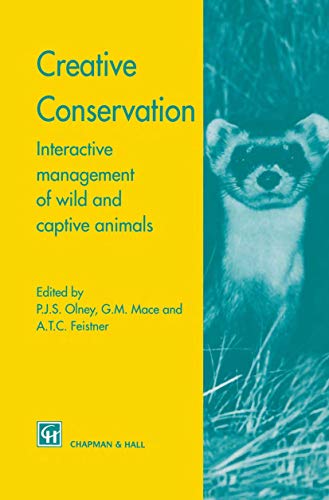
Creative Conservation: Interactive management of wild and captive animals
Da: Riverby Books (DC Inventory), Fredericksburg, VA, U.S.A.
Valutazione del venditore 5 su 5 stelle

hardcover. Condizione: Good. Hardcover, no just jacket. Good condition; some foxing to textblock. No date on the tile page. Copyright page dated 1994. 517 Pages. Pages are free of any writing or markings. Overall good condition. This book is apart of our Thomas Lovejoy collection. Please email with questions or to see any photos. Codice articolo F-9482
Compra usato
EUR 29,86
Spedizione EUR 8,87
Spedito in U.S.A.
Spedito in U.S.A.
Quantità: 1 disponibili
Foto dell'editore
Creative Conservation: Interactive Management of Wild and Captive Animals
Da: Anybook.com, Lincoln, Regno Unito
Valutazione del venditore 5 su 5 stelle
Condizione: Poor. This is an ex-library book and may have the usual library/used-book markings inside.This book has hardback covers. Book contains pen & pencil markings. In poor condition, suitable as a reading copy. Please note the Image in this listing is a stock photo and may not match the covers of the actual item,950grams, ISBN:9780412495700. Codice articolo 9527902
Compra usato
EUR 26,88
Spedizione EUR 15,38
Spedito da Regno Unito a U.S.A.
Spedito da Regno Unito a U.S.A.
Quantità: 1 disponibili
Foto dell'editore
Creative Conservation: Interactive Management of Wild and Captive Animals
Da: Anybook.com, Lincoln, Regno Unito
Valutazione del venditore 5 su 5 stelle
Condizione: Poor. This is an ex-library book and may have the usual library/used-book markings inside.This book has hardback covers. Book contains pen markings. In poor condition, suitable as a reading copy. No dust jacket. Please note the Image in this listing is a stock photo and may not match the covers of the actual item,900grams, ISBN:9780412495700. Codice articolo 9870945
Compra usato
EUR 29,25
Spedizione EUR 15,38
Spedito da Regno Unito a U.S.A.
Spedito da Regno Unito a U.S.A.
Quantità: 1 disponibili
Foto dell'editore
Creative Conservation: Interactive management of wild and captive animals
Da: AwesomeBooks, Wallingford, Regno Unito
Valutazione del venditore 5 su 5 stelle
Hardcover. Condizione: Very Good. Creative Conservation: Interactive management of wild and captive animals This book is in very good condition and will be shipped within 24 hours of ordering. The cover may have some limited signs of wear but the pages are clean, intact and the spine remains undamaged. This book has clearly been well maintained and looked after thus far. Money back guarantee if you are not satisfied. See all our books here, order more than 1 book and get discounted shipping. Codice articolo 7719-9780412495700
Compra usato
EUR 42,63
Spedizione EUR 4,86
Spedito da Regno Unito a U.S.A.
Spedito da Regno Unito a U.S.A.
Quantità: 2 disponibili
Foto dell'editore
Creative Conservation: Interactive management of wild and captive animals
Da: Bahamut Media, Reading, Regno Unito
Valutazione del venditore 4 su 5 stelle

Hardcover. Condizione: Very Good. This book is in very good condition and will be shipped within 24 hours of ordering. The cover may have some limited signs of wear but the pages are clean, intact and the spine remains undamaged. This book has clearly been well maintained and looked after thus far. Money back guarantee if you are not satisfied. See all our books here, order more than 1 book and get discounted shipping. Codice articolo 6545-9780412495700
Compra usato
EUR 41,88
Spedizione EUR 8,23
Spedito da Regno Unito a U.S.A.
Spedito da Regno Unito a U.S.A.
Quantità: 2 disponibili
Immagini fornite dal venditore
Creative Conservation: Interactive Management of Wild and Captive Animals
Editore:
Chapman & Hall, London, 1994
ISBN 10: 0412495708
ISBN 13: 9780412495700
Antico o usato
Rilegato
Da: PEMBERLEY NATURAL HISTORY BOOKS BA, ABA, Iver, Regno Unito
Valutazione del venditore 5 su 5 stelle
Condizione: Very Good. 517, figs. . HB. Vg. From the library of Nicholas Gould (1941-2014), former editor of 'International Zoo News', with his book-plate to endpaper. Presents a full review of the biological, logistic and economic concerns that exist in all efforts to manage populations, and is based upon the Sixth World Conference on Breeding Endangered Species, held in Jersey in 1992. Contents include: Re-introduction and captive breeding; Re-introduction of specific species; and Regional approaches.'A very substantial book . makes a detailed and irrefutable case for zoos as vital partners in the struggle to preserve the world's wildlife' - Nicholas Gould. [9780412495700]. Codice articolo S32022
Compra usato
EUR 54,68
Spedizione EUR 25,96
Spedito da Regno Unito a U.S.A.
Spedito da Regno Unito a U.S.A.
Quantità: 1 disponibili
Foto dell'editore
Creative Conservation: Interactive management of wild and captive animals
Da: GoldBooks, Denver, CO, U.S.A.
Valutazione del venditore 5 su 5 stelle
Hardcover. Condizione: new. New Copy. Customer Service Guaranteed. Codice articolo 72V70_95_0412495708
Compra nuovo
EUR 222,02
Spedizione EUR 4,91
Spedito in U.S.A.
Spedito in U.S.A.
Quantità: 1 disponibili
Immagini fornite dal venditore
Creative Conservation
Da: moluna, Greven, Germania
Valutazione del venditore 5 su 5 stelle
Gebunden. Condizione: New. Codice articolo 5914819
Compra nuovo
EUR 267,86
Spedizione EUR 48,99
Spedito da Germania a U.S.A.
Spedito da Germania a U.S.A.
Quantità: Più di 20 disponibili
Foto dell'editore
Creative Conservation : Interactive Management of Wild and Captive Animals
Da: GreatBookPrices, Columbia, MD, U.S.A.
Valutazione del venditore 5 su 5 stelle
Condizione: New. Codice articolo 675917-n
Compra nuovo
EUR 331,83
Spedizione EUR 2,35
Spedito in U.S.A.
Spedito in U.S.A.
Quantità: 15 disponibili
Immagini fornite dal venditore
Creative Conservation
Editore:
Springer Netherlands Dez 1993, 1993
ISBN 10: 0412495708
ISBN 13: 9780412495700
Nuovo
Rilegato
Da: BuchWeltWeit Ludwig Meier e.K., Bergisch Gladbach, Germania
Valutazione del venditore 5 su 5 stelle
Buch. Condizione: Neu. This item is printed on demand - it takes 3-4 days longer - Neuware -Past progress and future challenges R.J. Wheater Royal Zoological Society of Scotland, Edinburgh, UK. In the past two decades much has been achieved in the sphere of breeding endangered species, and we should be pleased that our co operative efforts have already borne so much fruit. However, on balance and despite the best efforts of conservationists, the position of wildlife in the wild places where they are best conserved has become worse, often dramatically worse. Before returning to the United Kingdom in 1972, I was in Uganda for 16 years, most of which time was spent as Chief Warden of Murchison Falls National Park. Our main problem was that an over-population of large mammals was having a devastating impact on the habitat. Devas tation was being wrought on woodland areas by the arrival of large numbers of elephants into the sanctuary of the Park, following changes in land use in the areas outside the Park. These changes were in response to the requirements of an ever-expanding human population. 556 pp. Englisch. Codice articolo 9780412495700
Compra nuovo
EUR 320,99
Spedizione EUR 23,00
Spedito da Germania a U.S.A.
Spedito da Germania a U.S.A.
Quantità: 2 disponibili