
Articoli correlati a Domino Effects in the Process Industries: Modelling,...
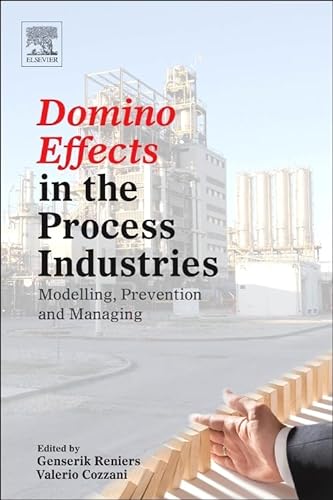
Sinossi
The topic concerns the so-called ‘domino effects’ or accidents with escalation effects within the chemical industry. Domino effects can be defined in a number of ways. For a list of domino effect definitions, see Reniers’ article in the Journal of Hazardous Materials 177 (2010). The most widely used definition is that of Delvosalle (1998): "A domino effect is a cascade of accidents (domino events) in which the consequences of a previous accident are increased by the following one(s), spatially as well as temporally, leading to a major accident.".
To the best of the authors’ knowledge, no book is currently available that specifically deals with the important topic of preventing domino effects in the chemical and process industries. However, a large amount of academic research has been carried out since the EU Seveso-II Directive entered into force (1996), requiring that such low frequency/high consequence events are considered in companies’ safety reports (art. 8). Academic interest is evident by the considerable amount of scientific papers on the subject published since 1996. The topic has thus gained importance within the academic world.
With respect to industry, domino effects and their prevention are mainly considered important due to the legislative requirements, that goes beyond the capabilities of simplified domino assessment methods used before the year 2000. Since the 2003 Amendment of the Seveso-II Directive, imposing even more strict regulations on the reporting of domino scenarios and on the identification of domino effects outside the boundaries of a single industrial site, domino effects constitute an issue that needs to be specifically addressed in the management of industrial sites.
Moreover, especially since 9/11, the possibility of domino effects has become important also from a security perspective, thus from the viewpoint of preventing and/or mitigating intentionally induced escalation events (e.g. by terrorists or by disgruntled employees).
- Presents Domino effects from a technological as well as a managerial (non-technological) perspective- holistic/multidisciplinary approach
- Covers Domino effects from a safety (non-intentional) as well as a security (intentional) perspective-guidelines for preventing accidents and actions to be taken
- Written for academics as well as industrialists (easy to understand, yet advanced science)-holistic overview of the topic from theoretical and practical aspects
- Provides State-of-the-art methodologies for domino effect assessment-easy to understand methods for assessment of domino effects
- Provides worked examples on key-methodologies-real life situations enabling the section of the most appropriate methodology
- Includes Glossary-clear and unambiguous definition of terms used throughout the text which avoids misunderstandings
Le informazioni nella sezione "Riassunto" possono far riferimento a edizioni diverse di questo titolo.
Informazioni sugli autori
Genserik Reniers works at the Universita di Bologna, DICAM in the Laboratory for Industrial Safety and Environmental Sustainability, Bologna in Italy.
Valerio Cozzani (1968) received his Ph.D. in Chemical Engineering from the University of Pisa (Italy) in 1996. During the Ph.D. he spent an year at the Industrial Hazard Unit (IPSC) of the Ispra European Community Joint Research Centre. After the Ph.D. he joined the National Research Group on Chemical and Environmental Risk of the Italian National Council of Research. Formerly lecturer at the University of Pisa, he is now professor at the Department of Civil, Chemical, Environmental and Materials Engineering of Bologna University, where he leads the Laboratory on Industrial Safety and Environmental Sustainability. He is Director of the academic graduate and undergraduate programs in Chemical Engineering an lectures on unit operations, design, loss prevention and risk assessment. He coordinated several joint university-industry training projects. His main research experience is in the field of safety of chemical processes and of environmental and energy technologies. The specific subjects afforded in his research activity are, among others, the development of innovative methodologies and models for hazard and risk analysis, the development of models for equipment damage and the implementation of procedures for the quantitative assessment of accidental scenarios triggered by external hazard factors. He has a wide experience in leading national and international research projects funded either by public organizations or by private companies. He coordinates the Italian working party on safety in the chemical and process industry (CISAP) and is Member of the Working Party of Loss Prevention (EFCE). He received the Trevor Kletz Merit Award 2015 for outstanding contributions to the field of Process Safety. He serves as Associate Editor of Safety Science and is a member of the Editorial Boards of the Journal of Hazardous Materials and of the Journal of Loss Prevention in the Process Industry.
Dalla quarta di copertina
Domino Effects in the Process Industries. Modelling, Prevention and Managing
Domino Effects in the Process Industries discusses state-of-the-art theories, conceptual models, insights and practical issues for handling domino effects in the chemical and process industries. This book addresses such extremely low frequency phenomena from a technological perspective by studying the causes of these events and introducing several approaches to assess and control the risks that result from knock-on scenarios. From a managerial viewpoint, the book discusses single- and multi-plant management insights and requirements to take prevention-, protection-, and mitigation measures to deal with domino effects.
Key Features:
- Discusses so called Domino Effects in major accidents that may afftect the chemical and process industries
- Outlines available qualitative and quantitative methods and tools for the assessment of accidents characterized by escalation
- Provides available knowledge for controlling and managing Domino Effects
- Identifies new research needs
Intended as a reference for both safety and security managers and industrial risk stakeholders,Domino Effects in the Process Industries deals with conceptual models, insights and practical issues concerning domino effects.
Le informazioni nella sezione "Su questo libro" possono far riferimento a edizioni diverse di questo titolo.
Risultati della ricerca per Domino Effects in the Process Industries: Modelling,...

Foto dell'editore
Domino Effects in the Process Industries: Modelling, Prevention and Managing
Da: MatSamstore, Chantilly, VA, U.S.A.
Valutazione del venditore 5 su 5 stelle

Condizione: New. Codice articolo 11-12-2025_MN_H0000VGX
Compra nuovo
EUR 100,28
Spedizione gratuita
Spedito in U.S.A.
Spedito in U.S.A.
Quantità: 1 disponibili
Foto dell'editore
DOMINO EFFECTS IN THE PROCESS INDUSTRIES ; MODELLING, PREVENTION AND MANAGING 1 ED
Da: Basi6 International, Irving, TX, U.S.A.
Valutazione del venditore 5 su 5 stelle
Condizione: Brand New. New. US edition. Expediting shipping for all USA and Europe orders excluding PO Box. Excellent Customer Service. Codice articolo ABEOCT25-268273
Compra nuovo
EUR 118,19
Spedizione gratuita
Spedito in U.S.A.
Spedito in U.S.A.
Quantità: 1 disponibili
Foto dell'editore
Domino Effects in the Process Industries
Da: Chiron Media, Wallingford, Regno Unito
Valutazione del venditore 5 su 5 stelle
Hardcover. Condizione: New. Brand new book, sourced directly from publisher. Dispatch time is 9-10 days from our warehouse. Book will be sent in robust, secure packaging to ensure it reaches you securely. Codice articolo 6666-ELS-9780444543233
Compra nuovo
EUR 116,06
Spedizione EUR 7,75
Spedito da Regno Unito a U.S.A.
Spedito da Regno Unito a U.S.A.
Quantità: 1 disponibili
Immagini fornite dal venditore
Domino Effects in the Process Industries
Print on DemandDa: BuchWeltWeit Ludwig Meier e.K., Bergisch Gladbach, Germania
Valutazione del venditore 5 su 5 stelle
Buch. Condizione: Neu. This item is printed on demand - it takes 3-4 days longer - Neuware -Domino Effects in the Process Industries discusses state-of-the-art theories, conceptual models, insights and practical issues surrounding large-scale knock-on accidents-so-called domino effects-in the chemical and process industries. The book treats such extremely low-frequency phenomena from a technological perspective, studying possible causes and introducing several approaches to assess and control the risks of these scenarios. The authors also examine these events from a managerial viewpoint, discussing single and multi-plant management insights and requirements to take pro-active measures to prevent such events. Academics, regulators, and industrialists who study and analyze domino effects in order to prevent such events will find the book unique and highly valuable. 384 pp. Englisch. Codice articolo 9780444543233
Compra nuovo
EUR 137,00
Spedizione EUR 23,00
Spedito da Germania a U.S.A.
Spedito da Germania a U.S.A.
Quantità: 2 disponibili
Immagini fornite dal venditore
Domino Effects in the Process Industries : Modelling, Prevention and Managing
Print on DemandDa: AHA-BUCH GmbH, Einbeck, Germania
Valutazione del venditore 5 su 5 stelle
Buch. Condizione: Neu. nach der Bestellung gedruckt Neuware - Printed after ordering - Domino Effects in the Process Industries discusses state-of-the-art theories, conceptual models, insights and practical issues surrounding large-scale knock-on accidents-so-called domino effects-in the chemical and process industries. The book treats such extremely low-frequency phenomena from a technological perspective, studying possible causes and introducing several approaches to assess and control the risks of these scenarios. The authors also examine these events from a managerial viewpoint, discussing single and multi-plant management insights and requirements to take pro-active measures to prevent such events. Academics, regulators, and industrialists who study and analyze domino effects in order to prevent such events will find the book unique and highly valuable. Codice articolo 9780444543233
Compra nuovo
EUR 165,42
Spedizione EUR 35,00
Spedito da Germania a U.S.A.
Spedito da Germania a U.S.A.
Quantità: 1 disponibili