
Articoli correlati a Discover Your Inner Economist: Use Incentives to Fall...
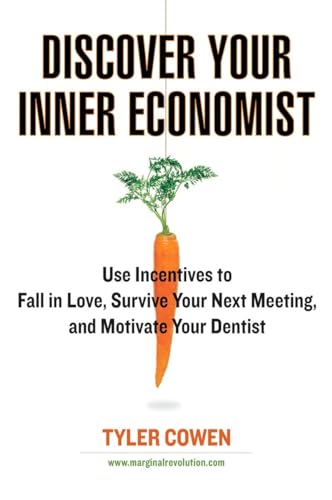
Discover Your Inner Economist: Use Incentives to Fall in Love, Survive Your Next Meeting, and Motivate Your Dentist - Brossura
Sinossi
One of America’s most respected economists presents a quirky, incisive romp through everyday life that reveals how you can turn economic reasoning to your advantage—often when you least expect it to be relevant.
Like no other economist, Tyler Cowen shows how economic notions—such as incentives, signals, and markets—apply far more widely than merely to the decisions of social planners, governments, and big business. What does economic theory say about ordering from a menu? Or attracting the right mate? Or controlling people who talk too much in meetings? Or dealing with your dentist? With a wryly amusing voice, in chapters such as “How to Control the World, The Basics” and “How to Control the World, Knowing When to Stop” Cowen reveals the hidden economic patterns behind everyday situations so you can get more of what you really want.
Readers will also gain less selfish insights into how to be a good partner, neighbor and even citizen of the world. For instance, what is the best way to give to charity? The chapter title “How to Save the World—More Christmas Presents Won’t Help” makes a point that is every bit as personal as it is global.
Incentives are at the core of an economic approach to the world, but they don’t just come in cash. In fact, money can be a disincentive. Cowen shows why, for example, it doesn’t work to pay your kids to do the dishes. Other kinds of incentives—like making sure family members know they will be admired if they respect you—can work. Another non-monetary incentive? Try having everyone stand up in your next meeting if you don’t want anyone to drone on. Deeply felt incentives like pride in one’s work or a passing smile from a loved one, can be the most powerful of all, even while they operate alongside more mundane rewards such as money and free food.
Discover Your Inner Economist is an introduction to the science of economics that shows it to be built on notions that are already within all of us. While the implications of those ideas lead to Cowen’s often counterintuitive advice, their wisdom is presented in ordinary examples taken from home life, work life, and even vacation life… How do you get a good guide in a Moroccan bazaar?
Le informazioni nella sezione "Riassunto" possono far riferimento a edizioni diverse di questo titolo.
Informazioni sull'autore
Tyler Cowen is a professor of economics at George Mason University. He is a prominent blogger at marginalrevolution.com, the world’s leading economics blog. He also writes regularly for The New York Times, and has written for Forbes, The Wall Street Journal, Newsweek, The Washington Post, The Los Angeles Times, and The Wilson Quarterly.
Le informazioni nella sezione "Su questo libro" possono far riferimento a edizioni diverse di questo titolo.
Risultati della ricerca per Discover Your Inner Economist: Use Incentives to Fall...

Foto dell'editore
Discover Your Inner Economist: Use Incentives to Fall in Love, Survive Your Next Meeting, and Motivate Your Dentist
Editore:
Penguin Putnam Inc, 2008
ISBN 10: 0452289637
ISBN 13: 9780452289635
Antico o usato
Paperback
Da: World of Books (was SecondSale), Montgomery, IL, U.S.A.
Valutazione del venditore 5 su 5 stelle

Paperback. Condizione: Very Good. In Discover Your Inner Economist, one of America's most respected economists presents a quirky, incisive romp through everyday life that reveals how you can turn economic reasoning to your advantage--often when you least expect it to be relevant. Like no other economist, Tyler Cowen shows how economic notions--such as incentives, signals, and markets--apply far more widely than merely to the decisions of social planners, governments, and big business. What does economic theory say about ordering from a menu? Or attracting the right mate? Or controlling people who talk too much in meetings? Or dealing with your dentist? With a wryly amusing voice, in such chapters as How to Control the World: The Basics and How to Control the World: Knowing When to Stop, Cowen reveals the hidden economic patterns behind everyday situations so you can get more of what you really want. Readers will also gain less selfish insights into how to be a good partner, neighbor, and even citizen of the world. For instance, what is the best way to give to charity? The chapter title How to Save the World--More Christmas Presents Won't Help makes a point that is every bit as personal as it is global. Incentives are at the core of an economic approach to the world, but they don't just come in cash. In fact, money can be a disincentive. Cowen shows why, for example, it doesn't work to pay your kids to do the dishes. Other kinds of incentives--like making sure family members know they will be admired if they respect you--can work. Another nonmonetary incentive? Try having everyone stand up in your next meeting if you don't want anyone to drone on. Deeply felt incentives, like pride in one's work or a passing smile from a loved one, can be the most powerful of all, even while they operate alongside more mundane rewards, such as money and free food. Discover Your Inner Economist is an introduction to the science of economics that shows it to be built on notions that are already within all of us. While the implications of those ideas lead to Cowen's often counterintuitive advice, their wisdom is presented in ordinary examples taken from home life, work life, and even vacation life. How, for example, do you get a good guide in a Moroccan bazaar? Codice articolo 00093271953
Compra usato
EUR 4,54
Spedizione gratuita
Spedito in U.S.A.
Spedito in U.S.A.
Quantità: 2 disponibili
Foto dell'editore
Discover Your Inner Economist: Use Incentives to Fall in Love, Survive Your Next Meeting, and Motivate Your Dentist
Editore:
Penguin Putnam Inc, 2008
ISBN 10: 0452289637
ISBN 13: 9780452289635
Antico o usato
Paperback
Da: World of Books (was SecondSale), Montgomery, IL, U.S.A.
Valutazione del venditore 5 su 5 stelle
Paperback. Condizione: Good. In Discover Your Inner Economist, one of America's most respected economists presents a quirky, incisive romp through everyday life that reveals how you can turn economic reasoning to your advantage--often when you least expect it to be relevant. Like no other economist, Tyler Cowen shows how economic notions--such as incentives, signals, and markets--apply far more widely than merely to the decisions of social planners, governments, and big business. What does economic theory say about ordering from a menu? Or attracting the right mate? Or controlling people who talk too much in meetings? Or dealing with your dentist? With a wryly amusing voice, in such chapters as How to Control the World: The Basics and How to Control the World: Knowing When to Stop, Cowen reveals the hidden economic patterns behind everyday situations so you can get more of what you really want. Readers will also gain less selfish insights into how to be a good partner, neighbor, and even citizen of the world. For instance, what is the best way to give to charity? The chapter title How to Save the World--More Christmas Presents Won't Help makes a point that is every bit as personal as it is global. Incentives are at the core of an economic approach to the world, but they don't just come in cash. In fact, money can be a disincentive. Cowen shows why, for example, it doesn't work to pay your kids to do the dishes. Other kinds of incentives--like making sure family members know they will be admired if they respect you--can work. Another nonmonetary incentive? Try having everyone stand up in your next meeting if you don't want anyone to drone on. Deeply felt incentives, like pride in one's work or a passing smile from a loved one, can be the most powerful of all, even while they operate alongside more mundane rewards, such as money and free food. Discover Your Inner Economist is an introduction to the science of economics that shows it to be built on notions that are already within all of us. While the implications of those ideas lead to Cowen's often counterintuitive advice, their wisdom is presented in ordinary examples taken from home life, work life, and even vacation life. How, for example, do you get a good guide in a Moroccan bazaar? Codice articolo 00090957720
Compra usato
EUR 4,54
Spedizione gratuita
Spedito in U.S.A.
Spedito in U.S.A.
Quantità: 2 disponibili
Immagini fornite dal venditore
Discover Your Inner Economist: Use Incentives to Fall in Love, Survive Your Next Meeting, and Motivate Your Dentist
Editore:
Penguin Publishing Group, 2008
ISBN 10: 0452289637
ISBN 13: 9780452289635
Antico o usato
Brossura
Da: Zoom Books Company, Lynden, WA, U.S.A.
Valutazione del venditore 5 su 5 stelle
Condizione: very_good. Book is in very good condition and may include minimal underlining highlighting. The book can also include "From the library of" labels. May not contain miscellaneous items toys, dvds, etc. . We offer 100% money back guarantee and 24 7 customer service. Codice articolo ZBV.0452289637.VG
Compra usato
EUR 4,55
Spedizione gratuita
Spedito in U.S.A.
Spedito in U.S.A.
Quantità: 1 disponibili
Foto dell'editore
Discover Your Inner Economist: Use Incentives to Fall in Love, Survive Your Next Meeting, and Motivate Your Dentist
Editore:
Penguin Publishing Group (edition Reprint), 2008
ISBN 10: 0452289637
ISBN 13: 9780452289635
Antico o usato
Paperback
Da: BooksRun, Philadelphia, PA, U.S.A.
Valutazione del venditore 5 su 5 stelle
Paperback. Condizione: Fair. Reprint. The item might be beaten up but readable. May contain markings or highlighting, as well as stains, bent corners, or any other major defect, but the text is not obscured in any way. Codice articolo 0452289637-7-1
Compra usato
EUR 4,70
Spedizione gratuita
Spedito in U.S.A.
Spedito in U.S.A.
Quantità: 1 disponibili
Immagini fornite dal venditore
Discover Your Inner Economist: Use Incentives to Fall in Love, Survive Your Next Meeting, and Motivate Your Dentist
Editore:
Penguin Publishing Group, 2008
ISBN 10: 0452289637
ISBN 13: 9780452289635
Antico o usato
Brossura
Da: Greenworld Books, Arlington, TX, U.S.A.
Valutazione del venditore 5 su 5 stelle
Condizione: very_good. Fast Free Shipping â" Very Good condition book with a firm cover and clean pages. Shows normal use and some light wear or limited notes markings. A solid, nice copy to enjoy. Codice articolo GWV.0452289637.VG
Compra usato
EUR 5,71
Spedizione gratuita
Spedito in U.S.A.
Spedito in U.S.A.
Quantità: 1 disponibili
Foto dell'editore
Discover Your Inner Economist: Use Incentives to Fall in Love, Survive Your Next Meeting, and Motivate Your Dentist
Editore:
Penguin Publishing Group, 2008
ISBN 10: 0452289637
ISBN 13: 9780452289635
Antico o usato
Paperback
Da: ThriftBooks-Atlanta, AUSTELL, GA, U.S.A.
Valutazione del venditore 5 su 5 stelle
Paperback. Condizione: Good. No Jacket. Pages can have notes/highlighting. Spine may show signs of wear. ~ ThriftBooks: Read More, Spend Less. Codice articolo G0452289637I3N00
Compra usato
EUR 6,22
Spedizione gratuita
Spedito in U.S.A.
Spedito in U.S.A.
Quantità: 1 disponibili
Foto dell'editore
Discover Your Inner Economist: Use Incentives to Fall in Love, Survive Your Next Meeting, and Motivate Your Dentist
Editore:
Penguin Putnam Inc, 2008
ISBN 10: 0452289637
ISBN 13: 9780452289635
Antico o usato
Paperback
Da: World of Books Inc, Montgomery, IL, U.S.A.
Valutazione del venditore 4 su 5 stelle

Paperback. Condizione: Good. In Discover Your Inner Economist, one of America's most respected economists presents a quirky, incisive romp through everyday life that reveals how you can turn economic reasoning to your advantage--often when you least expect it to be relevant. Like no other economist, Tyler Cowen shows how economic notions--such as incentives, signals, and markets--apply far more widely than merely to the decisions of social planners, governments, and big business. What does economic theory say about ordering from a menu? Or attracting the right mate? Or controlling people who talk too much in meetings? Or dealing with your dentist? With a wryly amusing voice, in such chapters as How to Control the World: The Basics and How to Control the World: Knowing When to Stop, Cowen reveals the hidden economic patterns behind everyday situations so you can get more of what you really want. Readers will also gain less selfish insights into how to be a good partner, neighbor, and even citizen of the world. For instance, what is the best way to give to charity? The chapter title How to Save the World--More Christmas Presents Won't Help makes a point that is every bit as personal as it is global. Incentives are at the core of an economic approach to the world, but they don't just come in cash. In fact, money can be a disincentive. Cowen shows why, for example, it doesn't work to pay your kids to do the dishes. Other kinds of incentives--like making sure family members know they will be admired if they respect you--can work. Another nonmonetary incentive? Try having everyone stand up in your next meeting if you don't want anyone to drone on. Deeply felt incentives, like pride in one's work or a passing smile from a loved one, can be the most powerful of all, even while they operate alongside more mundane rewards, such as money and free food. Discover Your Inner Economist is an introduction to the science of economics that shows it to be built on notions that are already within all of us. While the implications of those ideas lead to Cowen's often counterintuitive advice, their wisdom is presented in ordinary examples taken from home life, work life, and even vacation life. How, for example, do you get a good guide in a Moroccan bazaar? Codice articolo CIN0452289637G
Compra usato
EUR 6,39
Spedizione gratuita
Spedito in U.S.A.
Spedito in U.S.A.
Quantità: 2 disponibili
Foto dell'editore
Discover Your Inner Economist: Use Incentives to Fall in Love, Survive Your Next Meeting, and Motivate Your Dentist
Editore:
Penguin Putnam Inc, 2008
ISBN 10: 0452289637
ISBN 13: 9780452289635
Antico o usato
Paperback
Da: World of Books Inc, Montgomery, IL, U.S.A.
Valutazione del venditore 4 su 5 stelle
Paperback. Condizione: Very Good. In Discover Your Inner Economist, one of America's most respected economists presents a quirky, incisive romp through everyday life that reveals how you can turn economic reasoning to your advantage--often when you least expect it to be relevant. Like no other economist, Tyler Cowen shows how economic notions--such as incentives, signals, and markets--apply far more widely than merely to the decisions of social planners, governments, and big business. What does economic theory say about ordering from a menu? Or attracting the right mate? Or controlling people who talk too much in meetings? Or dealing with your dentist? With a wryly amusing voice, in such chapters as How to Control the World: The Basics and How to Control the World: Knowing When to Stop, Cowen reveals the hidden economic patterns behind everyday situations so you can get more of what you really want. Readers will also gain less selfish insights into how to be a good partner, neighbor, and even citizen of the world. For instance, what is the best way to give to charity? The chapter title How to Save the World--More Christmas Presents Won't Help makes a point that is every bit as personal as it is global. Incentives are at the core of an economic approach to the world, but they don't just come in cash. In fact, money can be a disincentive. Cowen shows why, for example, it doesn't work to pay your kids to do the dishes. Other kinds of incentives--like making sure family members know they will be admired if they respect you--can work. Another nonmonetary incentive? Try having everyone stand up in your next meeting if you don't want anyone to drone on. Deeply felt incentives, like pride in one's work or a passing smile from a loved one, can be the most powerful of all, even while they operate alongside more mundane rewards, such as money and free food. Discover Your Inner Economist is an introduction to the science of economics that shows it to be built on notions that are already within all of us. While the implications of those ideas lead to Cowen's often counterintuitive advice, their wisdom is presented in ordinary examples taken from home life, work life, and even vacation life. How, for example, do you get a good guide in a Moroccan bazaar? Codice articolo CIN0452289637VG
Compra usato
EUR 6,39
Spedizione gratuita
Spedito in U.S.A.
Spedito in U.S.A.
Quantità: 2 disponibili
Foto dell'editore
Discover Your Inner Economist: Use Incentives to Fall in Love, Survive Your Next Meeting, and Motivate Your Dentist
Editore:
Penguin Publishing Group, 2008
ISBN 10: 0452289637
ISBN 13: 9780452289635
Antico o usato
Brossura
Da: Wonder Book, Frederick, MD, U.S.A.
Valutazione del venditore 5 su 5 stelle
Condizione: Very Good. Very Good condition. A copy that may have a few cosmetic defects. May also contain light spine creasing or a few markings such as an owner's name, short gifter's inscription or light stamp. Codice articolo V17L-00777
Compra usato
EUR 6,45
Spedizione gratuita
Spedito in U.S.A.
Spedito in U.S.A.
Quantità: 2 disponibili
Foto dell'editore
Discover Your Inner Economist: Use Incentives to Fall in Love, Survive Your Next Meeting, and Motivate Your Dentist
Editore:
Penguin Publishing Group, 2008
ISBN 10: 0452289637
ISBN 13: 9780452289635
Antico o usato
Brossura
Da: Wonder Book, Frederick, MD, U.S.A.
Valutazione del venditore 5 su 5 stelle
Condizione: Good. Good condition. A copy that has been read but remains intact. May contain markings such as bookplates, stamps, limited notes and highlighting, or a few light stains. Codice articolo R05A-01409
Compra usato
EUR 6,45
Spedizione gratuita
Spedito in U.S.A.
Spedito in U.S.A.
Quantità: 3 disponibili