
Articoli correlati a The Color of Money: Black Banks and the Racial Wealth...
Sinossi
“Read this book. It explains so much about the moment…Beautiful, heartbreaking work.”
—Ta-Nehisi Coates
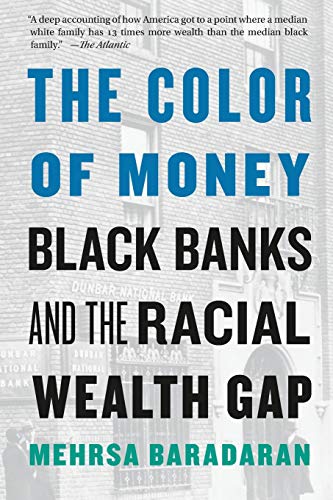
“A deep accounting of how America got to a point where a median white family has 13 times more wealth than the median black family.”
—The Atlantic
“Extraordinary…Baradaran focuses on a part of the American story that’s often ignored: the way African Americans were locked out of the financial engines that create wealth in America.”
—Ezra Klein
When the Emancipation Proclamation was signed in 1863, the black community owned less than 1 percent of the total wealth in America. More than 150 years later, that number has barely budged. The Color of Money seeks to explain the stubborn persistence of this racial wealth gap by focusing on the generators of wealth in the black community: black banks.
With the civil rights movement in full swing, President Nixon promoted “black capitalism,” a plan to support black banks and minority-owned businesses. But the catch-22 of black banking is that the very institutions needed to help communities escape the deep poverty caused by discrimination and segregation inevitably became victims of that same poverty. In this timely and eye-opening account, Baradaran challenges the long-standing belief that black communities could ever really hope to accumulate wealth in a segregated economy.
“Black capitalism has not improved the economic lives of black people, and Baradaran deftly explains the reasons why.”
—Los Angeles Review of Books
“A must read for anyone interested in closing America’s racial wealth gap.”
—Black Perspectives
Le informazioni nella sezione "Riassunto" possono far riferimento a edizioni diverse di questo titolo.
Risultati della ricerca per The Color of Money: Black Banks and the Racial Wealth...

Foto dell'editore
The Color of Money: Black Banks and the Racial Wealth Gap
Editore:
Harvard University Press, 2019
ISBN 10: 0674237471
ISBN 13: 9780674237476
Antico o usato
Paperback
Da: World of Books (was SecondSale), Montgomery, IL, U.S.A.
Valutazione del venditore 5 su 5 stelle

Paperback. Condizione: Good. ?Read this book. It explains so much about the moment?Beautiful, heartbreaking work.? ?Ta-Nehisi Coates?A deep accounting of how America got to a point where a median white family has 13 times more wealth than the median black family.??The Atlantic?Extraordinary?Baradaran focuses on a part of the American story that?s often ignored: the way African Americans were locked out of the financial engines that create wealth in America.??Ezra KleinWhen the Emancipation Proclamation was signed in 1863, the black community owned less than 1 percent of the total wealth in America. More than 150 years later, that number has barely budged. The Color of Money seeks to explain the stubborn persistence of this racial wealth gap by focusing on the generators of wealth in the black community: black banks.With the civil rights movement in full swing, President Nixon promoted ?black capitalism,? a plan to support black banks and minority-owned businesses. But the catch-22 of black banking is that the very institutions needed to help communities escape the deep poverty caused by discrimination and segregation inevitably became victims of that same poverty. In this timely and eye-opening account, Baradaran challenges the long-standing belief that black communities could ever really hope to accumulate wealth in a segregated economy.?Black capitalism has not improved the economic lives of black people, and Baradaran deftly explains the reasons why.??Los Angeles Review of Books?A must read for anyone interested in closing America?s racial wealth gap.??Black Perspectives. Codice articolo 00110113204
Compra usato
EUR 4,55
Spedizione gratuita
Spedito in U.S.A.
Spedito in U.S.A.
Quantità: 3 disponibili
Foto dell'editore
The Color of Money: Black Banks and the Racial Wealth Gap
Editore:
Harvard University Press, 2019
ISBN 10: 0674237471
ISBN 13: 9780674237476
Antico o usato
Paperback
Da: World of Books (was SecondSale), Montgomery, IL, U.S.A.
Valutazione del venditore 5 su 5 stelle
Paperback. Condizione: Very Good. ?Read this book. It explains so much about the moment?Beautiful, heartbreaking work.? ?Ta-Nehisi Coates?A deep accounting of how America got to a point where a median white family has 13 times more wealth than the median black family.??The Atlantic?Extraordinary?Baradaran focuses on a part of the American story that?s often ignored: the way African Americans were locked out of the financial engines that create wealth in America.??Ezra KleinWhen the Emancipation Proclamation was signed in 1863, the black community owned less than 1 percent of the total wealth in America. More than 150 years later, that number has barely budged. The Color of Money seeks to explain the stubborn persistence of this racial wealth gap by focusing on the generators of wealth in the black community: black banks.With the civil rights movement in full swing, President Nixon promoted ?black capitalism,? a plan to support black banks and minority-owned businesses. But the catch-22 of black banking is that the very institutions needed to help communities escape the deep poverty caused by discrimination and segregation inevitably became victims of that same poverty. In this timely and eye-opening account, Baradaran challenges the long-standing belief that black communities could ever really hope to accumulate wealth in a segregated economy.?Black capitalism has not improved the economic lives of black people, and Baradaran deftly explains the reasons why.??Los Angeles Review of Books?A must read for anyone interested in closing America?s racial wealth gap.??Black Perspectives. Codice articolo 00110751201
Compra usato
EUR 4,55
Spedizione gratuita
Spedito in U.S.A.
Spedito in U.S.A.
Quantità: 6 disponibili
Immagini fornite dal venditore
The Color of Money: Black Banks and the Racial Wealth Gap
Editore:
Belknap Press: An Imprint of Harvard University Press, 2019
ISBN 10: 0674237471
ISBN 13: 9780674237476
Antico o usato
Brossura
Da: Dream Books Co., Denver, CO, U.S.A.
Valutazione del venditore 5 su 5 stelle
Condizione: acceptable. This copy has clearly been enjoyedâ"expect noticeable shelf wear and some minor creases to the cover. Binding is strong, and all pages are legible. May contain previous library markings or stamps. Codice articolo DBV.0674237471.A
Compra usato
EUR 4,56
Spedizione gratuita
Spedito in U.S.A.
Spedito in U.S.A.
Quantità: 3 disponibili
Immagini fornite dal venditore
The Color of Money: Black Banks and the Racial Wealth Gap
Editore:
Belknap Press: An Imprint of Harvard University Press, 2019
ISBN 10: 0674237471
ISBN 13: 9780674237476
Antico o usato
Brossura
Da: Greenworld Books, Arlington, TX, U.S.A.
Valutazione del venditore 5 su 5 stelle
Condizione: good. Fast Free Shipping â" Good condition. It may show normal signs of use, such as light writing, highlighting, or library markings, but all pages are intact and the book is fully readable. A solid, complete copy that's ready to enjoy. Codice articolo GWV.0674237471.G
Compra usato
EUR 5,28
Spedizione gratuita
Spedito in U.S.A.
Spedito in U.S.A.
Quantità: 1 disponibili
Foto dell'editore
The Color of Money: Black Banks and the Racial Wealth Gap
ISBN 10: 0674237471
ISBN 13: 9780674237476
Antico o usato
Paperback
Da: BooksRun, Philadelphia, PA, U.S.A.
Valutazione del venditore 5 su 5 stelle
Paperback. Condizione: Very Good. Reprint. It's a well-cared-for item that has seen limited use. The item may show minor signs of wear. All the text is legible, with all pages included. It may have slight markings and/or highlighting. Codice articolo 0674237471-11-1
Compra usato
EUR 5,48
Spedizione gratuita
Spedito in U.S.A.
Spedito in U.S.A.
Quantità: 1 disponibili
Foto dell'editore
The Color of Money: Black Banks and the Racial Wealth Gap
Editore:
Belknap Press: An Imprint of Har, 2019
ISBN 10: 0674237471
ISBN 13: 9780674237476
Antico o usato
paperback
Da: Evergreen Goodwill, Seattle, WA, U.S.A.
Valutazione del venditore 5 su 5 stelle
paperback. Condizione: Good. Codice articolo mon0000274362
Compra usato
EUR 2,25
Spedizione EUR 3,58
Spedito in U.S.A.
Spedito in U.S.A.
Quantità: 1 disponibili
Foto dell'editore
The Color of Money: Black Banks and the Racial Wealth Gap
Editore:
Harvard University Press, 2019
ISBN 10: 0674237471
ISBN 13: 9780674237476
Antico o usato
Paperback
Da: World of Books Inc, Montgomery, IL, U.S.A.
Valutazione del venditore 4 su 5 stelle

Paperback. Condizione: Good. ?Read this book. It explains so much about the moment?Beautiful, heartbreaking work.? ?Ta-Nehisi Coates?A deep accounting of how America got to a point where a median white family has 13 times more wealth than the median black family.??The Atlantic?Extraordinary?Baradaran focuses on a part of the American story that?s often ignored: the way African Americans were locked out of the financial engines that create wealth in America.??Ezra KleinWhen the Emancipation Proclamation was signed in 1863, the black community owned less than 1 percent of the total wealth in America. More than 150 years later, that number has barely budged. The Color of Money seeks to explain the stubborn persistence of this racial wealth gap by focusing on the generators of wealth in the black community: black banks.With the civil rights movement in full swing, President Nixon promoted ?black capitalism,? a plan to support black banks and minority-owned businesses. But the catch-22 of black banking is that the very institutions needed to help communities escape the deep poverty caused by discrimination and segregation inevitably became victims of that same poverty. In this timely and eye-opening account, Baradaran challenges the long-standing belief that black communities could ever really hope to accumulate wealth in a segregated economy.?Black capitalism has not improved the economic lives of black people, and Baradaran deftly explains the reasons why.??Los Angeles Review of Books?A must read for anyone interested in closing America?s racial wealth gap.??Black Perspectives. Codice articolo CIN0674237471G
Compra usato
EUR 6,40
Spedizione gratuita
Spedito in U.S.A.
Spedito in U.S.A.
Quantità: 3 disponibili
Foto dell'editore
The Color of Money: Black Banks and the Racial Wealth Gap
Editore:
Harvard University Press, 2019
ISBN 10: 0674237471
ISBN 13: 9780674237476
Antico o usato
Paperback
Da: World of Books Inc, Montgomery, IL, U.S.A.
Valutazione del venditore 4 su 5 stelle
Paperback. Condizione: Very Good. ?Read this book. It explains so much about the moment?Beautiful, heartbreaking work.? ?Ta-Nehisi Coates?A deep accounting of how America got to a point where a median white family has 13 times more wealth than the median black family.??The Atlantic?Extraordinary?Baradaran focuses on a part of the American story that?s often ignored: the way African Americans were locked out of the financial engines that create wealth in America.??Ezra KleinWhen the Emancipation Proclamation was signed in 1863, the black community owned less than 1 percent of the total wealth in America. More than 150 years later, that number has barely budged. The Color of Money seeks to explain the stubborn persistence of this racial wealth gap by focusing on the generators of wealth in the black community: black banks.With the civil rights movement in full swing, President Nixon promoted ?black capitalism,? a plan to support black banks and minority-owned businesses. But the catch-22 of black banking is that the very institutions needed to help communities escape the deep poverty caused by discrimination and segregation inevitably became victims of that same poverty. In this timely and eye-opening account, Baradaran challenges the long-standing belief that black communities could ever really hope to accumulate wealth in a segregated economy.?Black capitalism has not improved the economic lives of black people, and Baradaran deftly explains the reasons why.??Los Angeles Review of Books?A must read for anyone interested in closing America?s racial wealth gap.??Black Perspectives. Codice articolo CIN0674237471VG
Compra usato
EUR 6,40
Spedizione gratuita
Spedito in U.S.A.
Spedito in U.S.A.
Quantità: 6 disponibili
Foto dell'editore
The Color of Money: Black Banks and the Racial Wealth Gap
Da: ThriftBooks-Dallas, Dallas, TX, U.S.A.
Valutazione del venditore 5 su 5 stelle
Paperback. Condizione: Fair. No Jacket. Former library book; Readable copy. Pages may have considerable notes/highlighting. ~ ThriftBooks: Read More, Spend Less. Codice articolo G0674237471I5N10
Compra usato
EUR 6,44
Spedizione gratuita
Spedito in U.S.A.
Spedito in U.S.A.
Quantità: 1 disponibili
Immagini fornite dal venditore
The Color of Money: Black Banks and the Racial Wealth Gap
Editore:
Belknap Press: An Imprint of Harvard University Press, 2019
ISBN 10: 0674237471
ISBN 13: 9780674237476
Antico o usato
Brossura
Da: Austin Goodwill 1101, Austin, TX, U.S.A.
Valutazione del venditore 5 su 5 stelle
Condizione: acceptable. Book shows noticeable wear from use. May include writing, highlighting, or other markings, but not excessive. Cover or edges may have visible wear. The book remains complete and fully readable. Codice articolo CTXV.0674237471.A
Compra usato
EUR 3,81
Spedizione EUR 2,96
Spedito in U.S.A.
Spedito in U.S.A.
Quantità: 1 disponibili