
Articoli correlati a Making It Explicit: Reasoning, Representing, and Discursive...
Sinossi
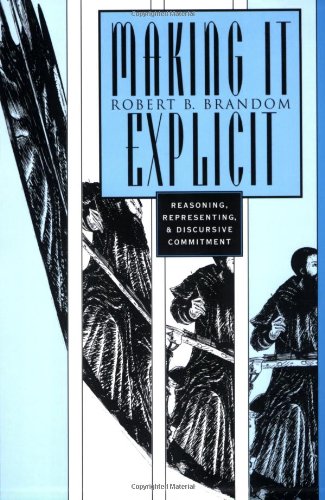
What would something unlike us--a chimpanzee, say, or a computer--have to be able to do to qualify as a possible knower, like us? To answer this question at the very heart of our sense of ourselves, philosophers have long focused on intentionality and have looked to language as a key to this condition. Making It Explicit is an investigation into the nature of language--the social practices that distinguish us as rational, logical creatures--that revises the very terms of this inquiry. Where accounts of the relation between language and mind have traditionally rested on the concept of representation, this book sets out an alternate approach based on inference, and on a conception of certain kinds of implicit assessment that become explicit in language. Making It Explicit is the first attempt to work out in detail a theory that renders linguistic meaning in terms of use--in short, to explain how semantic content can be conferred on expressions and attitudes that are suitably caught up in social practices.
At the center of this enterprise is a notion of discursive commitment. Being able to talk--and so in the fullest sense being able to think--is a matter of mastering the practices that govern such commitments, being able to keep track of one's own commitments and those of others. Assessing the pragmatic significance of speech acts is a matter of explaining the explicit in terms of the implicit. As he traces the inferential structure of the social practices within which things can be made conceptually explicit, the author defines the distinctively expressive role of logical vocabulary. This expressive account of language, mind, and logic is, finally, an account of who we are.
Le informazioni nella sezione "Riassunto" possono far riferimento a edizioni diverse di questo titolo.
Product Description
Reasoning, Representing, and Discursive Commitment
Le informazioni nella sezione "Su questo libro" possono far riferimento a edizioni diverse di questo titolo.
Risultati della ricerca per Making It Explicit: Reasoning, Representing, and Discursive...

Immagini fornite dal venditore
Making It Explicit: Reasoning, Representing, and Discursive Commitment
Editore:
Harvard University Press, 1998
ISBN 10: 0674543300
ISBN 13: 9780674543300
Antico o usato
Brossura
Da: Big River Books, Powder Springs, GA, U.S.A.
Valutazione del venditore 5 su 5 stelle

Condizione: good. This book is in good condition. The cover has minor creases or bends. The binding is tight and pages are intact. Some pages may have writing or highlighting. Codice articolo BRV.0674543300.G
Compra usato
EUR 37,41
Spedizione EUR 3,48
Spedito in U.S.A.
Spedito in U.S.A.
Quantità: 1 disponibili
Foto dell'editore
Making It Explicit
Da: PBShop.store UK, Fairford, GLOS, Regno Unito
Valutazione del venditore 5 su 5 stelle
PAP. Condizione: New. New Book. Shipped from UK. Established seller since 2000. Codice articolo WH-9780674543300
Compra nuovo
EUR 39,44
Spedizione EUR 7,89
Spedito da Regno Unito a U.S.A.
Spedito da Regno Unito a U.S.A.
Quantità: 15 disponibili
Immagini fornite dal venditore
Making It Explicit (Paperback)
Editore:
Harvard University Press, Cambridge, Mass, 1998
ISBN 10: 0674543300
ISBN 13: 9780674543300
Nuovo
Paperback
Da: Grand Eagle Retail, Bensenville, IL, U.S.A.
Valutazione del venditore 5 su 5 stelle
Paperback. Condizione: new. Paperback. What would something unlike us--a chimpanzee, say, or a computer--have to be able to do to qualify as a possible knower, like us? To answer this question at the very heart of our sense of ourselves, philosophers have long focused on intentionality and have looked to language as a key to this condition. Making It Explicit is an investigation into the nature of language--the social practices that distinguish us as rational, logical creatures--that revises the very terms of this inquiry. Where accounts of the relation between language and mind have traditionally rested on the concept of representation, this book sets out an alternate approach based on inference, and on a conception of certain kinds of implicit assessment that become explicit in language. Making It Explicit is the first attempt to work out in detail a theory that renders linguistic meaning in terms of use--in short, to explain how semantic content can be conferred on expressions and attitudes that are suitably caught up in social practices.At the center of this enterprise is a notion of discursive commitment. Being able to talk--and so in the fullest sense being able to think--is a matter of mastering the practices that govern such commitments, being able to keep track of one's own commitments and those of others. Assessing the pragmatic significance of speech acts is a matter of explaining the explicit in terms of the implicit. As he traces the inferential structure of the social practices within which things can be made conceptually explicit, the author defines the distinctively expressive role of logical vocabulary. This expressive account of language, mind, and logic is, finally, an account of who we are. Where accounts of the relation between language and mind often rest on the concept of representation, Brandom sets out an approach based on inference, and on a conception of certain kinds of implicit assessment that become explicit in language. It is the first attempt to work out a detailed theory rendering linguistic meaning in terms of use. Shipping may be from multiple locations in the US or from the UK, depending on stock availability. Codice articolo 9780674543300
Compra nuovo
EUR 49,06
Spedizione gratuita
Spedito in U.S.A.
Spedito in U.S.A.
Quantità: 1 disponibili
Immagini fornite dal venditore
Making It Explicit
Editore:
Harvard University Press, US, 1998
ISBN 10: 0674543300
ISBN 13: 9780674543300
Nuovo
Paperback
Da: Rarewaves.com USA, London, LONDO, Regno Unito
Valutazione del venditore 5 su 5 stelle
Paperback. Condizione: New. What would something unlike us--a chimpanzee, say, or a computer--have to be able to do to qualify as a possible knower, like us? To answer this question at the very heart of our sense of ourselves, philosophers have long focused on intentionality and have looked to language as a key to this condition. Making It Explicit is an investigation into the nature of language--the social practices that distinguish us as rational, logical creatures--that revises the very terms of this inquiry. Where accounts of the relation between language and mind have traditionally rested on the concept of representation, this book sets out an alternate approach based on inference, and on a conception of certain kinds of implicit assessment that become explicit in language. Making It Explicit is the first attempt to work out in detail a theory that renders linguistic meaning in terms of use--in short, to explain how semantic content can be conferred on expressions and attitudes that are suitably caught up in social practices.At the center of this enterprise is a notion of discursive commitment. Being able to talk--and so in the fullest sense being able to think--is a matter of mastering the practices that govern such commitments, being able to keep track of one's own commitments and those of others. Assessing the pragmatic significance of speech acts is a matter of explaining the explicit in terms of the implicit. As he traces the inferential structure of the social practices within which things can be made conceptually explicit, the author defines the distinctively expressive role of logical vocabulary. This expressive account of language, mind, and logic is, finally, an account of who we are. Codice articolo LU-9780674543300
Compra nuovo
EUR 51,20
Spedizione gratuita
Spedito da Regno Unito a U.S.A.
Spedito da Regno Unito a U.S.A.
Quantità: 14 disponibili
Foto dell'editore
Making It Explicit - Reasoning, Representing, and Discursive Commitment (Paper) (eng)
Da: Brook Bookstore On Demand, Napoli, NA, Italia
Valutazione del venditore 5 su 5 stelle
Condizione: new. Codice articolo c70145209dc7744006086ec710c1aad6
Compra nuovo
EUR 47,63
Spedizione EUR 11,00
Spedito da Italia a U.S.A.
Spedito da Italia a U.S.A.
Quantità: Più di 20 disponibili
Immagini fornite dal venditore
Making It Explicit: Reasoning, Representing, and Discursive Commitment
Editore:
Harvard University Press, Cambridge, 1998
ISBN 10: 0674543300
ISBN 13: 9780674543300
Antico o usato
Paperback
Da: Lectern Books, Brooklyn, NY, U.S.A.
Valutazione del venditore 5 su 5 stelle
Paperback. Condizione: Near Fine. 8vo. 741 pp. Near Fine. Slight wear to wraps. One small pen marking to top edge of textblock, crease to top corner of rear wrap. Codice articolo c00891
Compra usato
EUR 53,89
Spedizione EUR 5,23
Spedito in U.S.A.
Spedito in U.S.A.
Quantità: 1 disponibili
Immagini fornite dal venditore
Making It Explicit
Editore:
Harvard University Press, US, 1998
ISBN 10: 0674543300
ISBN 13: 9780674543300
Nuovo
Paperback
Da: Rarewaves USA, HEBRON, KY, U.S.A.
Valutazione del venditore 5 su 5 stelle
Paperback. Condizione: New. What would something unlike us--a chimpanzee, say, or a computer--have to be able to do to qualify as a possible knower, like us? To answer this question at the very heart of our sense of ourselves, philosophers have long focused on intentionality and have looked to language as a key to this condition. Making It Explicit is an investigation into the nature of language--the social practices that distinguish us as rational, logical creatures--that revises the very terms of this inquiry. Where accounts of the relation between language and mind have traditionally rested on the concept of representation, this book sets out an alternate approach based on inference, and on a conception of certain kinds of implicit assessment that become explicit in language. Making It Explicit is the first attempt to work out in detail a theory that renders linguistic meaning in terms of use--in short, to explain how semantic content can be conferred on expressions and attitudes that are suitably caught up in social practices.At the center of this enterprise is a notion of discursive commitment. Being able to talk--and so in the fullest sense being able to think--is a matter of mastering the practices that govern such commitments, being able to keep track of one's own commitments and those of others. Assessing the pragmatic significance of speech acts is a matter of explaining the explicit in terms of the implicit. As he traces the inferential structure of the social practices within which things can be made conceptually explicit, the author defines the distinctively expressive role of logical vocabulary. This expressive account of language, mind, and logic is, finally, an account of who we are. Codice articolo LU-9780674543300
Compra nuovo
EUR 59,99
Spedizione gratuita
Spedito in U.S.A.
Spedito in U.S.A.
Quantità: 1 disponibili
Foto dell'editore
Making It Explicit: Reasoning, Representing & Discursive Commitment: Reasoning, Representing and Discursive Commitment
Da: Kennys Bookshop and Art Galleries Ltd., Galway, GY, Irlanda
Valutazione del venditore 5 su 5 stelle
Condizione: New. 1998. Revised ed. Paperback. This text examines the nature of language from the perspective of inference rather than representation. It proposes a theory that renders linguistic "meaning" in terms of "use", explaining how semantic content can be conferred on expressions and attitudes that are part of social practice. Num Pages: 768 pages. BIC Classification: CFA; CFB; CFG; JMR. Category: (P) Professional & Vocational; (UP) Postgraduate, Research & Scholarly; (UU) Undergraduate. Dimension: 233 x 162 x 36. Weight in Grams: 998. . . . . . Codice articolo V9780674543300
Compra nuovo
EUR 50,78
Spedizione EUR 9,50
Spedito da Irlanda a U.S.A.
Spedito da Irlanda a U.S.A.
Quantità: Più di 20 disponibili
Foto dell'editore
Making It Explicit: Reasoning, Representing, and Discursive Commitment
Da: Ria Christie Collections, Uxbridge, Regno Unito
Valutazione del venditore 5 su 5 stelle
Condizione: New. In English. Codice articolo ria9780674543300_new
Compra nuovo
EUR 47,90
Spedizione EUR 17,43
Spedito da Regno Unito a U.S.A.
Spedito da Regno Unito a U.S.A.
Quantità: Più di 20 disponibili
Foto dell'editore
Making It Explicit: Reasoning, Representing, and Discursive Commitment
Da: Majestic Books, Hounslow, Regno Unito
Valutazione del venditore 4 su 5 stelle

Condizione: New. pp. 768. Codice articolo 8071594
Compra nuovo
EUR 62,78
Spedizione EUR 7,58
Spedito da Regno Unito a U.S.A.
Spedito da Regno Unito a U.S.A.
Quantità: 3 disponibili