
Articoli correlati a Analysis and Synthesis of MOS Translinear Circuits:...
Sinossi
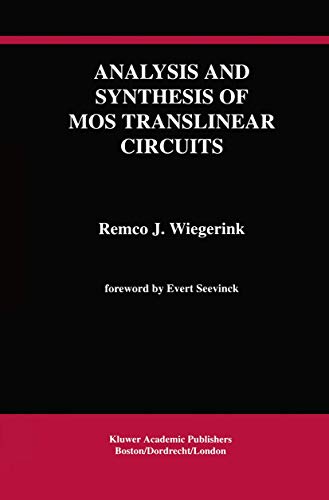
This book has its roots in an idea first formulated by Barrie Gilbert in 1975. He showed how bipolar analog circuits can realize nonlinear and computational functions. This extended the analog art from linear to nonlinear applications, hence the name trans linear circuits. Not only did this new principle enable marvellous signal processing functions to be accurately implemented, but also the circuits were simple and practical. The perennial problems of analog Ie design, namely temperature sensitivity, processing spread, device nonlinearity and paracitic capacitance were solved to a large extent. Using the trans linear principle in circuit design requires changing your point of view in two ways. First, the grossly nonlinear characteristic of transistors is viewed as an asset rather than as a harmful property. Second, no longer are the signals represented by voltages, but by currents. In fact, the attendant voltage changes are distorted but, as they are very small, they are only of secondary interest. Understanding and analyzing a given trans linear circuit is fairly straightforward. But what about the converse situation: suppose you're given some nonlinear or computational function to implement? How to find a suitable translinear circuit realization? The general problem of analog circuit synthesis is a difficult one and is receiving much attention nowadays. Some years ago, I had the opportunity to investigate methods for designing bipolar trans linear circuits. It turned out that translinear networks have some unique topological properties. Using these properties it was possible to establish heuristic synthesis procedures.
Le informazioni nella sezione "Riassunto" possono far riferimento a edizioni diverse di questo titolo.
Recensione
' I recommend this work to anyone involved in MOS analog design ' Computing Reviews Aug. 1994
Contenuti
Foreword. 1. Introduction. 2. The MOS Translinear Principle. 3. Analysis of MOS Translinear Circuits. 4. Synthesis of MOS Translinear Circuits: a Design Strategy. 5. Comparison of MOS Translinear Loop Topologies. 6. Application: Fast Four-Quadrant Current Multiplier. 7. Application: Variable-Gamma Circuit for Colour Television. 8. Conclusions. Appendix A: TL graphs of MTL networks with one or two loops and less than 8 transistors. Appendix B: MOS translinear loops with 7 or less transistors. Appendix C: Some MTL network realizations. Index.
Le informazioni nella sezione "Su questo libro" possono far riferimento a edizioni diverse di questo titolo.
Risultati della ricerca per Analysis and Synthesis of MOS Translinear Circuits:...

Foto dell'editore
Analysis and Synthesis of MOS Translinear Circuits (The Springer International Series in Engineering and Computer Science, 246)
Da: Phatpocket Limited, Waltham Abbey, HERTS, Regno Unito
Valutazione del venditore 5 su 5 stelle

Condizione: Good. Your purchase helps support Sri Lankan Children's Charity 'The Rainbow Centre'. Ex-library, so some stamps and wear, but in good overall condition. Our donations to The Rainbow Centre have helped provide an education and a safe haven to hundreds of children who live in appalling conditions. Codice articolo Z1-K-025-01951
Compra usato
EUR 59,16
Spedizione EUR 12,59
Spedito da Regno Unito a U.S.A.
Spedito da Regno Unito a U.S.A.
Quantità: 1 disponibili
Foto dell'editore
Analysis And Synthesis Of Mos Translinear Circuits
Da: Basi6 International, Irving, TX, U.S.A.
Valutazione del venditore 5 su 5 stelle
Condizione: Brand New. New. US edition. Expediting shipping for all USA and Europe orders excluding PO Box. Excellent Customer Service. Codice articolo ABEOCT25-378545
Compra nuovo
EUR 126,98
Spedizione gratuita
Spedito in U.S.A.
Spedito in U.S.A.
Quantità: 1 disponibili
Foto dell'editore
Analysis And Synthesis Of Mos Translinear Circuits
Da: Romtrade Corp., STERLING HEIGHTS, MI, U.S.A.
Valutazione del venditore 5 su 5 stelle
Condizione: New. This is a Brand-new US Edition. This Item may be shipped from US or any other country as we have multiple locations worldwide. Codice articolo ABBB-163447
Compra nuovo
EUR 128,66
Spedizione gratuita
Spedito in U.S.A.
Spedito in U.S.A.
Quantità: 1 disponibili
Foto dell'editore
Analysis and Synthesis of MOS Translinear Circuits
Da: Buchpark, Trebbin, Germania
Valutazione del venditore 5 su 5 stelle
Condizione: Sehr gut. Zustand: Sehr gut | Sprache: Englisch | Produktart: Bücher | This book has its roots in an idea first formulated by Barrie Gilbert in 1975. He showed how bipolar analog circuits can realize nonlinear and computational functions. This extended the analog art from linear to nonlinear applications, hence the name trans linear circuits. Not only did this new principle enable marvellous signal processing functions to be accurately implemented, but also the circuits were simple and practical. The perennial problems of analog Ie design, namely temperature sensitivity, processing spread, device nonlinearity and paracitic capacitance were solved to a large extent. Using the trans linear principle in circuit design requires changing your point of view in two ways. First, the grossly nonlinear characteristic of transistors is viewed as an asset rather than as a harmful property. Second, no longer are the signals represented by voltages, but by currents. In fact, the attendant voltage changes are distorted but, as they are very small, they are only of secondary interest. Understanding and analyzing a given trans linear circuit is fairly straightforward. But what about the converse situation: suppose you're given some nonlinear or computational function to implement? How to find a suitable translinear circuit realization? The general problem of analog circuit synthesis is a difficult one and is receiving much attention nowadays. Some years ago, I had the opportunity to investigate methods for designing bipolar trans linear circuits. It turned out that translinear networks have some unique topological properties. Using these properties it was possible to establish heuristic synthesis procedures. Codice articolo 3036294/202
Compra usato
EUR 57,26
Spedizione EUR 105,00
Spedito da Germania a U.S.A.
Spedito da Germania a U.S.A.
Quantità: 3 disponibili
Immagini fornite dal venditore
Analysis and Synthesis of MOS Translinear Circuits
Print on DemandDa: moluna, Greven, Germania
Valutazione del venditore 5 su 5 stelle
Gebunden. Condizione: New. Dieser Artikel ist ein Print on Demand Artikel und wird nach Ihrer Bestellung fuer Sie gedruckt. This book has its roots in an idea first formulated by Barrie Gilbert in 1975. He showed how bipolar analog circuits can realize nonlinear and computational functions. This extended the analog art from linear to nonlinear applications, hence the name trans . Codice articolo 5971453
Compra nuovo
EUR 136,16
Spedizione EUR 48,99
Spedito da Germania a U.S.A.
Spedito da Germania a U.S.A.
Quantità: Più di 20 disponibili
Foto dell'editore
Analysis and Synthesis of MOS Translinear Circuits
Da: Biblios, Frankfurt am main, HESSE, Germania
Valutazione del venditore 4 su 5 stelle

Condizione: Used. pp. 180. Codice articolo 182519059
Compra usato
EUR 178,65
Spedizione EUR 9,95
Spedito da Germania a U.S.A.
Spedito da Germania a U.S.A.
Quantità: 1 disponibili
Foto dell'editore
Analysis and Synthesis of Mos Translinear Circuits
Da: GreatBookPrices, Columbia, MD, U.S.A.
Valutazione del venditore 5 su 5 stelle
Condizione: New. Codice articolo 757959-n
Compra nuovo
EUR 193,24
Spedizione EUR 2,37
Spedito in U.S.A.
Spedito in U.S.A.
Quantità: 15 disponibili
Immagini fornite dal venditore
Analysis and Synthesis of Mos Translinear Circuits
Da: GreatBookPrices, Columbia, MD, U.S.A.
Valutazione del venditore 5 su 5 stelle
Condizione: As New. Unread book in perfect condition. Codice articolo 757959
Compra usato
EUR 193,54
Spedizione EUR 2,37
Spedito in U.S.A.
Spedito in U.S.A.
Quantità: 15 disponibili
Foto dell'editore
Analysis and Synthesis of MOS Translinear Circuits (The Springer International Series in Engineering and Computer Science, 246)
Da: Ria Christie Collections, Uxbridge, Regno Unito
Valutazione del venditore 5 su 5 stelle
Condizione: New. In English. Codice articolo ria9780792393900_new
Compra nuovo
EUR 185,11
Spedizione EUR 13,36
Spedito da Regno Unito a U.S.A.
Spedito da Regno Unito a U.S.A.
Quantità: Più di 20 disponibili
Immagini fornite dal venditore
Analysis and Synthesis of MOS Translinear Circuits
Print on DemandDa: preigu, Osnabrück, Germania
Valutazione del venditore 5 su 5 stelle
Buch. Condizione: Neu. Analysis and Synthesis of MOS Translinear Circuits | Remco J. Wiegerink | Buch | The Springer International Series in Engineering and Computer Science | xiii | Englisch | 1993 | Springer | EAN 9780792393900 | Verantwortliche Person für die EU: Springer Verlag GmbH, Tiergartenstr. 17, 69121 Heidelberg, juergen[dot]hartmann[at]springer[dot]com | Anbieter: preigu Print on Demand. Codice articolo 102592896
Compra nuovo
EUR 141,20
Spedizione EUR 70,00
Spedito da Germania a U.S.A.
Spedito da Germania a U.S.A.
Quantità: 5 disponibili