
Articoli correlati a Handbook for Evaluating Knowledge-Based Systems: Conceptual...
Handbook for Evaluating Knowledge-Based Systems: Conceptual Framework and Compendium of Methods - Rilegato
Sinossi
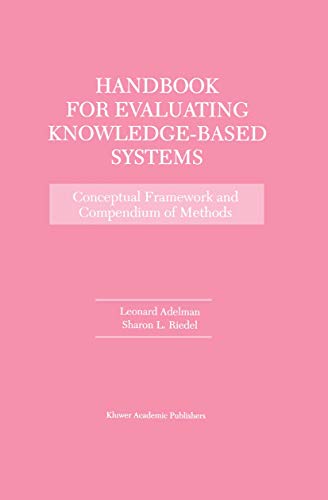
Knowledge-based systems are increasingly found in a wide variety of settings and this handbook has been written to meet a specific need in their widening use. While there have been many successful applications of knowledge-based systems, some applications have failed because they never received the corrective feedback that evaluation provides for keeping development focused on the users' needs in their actual working environment. This handbook provides a conceptual framework and compendium of methods for performing evaluations of knowledge-based systems during their development. Its focus is on the users' and subject matter experts' evaluation of the usefulness of the system, and not on the developers' testing of the adequacy of the programming code.
Le informazioni nella sezione "Riassunto" possono far riferimento a edizioni diverse di questo titolo.
Contenuti
Preface. 1. Introduction. 2. Overview: Development Models, Evaluation Dimensions, and Evaluation Models. 3. Framework for Evaluating Knowledge-Based Systems. 4. Requirement Validations. 5. Knowledge Base Validation. 6. Knowledge Base Verification. 7. Usability Evaluation. 8. Performance Evaluation. 9. Planning and Managing Knowledge-Based System Evaluations. Appendix. References. Author Index. Subject Index.
Product Description
Book by Adelman Leonard Riedel Sharon L
Le informazioni nella sezione "Su questo libro" possono far riferimento a edizioni diverse di questo titolo.
Risultati della ricerca per Handbook for Evaluating Knowledge-Based Systems: Conceptual...

Immagini fornite dal venditore
Handbook for Evaluating Knowledge-Based Systems
Da: moluna, Greven, Germania
Valutazione del venditore 5 su 5 stelle

Condizione: New. Knowledge-based systems are increasingly found in a wide variety of settings and this handbook has been written to meet a specific need in their widening use. While there have been many successful applications of knowledge-based systems, some application. Codice articolo 5971809
Compra nuovo
EUR 148,64
Spedizione EUR 48,99
Spedito da Germania a U.S.A.
Spedito da Germania a U.S.A.
Quantità: 1 disponibili
Foto dell'editore
Handbook for Evaluating Knowledge-Based Systems: Conceptual Framework and Compendium of Methods
Da: Ria Christie Collections, Uxbridge, Regno Unito
Valutazione del venditore 5 su 5 stelle
Condizione: New. In English. Codice articolo ria9780792399063_new
Compra nuovo
EUR 184,49
Spedizione EUR 13,32
Spedito da Regno Unito a U.S.A.
Spedito da Regno Unito a U.S.A.
Quantità: Più di 20 disponibili
Foto dell'editore
Handbook for Evaluating Knowledge-Based Systems : Conceptual Framework and Compendium of Methods
Da: GreatBookPricesUK, Woodford Green, Regno Unito
Valutazione del venditore 5 su 5 stelle
Condizione: New. Codice articolo 758235-n
Compra nuovo
EUR 183,42
Spedizione EUR 17,70
Spedito da Regno Unito a U.S.A.
Spedito da Regno Unito a U.S.A.
Quantità: Più di 20 disponibili
Immagini fornite dal venditore
Handbook for Evaluating Knowledge-Based Systems : Conceptual Framework and Compendium of Methods
Da: GreatBookPrices, Columbia, MD, U.S.A.
Valutazione del venditore 5 su 5 stelle
Condizione: New. Codice articolo 758235-n
Compra nuovo
EUR 204,19
Spedizione EUR 2,36
Spedito in U.S.A.
Spedito in U.S.A.
Quantità: Più di 20 disponibili
Immagini fornite dal venditore
Handbook for Evaluating Knowledge-Based Systems : Conceptual Framework and Compendium of Methods
Da: AHA-BUCH GmbH, Einbeck, Germania
Valutazione del venditore 5 su 5 stelle
Buch. Condizione: Neu. Druck auf Anfrage Neuware - Printed after ordering - Knowledge-based systems are increasingly found in a wide variety of settings and this handbook has been written to meet a specific need in their widening use. While there have been many successful applications of knowledge-based systems, some applications have failed because they never received the corrective feedback that evaluation provides for keeping development focused on the users' needs in their actual working environment. This handbook provides a conceptual framework and compendium of methods for performing evaluations of knowledge-based systems during their development. Its focus is on the users' and subject matter experts' evaluation of the usefulness of the system, and not on the developers' testing of the adequacy of the programming code. The handbook permits evaluators to systematically answer the following kinds of questions: Does the knowledge-based system meet the users' task requirements Is the system easy to use Is the knowledge base logically consistent Does it meet the required level of expertise Does the system improve performance The authors have produced a handbook that will serve two audiences: a tool that can be used to create knowledge-based systems (practitioners, developers, and evaluators) and a framework that will stimulate more research in the area (academic researchers and students). To accomplish this, the handbook is built around a conceptual framework that integrates the different types of evaluations into the system of development process. The kinds of questions that can be answered, and the methods available for answering them, will change throughout the system development life cycle. And throughout this process, one needs to know what can be done, and what can't. It is this dichotomy that addresses needs in both the practitioner and academic research audiences. Codice articolo 9780792399063
Compra nuovo
EUR 174,36
Spedizione EUR 35,00
Spedito da Germania a U.S.A.
Spedito da Germania a U.S.A.
Quantità: 1 disponibili
Immagini fornite dal venditore
Handbook for Evaluating Knowledge-Based Systems
Print on DemandDa: BuchWeltWeit Ludwig Meier e.K., Bergisch Gladbach, Germania
Valutazione del venditore 5 su 5 stelle
Buch. Condizione: Neu. This item is printed on demand - it takes 3-4 days longer - Neuware -Knowledge-based systems are increasingly found in a wide variety of settings and this handbook has been written to meet a specific need in their widening use. While there have been many successful applications of knowledge-based systems, some applications have failed because they never received the corrective feedback that evaluation provides for keeping development focused on the users' needs in their actual working environment. This handbook provides a conceptual framework and compendium of methods for performing evaluations of knowledge-based systems during their development. Its focus is on the users' and subject matter experts' evaluation of the usefulness of the system, and not on the developers' testing of the adequacy of the programming code. The handbook permits evaluators to systematically answer the following kinds of questions: Does the knowledge-based system meet the users' task requirements Is the system easy to use Is the knowledge base logically consistent Does it meet the required level of expertise Does the system improve performance The authors have produced a handbook that will serve two audiences: a tool that can be used to create knowledge-based systems (practitioners, developers, and evaluators) and a framework that will stimulate more research in the area (academic researchers and students). To accomplish this, the handbook is built around a conceptual framework that integrates the different types of evaluations into the system of development process. The kinds of questions that can be answered, and the methods available for answering them, will change throughout the system development life cycle. And throughout this process, one needs to know what can be done, and what can't. It is this dichotomy that addresses needs in both the practitioner and academic research audiences. 420 pp. Englisch. Codice articolo 9780792399063
Compra nuovo
EUR 187,20
Spedizione EUR 23,00
Spedito da Germania a U.S.A.
Spedito da Germania a U.S.A.
Quantità: 1 disponibili
Immagini fornite dal venditore
Handbook for Evaluating Knowledge-Based Systems | Conceptual Framework and Compendium of Methods
Print on DemandDa: preigu, Osnabrück, Germania
Valutazione del venditore 5 su 5 stelle
Buch. Condizione: Neu. Handbook for Evaluating Knowledge-Based Systems | Conceptual Framework and Compendium of Methods | Sharon L. Riedel (u. a.) | Buch | Einband - fest (Hardcover) | Englisch | 1997 | Springer US | EAN 9780792399063 | Verantwortliche Person für die EU: Springer Heidelberg, Tiergartenstr. 17, 69121 Heidelberg, buchhandel-buch[at]springer[dot]com | Anbieter: preigu Print on Demand. Codice articolo 102548696
Compra nuovo
EUR 141,20
Spedizione EUR 70,00
Spedito da Germania a U.S.A.
Spedito da Germania a U.S.A.
Quantità: 5 disponibili
Foto dell'editore
Handbook for Evaluating Knowledge-Based Systems
Da: Kennys Bookshop and Art Galleries Ltd., Galway, GY, Irlanda
Valutazione del venditore 5 su 5 stelle
Condizione: New. A handbook that serves as a tool that can be used to create knowledge-based systems (for practitioners, developers, and evaluators) and a framework that stimulates more research in the area (for academic researchers and students). Num Pages: 392 pages, biography. BIC Classification: UYQE. Category: (P) Professional & Vocational. Dimension: 234 x 156 x 23. Weight in Grams: 763. . 1997. Hardback. . . . . Codice articolo V9780792399063
Compra nuovo
EUR 203,56
Spedizione EUR 9,50
Spedito da Irlanda a U.S.A.
Spedito da Irlanda a U.S.A.
Quantità: 15 disponibili
Immagini fornite dal venditore
Handbook for Evaluating Knowledge-Based Systems
Editore:
Springer US, Springer US Apr 1997, 1997
ISBN 10: 0792399064
ISBN 13: 9780792399063
Nuovo
Rilegato
Da: buchversandmimpf2000, Emtmannsberg, BAYE, Germania
Valutazione del venditore 5 su 5 stelle
Buch. Condizione: Neu. This item is printed on demand - Print on Demand Titel. Neuware -Knowledge-based systems are increasingly found in a wide variety of settings and this handbook has been written to meet a specific need in their widening use. While there have been many successful applications of knowledge-based systems, some applications have failed because they never received the corrective feedback that evaluation provides for keeping development focused on the users' needs in their actual working environment. This handbook provides a conceptual framework and compendium of methods for performing evaluations of knowledge-based systems during their development. Its focus is on the users' and subject matter experts' evaluation of the usefulness of the system, and not on the developers' testing of the adequacy of the programming code. The handbook permits evaluators to systematically answer the following kinds of questions: Does the knowledge-based system meet the users' task requirements Is the system easy to use Is the knowledge base logically consistent Does it meet the required level of expertise Does the system improve performance The authors have produced a handbook that will serve two audiences: a tool that can be used to create knowledge-based systems (practitioners, developers, and evaluators) and a framework that will stimulate more research in the area (academic researchers and students). To accomplish this, the handbook is built around a conceptual framework that integrates the different types of evaluations into the system of development process. The kinds of questions that can be answered, and the methods available for answering them, will change throughout the system development life cycle. And throughout this process, one needs to know what can be done, and what can't. It is this dichotomy that addresses needs in both the practitioner and academic research audiences.Springer Verlag GmbH, Tiergartenstr. 17, 69121 Heidelberg 420 pp. Englisch. Codice articolo 9780792399063
Compra nuovo
EUR 160,49
Spedizione EUR 60,00
Spedito da Germania a U.S.A.
Spedito da Germania a U.S.A.
Quantità: 1 disponibili
Foto dell'editore
Handbook for Evaluating Knowledge-Based Systems
Da: Books Puddle, Woodside, NY, U.S.A.
Valutazione del venditore 4 su 5 stelle

Condizione: New. pp. 420. Codice articolo 26300693
Compra nuovo
EUR 236,75
Spedizione EUR 3,56
Spedito in U.S.A.
Spedito in U.S.A.
Quantità: 4 disponibili