
Articoli correlati a The Mirror, the Window, and the Telescope: How Renaissance...
The Mirror, the Window, and the Telescope: How Renaissance Linear Perspective Changed Our Vision of the Universe - Rilegato
Sinossi
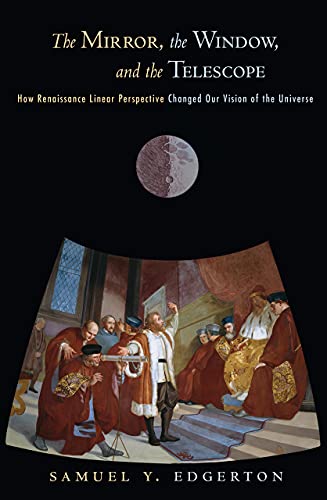
Building on the knowledge he has accumulated over his distinguished career, Edgerton has written the definitive, up-to-date work on linear perspective, showing how this simple artistic tool did indeed change our present vision of the universe.
In The Mirror, the Window, and the Telescope, Samuel Y. Edgerton brings fresh insight to a subject of perennial interest to the history of art and science in the West: the birth of linear perspective. Edgerton retells the fascinating story of how perspective emerged in early fifteenth-century Florence, growing out of an artistic and religious context in which devout Christians longed for divine presence in their daily lives. And yet, ironically, its discovery would have a profound effect not only on the history of art but on the history of science and technology, ultimately undermining the very medieval Christian cosmic view that gave rise to it in the first place.
Among Edgerton's cast of characters is Filippo Brunelleschi, who first demonstrated how a familiar object could be painted in a picture exactly as it appeared in a mirror reflection. Brunelleschi communicated the principles of this new perspective to his artist friends Donatello, Masaccio, Masolino, and Fra Angelico. But it was the humanist scholar Leon Battista Alberti who codified Brunelleschi's perspective rules into a simple formula that even mathematically disadvantaged artists could understand. By looking through a window the geometric beauties of this world were revealed without the theological implications of a mirror reflection. Alberti's treatise, "On Painting," spread the new concept throughout Italy and transalpine Europe, even influencing later scientists including Galileo Galilei. In fact, it was Galileo's telescope, called at the time a "perspective tube," that revealed the earth to be not a mirror reflection of the heavens, as Brunelleschi had advocated, but just the other way around.
In The Mirror, the Window, and the Telescope, Samuel Y. Edgerton brings fresh insight to a subject of perennial interest to the history of art and science in the West: the birth of linear perspective. Edgerton retells the fascinating story of how perspective emerged in early fifteenth-century Florence, growing out of an artistic and religious context in which devout Christians longed for divine presence in their daily lives. And yet, ironically, its discovery would have a profound effect not only on the history of art but on the history of science and technology, ultimately undermining the very medieval Christian cosmic view that gave rise to it in the first place. Among Edgerton's cast of characters is Filippo Brunelleschi, who first demonstrated how a familiar object could be painted in a picture exactly as it appeared in a mirror reflection. Brunelleschi communicated the principles of this new perspective to his artist friends Donatello, Masaccio, Masolino, and Fra Angelico. But it was the humanist scholar Leon Battista Alberti who codified Brunelleschi's perspective rules into a simple formula that even mathematically disadvantaged artists could understand.By looking through a window the geometric beauties of this world were revealed without the theological implications of a mirror reflection. Alberti's treatise, "On Painting," spread the new concept throughout Italy and transalpine Europe, even influencing later scientists including Galileo Galilei. In fact, it was Galileo's telescope, called at the time a "perspective tube," that revealed the earth to be not a mirror reflection of the heavens, as Brunelleschi had advocated, but just the other way around. Building on the knowledge he has accumulated over his distinguished career, Edgerton has written the definitive, up-to-date work on linear perspective, showing how this simple artistic tool did indeed change our present vision of the universe.
Le informazioni nella sezione "Riassunto" possono far riferimento a edizioni diverse di questo titolo.
Informazioni sull'autore
Samuel Y. Edgerton is Amos Lawrence Professor of Art History Emeritus at Williams College. He is the author of many books, including Theaters of Conversion: Religious Architecture and Indian Artisans in Colonial Mexico and The Heritage of Giotto's Geometry: Art and Science on the Eve of the Scientific Revolution.
Le informazioni nella sezione "Su questo libro" possono far riferimento a edizioni diverse di questo titolo.
Altre edizioni note dello stesso titolo

Risultati della ricerca per The Mirror, the Window, and the Telescope: How Renaissance...

Foto dell'editore
The Mirror, the Window, and the Telescope: How Renaissance Linear Perspective Changed Our Vision of the Universe
Editore:
Cornell University Press, 2009
ISBN 10: 0801447585
ISBN 13: 9780801447587
Antico o usato
Rilegato
Da: Midtown Scholar Bookstore, Harrisburg, PA, U.S.A.
Valutazione del venditore 5 su 5 stelle

Hardcover. Condizione: Good. Good - Bumped and creased book with tears to the extremities, but not affecting the text block, may have remainder mark or previous owner's name - GOOD Standard-sized. Codice articolo M0801447585Z3
Compra usato
EUR 16,68
Spedizione EUR 5,20
Spedito in U.S.A.
Spedito in U.S.A.
Quantità: 4 disponibili
Foto dell'editore
The Mirror, the Window, and the Telescope: How Renaissance Linear Perspective Changed Our Vision of the Universe
Editore:
Cornell University Press, 2009
ISBN 10: 0801447585
ISBN 13: 9780801447587
Antico o usato
Rilegato
Da: Midtown Scholar Bookstore, Harrisburg, PA, U.S.A.
Valutazione del venditore 5 su 5 stelle
Hardcover. Condizione: Acceptable. damaged/worn/marked copy Standard-sized. Codice articolo 0801447585-01
Compra usato
EUR 20,07
Spedizione EUR 5,20
Spedito in U.S.A.
Spedito in U.S.A.
Quantità: 1 disponibili
Immagini fornite dal venditore
MIRROR THE WINDOW & THE TELESC
Da: moluna, Greven, Germania
Valutazione del venditore 5 su 5 stelle
Condizione: New. Edgerton shows how linear perspective emerged in early fifteenth-century Florence out of an artistic and religious context in which devout Christians longed for divine presence in their daily lives and ultimately undermined medieval Christian cosmology. Codice articolo 595002881
Compra nuovo
EUR 165,09
Spedizione EUR 48,99
Spedito da Germania a U.S.A.
Spedito da Germania a U.S.A.
Quantità: Più di 20 disponibili
Immagini fornite dal venditore
Mirror, the Window, and the Telescope : How Renaissance Linear Perspective Changed Our Vision of the Universe
Da: GreatBookPricesUK, Woodford Green, Regno Unito
Valutazione del venditore 5 su 5 stelle
Condizione: New. Codice articolo 6117023-n
Compra nuovo
EUR 200,48
Spedizione EUR 17,50
Spedito da Regno Unito a U.S.A.
Spedito da Regno Unito a U.S.A.
Quantità: Più di 20 disponibili
Immagini fornite dal venditore
Mirror, the Window, and the Telescope : How Renaissance Linear Perspective Changed Our Vision of the Universe
Da: GreatBookPrices, Columbia, MD, U.S.A.
Valutazione del venditore 5 su 5 stelle
Condizione: New. Codice articolo 6117023-n
Compra nuovo
EUR 222,74
Spedizione EUR 2,29
Spedito in U.S.A.
Spedito in U.S.A.
Quantità: Più di 20 disponibili
Foto dell'editore
The Mirror, the Window, and the Telescope How Renaissance Linear Perspective Changed Our Vision of the Universe
Da: Revaluation Books, Exeter, Regno Unito
Valutazione del venditore 5 su 5 stelle
Hardcover. Condizione: Brand New. 1st edition. 224 pages. 9.00x6.00x0.50 inches. In Stock. Codice articolo x-0801447585
Compra nuovo
EUR 222,71
Spedizione EUR 11,66
Spedito da Regno Unito a U.S.A.
Spedito da Regno Unito a U.S.A.
Quantità: 2 disponibili
Immagini fornite dal venditore
Mirror, the Window, and the Telescope : How Renaissance Linear Perspective Changed Our Vision of the Universe
Editore:
Cornell University Press, 2009
ISBN 10: 0801447585
ISBN 13: 9780801447587
Antico o usato
Rilegato
Da: GreatBookPricesUK, Woodford Green, Regno Unito
Valutazione del venditore 5 su 5 stelle
Condizione: As New. Unread book in perfect condition. Codice articolo 6117023
Compra usato
EUR 234,25
Spedizione EUR 17,50
Spedito da Regno Unito a U.S.A.
Spedito da Regno Unito a U.S.A.
Quantità: Più di 20 disponibili
Foto dell'editore
The Mirror, the Window, and the Telescope: How Renaissance Linear Perspective Changed Our Vision of the Universe
Editore:
Cornell University Press, 2009
ISBN 10: 0801447585
ISBN 13: 9780801447587
Antico o usato
Rilegato
Da: Mispah books, Redhill, SURRE, Regno Unito
Valutazione del venditore 4 su 5 stelle

Hardcover. Condizione: Like New. LIKE NEW. SHIPS FROM MULTIPLE LOCATIONS. book. Codice articolo ERICA78708014475856
Compra usato
EUR 224,65
Spedizione EUR 29,16
Spedito da Regno Unito a U.S.A.
Spedito da Regno Unito a U.S.A.
Quantità: 1 disponibili
Immagini fornite dal venditore
Mirror, the Window, and the Telescope : How Renaissance Linear Perspective Changed Our Vision of the Universe
Editore:
Cornell University Press, 2009
ISBN 10: 0801447585
ISBN 13: 9780801447587
Antico o usato
Rilegato
Da: GreatBookPrices, Columbia, MD, U.S.A.
Valutazione del venditore 5 su 5 stelle
Condizione: As New. Unread book in perfect condition. Codice articolo 6117023
Compra usato
EUR 259,84
Spedizione EUR 2,29
Spedito in U.S.A.
Spedito in U.S.A.
Quantità: Più di 20 disponibili
Immagini fornite dal venditore
The Mirror, the Window, and the Telescope : How Renaissance Linear Perspective Changed Our Vision of the Universe
Editore:
Cornell University Press Feb 2009, 2009
ISBN 10: 0801447585
ISBN 13: 9780801447587
Nuovo
Rilegato
Da: AHA-BUCH GmbH, Einbeck, Germania
Valutazione del venditore 5 su 5 stelle
Buch. Condizione: Neu. Neuware - Edgerton shows how linear perspective emerged in early fifteenth-century Florence out of an artistic and religious context in which devout Christians longed for divine presence in their daily lives and ultimately undermined medieval Christian cosmology. Codice articolo 9780801447587
Compra nuovo
EUR 229,72
Spedizione EUR 62,40
Spedito da Germania a U.S.A.
Spedito da Germania a U.S.A.
Quantità: 2 disponibili