
Articoli correlati a After the Fall of the Wall: Life Courses in the Transformati...
After the Fall of the Wall: Life Courses in the Transformation of East Germany - Rilegato
Libro 2 di 22: Studies in Social Inequality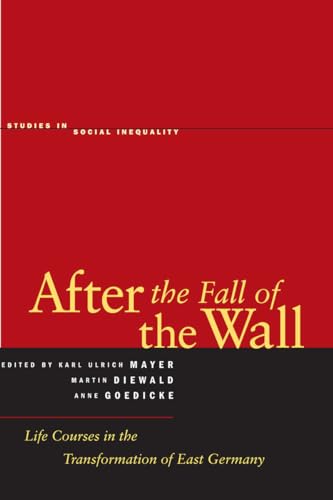
Sinossi
The fall of the Berlin Wall in 1989 was the beginning of one of the most interesting natural experiments in recent history. The East German transition from a Communist state to part of the Federal Republic of Germany abruptly created a new social order as old institutions were abolished and new counterparts imported. This unique situation provides an exceptional opportunity to examine the central tenets of life course sociology.
The empirical chapters of this book draw a comprehensive picture of life course transformation, demonstrating how the combination of life course dynamics coupled with an extraordinary pace of system change affect individual lives. How much turbulence was created by the transition and how much stability was preserved? How did the qualifications and resources acquired before 1989 influence the fortunes in the restructured economy? How did the privatization and reorganization of firms impact individuals? Did the transformation experiences differ by age/cohort and gender? How stable were social networks at work and in the family? Were personality characteristics important mediators of post-1989 success or failure or were they rather changed by them? How specific were the East German life trajectories in comparison with Poland and West-Germany?
Le informazioni nella sezione "Riassunto" possono far riferimento a edizioni diverse di questo titolo.
Informazioni sull'autore
Martin Diewald is Professor of Sociology at the University of Bielefeld,Germany. Anne Goedicke is Assistant Professor of Sociology at the Universityof Duisburg-Essen, Germany. Karl Ulrich Mayer is Chair of the Department ofSociology and Director of the Center for Research on Inequalities and theLife Course (CIQLE) at Yale University.
Dalla quarta di copertina
“At the beginning of the 1990s many people thought that the economic problems of East Germany would soon be a thing of the past, that Germany would quickly be unified in economic terms. It turned out that the process of economic integration has been much more difficult than expected. This book analyzes the unusual turbulences and unexpected continuities in the transformation of life courses under conditions of sudden system change. It will be a milestone in life course research.”—Hans-Peter Blossfeld, Otto-Friedrich-Universität, Bamberg, Germany
The fall of the Berlin Wall in 1989 was the beginning of one of the most interesting natural experiments in recent history. The East German transition from a Communist state to part of the Federal Republic of Germany abruptly created a new social order as old institutions were abolished and new counterparts imported. This unique situation provides an exceptional opportunity to examine the central tenets of life course sociology.
The empirical chapters of this book draw a comprehensive picture of life course transformation, demonstrating how the combination of life course dynamics coupled with an extraordinary pace of system change affect individual lives. How much turbulence was created by the transition and how much stability was preserved? How did the qualifications and resources acquired before 1989 influence the fortunes in the restructured economy? How did the privatization and reorganization of firms impact individuals? Did the transformation experiences differ by age/cohort and gender? How stable were social networks at work and in the family? Were personality characteristics important mediators of post-1989 success or failure or were they rather changed by them? How specific were the East German life trajectories in comparison with Poland and West-Germany?
The empirical chapters of this book draw a comprehensive picture of life course transformation, demonstrating how the combination of life course dynamics coupled with an extraordinary pace of system change affect individual lives. How much turbulence was created by the transition and how much stability was preserved? How did the qualifications and resources acquired before 1989 influence the fortunes in the restructured economy? How did the privatization and reorganization of firms impact individuals? Did the transformation experiences differ by age/cohort and gender? How stable were social networks at work and in the family? Were personality characteristics important mediators of post-1989 success or failure or were they rather changed by them? How specific were the East German life trajectories in comparison with Poland and West-Germany?
Dal risvolto di copertina interno
The fall of the Berlin Wall in 1989 was the beginning of one of the most interesting natural experiments in recent history. The East German transition from a Communist state to part of the Federal Republic of Germany abruptly created a new social order as old institutions were abolished and new counterparts imported. This unique situation provides an exceptional opportunity to examine the central tenets of life course sociology.
The empirical chapters of this book draw a comprehensive picture of life course transformation, demonstrating how the combination of life course dynamics coupled with an extraordinary pace of system change affect individual lives. How much turbulence was created by the transition and how much stability was preserved? How did the qualifications and resources acquired before 1989 influence the fortunes in the restructured economy? How did the privatization and reorganization of firms impact individuals? Did the transformation experiences differ by age/cohort and gender? How stable were social networks at work and in the family? Were personality characteristics important mediators of post-1989 success or failure or were they rather changed by them? How specific were the East German life trajectories in comparison with Poland and West-Germany?
The empirical chapters of this book draw a comprehensive picture of life course transformation, demonstrating how the combination of life course dynamics coupled with an extraordinary pace of system change affect individual lives. How much turbulence was created by the transition and how much stability was preserved? How did the qualifications and resources acquired before 1989 influence the fortunes in the restructured economy? How did the privatization and reorganization of firms impact individuals? Did the transformation experiences differ by age/cohort and gender? How stable were social networks at work and in the family? Were personality characteristics important mediators of post-1989 success or failure or were they rather changed by them? How specific were the East German life trajectories in comparison with Poland and West-Germany?
Le informazioni nella sezione "Su questo libro" possono far riferimento a edizioni diverse di questo titolo.
Risultati della ricerca per After the Fall of the Wall: Life Courses in the Transformati...

Immagini fornite dal venditore
After the Fall of the Wall: Life Courses in the Transformation of East Germany
Editore:
Stanford University Press, 2006
ISBN 10: 0804752087
ISBN 13: 9780804752084
Antico o usato
Rilegato
Da: books4less (Versandantiquariat Petra Gros GmbH & Co. KG), Welling, Germania
Valutazione del venditore 5 su 5 stelle

gebundene Ausgabe. Condizione: Gut. 380 Seiten; Der Erhaltungszustand des hier angebotenen Werks ist trotz seiner Bibliotheksnutzung sehr sauber. Es befindet sich neben dem Rückenschild lediglich ein Bibliotheksstempel im Buch; ordnungsgemäß entwidmet. In ENGLISCHER Sprache. Sprache: Englisch Gewicht in Gramm: 700. Codice articolo 2122424
Compra usato
EUR 24,95
Spedizione EUR 15,95
Spedito da Germania a U.S.A.
Spedito da Germania a U.S.A.
Quantità: 1 disponibili
Foto dell'editore
After the Fall of the Wall : Life Courses in the Transformation of East Germany
Editore:
Stanford University Press, 2006
ISBN 10: 0804752087
ISBN 13: 9780804752084
Antico o usato
Rilegato
Prima edizione
Da: Better World Books: West, Reno, NV, U.S.A.
Valutazione del venditore 5 su 5 stelle
Condizione: Very Good. 1st Edition. Pages intact with possible writing/highlighting. Binding strong with minor wear. Dust jackets/supplements may not be included. Stock photo provided. Product includes identifying sticker. Better World Books: Buy Books. Do Good. Codice articolo 68225470-75
Compra usato
EUR 49,65
Spedizione gratuita
Spedito in U.S.A.
Spedito in U.S.A.
Quantità: 1 disponibili
Foto dell'editore
After the Fall of the Wall : Life Courses in the Transformation of East Germany
Editore:
Stanford University Press, 2006
ISBN 10: 0804752087
ISBN 13: 9780804752084
Antico o usato
Rilegato
Prima edizione
Da: Better World Books: West, Reno, NV, U.S.A.
Valutazione del venditore 5 su 5 stelle
Condizione: Very Good. 1st Edition. Former library copy. Pages intact with possible writing/highlighting. Binding strong with minor wear. Dust jackets/supplements may not be included. Includes library markings. Stock photo provided. Product includes identifying sticker. Better World Books: Buy Books. Do Good. Codice articolo 18768443-6
Compra usato
EUR 49,65
Spedizione gratuita
Spedito in U.S.A.
Spedito in U.S.A.
Quantità: 1 disponibili
Immagini fornite dal venditore
After the Fall of the Wall: Life Courses in the Transformation of East Germany.
Editore:
Stanford, Stanford University Press, 2006
ISBN 10: 0804752087
ISBN 13: 9780804752084
Antico o usato
Rilegato
Prima edizione
Da: Librarium of The Hague, The Hague, Paesi Bassi
Valutazione del venditore 5 su 5 stelle
Hardcover. Condizione: . ~ ~ NOTE: TOTAL REDUCTION SALE: THE PRICE OF THIS BOOK IS CURRENTLY REDUCED! ~ ~ (illustratore). 1st Edition. BRAND NEW. Virgin copy, not yet traded. Royal octavo. Pp. xx, 380. Tables and figures. Notes, references, glossary, index. HARDCOVER with dust-jacket. ~ FIRST EDITION. Q-5. Codice articolo 3508
Compra usato
EUR 22,50
Spedizione EUR 35,00
Spedito da Paesi Bassi a U.S.A.
Spedito da Paesi Bassi a U.S.A.
Quantità: 1 disponibili
Immagini fornite dal venditore
After the Fall of the Wall : Life Courses in the Transformation of East Germany
Da: GreatBookPrices, Columbia, MD, U.S.A.
Valutazione del venditore 5 su 5 stelle
Condizione: New. Codice articolo 4153913-n
Compra nuovo
EUR 90,22
Spedizione EUR 2,36
Spedito in U.S.A.
Spedito in U.S.A.
Quantità: 1 disponibili
Immagini fornite dal venditore
After the Fall of the Wall
Editore:
Stanford University Press, US, 2006
ISBN 10: 0804752087
ISBN 13: 9780804752084
Nuovo
Rilegato
Da: Rarewaves USA, HEBRON, KY, U.S.A.
Valutazione del venditore 5 su 5 stelle
Hardback. Condizione: New. The fall of the Berlin Wall in 1989 was the beginning of one of the most interesting natural experiments in recent history. The East German transition from a Communist state to part of the Federal Republic of Germany abruptly created a new social order as old institutions were abolished and new counterparts imported. This unique situation provides an exceptional opportunity to examine the central tenets of life course sociology. The empirical chapters of this book draw a comprehensive picture of life course transformation, demonstrating how the combination of life course dynamics coupled with an extraordinary pace of system change affect individual lives. How much turbulence was created by the transition and how much stability was preserved? How did the qualifications and resources acquired before 1989 influence the fortunes in the restructured economy? How did the privatization and reorganization of firms impact individuals? Did the transformation experiences differ by age/cohort and gender? How stable were social networks at work and in the family? Were personality characteristics important mediators of post-1989 success or failure or were they rather changed by them? How specific were the East German life trajectories in comparison with Poland and West-Germany? Codice articolo LU-9780804752084
Compra nuovo
EUR 92,66
Spedizione gratuita
Spedito in U.S.A.
Spedito in U.S.A.
Quantità: Più di 20 disponibili
Foto dell'editore
After the Fall of the Wall
Da: PBShop.store UK, Fairford, GLOS, Regno Unito
Valutazione del venditore 5 su 5 stelle
HRD. Condizione: New. New Book. Shipped from UK. Established seller since 2000. Codice articolo FW-9780804752084
Compra nuovo
EUR 89,63
Spedizione EUR 7,03
Spedito da Regno Unito a U.S.A.
Spedito da Regno Unito a U.S.A.
Quantità: 1 disponibili
Immagini fornite dal venditore
After the Fall of the Wall : Life Courses in the Transformation of East Germany
Editore:
Stanford University Press, 2006
ISBN 10: 0804752087
ISBN 13: 9780804752084
Antico o usato
Rilegato
Da: GreatBookPrices, Columbia, MD, U.S.A.
Valutazione del venditore 5 su 5 stelle
Condizione: As New. Unread book in perfect condition. Codice articolo 4153913
Compra usato
EUR 94,46
Spedizione EUR 2,36
Spedito in U.S.A.
Spedito in U.S.A.
Quantità: 1 disponibili
Foto dell'editore
After the Fall of the Wall: Life Courses in the Transformation of East Germany (Studies in Social Inequality)
Da: Ria Christie Collections, Uxbridge, Regno Unito
Valutazione del venditore 5 su 5 stelle
Condizione: New. In English. Codice articolo ria9780804752084_new
Compra nuovo
EUR 89,75
Spedizione EUR 13,53
Spedito da Regno Unito a U.S.A.
Spedito da Regno Unito a U.S.A.
Quantità: 1 disponibili
Foto dell'editore
After the Fall of the Wall: Life Courses in the Transformation of East Germany
Editore:
Stanford University Press, 2006
ISBN 10: 0804752087
ISBN 13: 9780804752084
Nuovo
Rilegato
Prima edizione
Da: Kennys Bookshop and Art Galleries Ltd., Galway, GY, Irlanda
Valutazione del venditore 5 su 5 stelle
Condizione: New. Through careful examination of the lives of East Germans in the decade after the fall of the Berlin Wall, this book details how a very sudden and very radical system change alters the interweaving of individual agency with institutions and social structures in shaping life-course trajectories. Editor(s): Diewald, Martin; Goedicke, Anne; Mayer, Karl Ulrich. Series: Studies in Social Inequality. Num Pages: 408 pages, Illustrations. BIC Classification: 1DFGE; HBJD; HBLW3; HBTB; JH. Category: (P) Professional & Vocational; (UP) Postgraduate, Research & Scholarly; (UU) Undergraduate. Dimension: 5969 x 3963 x 27. Weight in Grams: 699. . 2006. 1st Edition. Hardcover. . . . . Codice articolo V9780804752084
Compra nuovo
EUR 95,73
Spedizione EUR 9,50
Spedito da Irlanda a U.S.A.
Spedito da Irlanda a U.S.A.
Quantità: 1 disponibili