
Articoli correlati a The Constitution As a Social Design: Gender And Civic...
The Constitution As a Social Design: Gender And Civic Membership in the American Constitutional Order - Brossura
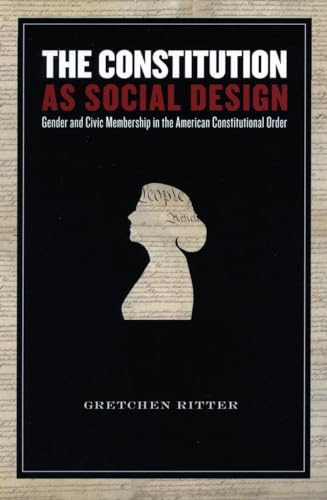
Sinossi
This book focuses on gender and civic membership in American constitutional politics from the adoption of the Nineteenth Amendment through Second Wave Feminism. It examines how American civic membership is gendered, and how the terms of civic membership available to men and women shape their political identities, aspirations, and behavior. The book also explores the dynamics of American constitutional development through a focus on civic membership—a legal and political construct at the heart of the constitutional order.This is a book about gender politics and constitutional development, and about what each of these can tell us about the other. It considers the options and choices faced by women’s rights activists in the United States as they voiced their claims for civic inclusion from Reconstruction through Second Wave Feminism, and it makes evident the limits of liberal citizenship for women.
Le informazioni nella sezione "Riassunto" possono far riferimento a edizioni diverse di questo titolo.
Informazioni sull'autore
Gretchen Ritter is Associate Professor of Government and Director of the Center for Women's and Gender Studies at the University of Texas, Austin. She is the author of Goldbugs and Greenbacks: The Antimonopoly Tradition and the Politics of Finance (1997)
Dalla quarta di copertina
This book focuses on gender and civic membership in American constitutional politics from the adoption of the Nineteenth Amendment through Second Wave Feminism. It examines how American civic membership is gendered, and how the terms of civic membership available to men and women shape their political identities, aspirations, and behavior. The book also explores the dynamics of American constitutional development through a focus on civic membership—a legal and political construct at the heart of the constitutional order.
This is a book about gender politics and constitutional development, and about what each of these can tell us about the other. It considers the options and choices faced by women’s rights activists in the United States as they voiced their claims for civic inclusion from Reconstruction through Second Wave Feminism, and it makes evident the limits of liberal citizenship for women.
This is a book about gender politics and constitutional development, and about what each of these can tell us about the other. It considers the options and choices faced by women’s rights activists in the United States as they voiced their claims for civic inclusion from Reconstruction through Second Wave Feminism, and it makes evident the limits of liberal citizenship for women.
Dal risvolto di copertina interno
This book focuses on gender and civic membership in American constitutional politics from the adoption of the Nineteenth Amendment through Second Wave Feminism. It examines how American civic membership is gendered, and how the terms of civic membership available to men and women shape their political identities, aspirations, and behavior. The book also explores the dynamics of American constitutional development through a focus on civic membership a legal and political construct at the heart of the constitutional order.
This is a book about gender politics and constitutional development, and about what each of these can tell us about the other. It considers the options and choices faced by women s rights activists in the United States as they voiced their claims for civic inclusion from Reconstruction through Second Wave Feminism, and it makes evident the limits of liberal citizenship for women.
This is a book about gender politics and constitutional development, and about what each of these can tell us about the other. It considers the options and choices faced by women s rights activists in the United States as they voiced their claims for civic inclusion from Reconstruction through Second Wave Feminism, and it makes evident the limits of liberal citizenship for women.
Estratto. © Ristampato con autorizzazione. Tutti i diritti riservati.
The Constitution as Social Design
Gender and Civic Membership in the American Constitutional OrderBy GRETCHEN RITTERSTANFORD UNIVERSITY PRESS
Copyright © 2006 Gretchen RitterAll right reserved.
ISBN: 978-0-8047-5438-5
Contents
Acknowledgments....................................................ix1. The Constitution as Social Design...............................1PART I. THE IMPACT OF THE NINETEENTH AMENDMENT2. Voting..........................................................333. Marriage........................................................664. Jury Service....................................................100PART II. WAR AND CIVIC MEMBERSHIP IN THE 1940S5. Labor...........................................................1356. War Service.....................................................174PART III. SECOND WAVE FEMINISM7. Equality........................................................2158. Privacy.........................................................2619. The Politics of Presence........................................297Notes..............................................................327Bibliography.......................................................341Index..............................................................367
Chapter One
The Constitution as Social DesignA constitution not only constitutes a structure of power and authority, it constitutes a people in a certain way. It proposes a distinctive identity and envisions a form of politicalness for individuals in their new collective capacity. - Sheldon S. Wolin, The Presence of the Past
Harriet Stanton Blatch was committed to woman suffrage. When her mother, Elizabeth Cady Stanton, passed away in 1902, Harriet returned from England to carry on her mother's work. Winning the vote became Harriet's full-time mission until the Nineteenth Amendment was adopted in 1920. The amendment was a personal as well as a political victory. It represented the fulfillment of a long-held family dream that American women would become full and equal citizens. Yet for Harriet, like her mother before her, the vote was merely a starting point in the campaign for true democracy. Reflecting on the seventy-fifth anniversary of the 1848 Woman's Rights Convention at Seneca Falls, Blatch confided, "My mother could not conceive of suffrage as standing by itself, as an issue unrelated to other issues. For her it was inseparable from the antislavery agitation, from women's demand for entry into the Weld of labor, into the universities and professions" (DuBois, 1997, 226). Blatch was well aware that women's fight for equality did not end with the vote. Women's inclusion in the electorate did little to change their status of economic dependency. As wives, mothers, and workers, American women remained economically subordinate, and the political system was ill equipped to address the problems of industrial exploitation and legal discrimination that made them so.
By her eightieth birthday, in 1936, Blatch was still looking to the future: "The failures of a decade cannot shake my faith in democracy and liberty," she declared to the friends and family who had gathered in New York to celebrate with her. "I am here to represent the feminist side in this discussion of the future of democracy," she said (DuBois, 1997, 5). Blatch must have known when she passed away in 1940 that much remained to be done. Women still suffered legal discrimination. Even with the gains made during the New Deal, American social provisioning paled in comparison to the social policy regimes emerging in Western Europe. Under the leadership of Franklin Delano Roosevelt, American democracy was more vibrant than it had been when women first won the vote in 1920. Yet it seemed that there were limits on how much American democracy could expand. Both Elizabeth Cady Stanton and Harriet Stanton Blatch had operated within a constitutional order which made the achievement of a more expansive, enriched democracy difficult.
This book is about the contribution that generations of feminists made to the promise of American democracy. It is also about the constitutional order that both constrained and inspired their democratic ambitions.
When did women achieve full civic membership in the Unites States? Was it in 1789, when the Constitution was adopted? Or was it in 1868, when the Fourteenth Amendment defined national citizenship for the first time? Was it in 1920, when women finally received the right to vote? Or in the 1960s and 1970s, when women were granted new rights in employment and education? Or, perhaps, did the failure to adopt the Equal Rights Amendment in the early 1980s illustrate that women are still not recognized as full and equal members of the polity? The absence of a clear answer to this question is indicative of women's ambiguous place in the American civic order.
For much of the nation's history, women's presence in the community of "the People" was assumed but not specified. Before the twentieth century, women's place in the American political community was conceived of relationally. As wives, daughters, servants, and slaves, women were represented in public affairs through their husbands, fathers, and masters. They had no independent civic status. Then, in the late nineteenth century and throughout the twentieth century, women gradually came to be seen as individuals. Individualism seems essential for civic recognition in America, a nation whose public philosophy is premised on liberalism and natural rights. American women's claim to an autonomous legal and political status has been hard-fought; in many ways they are still not fully recognized in those terms. Yet autonomy is not an unambiguously positive status for women. It remains uncertain what it would take for women to secure a civic membership that provides them with equal rights and status, and that is more fully expressive of their social identities, experiences, and concerns.
This book is about gender and civic membership in American constitutional politics, from the adoption of the Nineteenth Amendment through second wave feminism. There are two central concerns that motivate this work. First, it examines how American civic membership is gendered, and how the terms of civic membership available to men and women shape their political identities, aspirations, and behavior. Second, this book explores the dynamics of American constitutional development through a focus on civic membership, which is understood here as a legal and political construct at the heart of the constitutional order. In other words, this is a book about gender politics and constitutional development, and about what each of these can tell us about the other.
Within the American constitutional order women have undergone a shift from a civic status based upon marriage, family relations, and economic dependency to one based upon the principles of liberal individualism and legal personhood. Yet the attainment of a liberal civic status remains partial; in the struggle to achieve standing as public-realm individuals, women still face resistance to the idea that their sex does not matter to their civic membership. The federal government and many in the broader society will go only so far in granting women constitutional equality. Many prefer to think that it is appropriate for women to be recognized as relational beings, tied to their children and spouses, who are situated and shaped by their lives in the domestic realm.
The shift from a citizenship based on domesticity and dependency to one that is imperfectly based on liberal individualism and legal personhood corresponds to the nation's emergence as a modern liberal constitutional order. By considering the constitutional transition from a common law system of social governance to a modern liberal system of social governance, we can better understand how our modern institutions sometimes alleviate social hierarchies and sometimes reformulate them. Many of these hierarchies contain changing conceptions of the household and the place of its members in politics. I contend that the modern liberal order that took hold in the United States in the twentieth century retained imprints from the earlier common law system of governance, meaning that status hierarchies connected to marriage, labor, and race were modernized under such rubrics as privacy, autonomy, and federalism. Put positively, despite the problematic way in which it is conceived, individualism (a status that for women is premised on their separation from domestic relations) affords some members of previously subordinated groups new opportunities for political efficacy and social mobility.
Approaching constitutional development through debates over civic membership allows for new insights into one of the central paradoxes of American history-namely, how it is that a nation founded on universalist principles of equality is so marked by a history of hierarchy, subordination, and exclusion. How can Thomas Jefferson be both the author of the Declaration of Independence and the master (and father) of slaves? How can the legacies of slavery, coverture, immigrant exclusion, Indian extermination, and relocation camps be reconciled with a history that includes the Declaration, the Bill of the Rights, the Emancipation Proclamation, the Four Freedoms, and the "I have a dream" speech? Many resolve this contradiction by imagining that liberal individualism and equality constitute the core truth about America, while practices of subordination do not represent the nation's spirit or destiny and are better understood as historical remnants that eventually were swept away by the power of American political ideals. Such a portrait is seductive, not least for the subordinated groups who invoke it to advance claims of inclusion. Yet it is also a troublesome misrepresentation for a nation that often proves willing not only to retain and reformulate certain forms of social hierarchy, but to generate new institutions and practices of political and social exclusion. It makes more sense, then, to begin with the premise that both hierarchy and equality have been central to the principles and practices of the American constitutional order.
We can begin to make sense of the duality of the American political experience by looking comprehensively at the constitutional order as a social design that expresses and manages, through the terms of civic membership, the competing principles of individual rights and concerns with social order. The polity is shaped by a civic order that affords different terms of rights and recognition and that demands different duties from various groups within the nation. Variations in the terms of civic membership accord with the civic standing and social place of particular social groups. The focus of the book's analysis is debates on gender and civic membership. For, as both a central and long-subordinated group in American politics, women's civic membership reveals the boundaries and nature of the constitution order. The first part of the book considers the impact of the Nineteenth Amendment and finds that, while suffrage provided women with a claim to an identity as engaged citizens and legal persons, marriage remained a defining element in the civic status of women and men. Part II focuses on the 1940s, and finds that the new validations of labor status and military status worked to elevate the civic position of American men over women. Part III examines the impact of second wave feminism on civic membership. Inspired by the civil rights revolution, the 1960s and 1970s were decades when women's citizenship expanded under the rubric of equality. Yet, since many Americans remained convinced that sex differences run more than skin deep, and that women's social roles should involve more than their individual ambitions, there was a limit to how far equality pursuits could go. In areas like contraception and abortion, privacy became an alternative principle for expanding the rights of women. What emerges from this analysis is the long, uneven, and still unfinished process of claiming the status of full legal personhood for women. The conclusion of this book offers an alternative vision of civic presence for women based on an embodied, public form of civic membership.
Theoretical Framework
A vast comparative literature on citizenship and civic membership has emerged in recent years. This literature arose in response to large-scale historical events in the late twentieth century, such as the birth of new nations following the collapse of the Soviet Union; the rise of globalization and attendant changes in political and economic relations; the growth in political formations and claims based on race, gender, ethnicity, and religion; and an increase in claims of civic dualism associated with new patterns of migration and the expansion of transnational governing institutions. These events have changed and complicated the terms of civic membership away from the stable patterns established after World War II in the industrial West. Understanding this shift away from industrialism, nationalism, and legal individualism as foundations for civic membership has led many scholars to consider the role that institutions play in organizing political identities and the relationship between the populous and the state. Some of this work, including this book, takes the form of historical inquiry into where we have been in order to clarify our view of where we are going.
This study of U.S. civic membership and gender politics is situated within the framework of constitutional politics. Civic membership refers to the legal and political status of all persons under U.S. political authority. In addition to citizens, this category would include slaves, wards (e.g., Native Americans), permanent residents, immigrants in the process of naturalizing, colonized subjects (e.g., the populations of the Philippines and Puerto Rico following the Spanish American War), and women who lost their U.S. citizenship through marriage to foreign nationals. In contrast, citizenship is conceived of here in the formal sense, as a legal status. One either is or is not a citizen of a nation. Since the adoption of the Fourteenth Amendment in 1868, all persons born in the United States, or naturalized by the federal government, are considered American citizens. Specific legal rights typically attach to citizenship, such as the right to vote or to serve on a jury. Certain duties are expected of citizens, including the duty to defend the nation in times of war. Governments typically provide certain social benefits to their citizens as well, often in recognition of their civic service-such as social security, veterans' benefits, and Medicare. Though not all citizens have these rights, benefits, and duties, citizenship is typically used as a legal marker for their assignment. Throughout this book, references to citizenship are narrowly specified in terms of formal legal status.
Civic membership also refers to the broader political, legal, and social meanings that attach to one's place within the polity. It is conceived of dynamically and historically, as involving everyday political practices and processes in which the state and its members both enact and contest members' rights, duties, and civic statuses within different institutional and discursive settings. Civic membership is located in all of the places where the state and the populous intersect: in the legal realm, the regulatory and policy realms, and the realm of political representation and popular culture. Within the nation the experience of civic membership varies, both according to the institutional or ideological site where interaction occurs (in a voting booth, before a court of law, on a welfare line, or in a classroom where students pledge allegiance to the Xag), and according to the social group represented in that experience. The positions of various social groups come together in a larger civic order, where the civic standing of each is defined relative to the rest.
The constitutional order of the United States refers to the role of the Constitution, constitutional discourse, and constitutional law in structuring the polity institutionally and socially. Appeals to constitutional laws and norms represent appeals to foundational law and to fundamental political commitments that bind us across generations. The community invoked and created in the phrase "We, the People," stands at the center of the institutional framework and political community that the Constitution defines. On the one hand, the Constitution outlines the power and offices of the national government. On the other hand, the Constitution suggests a civic order in which the government and "the People" have a set of rights and duties toward one another. Civic membership, to the extent that it speaks to the reciprocal relationship between the people and the government, is at the heart of the constitutional order. Usually in American politics, the overall terms of civic membership are assumed, but occasionally they are deeply challenged, either internally (by social movements and political realignments) or externally (by wars or economic depressions), in ways that affect the structure of the larger constitutional order and the relationship of various social groups to one another within constitutional politics.
(Continues...)
Excerpted from The Constitution as Social Designby GRETCHEN RITTER Copyright © 2006 by Gretchen Ritter. Excerpted by permission.
All rights reserved. No part of this excerpt may be reproduced or reprinted without permission in writing from the publisher.
Excerpts are provided by Dial-A-Book Inc. solely for the personal use of visitors to this web site.
Le informazioni nella sezione "Su questo libro" possono far riferimento a edizioni diverse di questo titolo.
Risultati della ricerca per The Constitution As a Social Design: Gender And Civic...

Immagini fornite dal venditore
The Constitution As Social Design: Gender And Civic Membership in the American Constitutional Order
Editore:
Stanford University Press, 2006
ISBN 10: 0804754381
ISBN 13: 9780804754385
Antico o usato
Brossura
Da: Austin Goodwill 1101, Austin, TX, U.S.A.
Valutazione del venditore 5 su 5 stelle

Condizione: acceptable. Book shows noticeable wear from use. May include writing, highlighting, or other markings, but not excessive. Cover or edges may have visible wear. The book remains complete and fully readable. Codice articolo CTXV.0804754381.A
Compra usato
EUR 3,42
Spedizione EUR 2,90
Spedito in U.S.A.
Spedito in U.S.A.
Quantità: 1 disponibili
Foto dell'editore
The Constitution As Social Design: Gender And Civic Membership in the American Constitutional Order
Editore:
Stanford University Press, 2006
ISBN 10: 0804754381
ISBN 13: 9780804754385
Antico o usato
Paperback
Da: Midtown Scholar Bookstore, Harrisburg, PA, U.S.A.
Valutazione del venditore 5 su 5 stelle
Paperback. Condizione: Good. Good - Bumped and creased book with tears to the extremities, but not affecting the text block, may have remainder mark or previous owner's name - GOOD Standard-sized. Codice articolo M0804754381Z3
Compra usato
EUR 2,50
Spedizione EUR 5,28
Spedito in U.S.A.
Spedito in U.S.A.
Quantità: 2 disponibili
Immagini fornite dal venditore
The Constitution As Social Design: Gender And Civic Membership in the American Constitutional Order
Editore:
Stanford University Press, 2006
ISBN 10: 0804754381
ISBN 13: 9780804754385
Antico o usato
Brossura
Da: Goodwill of Greater Milwaukee and Chicago, Racine, WI, U.S.A.
Valutazione del venditore 5 su 5 stelle
Condizione: acceptable. Book is considered to be in acceptable condition. The actual cover image may not match the stock photo. Book may have one or more of the following defects: noticeable wear on the cover dust jacket or spine; curved, dog eared or creased page s ; writing or highlighting inside or on the edges; sticker s or other adhesive on cover; CD DVD may not be included; and book may be a former library copy. Codice articolo SEWV.0804754381.A
Compra usato
EUR 7,00
Spedizione EUR 2,64
Spedito in U.S.A.
Spedito in U.S.A.
Quantità: 1 disponibili
Foto dell'editore
Constitution As a Social Design : Gender And Civic Membership in the American Constitutional Order
Da: GreatBookPrices, Columbia, MD, U.S.A.
Valutazione del venditore 5 su 5 stelle
Condizione: New. Codice articolo 4153955-n
Compra nuovo
EUR 32,01
Spedizione EUR 2,32
Spedito in U.S.A.
Spedito in U.S.A.
Quantità: Più di 20 disponibili
Foto dell'editore
The Constitution As Social Design: Gender And Civic Membership in the American Constitutional Order
Da: California Books, Miami, FL, U.S.A.
Valutazione del venditore 5 su 5 stelle
Condizione: New. Codice articolo I-9780804754385
Compra nuovo
EUR 34,41
Spedizione gratuita
Spedito in U.S.A.
Spedito in U.S.A.
Quantità: Più di 20 disponibili
Foto dell'editore
The Constitution as Social Design: Gender and Civic Membership in the American Constitutional Order
Editore:
Stanford University Press, 2006
ISBN 10: 0804754381
ISBN 13: 9780804754385
Antico o usato
Paperback / softback
Da: THE SAINT BOOKSTORE, Southport, Regno Unito
Valutazione del venditore 5 su 5 stelle
Paperback / softback. Condizione: Good. Used copy in good condition - Usually dispatched within 3 working days. Codice articolo D9780804754385
Compra usato
EUR 10,98
Spedizione EUR 24,09
Spedito da Regno Unito a U.S.A.
Spedito da Regno Unito a U.S.A.
Quantità: 2 disponibili
Immagini fornite dal venditore
Constitution As a Social Design : Gender And Civic Membership in the American Constitutional Order
Editore:
Stanford University Press, 2006
ISBN 10: 0804754381
ISBN 13: 9780804754385
Antico o usato
Brossura
Da: GreatBookPrices, Columbia, MD, U.S.A.
Valutazione del venditore 5 su 5 stelle
Condizione: As New. Unread book in perfect condition. Codice articolo 4153955
Compra usato
EUR 32,87
Spedizione EUR 2,32
Spedito in U.S.A.
Spedito in U.S.A.
Quantità: Più di 20 disponibili
Immagini fornite dal venditore
The Constitution As Social Design
Editore:
Stanford University Press, US, 2006
ISBN 10: 0804754381
ISBN 13: 9780804754385
Nuovo
Paperback
Da: Rarewaves USA, HEBRON, KY, U.S.A.
Valutazione del venditore 5 su 5 stelle
Paperback. Condizione: New. This book focuses on gender and civic membership in American constitutional politics from the adoption of the Nineteenth Amendment through Second Wave Feminism. It examines how American civic membership is gendered, and how the terms of civic membership available to men and women shape their political identities, aspirations, and behavior. The book also explores the dynamics of American constitutional development through a focus on civic membership-a legal and political construct at the heart of the constitutional order. This is a book about gender politics and constitutional development, and about what each of these can tell us about the other. It considers the options and choices faced by women's rights activists in the United States as they voiced their claims for civic inclusion from Reconstruction through Second Wave Feminism, and it makes evident the limits of liberal citizenship for women. Codice articolo LU-9780804754385
Compra nuovo
EUR 35,86
Spedizione gratuita
Spedito in U.S.A.
Spedito in U.S.A.
Quantità: Più di 20 disponibili
Immagini fornite dal venditore
The Constitution As a Social Design
Da: eCampus, Lexington, KY, U.S.A.
Valutazione del venditore 4 su 5 stelle

Condizione: New. Codice articolo N:9780804754385:ONHAND
Compra nuovo
EUR 34,07
Spedizione EUR 3,51
Spedito in U.S.A.
Spedito in U.S.A.
Quantità: 2 disponibili
Foto dell'editore
The Constitution As Social Design
Da: PBShop.store UK, Fairford, GLOS, Regno Unito
Valutazione del venditore 5 su 5 stelle
PAP. Condizione: New. New Book. Shipped from UK. Established seller since 2000. Codice articolo FW-9780804754385
Compra nuovo
EUR 36,20
Spedizione EUR 5,83
Spedito da Regno Unito a U.S.A.
Spedito da Regno Unito a U.S.A.
Quantità: 15 disponibili