
Articoli correlati a The Rise and Fall of Urban Economies: Lessons from...
The Rise and Fall of Urban Economies: Lessons from San Francisco and Los Angeles - Rilegato
Libro 16 di 20: Innovation and Technology in the World Economy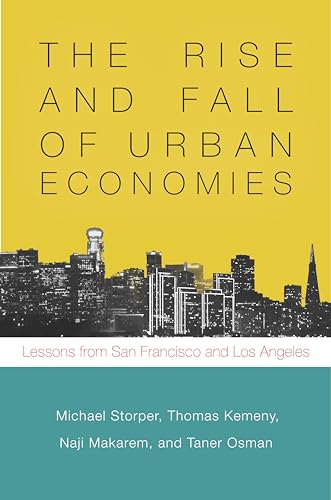
Sinossi
Today, the Bay Area is home to the most successful knowledge economy in America, while Los Angeles has fallen progressively further behind its neighbor to the north and a number of other American metropolises. Yet, in 1970, experts would have predicted that L.A. would outpace San Francisco in population, income, economic power, and influence. The usual factors used to explain urban growth—luck, immigration, local economic policies, and the pool of skilled labor—do not account for the contrast between the two cities and their fates. So what does?
The Rise and Fall of Urban Economies challenges many of the conventional notions about economic development and sheds new light on its workings. The authors argue that it is essential to understand the interactions of three major components—economic specialization, human capital formation, and institutional factors—to determine how well a regional economy will cope with new opportunities and challenges. Drawing on economics, sociology, political science, and geography, they argue that the economic development of metropolitan regions hinges on previously underexplored capacities for organizational change in firms, networks of people, and networks of leaders. By studying San Francisco and Los Angeles in unprecedented levels of depth, this book extracts lessons for the field of economic development studies and urban regions around the world.
The Rise and Fall of Urban Economies challenges many of the conventional notions about economic development and sheds new light on its workings. The authors argue that it is essential to understand the interactions of three major components—economic specialization, human capital formation, and institutional factors—to determine how well a regional economy will cope with new opportunities and challenges. Drawing on economics, sociology, political science, and geography, they argue that the economic development of metropolitan regions hinges on previously underexplored capacities for organizational change in firms, networks of people, and networks of leaders. By studying San Francisco and Los Angeles in unprecedented levels of depth, this book extracts lessons for the field of economic development studies and urban regions around the world.
Le informazioni nella sezione "Riassunto" possono far riferimento a edizioni diverse di questo titolo.
Informazioni sugli autori
Michael Storper is Professor of Urban Planning at the University of California, Los Angeles.Thomas Kemeny is Lecturer in Human Geography at the University of Southampton.Naji Makarem is Lecturer in the Bartlett Development Planning Unit (DPU) at University College London (UCL).Taner Osman is an instructor in the Department of Urban Planning at the University of California, Los Angeles.
Michael Storper is Professor of Urban Planning at the University of California, Los Angeles. Thomas Kemeny is Lecturer in Human Geography at the University of Southampton. Naji Makarem is Lecturer in the Bartlett Development Planning Unit (DPU) at University College London (UCL). Taner Osman is an instructor in the Department of Urban Planning at the University of California, Los Angeles.
Estratto. © Ristampato con autorizzazione. Tutti i diritti riservati.
The Rise and Fall of Urban Economies
Lessons from San Francisco and Los Angeles
By Michael Storper, Thomas Kemeny, Naji Philip Makarem, Taner OsmanSTANFORD UNIVERSITY PRESS
Copyright © 2015 Board of Trustees of the Leland Stanford Junior University
All rights reserved.
ISBN: 978-0-8047-8940-0All rights reserved.
Contents
List of Figures, Maps, and Tables,
Acknowledgments,
1. The Divergent Development of Urban Regions,
2. Divergent Development: The Conceptual Challenge,
3. The Motor of Divergence: High-Wage or Low-Wage Specialization,
4. The Role of Labor in Divergence: Quality of Workers or Quality of Jobs?,
5. Economic Specialization: Pathways to Change,
6. Economic Development Policies: Their Role in Economic Divergence,
7. Beliefs and Worldviews in Economic Development: To Which Club Do We Belong?,
8. Seeing the Landscape: The Relational Infrastructure of Regions,
9. Connecting the Dots: What Caused Divergence?,
10. Shaping Economic Development: Policies and Strategies,
11. Improving Analysis of Urban Regions: Methods and Models,
Notes,
Works Cited,
Index,
CHAPTER 1
The Divergent Development of Urban Regions
FOR THE FIRST TIME IN HUMAN HISTORY, MORE THAN HALF of the world's population lives in urban areas. Eighty-five million people per year are moving to cities worldwide, most of them in the developing world. The most populated six hundred urban areas, or metropolitan regions, concentrate about a fifth of the world's population and about half of world economic output; these proportions will rise to a quarter of the population and more than 60 percent of output in just the next fifteen years (McKinsey, 2011). Indeed, the concentration of economic output in cities is even starker: just 23 mega city-regions (with ten million people or more) produce about a quarter of world economic output. This is not just due to the rapid urbanization in the developing world. Fully 90 percent of U.S. economic growth since 1978 has come from 254 large cities and 50 percent from the 30 largest metropolitan regions. About half of U.S. employment is located on 1.5 percent of its land area.
Even though the world is urbanizing, cities continue to have very different levels of economic development. Within the United States, for example, large metropolitan regions (with more than 1 million people) have average per capita incomes that are 40 percent higher than the rest of the country. On a world scale, residents of larger cities earn incomes that are about four times the global average. Incomes in large urban areas range from about $2,000 per year in Cairo to about $75,000 in cities such as San Francisco, Oslo, and Hartford, Connecticut. Finally, significant differences remain in income levels among metropolitan regions within single countries; in the United States, per capita income in Brownsville, Texas, is $23,000 per year compared to about $75,000 in the San Francisco Bay Area or Washington, D.C., or about a one-to-three ratio.
Economies have forces that sometimes allow development levels to become more similar and others that sometimes pull them apart. The income levels of U.S. states converged from 1880 to 1980, where the richest state (Connecticut) went from being 4.5 times as rich as the poorest (Mississippi) to just 1.76 times. But such convergence came to a stop around 1980 (Ganong and Shoag, 2012). Over the course of that century, U.S. city-regions went up and down the income rankings, fluctuating much more than states. Intermetropolitan per capita income convergence also came to a halt sometime in the 1980s (Moretti, 2012; Drennan and Lobo, 1999; Yamamoto, 2007).
The pattern of income differences between countries and cities changes over time. For countries, economic historians refer to a Great Divergence: China was by far the richest nation in the world in 1492 and still had a higher per capita income than Spain or Britain in 1750. It spent the next two and a half centuries falling behind the West before beginning its climb back up the income ladder in recent years (Pomeranz, 2000; O'Rourke and Williamson, 1999). We now speak of a new "great divergence" in development between city-regions within countries (Moretti, 2012). This means that while it will be essential to promote and sustain urbanization as a key basis for prosperity in the twenty-first century, urbanization alone will not ensure prosperity for every city-region. In the United States, Detroit was the sixth richest metropolitan region in in 1970; it is now 52nd on the list. Boston is now one of the top five American metropolitan regions in income, but it has had many ups and downs in its four-century history and it was down and out as recently as 1980 (Glaeser, 2003).
In this book, we study the divergent fates of two great California city-regions, Los Angeles and San Francisco. In 1970, they had similar levels of per capita income and were fourth and first, respectively, among U.S. metropolitan regions. In 2010, they had almost a one third difference in per capita income and Los Angeles had slipped to 25th place. Throughout history, these kinds of changes in fortune have occurred in the world's great city-regions, often due to war or political change. But in the case at hand, they occurred because of the way that two wealthy, highly developed city-regions entered the New Economy.
In typical lore about these two cities, Los Angeles is said to have fallen on hard times because of the loss of much of its aerospace sector after the end of the Cold War, a flood of low-skilled immigrants from Latin America, and governmental failure. San Francisco won the information age lottery, becoming the world center of that technological revolution and hosting highly skilled immigrants. But none of these factors explain why these two cities diverged from similar starting points, and we will demonstrate in this book that the divergent process of change was principally due to the different ways the two economies reshaped their social and economic networks, the practices of their firms, and the overall ecology of organizations in their economies.
Two Great City-Regions: Los Angeles and San Francisco
By any standard, the Los Angeles and San Francisco metropolitan regions are large, wealthy, and dynamic. Los Angeles, in this context, means the Greater Los Angeles metropolitan region (known officially as the Combined Statistical Area [CSA] encompassing five adjacent, continuously urbanized counties (Los Angeles, Orange and Ventura, and parts of San Bernardino and Riverside). Los Angeles is one of the largest economies in the world. In 2011, its nominal gross metropolitan product was $897 billion, which would make it the world's 16th largest economy, after Mexico (112 million inhabitants) and before Indonesia (220 million). Los Angeles had 18.08 million residents in 2011, making it the second most populous metropolitan area in the United States. Meanwhile, the San Francisco Bay Area generated a gross metropolitan economic output of $575 million, with a population of 7.5 million, making it the world's 22nd largest economy, just after Argentina (35 million) and before Sweden, with 9.6 million people.
Los Angeles is perhaps best known for Hollywood's entertainment industry, though it has a highly diversified economy. Its icons are the palm-lined streets of Beverly Hills and the mansions of Malibu, the hundred-mile string of wide sandy beaches along Santa Monica Bay and the Orange County coastline, its car-and-freeway landscape, and a way of life shaped by its year-round sunny, temperate climate. Los Angeles is frequently characterized as a vast suburban sprawl, but this is something of an illusion. Its settlements include sprawling neighborhoods of single-family houses, opulent villas, rustic canyon settlements, and beachside bungalows but also high-rise corridors and urban neighborhoods of medium-density apartments, all interlaced with commercial boulevards that stretch for long distances. As a whole, the Los Angeles metropolitan region has a higher average population density than the New York metropolitan area, and its population density is about 20 percent higher than that of the San Francisco Bay Area. Though it has a small downtown for a region its size, Los Angeles has several neighborhoods with double the average density of the City of San Francisco, the Bay Area's urbanized core.
The San Francisco metropolitan area, which is also known as the Bay Area, is a Combined Statistical Area that until 2010 comprised ten varied counties, from the Sonoma and Napa wine country in the north to Silicon Valley and the Santa Cruz Mountains and coast in the south, and from the wild Pacific coastline to the west inland to the mountains separating it from the Central Valley of interior California. With metropolitan expansion, the definition of the region (defined by the U.S. Office of Management and Budget [OMB] as the San Jose–San Francisco–Oakland Combined Statistical Area) was expanded in 2012 to include two inland counties that contain dormitory suburbs in California's interior Central Valley.
The Bay Area is best known for the city of San Francisco: an iconically beautiful, hilly settlement surrounded by water and known worldwide for the Golden Gate Bridge, its waterfront, and colorful neighborhoods of ornate attached row houses. Outside the city of San Francisco, the Bay Area has densely urbanized areas in the East Bay (Oakland) and the low-density suburban megaregion of Silicon Valley. Its settlements are as diverse as those of Los Angeles, from forested rustic neighborhoods through typical California suburbs to dense European-style urban living.
Divergence: The Problem to Be Investigated in This Book
Depending on the method of calculation employed, the overall size of the economy (regional gross output) of the economy of Greater Los Angeles is third or fourth among metropolitan regions in the world, while that of the San Francisco Bay Area is about nineteenth. In terms of per capita income, inversely, San Francisco is consistently in the top five metro areas, and in a more select group of regions with more than 5 million people, it is usually first or second. In that latter group, Los Angeles ranks about 20th. For much of the twentieth century, Los Angeles successfully played catch-up in terms of income to its northern counterpart, all the while absorbing many more new people (Rand, 1967). Between 1970 and 1980, Los Angeles's income level began to fall behind that of its northern neighbor. As Figure 1.1 illustrates, in 1970, per capita personal income levels in Los Angeles were 92 percent of those found in San Francisco. By 2012, they amounted to only 71 percent.
As seen in Figure 1.1, Los Angeles has not only failed to keep pace with the Bay Area, but it has been unable to match the performance of many other major American metropolises. In addition to our two California regions, the figure tracks per capita income dynamics between 1970 and 2012 for all other Consolidated Statistical Areas whose populations were over 5 million in 1970: New York–Newark, NY–NJ–CT–PA; Chicago–Naperville, IL–IN–WI; Washington–Baltimore–Arlington, DC–MD–VA–WV–PA; Philadelphia–Reading–Camden, PA–NJ–DE–MD; Boston–Worcester–Providence, MA–RI–NH–CT; and Detroit–Warren–Ann Arbor, MI. To make for a readable figure, incomes are averaged across New York; Chicago; Boston; Washington, D.C.; and Philadelphia, while the Detroit region is presented separately. Across these larger cities, Los Angeles most closely resembles Detroit. The larger story told in Figure 1.1 is that it is not sufficient to observe that the Bay Area is an especially fortunate case among American cities; San Francisco has indeed outperformed most metropolitan areas, but Los Angeles has foundered by that same standard.
Stated another way, the Bay Area and Los Angeles belonged to similar development clubs in 1970. Both regions had more educated workforces than the United States as a whole, and they hosted significantly higher proportions of Hispanics than the country as a whole. Both regions developed rapidly in resource-rich California, benefiting from business and financial links to the state's agricultural and natural resources hinterlands. Both nurtured dynamic and variegated manufacturing and service economies. Both benefited from large-scale federal procurement of military hardware from their regional firms. Both were centers of innovation in knowledge- and technology-intensive sectors, producing iconic goods for global markets such as airplanes, semiconductors, communications equipment, and entertainment. Both hosted major scientific research communities, consisting of 6 of the world's top-20-ranked research universities, as well as government research laboratories, independent institutes, large private firms with research and development (R&D) operations, and research hospitals. Migrants were attracted to their natural beauty, excellent climates, and high quality of life, thus sustaining high real estate prices and continued expansion of local markets for nontradable goods and services. Both shared California's relatively progressive governmental structure, institutions, infrastructure, and education policies.
Thus we arrive at the question that is at the center of this book: given similar incomes and wages in 1970 and all of these common developmental characteristics, why did San Francisco surge forward and Los Angeles fall so far behind?
Several Facets of Divergence
Urban and development economics compare economic well-being by correcting money incomes for different levels of local prices, as a way to identify "real" income. Internationally, this involves correcting for purchasing power parity; interregionally, it principally involves correcting for housing prices, the major reason why living costs differ from place to place. For instance, in the years 2007–2008, nominal income in Los Angeles was 70 percent of that of the Bay Area, but its median selling price for homes was 79 percent of that of the Bay Area. Median housing prices are not a precise measure of housing cost differences, because they reflect only costs of new entrants to a region, while most residents are buying and selling within the regional market and paying the difference between past capitalization and present prices. More accurate accounting of effective housing costs should capture the range of situations (immigrants, homeowners, degree of capitalization, income level, renters). Using microdata from the decennial census and the American Community Survey, we can calculate such costs for different parts of the population. Annual housing expenditures are estimated by summing annualized rent or mortgage payments, utilities, insurance, condominium fees, property taxes, and other costs where applicable. Each household's housing expenditures are then subtracted from its total wage and salary income to arrive its real income. Since the housing cost information is collected only from 1980 forward, Figure 1.2 presents median values of real (housing-cost-adjusted) income for each region for 1980, 1990, 2000, and 2010.
As the figure shows, from relatively comparable beginnings, San Francisco's real income advantage over Los Angeles grew strikingly, from 14 percent in 1980 to 50 percent by 2010. The broad trajectory and magnitudes of real incomes in Los Angeles and San Francisco reinforce a story in which San Francisco has, from comparable beginnings, strongly outperformed its southern neighbor.
Income Growth or Population Growth?
If a region or country increases its income while maintaining a stable population — something like Denmark — we think very differently about it as compared with a place where incomes rise in a context of considerable population growth, as in Chinese cities today, many American Sun Belt cities in recent decades, and California in much of the twentieth century.
Characteristics of the new population matter as well. Consider an economy that grows richer while welcoming only skilled individuals versus another that accommodates a wider variety of immigrants and pulls them up the wealth ladder — a difference we might describe as one of outcome versus opportunity. One economy might increase its per capita income through stricter gatekeeping, whether through formal immigration controls or high housing prices. Meanwhile, a more "welcoming" urban region might receive an influx of migrants whose lower education and skills reduce average income.
Figure 1.3 presents rates of compound annual population and income growth between 1970 and 2012 for the 30 most populous U.S. Combined Statistical Areas. Average values for all U.S. urban regions are documented with solid horizontal and vertical rules. From the figure, we see that the populations of both Los Angeles and San Francisco grew much faster than cities in the Northeast and Midwest, and considerably slower than the Sun Belt metro regions.
Between 1970 and 2012, the Greater Los Angeles economy added more than 8 million people, nearly doubling in size. This makes Los Angeles a distinctly different case from Rust Belt regions like Detroit. Over the same period, the Bay Area grew by about 60 percent, adding more than 3 million people. By the same standard, however, growth rates in both population and income have been slower in Los Angeles than in Houston, Dallas, Atlanta, Miami, Raleigh, Seattle, Denver, Orlando, and Portland.
(Continues...)
Excerpted from The Rise and Fall of Urban Economies by Michael Storper, Thomas Kemeny, Naji Philip Makarem, Taner Osman. Copyright © 2015 Board of Trustees of the Leland Stanford Junior University. Excerpted by permission of STANFORD UNIVERSITY PRESS.
All rights reserved. No part of this excerpt may be reproduced or reprinted without permission in writing from the publisher.
Excerpts are provided by Dial-A-Book Inc. solely for the personal use of visitors to this web site.
Le informazioni nella sezione "Su questo libro" possono far riferimento a edizioni diverse di questo titolo.
Risultati della ricerca per The Rise and Fall of Urban Economies: Lessons from...

Foto dell'editore
The Rise and Fall of Urban Economies: Lessons from San Francisco and Los Angeles
Editore:
Stanford Business Books, 2015
ISBN 10: 0804789401
ISBN 13: 9780804789400
Antico o usato
Rilegato
Da: ThriftBooks-Atlanta, AUSTELL, GA, U.S.A.
Valutazione del venditore 5 su 5 stelle

Hardcover. Condizione: As New. No Jacket. Pages are clean and are not marred by notes or folds of any kind. ~ ThriftBooks: Read More, Spend Less. Codice articolo G0804789401I2N00
Compra usato
EUR 10,08
Spedizione gratuita
Spedito in U.S.A.
Spedito in U.S.A.
Quantità: 1 disponibili
Foto dell'editore
The Rise and Fall of Urban Economies: Lessons from San Francisco and Los Angeles (Innovation and Technology in the World Economy)
Editore:
Stanford Business Books, 2015
ISBN 10: 0804789401
ISBN 13: 9780804789400
Antico o usato
Rilegato
Da: Midtown Scholar Bookstore, Harrisburg, PA, U.S.A.
Valutazione del venditore 5 su 5 stelle
Hardcover. Condizione: Good. Good - Bumped and creased book with tears to the extremities, but not affecting the text block, may have remainder mark or previous owner's name - GOOD Standard-sized. Codice articolo M0804789401Z3
Compra usato
EUR 5,53
Spedizione EUR 5,37
Spedito in U.S.A.
Spedito in U.S.A.
Quantità: 5 disponibili
Foto dell'editore
The Rise and Fall of Urban Economies
Editore:
Stanford University Press, 2015
ISBN 10: 0804789401
ISBN 13: 9780804789400
Antico o usato
Rilegato
Da: PBShop.store UK, Fairford, GLOS, Regno Unito
Valutazione del venditore 5 su 5 stelle
HRD. Condizione: Used - Very Good. Used - Like New Book. Shipped from UK. Established seller since 2000. Codice articolo P1-9780804789400
Compra usato
EUR 18,09
Spedizione EUR 6,00
Spedito da Regno Unito a U.S.A.
Spedito da Regno Unito a U.S.A.
Quantità: 1 disponibili
Foto dell'editore
The Rise and Fall of Urban Economies: Lessons from San Francisco and Los Angeles (Innovation and Technology in the World Economy)
Da: GoldBooks, Denver, CO, U.S.A.
Valutazione del venditore 5 su 5 stelle
Hardcover. Condizione: new. New Copy. Customer Service Guaranteed. Codice articolo 55M56_59_0804789401
Compra nuovo
EUR 43,60
Spedizione EUR 4,92
Spedito in U.S.A.
Spedito in U.S.A.
Quantità: 1 disponibili
Immagini fornite dal venditore
The Rise and Fall of Urban Economies : Lessons from San Francisco and Los Angeles
Print on DemandDa: AHA-BUCH GmbH, Einbeck, Germania
Valutazione del venditore 5 su 5 stelle
Buch. Condizione: Neu. nach der Bestellung gedruckt Neuware - Printed after ordering - Today, the Bay Area is home to the most successful knowledge economy in America, while Los Angeles has fallen progressively further behind its neighbor to the north and a number of other American metropolises. Yet, in 1970, experts would have predicted that L.A. would outpace San Francisco in population, income, economic power, and influence. The usual factors used to explain urban growth-luck, immigration, local economic policies, and the pool of skilled labor-do not account for the contrast between the two cities and their fates. So what does The Rise and Fall of Urban Economies challenges many of the conventional notions about economic development and sheds new light on its workings. The authors argue that it is essential to understand the interactions of three major components-economic specialization, human capital formation, and institutional factors-to determine how well a regional economy will cope with new opportunities and challenges. Drawing on economics, sociology, political science, and geography, they argue that the economic development of metropolitan regions hinges on previously underexplored capacities for organizational change in firms, networks of people, and networks of leaders. By studying San Francisco and Los Angeles in unprecedented levels of depth, this book extracts lessons for the field of economic development studies and urban regions around the world. Codice articolo 9780804789400
Compra nuovo
EUR 22,30
Spedizione EUR 35,00
Spedito da Germania a U.S.A.
Spedito da Germania a U.S.A.
Quantità: 1 disponibili
Immagini fornite dal venditore
The Rise and Fall of Urban Economies: Lessons from San Francisco and Los Angeles
Da: moluna, Greven, Germania
Valutazione del venditore 5 su 5 stelle
Condizione: New. Über den AutorrnrnMichael Storper is Professor of Urban Planning at the University of California, Los Angeles.nnThomas Kemeny is Lecturer in Human Geography at the University of Southampton.nnNaji Makarem is Lecturer in. Codice articolo 595016515
Compra nuovo
EUR 15,07
Spedizione EUR 48,99
Spedito da Germania a U.S.A.
Spedito da Germania a U.S.A.
Quantità: 1 disponibili
Immagini fornite dal venditore
The Rise and Fall of Urban Economies | Lessons from San Francisco and Los Angeles
Da: preigu, Osnabrück, Germania
Valutazione del venditore 5 su 5 stelle
Buch. Condizione: Neu. The Rise and Fall of Urban Economies | Lessons from San Francisco and Los Angeles | Michael Storper (u. a.) | Buch | Einband - fest (Hardcover) | Englisch | 2015 | Stanford University Press | EAN 9780804789400 | Verantwortliche Person für die EU: Mare Nostrum Group B.V., Doelen 72, 4831 GR BREDA, NIEDERLANDE, gpsr[at]mare-nostrum[dot]co[dot]uk | Anbieter: preigu. Codice articolo 104692494
Compra nuovo
EUR 16,45
Spedizione EUR 70,00
Spedito da Germania a U.S.A.
Spedito da Germania a U.S.A.
Quantità: 1 disponibili
Foto dell'editore
The Rise and Fall of Urban Economies: Lessons from San Francisco and Los Angeles (eng)
Da: Brook Bookstore On Demand, Napoli, NA, Italia
Valutazione del venditore 5 su 5 stelle
Condizione: new. Codice articolo 8200d976a377def2c3f713e7b0b19da7
Compra nuovo
EUR 131,97
Spedizione EUR 6,80
Spedito da Italia a U.S.A.
Spedito da Italia a U.S.A.
Quantità: Più di 20 disponibili
Foto dell'editore
The Rise and Fall of Urban Economies
Da: PBShop.store UK, Fairford, GLOS, Regno Unito
Valutazione del venditore 5 su 5 stelle
HRD. Condizione: New. New Book. Shipped from UK. Established seller since 2000. Codice articolo FW-9780804789400
Compra nuovo
EUR 141,04
Spedizione EUR 6,00
Spedito da Regno Unito a U.S.A.
Spedito da Regno Unito a U.S.A.
Quantità: 15 disponibili
Immagini fornite dal venditore
Rise and Fall of Urban Economies : Lessons from San Francisco and Los Angeles
Da: GreatBookPrices, Columbia, MD, U.S.A.
Valutazione del venditore 5 su 5 stelle
Condizione: New. Codice articolo 24062750-n
Compra nuovo
EUR 145,15
Spedizione EUR 2,36
Spedito in U.S.A.
Spedito in U.S.A.
Quantità: Più di 20 disponibili