
Articoli correlati a Oracle Night
Sinossi
02
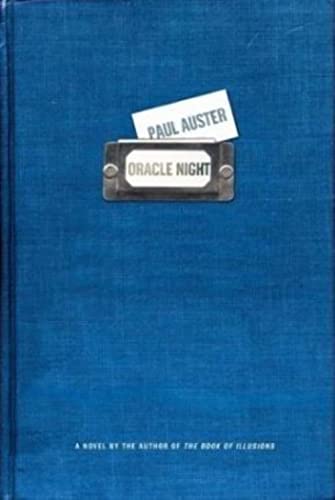
Several months into his recovery from a near-fatal illness, thirty-four-year-old novelist Sidney Orr enters a stationery shop in the Cobble Hill section of Brooklyn and buys a blue notebook. It is September 18, 1982, and for the next nine days Orr will live under the spell of this blank book, trapped inside a world of eerie premonitions and puzzling events that threaten to destroy his marriage and undermine his faith in reality.
Why does his wife suddenly break down in tears in the backseat of a taxi just hours after Sidney begins writing in the notebook? Why does M. R. Chang, the owner of the stationery shop, precipitously close his business the next day? What are the connections between a 1938 Warsaw telephone directory and a lost novel in which the hero can predict the future? At what point does animosity explode into violence? To what degree is forgiveness the ultimate expression of love?
Paul Auster’s mesmerizing eleventh novel reads like an old-fashioned ghost story. But there are no ghosts in this book—only flesh-and-blood human beings, wandering through the haunted realms of everyday life. At once a meditation on the nature of time and a journey through the labyrinth of one man’s imagination, Oracle Night is a narrative tour de force that confirms Auster’s reputation as one of the boldest, most original writers at work in America today.
Why does his wife suddenly break down in tears in the backseat of a taxi just hours after Sidney begins writing in the notebook? Why does M. R. Chang, the owner of the stationery shop, precipitously close his business the next day? What are the connections between a 1938 Warsaw telephone directory and a lost novel in which the hero can predict the future? At what point does animosity explode into violence? To what degree is forgiveness the ultimate expression of love?
Paul Auster’s mesmerizing eleventh novel reads like an old-fashioned ghost story. But there are no ghosts in this book—only flesh-and-blood human beings, wandering through the haunted realms of everyday life. At once a meditation on the nature of time and a journey through the labyrinth of one man’s imagination, Oracle Night is a narrative tour de force that confirms Auster’s reputation as one of the boldest, most original writers at work in America today.
Several months into his recovery from a near-fatal illness, thirty-four-year-old novelist Sidney Orr enters a stationery shop in the Cobble Hill section of Brooklyn and buys a blue notebook. It is September 18, 1982, and for the next nine days Orr will live under the spell of this blank book, trapped inside a world of eerie premonitions and puzzling events that threaten to destroy his marriage and undermine his faith in reality.
Why does his wife suddenly break down in tears in the backseat of a taxi just hours after Sidney begins writing in the notebook? Why does M. R. Chang, the owner of the stationery shop, precipitously close his business the next day? What are the connections between a 1938 Warsaw telephone directory and a lost novel in which the hero can predict the future? At what point does animosity explode into violence? To what degree is forgiveness the ultimate expression of love?
Paul Auster’s mesmerizing eleventh novel reads like an old-fashioned ghost story. But there are no ghosts in this book—only flesh-and-blood human beings, wandering through the haunted realms of everyday life. At once a meditation on the nature of time and a journey through the labyrinth of one man’s imagination, Oracle Night is a narrative tour de force that confirms Auster’s reputation as one of the boldest, most original writers at work in America today.
Why does his wife suddenly break down in tears in the backseat of a taxi just hours after Sidney begins writing in the notebook? Why does M. R. Chang, the owner of the stationery shop, precipitously close his business the next day? What are the connections between a 1938 Warsaw telephone directory and a lost novel in which the hero can predict the future? At what point does animosity explode into violence? To what degree is forgiveness the ultimate expression of love?
Paul Auster’s mesmerizing eleventh novel reads like an old-fashioned ghost story. But there are no ghosts in this book—only flesh-and-blood human beings, wandering through the haunted realms of everyday life. At once a meditation on the nature of time and a journey through the labyrinth of one man’s imagination, Oracle Night is a narrative tour de force that confirms Auster’s reputation as one of the boldest, most original writers at work in America today.
Le informazioni nella sezione "Riassunto" possono far riferimento a edizioni diverse di questo titolo.
Informazioni sull'autore
Paul Auster’s most recent novel, The Book of Illusions (0-312-42181-8), was a national bestseller, as was I Thought My Father Was God (0-312-42100-1), the NPR National Story Project anthology, which he edited. He lives in Brooklyn, New York.
Estratto. © Ristampato con autorizzazione. Tutti i diritti riservati.
From Oracle Night:
It was the second bewildering conversation we’d had in the past eighteen hours. Once again, Grace had been hinting at something she refused to name, some kind of inner turmoil that seemed to be dogging her conscience, and it left me at a loss, groping dumbly to figure out what was going on. And yet how tender she was that evening, how glad to accept my small ministrations, how happy to have me sit beside her on the bed. After all we’d been through together in the past year, after all her steadfastness and composure during my long illness, it seemed impossible that she could ever do anything that would disappoint me. And even if she did, I was foolish enough and loyal enough not to care. I wanted to stay married to her for the rest of my life, and if Grace had slipped at some point or done something she wasn’t proud of, what difference could that make in the long run? It wasn’t my job to judge her. I was her husband, not a lieutenant in the moral police, and I meant to stand by her no matter what.
It was the second bewildering conversation we’d had in the past eighteen hours. Once again, Grace had been hinting at something she refused to name, some kind of inner turmoil that seemed to be dogging her conscience, and it left me at a loss, groping dumbly to figure out what was going on. And yet how tender she was that evening, how glad to accept my small ministrations, how happy to have me sit beside her on the bed. After all we’d been through together in the past year, after all her steadfastness and composure during my long illness, it seemed impossible that she could ever do anything that would disappoint me. And even if she did, I was foolish enough and loyal enough not to care. I wanted to stay married to her for the rest of my life, and if Grace had slipped at some point or done something she wasn’t proud of, what difference could that make in the long run? It wasn’t my job to judge her. I was her husband, not a lieutenant in the moral police, and I meant to stand by her no matter what.
Le informazioni nella sezione "Su questo libro" possono far riferimento a edizioni diverse di questo titolo.
Risultati della ricerca per Oracle Night

Foto dell'editore
Oracle Night (Auster, Paul)
Editore:
Henry Holt and Co., 2003
ISBN 10: 0805073205
ISBN 13: 9780805073201
Antico o usato
Rilegato
Da: World of Books (was SecondSale), Montgomery, IL, U.S.A.
Valutazione del venditore 5 su 5 stelle

Condizione: Very Good. Item in very good condition! Textbooks may not include supplemental items i.e. CDs, access codes etc. Codice articolo 00109786000
Compra usato
EUR 3,65
Spedizione gratuita
Spedito in U.S.A.
Spedito in U.S.A.
Quantità: 1 disponibili
Foto dell'editore
Oracle Night (Auster, Paul)
Editore:
Henry Holt and Co., 2003
ISBN 10: 0805073205
ISBN 13: 9780805073201
Antico o usato
Rilegato
Da: World of Books (was SecondSale), Montgomery, IL, U.S.A.
Valutazione del venditore 5 su 5 stelle
Condizione: Good. Item in good condition. Textbooks may not include supplemental items i.e. CDs, access codes etc. Codice articolo 00098436845
Compra usato
EUR 3,65
Spedizione gratuita
Spedito in U.S.A.
Spedito in U.S.A.
Quantità: 1 disponibili
Foto dell'editore
Oracle Night: A Novel (Auster, Paul)
Editore:
Henry Holt and Co., 2003
ISBN 10: 0805073205
ISBN 13: 9780805073201
Antico o usato
Rilegato
Da: Your Online Bookstore, Houston, TX, U.S.A.
Valutazione del venditore 5 su 5 stelle
Hardcover. Condizione: Good. Codice articolo 0805073205-3-23783954
Compra usato
EUR 3,66
Spedizione gratuita
Spedito in U.S.A.
Spedito in U.S.A.
Quantità: 1 disponibili
Foto dell'editore
Oracle Night: A Novel
Editore:
Henry Holt and Co., 2003
ISBN 10: 0805073205
ISBN 13: 9780805073201
Antico o usato
Rilegato
Da: Evergreen Goodwill, Seattle, WA, U.S.A.
Valutazione del venditore 5 su 5 stelle
hardcover. Condizione: Good. Codice articolo mon0000718265
Compra usato
EUR 1,80
Spedizione EUR 3,46
Spedito in U.S.A.
Spedito in U.S.A.
Quantità: 1 disponibili
Foto dell'editore
Oracle Night: A Novel
Editore:
Henry Holt and Co. (edition ), 2003
ISBN 10: 0805073205
ISBN 13: 9780805073201
Antico o usato
Rilegato
Da: BooksRun, Philadelphia, PA, U.S.A.
Valutazione del venditore 5 su 5 stelle
Hardcover. Condizione: Very Good. With dust jacket. It's a well-cared-for item that has seen limited use. The item may show minor signs of wear. All the text is legible, with all pages included. It may have slight markings and/or highlighting. Codice articolo 0805073205-11-22-29
Compra usato
EUR 5,44
Spedizione gratuita
Spedito in U.S.A.
Spedito in U.S.A.
Quantità: 1 disponibili
Foto dell'editore
Oracle Night
Editore:
Henry Holt And Company, 2003
ISBN 10: 0805073205
ISBN 13: 9780805073201
Antico o usato
Rilegato
Da: World of Books Inc, Montgomery, IL, U.S.A.
Valutazione del venditore 2 su 5 stelle

Hardback. Condizione: Good. Several months into his recovery from a near-fatal illness, thirty-four-year-old novelist Sidney Orr enters a stationery shop in the Cobble Hill section of Brooklyn and buys a blue notebook. It is September 18, 1982, and for the next nine days Orr will live under the spell of this blank book, trapped inside a world of eerie premonitions and bewildering events that threaten to destroy his marriage and undermine his faith in reality. A novel that expands to fill volumes in the reader's mind, Oracle Night is a beautifully constructed meditation on time, love, storytelling, and the imagination by one of the great writers of our time (San Francisco Chronicle). Codice articolo CIN0805073205G
Compra usato
EUR 5,44
Spedizione gratuita
Spedito in U.S.A.
Spedito in U.S.A.
Quantità: 2 disponibili
Foto dell'editore
Oracle Night: A Novel
Editore:
Henry Holt and Co., 2003
ISBN 10: 0805073205
ISBN 13: 9780805073201
Antico o usato
Rilegato
Da: Half Price Books Inc., Dallas, TX, U.S.A.
Valutazione del venditore 5 su 5 stelle
hardcover. Condizione: Very Good. Connecting readers with great books since 1972! Used books may not include companion materials, and may have some shelf wear or limited writing. We ship orders daily and Customer Service is our top priority! Codice articolo S_466451997
Compra usato
EUR 2,68
Spedizione EUR 3,25
Spedito in U.S.A.
Spedito in U.S.A.
Quantità: 1 disponibili
Foto dell'editore
Oracle Night
Editore:
Holt & Company, Henry, 2003
ISBN 10: 0805073205
ISBN 13: 9780805073201
Antico o usato
Rilegato
Da: Better World Books, Mishawaka, IN, U.S.A.
Valutazione del venditore 5 su 5 stelle
Condizione: Very Good. Pages intact with possible writing/highlighting. Binding strong with minor wear. Dust jackets/supplements may not be included. Stock photo provided. Product includes identifying sticker. Better World Books: Buy Books. Do Good. Codice articolo 3504931-6
Compra usato
EUR 6,00
Spedizione gratuita
Spedito in U.S.A.
Spedito in U.S.A.
Quantità: 2 disponibili
Foto dell'editore
Oracle Night: A Novel (Auster, Paul)
Editore:
Henry Holt and Co., 2003
ISBN 10: 0805073205
ISBN 13: 9780805073201
Antico o usato
Rilegato
Da: Wonder Book, Frederick, MD, U.S.A.
Valutazione del venditore 5 su 5 stelle
Condizione: Good. Good condition. Good dust jacket. A copy that has been read but remains intact. May contain markings such as bookplates, stamps, limited notes and highlighting, or a few light stains. Codice articolo H13M-00688
Compra usato
EUR 6,23
Spedizione gratuita
Spedito in U.S.A.
Spedito in U.S.A.
Quantità: 1 disponibili
Foto dell'editore
Oracle Night: A Novel (Auster, Paul)
Editore:
Henry Holt and Co., 2003
ISBN 10: 0805073205
ISBN 13: 9780805073201
Antico o usato
Rilegato
Da: Wonder Book, Frederick, MD, U.S.A.
Valutazione del venditore 5 su 5 stelle
Condizione: As New. Like New condition. Very Good dust jacket. A near perfect copy that may have very minor cosmetic defects. Codice articolo F30B-07175
Compra usato
EUR 6,23
Spedizione gratuita
Spedito in U.S.A.
Spedito in U.S.A.
Quantità: 2 disponibili