
Articoli correlati a Charting a New Diplomatic Course: Alternative Approaches...
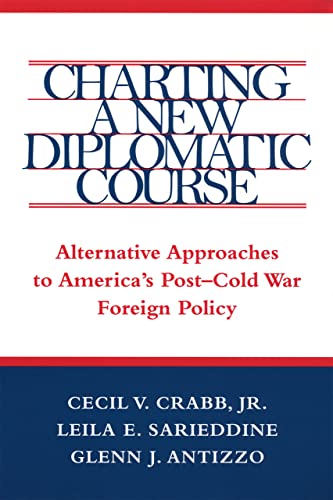
Charting a New Diplomatic Course: Alternative Approaches to America's Post-Cold War Foreign Policy - Brossura
Sinossi
America’s victory in the Cold War is a milestone in the nation’s diplomatic experience. The disintegration of the Soviet Union and the defeat of communism have made “containment” policy—the foundation of U.S. foreign relations for almost a half-century—obsolete, and policymakers and political scientists alike struggle to decide what new strategy should guide the country’s involvement on the international stage. In this pathbreaking work, Cecil V. Crabb,Jr., Leila E. Sarieddine, and Glenn J.Antizzo identify and analyze six distinct approaches to America’s diplomatic course after the Cold War, addressing perhaps the most important question of our time: what should U.S. foreign policy be in the twenty-first century?
First, the authors examine the familiar doctrine of American isolationism and consider an alternative approach, conservative neo-isolationism, which encourages policymakers to use careful discrimination but decisive action in assuming commitments abroad. Liberal neo-isolationism, a third possible course, resists active interventionist strategies because of the dangers they pose to congressional power and America’s democratic system.
At the opposite end of the spectrum are conservative interventionism, the belief that America must maintain a strong military arsenal and engage in “preventative diplomacy”; liberal interventionism—the conviction that America has a responsibility to actively promote the cause of democracy and defend human rights beyond its own borders; and pragmatic interventionism, an approach—taken by the Clinton Administration—that relies on a cost/benefit analysis of policy as problems arise.
Elegantly written and authoritatively researched, Charting a New Diplomatic Course provides a much- needed frame of reference for anyone interested in America’s future in international affairs.
Le informazioni nella sezione "Riassunto" possono far riferimento a edizioni diverse di questo titolo.
Informazioni sull'autore
Cecil V. Crabb, Jr., professor emeritus of political science at Louisiana State University, is the author of many books, including The Doctrines of American Foreign Policy: Their Meaning, Role, and Future. Leila E. Sarieddine is assistant professor of political science at Southern University in Baton Rouge. Glenn J. Antizzo is assistant professor of government at Nicholls State University in Thibodaux, Louisiana. Crabb, Sarieddine, and Antizzo also coauthored Congress and the Foreign Policy Process: Modes of Legislative Behavior.
Le informazioni nella sezione "Su questo libro" possono far riferimento a edizioni diverse di questo titolo.
Risultati della ricerca per Charting a New Diplomatic Course: Alternative Approaches...

Foto dell'editore
Charting a New Diplomatic Course: Alternative Approaches to America's Post-Cold War Foreign Policy (Political Traditions in Foreign Policy Series)
Da: Midtown Scholar Bookstore, Harrisburg, PA, U.S.A.
Valutazione del venditore 5 su 5 stelle

Paperback. Condizione: Very Good. Very Good - Crisp, clean, unread book with some shelfwear/edgewear, may have a remainder mark - NICE Standard-sized. Codice articolo M0807127485Z2
Compra usato
EUR 5,53
Spedizione EUR 5,33
Spedito in U.S.A.
Spedito in U.S.A.
Quantità: Più di 20 disponibili
Foto dell'editore
Charting a New Diplomatic Course: Alternative Approaches to America's Post-Cold War Foreign Policy (Political Traditions in Foreign Policy Series) [Paperback] Crabb Jr., Cecil V. and Sarieddine, Leila S.
Da: Broad Street Books, Branchville, NJ, U.S.A.
Valutazione del venditore 5 su 5 stelle
Paperback. Condizione: New. Brand New Book, Crisp and Clean. Codice articolo 33599
Compra nuovo
EUR 11,86
Spedizione EUR 4,40
Spedito in U.S.A.
Spedito in U.S.A.
Quantità: 1 disponibili
Foto dell'editore
Charting a New Diplomatic Course: Alternative Approaches to America's Post-Cold War Foreign Policy
Editore:
Louisiana State Univ Pr, 2001
ISBN 10: 0807127485
ISBN 13: 9780807127483
Antico o usato
Trade Paperback
Da: Taos Books, Santa Fe, NM, U.S.A.
Valutazione del venditore 4 su 5 stelle

Trade Paperback. Condizione: Very Good +. Trade paperback edition, no creases in spine, no slant, bumped top tip from back, very tight binding, 225 clean and unmarked pages. Codice articolo 16198
Compra usato
EUR 13,69
Spedizione EUR 5,11
Spedito in U.S.A.
Spedito in U.S.A.
Quantità: 1 disponibili
Foto dell'editore
Charting a New Diplomatic Course (Paperback)
Editore:
Louisiana State University Press, Baton Rouge, 2001
ISBN 10: 0807127485
ISBN 13: 9780807127483
Nuovo
Paperback
Da: Grand Eagle Retail, Bensenville, IL, U.S.A.
Valutazione del venditore 5 su 5 stelle
Paperback. Condizione: new. Paperback. The authors of Charting a New Diplomatic Course identify and analyze distinct approaches to America's diplomatic course after the Cold War. They anchor their analysis of recent American foreign policy in traditional principals and political debates-isolationism vs. interventionism and liberalism vs. conservatism. The policies studied here help clarify most of the positions advocated by governmental officials, informed students of global affairs, members of the news media, and ordinary citizens. This work identifies and analyzes six distinct approaches to America's diplomatic course after the Cold War in an attempt to answer the question: what should US foreign policy be in the 21st century? The approaches range from conservative neo-isolationism to liberal interventionism. Shipping may be from multiple locations in the US or from the UK, depending on stock availability. Codice articolo 9780807127483
Compra nuovo
EUR 39,16
Spedizione gratuita
Spedito in U.S.A.
Spedito in U.S.A.
Quantità: 1 disponibili
Foto dell'editore
Charting A New Diplomatic Course
Da: Kennys Bookshop and Art Galleries Ltd., Galway, GY, Irlanda
Valutazione del venditore 5 su 5 stelle
Condizione: New. Codice articolo V9780807127483
Compra nuovo
EUR 41,33
Spedizione EUR 9,50
Spedito da Irlanda a U.S.A.
Spedito da Irlanda a U.S.A.
Quantità: 5 disponibili
Foto dell'editore
Charting a New Diplomatic Course Alternative Approaches to America`s PostCold War Foreign Policy
Da: Revaluation Books, Exeter, Regno Unito
Valutazione del venditore 5 su 5 stelle
Paperback. Condizione: Brand New. 312 pages. 8.75x5.80x0.75 inches. In Stock. Codice articolo x-0807127485
Compra nuovo
EUR 46,02
Spedizione EUR 11,77
Spedito da Regno Unito a U.S.A.
Spedito da Regno Unito a U.S.A.
Quantità: 2 disponibili
Foto dell'editore
Charting A New Diplomatic Course
Da: Kennys Bookstore, Olney, MD, U.S.A.
Valutazione del venditore 5 su 5 stelle
Condizione: New. Codice articolo V9780807127483
Compra nuovo
EUR 51,54
Spedizione EUR 9,33
Spedito in U.S.A.
Spedito in U.S.A.
Quantità: 5 disponibili
Foto dell'editore
Charting a New Diplomatic Course: Alternative Approaches to America's Post-Cold War Foreign Policy (Political Traditions in Foreign Policy Series)
Editore:
Louisiana State University Press, 2001
ISBN 10: 0807127485
ISBN 13: 9780807127483
Nuovo
Brossura
Da: Books Puddle, Woodside, NY, U.S.A.
Valutazione del venditore 4 su 5 stelle
Condizione: New. pp. 225. Codice articolo 2697068062
Compra nuovo
EUR 66,16
Spedizione EUR 3,55
Spedito in U.S.A.
Spedito in U.S.A.
Quantità: 1 disponibili
Foto dell'editore
Charting a New Diplomatic Course: Alternative Approaches to America's Post-Cold War Foreign Policy (Political Traditions in Foreign Policy Series)
Editore:
Louisiana State University Press, 2001
ISBN 10: 0807127485
ISBN 13: 9780807127483
Nuovo
Brossura
Da: Majestic Books, Hounslow, Regno Unito
Valutazione del venditore 4 su 5 stelle
Condizione: New. pp. 225. Codice articolo 96377793
Compra nuovo
EUR 64,27
Spedizione EUR 7,65
Spedito da Regno Unito a U.S.A.
Spedito da Regno Unito a U.S.A.
Quantità: 1 disponibili
Immagini fornite dal venditore
Charting a New Diplomatic Course : Alternative Approaches to America's Post-Cold War Foreign Policy
Da: AHA-BUCH GmbH, Einbeck, Germania
Valutazione del venditore 5 su 5 stelle
Taschenbuch. Condizione: Neu. Neuware - America's victory in the Cold War is a milestone in the nation's diplomatic experience. The disintegration of the Soviet Union and the defeat of communism have made ''containment'' policy, the foundation of U.S. foreign relations for almost a half-century, obsolete, and policymakers and political scientists alike struggle to decide what new strategy should guide the country's involvement on the international stage. In this pathbreaking work, Cecil V. Crabb,Jr., Leila E. Sarieddine, and Glenn J. Antizzo identify and analyse six distinct approaches to America's diplomatic course after the Cold War, addressing perhaps the most important question of our time: what should U.S. foreign policy be in the twenty-first century First, the authors examine the familiar doctrine of American isolationism and consider an alternative approach, conservative neo-isolationism, which encourages policymakers to use careful discrimination but decisive action in assuming commitments abroad. Liberal neo-isolationism, a third possible course, resists active interventionist strategies because of the dangers they pose to congressional power and America's democratic system.At the opposite end of the spectrum are conservative interventionism, the belief that America must maintain a strong military arsenal and engage in ''preventative diplomacy''; liberal interventionism, the conviction that America has a responsibility to actively promote the cause of democracy and defend human rights beyond its own borders; and pragmatic interventionism, an approach, taken by the Clinton Administration, that relies on a cost/benefit analysis of policy as problems arise. Elegantly written and authoritatively researched, Charting a New Diplomatic Course provides a much- needed frame of reference for anyone interested in America's future in international affairs. Codice articolo 9780807127483
Compra nuovo
EUR 50,60
Spedizione EUR 35,00
Spedito da Germania a U.S.A.
Spedito da Germania a U.S.A.
Quantità: 2 disponibili