
Articoli correlati a The Worlds of Petrarch: No. 14
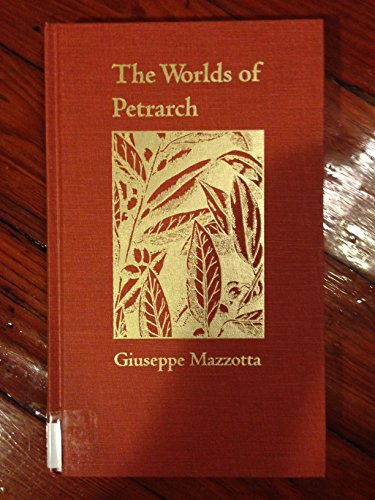
Sinossi
At the center of Petrarch's vision, announcing a new way of seeing the world, was the individual, a sense of the self that would one day become the center of modernity as well. This self, however, seemed to be fragmented in Petrarch's work, divided among the worlds of philosophy, faith, and love of the classics, politics, art, and religion, of Italy, France, Greece, and Rome. In recent decades scholars have explored each of these worlds in depth. In this work, Giuseppe Mazzotta shows for the first time how all these fragmentary explorations relate to each other, how these separate worlds are part of a common vision.
Written in a clear and passionate style, The Worlds of Petrarch takes us into the politics of culture, the poetic imagination, into history and ethics, art and music, rhetoric and theology. With this encyclopedic strategy, Mazzotta is able to demonstrate that the self for Petrarch is not a unified whole but a unity of parts, and, at the same time, that culture emerges not from a consensus but from a conflict of ideas produced by opposition and dark passion. These conflicts, intrinsic to Petrarch's style of thought, lead Mazzotta to a powerful rethinking of the concepts of "fragments" and "unity" and, finally, to a new understanding of the relationship between them.
Le informazioni nella sezione "Riassunto" possono far riferimento a edizioni diverse di questo titolo.
Informazioni sull'autore
Giuseppe Mazzotta is Professor and Chair, Italian Language and Literature Department, Yale University. His is the author of Dante, Poet of the Desert, The World at Play, and Dante's Vision and the Circle of Knowledge.
Estratto. © Ristampato con autorizzazione. Tutti i diritti riservati.
The Worlds of Petrarch
By Giuseppe MazzottaDuke University Press
Copyright © 1993 Duke University Press
All rights reserved.
ISBN: 978-0-8223-1363-2All rights reserved.
Contents
Acknowledgments,
Note on Petrarch's Texts,
Petrarch's Works,
Translations,
Introduction,
Chapter I: Antiquity and the New Arts,
Chapter II: The Thought of Love,
Chapter III: The Canzoniere and the Language of the Self,
Chapter IV: Ethics of Self,
Chapter V: The World of History,
Chapter VI: Orpheus: Rhetoric and Music,
Chapter VII: Humanism and Monastic Spirituality,
Appendix 1: Petrarch's Song 126,
Appendix 2: Ambivalences of Power,
Notes,
About the Author,
CHAPTER 1
Antiquity and the New Arts
* * *
The convention of partitioning history according to distinguishable and discrete intellectual periods has not gone unchallenged in recent times. Historiographic categories such as "Renaissance," "modernity," and "Middle Ages" continue to retain at least a nominal validity as terms of chronological demarcation (certainly useful for primers of literary history), but the historical specificity of each epoch, which in the nineteenth century could be defined with ease, is now hard to pinpoint. In 1870 Francesco De Sanctis published his Storia della letteratura italiana, which is shaped by the Hegelian belief in the organic, teleological process of history. The security of the Hegelian historiographic model, wherein contradictory individual phenomena can be manipulated into an overarching totality or significant unity, is in question from a variety of perspectives. Paradoxically, two radically contrasting premises about history usually end up agreeing in their dismissal of historical boundaries. These boundaries are arbitrary, it is said, because "human nature tends to remain much the same in all times." The judgment is underwritten by those who believe in the irreducible individuality of each spiritual and artistic experience. But the major doubts about the legitimacy of traditional historical periodizations occur to scholars who, engaged as they are in interpretive practices, inevitably come to discover that data cannot be rigidly classified or epistemological breaks identified and to recognize the crudeness of the notion of originality and foundation in literary history. They discover, in short, that textual details do not always fit the generality of formulas established a priori and that canons of a culture repress or exclude what may contradict the myths of that culture.
These doubts have been recently reinforced by deconstructive modes of analysis, but they need not be thought of merely as the domain of deconstruction theory. Renaissance scholars, for instance, have long been aware of how blurred the dividing line between "medieval" and "Renaissance" culture is. They have wondered whether the concept "Renaissance" is, in the words of Erwin Panofsky, an accurate "self-definition" or a mere "self-deception," and they have probed the degree to which the uniqueness of the Italian Renaissance extends the Carolingian revival and the Ottonian resurgence of the tenth century.
The notion of "modernity" is certainly no less problematical. In an important study written in the 1970s, The Legitimacy of the Modern Age, Hans Blumenberg argues that modernity, a period that stretches broadly from the 1600s to the present, is a legitimate category of history in that it inaugurates a new configuration in the field of knowledge. The "epochal threshold" or reversal of direction from the core of theological dogmatics, which characterizes the historical process until the 1600s, is not embodied by Nicholas Cusanus, as Hans-Georg Gadamer maintains, but by Giordano Bruno's "heretical" casting of the plurality of worlds in an infinite cosmology. Blumenberg never stops to consider "modernity" as a theoretical, persistently present question of positing a break from tradition if only to discover that modernity is forever inscribed in the archives of the past. Nor does he probe the self-evident aporia of any historicist philosophy that affirms the ceaseless mobility of the historical process and yet must arrest history's flow in order to impart a new direction to it. His aim, rather, is to counter Karl Lowith's assertion that the discourse of modernity is a secular retrieval of medieval themes. The legitimacy of the modern age, stated simply, resides in the scientific subversion of the authority of the canon as well as of the paradigms of knowledge rampant in the theological, medieval models of the economy of creation.
Medieval and Renaissance scholars could easily take to task Blumenberg's concept of a prolonged, unified Middle Ages as well as his version of an unscientific Middle Ages as the last in an endless series of myths that modernity keeps forging about the past in order to justify itself. If one were to look at the 1979 issue of New Literary History devoted to the "Alterity of the Middle Ages," one could perceive the fallacy of, say, Henry O. Taylor's The Mediaeval Mind, with its overt claim that the Middle Ages was a time of spiritual homogeneity. One could also see the gulf yawning between the present state of medieval studies and that of the nineteenth century, when Gaston Paris at the Collège de France, Francisque Michel at Bordeaux, Léon Gautier, and, eventually, Joseph Bédier made the knowledge of the Middle Ages (in the double value of the genitive case) central to the curriculum. These savants could even object to the distortions as to what the Middle Ages were (and the list of perpetrators goes from Rabelais to Voltaire to Chateaubriand to Hugo) without themselves escaping other distortions they inevitably committed in the name of paleography, philology, and archaeology.
The old myths about the Middle Ages linger tenaciously in new guises. Because the encyclopedia of Vincent of Beauvais, written toward the middle of the thirteenth century, in many ways derives from Isidore of Seville's Etymologies, written some seven centuries earlier, it is still assumed by medievalists that the inventory of knowledge remains unchanged. That Vincent makes available to the general public the new Aristotle, Arabic writings on the sciences, and the Chartrians is not deemed sufficient to dispel the notion that knowledge in the Middle Ages is a perpetual anachronism, an immutable, closed-off space of superstitious beliefs. The impression of an immobile universe of knowledge is reinforced by the practice of biblical exegesis (notoriously conservative), which, in its quasi-mechanical repetitiveness, seeks to shelter the sovereignty of the Biblical Text from subversive encroachments. The infinitely selfsame message of biblical exegesis, of the Neoplatonic structures, and of forever-fixed scholastic arrangements of the totality of creation unavoidably project the Middle Ages as the parable of an untroubled Utopia of the soul, of an otherness no longer accessible to us, of an "alterity," in short (the word, of course, is the matrix of allegory), that is both an alibi and a scandal to current intellectual concerns.
This powerful and alluring vision of an ordered world is a repression of history, of the contradictory voices punctuating the philosophical debates, the spiritual lacerations, or the political struggles of the thirteenth and fourteenth centuries. One would only have to mention the impact of Aristotle's De anima and its commentary by Averroës at the universities of Oxford and Paris in the thirteenth century; Marsilius's doctrine of law as coercive power (potentia coactiva), his determination of the ground of authority and popular sovereignty; or the crisis of biblical exegesis, which was the genuine bone of contention between St. Bernard of Clairvaux and Abelard. Finally, one would have to mention the consciousness that poets such as Jean de Meun, Dante, Chaucer, and others have of the crisis investing the various forms of knowledge. Because of the steady interrogation of their own values and epistemological premises, these poets and philosophers question us at the moment in which we recognize the problematic status of the Middle Ages as a category of cognition.
I have no wish to cut through this swath of problems in an abstract manner. I shall focus on Petrarch, instead, because he consistently reflects, both in his prose meditations and in his poetry, on his own radical difference from the world of the past as well as his apartness from his own times. This private experience of apartness is the basis for the articulation of a larger historical rupture. It is Petrarch, as a matter of fact, who posits a clear-cut division between the Middle Ages and modernity as the historical time that supersedes and alters the achievements of what has come to be known as the "Dark Ages." The phrase, which reappears in d'Alembert as "la nuit médiévale" to be opposed to "l'époque de lumière," had circulated even before Petrarch. For Petrarch it designates the limits of vision—the limit of a culture that ignores the values of the classical world and that spans the time between the birth of Christ and his own age. In truth, Petrarch will also say that the advent of Christ marks "the end of the darkness and the night of error ... the dawn of the true light." Yet the decline of Rome and the concomitant eclipse of classical antiquity has cast a thick shadow on mans earthly life.
In and of itself, the desire to promote the rebirth of classical antiquity and its rich spiritual deposit cannot be said to start with Petrarch. The twelfth-century revival of classicism simply belies such a hypothetical claim. In Italy, on the other hand, the likes of Albertino Mussato, Lovato dei Lovati, Geremia da Montagnone, and Giovanni del Virgilio were involved in the early fourteenth century in salvaging what seemed to be the hopelessly defaced documents and texts of the pagan past. Few poets had understood, as much as Dante, the radical modernity of Vergil. Modernity, as a matter of fact, is a thematic strain in Dante's poetic thought. Guinizelli is acknowledged as the ranking poet in the uso moderno—a phrase that makes modernity another term for the ephemeral, for the predicament of temporality in which each experience will be unavoidably transcended by a succeeding one. But Vergil's modernity is asserted as his power to enter and affect the concerns of the present. More generally, a mere listing of well-known titles—Poetria nova, Logica nova, Vita nova—or of the awareness of a new poetic style, the stil nuovo, shows that there is a rhetoric of the "new" which is systematically invoked for the accretion of knowledge or for stressing departures, whether real or not, from established practices.
We must, however, distinguish between the new as a fact and the new as an idea or as a way of thinking. New facts and experiences are indisputable throughout the medieval centuries. The idea of the new, paradoxically, was introduced by Christianity's subversion of the most cherished myths of classicism, by the insertion, that is, into history of the story of redemption that was bound to perplex the exacting rigor of the natural philosophers. The paradox consists in the fact that the renewal of man's spiritual history entails the closure of history. As far as Petrarch goes, the laicization of culture, which he calls for, is an imaginative extension of the "dawn of light" ushered in by the Incarnation.
If there is any radicality in Petrarch's epistemological break from the Dark Ages, it will be found in the retrieval of antiquity not as an episodic, contingent event, but as a systematic undertaking, as a total personal enterprise that involves him in a fundamental rethinking of the whole canon. Even after making allowances for the genuine affection Boccaccio felt for Petrarch, one is struck by how deeply Boccaccio grasped the significance of Petrarch's role as he acknowledges that Petrarch alone among the figures of his times had reinstated "Apollo in his ancient sanctuary"; that he had "reinvested the muses, soiled by rusticity, with their ancient beauty," and "had rededicated to the Romans the Capitol."
Contemporary critics of Petrarch, Petrarch's own claims notwithstanding, continue to consider him as a belated poet, painfully aware of the long shadow Dante casts on him; as a self-absorbed, narcissistic figure forever moaning over the impermanence in the world of time. This common perception of Petrarch's pathos, in point of fact, superimposes on Petrarch the fads of later Petrarchism and mistakes the pose of later poets for that of Petrarch himself, as if he were unaware that the ruptured sense he has of himself turns into the imaginary space where larger concerns are tested. But how exactly does Petrarch's insight into his own self affect his impulse to forge a new culture? In what way is this culture new?
There are many texts one could study in order to carry out such an exploration of how the figuration of a broken self issues into a sustained intellectual project. I shall look at a well-known letter from The Familiares (Letters on Familiar Matters) Petrarch wrote as a response to Giovanni Colonna, who bids him to write down the conversation they held one day while wandering through the ruins of Rome. I should remark on how essential conversations, letters, and polemics (his hatreds are subtle but famous) are to Petrarch's style of thought. It is a style that needs the support of objective evidence, of different minds turning together, in conversation, as if the discovery of truth were inseparable from the ability to communicate. But Petrarch will never lapse into the illusions of what in modern times has come to be known as objectivist literature.
He begins his letter by evoking wistfully that wandering, "deambulabamus Rome soli," until the two of them sit among the Baths of Diocletian. The chief rhetorical move of the letter is to insist that he is unable to duplicate the intensity of the pathos felt that day: "Redde mihi ilium locum, illud ocium, illam diem, illam attentationem tuam, illam ingenii mei venam.... Sed mutata sunt omnia; locus abest, dies abut, ocium periit, pro facie tua mutas litteras aspicio" (Give me back that place, that idle mood, that day, that attention of yours, that particular vein of my talent.... But all things are changed; the place is not present, the day has passed, the idle mood has gone, and instead of your face I look upon silent words). The anaphoric sequence, "ilium ... illud ... illam," which makes poignant the impossibility of regaining the multifaceted moods of that day, stresses from the start the awareness of the gaps of time, the sense of disjunction between proximate temporal experiences, or, to put it most simply, the perpetual fragmentation in the ordinary texture of life.
The rhetorical structure of this paragraph aims at providing the revelation of time's fleeting essence: it introduces time as the principle of difference and as a devastation from which nothing is left untouched. But the metaphor of "wandering" ("deambulabamus") that opens the text forces us to considerations of the complementary problem of space. Wandering, let me say, is a favorite metaphor with Petrarch, for it brings to one focus the movement of the Augustinian unquiet heart and pure drifting. Many of his texts crystallize such ambivalent motion. "The Ascent of Mount Ventoux" is the record of a quest and gratuitous mountain climbing. On His Own Ignorance is written during a ride on the Po River, as if the tortuous flow of the river were a metaphor for the rambling of the mind. "Wandering," properly speaking, is neither a journey with a destination, nor is it quite an exile, for "home"—whether Platonic or biblical, a place of departure and arrival one longs for—is not the issue. To wander is a pure adventure in pursuit of the ghostly traces of time, a moving about which allows a worldview to emerge. This worldview combines the aimlessness, the utter dislocation of the sightseer as he confronts alien objects, which are themselves dislocated out of any intelligible framework, with the muteness of the ruins. The ruins, in turn, recall something else, but what is conjured up does not rise up as it once was. Because ruins suspend the principle of identity and show that the past is out of reach, they are the material signs of time as it effaces all signs, emblems of a difference made materially immanent. The shifting viewpoints in the two friends' perambulation, finally, yield the figuration of a noncommunicating world which stands in stark contrast to the conversational mood enveloping them.
This figuration puts Petrarch, as well as us, in the path of a revelation: the revelation of both time and space as ruptured both in themselves and from each other. But the fragmentariness of viewpoints, of time, space, and objects, also reveals the power of local, partial shapes. The principle of localization, I submit, is central to Petrarch's imagination: the source of the Sorgue River, the grass of Vaucluse, the Capitol in Rome, and not Paris, as the place where the crowning of the poet must occur, Avignon, the Roman forum, are privileged spots which show that for Petrarch there is a truth of the moment as well as the truth of a place. The irreducible genius loci lays a trap, ensnares the poet, and forces him to extract its secret essence.
The thematic burden of the letter is the record of the (un)recognizable spots of Roman myth. Petrarch and Giovanni Colonna see, the letter says, where Evander's residence stood; they point out the cave of Cacus and the she-wolf that nursed Romulus and Remus. They remember the duel of the Horatii and Curiatii, the Tarpeian Rock, and the place of Caesar's triumph and death. They wander from the column of Trajan to Hadrian's tomb, to the palace of Nero and that of Augustus. Giovanni Colonna, on his part, takes special note of the Christianized pagan ruins—Trajan's bridge, which has taken the name of St. Peter; he points out the place where St. Peter was crucified, St. Lawrence grilled, and Constantine healed of his leprosy.
(Continues...)
Excerpted from The Worlds of Petrarch by Giuseppe Mazzotta. Copyright © 1993 Duke University Press. Excerpted by permission of Duke University Press.
All rights reserved. No part of this excerpt may be reproduced or reprinted without permission in writing from the publisher.
Excerpts are provided by Dial-A-Book Inc. solely for the personal use of visitors to this web site.
Le informazioni nella sezione "Su questo libro" possono far riferimento a edizioni diverse di questo titolo.
Altre edizioni note dello stesso titolo

Risultati della ricerca per The Worlds of Petrarch: No. 14

Foto dell'editore
The Worlds of Petrarch (Duke Monographs in Medieval and Renaissance Studies)
Editore:
Duke University Press, 1993
ISBN 10: 0822313634
ISBN 13: 9780822313632
Antico o usato
Rilegato
Da: Ammareal, Morangis, Francia
Valutazione del venditore 5 su 5 stelle

Hardcover. Condizione: Bon. Ancien livre de bibliothèque avec équipements. Ammareal reverse jusqu'à 15% du prix net de cet article à des organisations caritatives. ENGLISH DESCRIPTION Book Condition: Used, Good. Former library book. Ammareal gives back up to 15% of this item's net price to charity organizations. Codice articolo G-659-312
Compra usato
EUR 6,99
Spedizione EUR 16,50
Spedito da Francia a U.S.A.
Spedito da Francia a U.S.A.
Quantità: 1 disponibili
Foto dell'editore
The Worlds of Petrarch
Editore:
Duke University Press Books, Duham and London, 1993
ISBN 10: 0822313634
ISBN 13: 9780822313632
Antico o usato
Rilegato
Prima edizione
Da: West Side Book Shop, ABAA, Ann Arbor, MI, U.S.A.
Valutazione del venditore 4 su 5 stelle

Hardcover. Condizione: Near Fine. No Jacket. First Edition. xvi + 232 pp, black marker line across bottom edge textblock, acknowledgements, Note on Petrarch's texts, Introduction & seven titled chapters, Appendix 1: Petrarch's Song 126, Appendix 2: Ambivalences of Power, chapter notes, index. 5.75" x 9.3" red cloth boards, silver spine letters, silver letters & design laid on fr board. Binding tight and square, pages clean, unmarked, paper well-preserved. Size: Octavo. Book. Codice articolo 008691
Compra usato
EUR 26,74
Spedizione EUR 4,33
Spedito in U.S.A.
Spedito in U.S.A.
Quantità: 1 disponibili
Foto dell'editore
Duke Monographs in Medieval & Renaissance Studies: The Worlds of Petrarch (Volume 14)
Editore:
Duke University Press, 1993
ISBN 10: 0822313634
ISBN 13: 9780822313632
Antico o usato
Brossura
Da: Anybook.com, Lincoln, Regno Unito
Valutazione del venditore 5 su 5 stelle
Condizione: Good. Volume 14. This is an ex-library book and may have the usual library/used-book markings inside.This book has soft covers. Clean from markings. In good all round condition. Please note the Image in this listing is a stock photo and may not match the covers of the actual item,450grams, ISBN:0822313634. Codice articolo 9878728
Compra usato
EUR 31,18
Spedizione EUR 15,85
Spedito da Regno Unito a U.S.A.
Spedito da Regno Unito a U.S.A.
Quantità: 1 disponibili
Foto dell'editore
Worlds of Petrarch
Editore:
Duke University Press, 1993
ISBN 10: 0822313634
ISBN 13: 9780822313632
Antico o usato
Rilegato
Prima edizione
Da: Tacoma Book Center, Tacoma, WA, U.S.A.
Valutazione del venditore 4 su 5 stelle
Hardcover. Condizione: Very Good. First edition. ISBN 0822313634. Hardcover copy in very good condition. Black slash on bottom edge of pages, else tight clean copy. First printing. Codice articolo 9990150299
Compra usato
EUR 57,93
Spedizione EUR 4,76
Spedito in U.S.A.
Spedito in U.S.A.
Quantità: 1 disponibili
Foto dell'editore
The Worlds of Petrarch (Duke Monographs in Medieval and Renaissance Studies)
Editore:
Duke University Press Books, 1993
ISBN 10: 0822313634
ISBN 13: 9780822313632
Antico o usato
Rilegato
Da: Recycle Bookstore, San Jose, CA, U.S.A.
Valutazione del venditore 4 su 5 stelle
Hardcover. Condizione: Very Good. Remainder mark along the bottom edge of pages, otherwise nearly as new. Pages are bright and clean, Gilt bright on cover and spine. Codice articolo 946976
Compra usato
EUR 57,93
Spedizione EUR 4,98
Spedito in U.S.A.
Spedito in U.S.A.
Quantità: 1 disponibili
Foto dell'editore
The Worlds of Petrarch (Duke Monographs in Medieval and Renaissance Studies) Giuseppe Mazzotta
Editore:
Duke University Press, 1993
ISBN 10: 0822313634
ISBN 13: 9780822313632
Antico o usato
Rilegato
Da: BUCHSERVICE / ANTIQUARIAT Lars Lutzer, Wahlstedt, Germania
Valutazione del venditore 5 su 5 stelle
Hardcover. Condizione: gut. The Worlds of Petrarch (Duke Monographs in Medieval and Renaissance Studies) In englischer Sprache. pages. Codice articolo BN329111
Compra usato
EUR 179,90
Spedizione EUR 39,95
Spedito da Germania a U.S.A.
Spedito da Germania a U.S.A.
Quantità: 1 disponibili