
Articoli correlati a Southern Frontier Humor: An Anthology
Sinossi
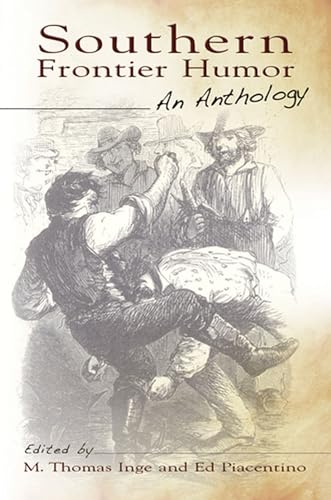
If, as some suggest, American literature began with Huckleberry Finn, then the humorists of the Old South surely helped us to shape that literature. Twain himself learned to write by reading the humorists’ work, and later writers were influenced by it. This book marks the first new collection of humor from that region published in fifteen years—and the first fresh selection of sketches and tales to appear in over forty years.
Thomas Inge and Ed Piacentino bring their knowledge of and fondness for this genre to a collection that reflects the considerable body of scholarship that has been published on its major figures and the place of the movement in American literary history. They breathe new life into the subject, gathering a new selection of texts and adding Twain—the only major American author to contribute to and emerge from the movement—as well as several recently identified humorists.
All of the major writers are represented, from Augustus Baldwin Longstreet to Thomas Bangs Thorpe, as well as a great many lesser-known figures like Hamilton C. Jones, Joseph M. Field, and John S. Robb. The anthology also includes several writers only recently discovered to be a part of the tradition, such as Joseph Gault, Christopher Mason Haile, James Edward Henry, and Marcus Lafayette Byrn, and features authors previously overlooked, such as William Gilmore Simms, Ham Jones, Orlando Benedict Mayer, and Adam Summer.
Selections are timely, reflecting recent trends in literary history and criticism sensitive to issues of gender, race, and ethnicity. The editors have also taken pains to seek out first printings to avoid the kinds of textual corruptions that often occur in later versions of these sketches. Southern Frontier Humor offers students and general readers alike a broad perspective and new appreciation of this singular form of writing from the Old South—and provides some chuckles along the way.
Le informazioni nella sezione "Riassunto" possono far riferimento a edizioni diverse di questo titolo.
Informazioni sull'autore
About the Editors
M. Thomas Inge is Blackwell Professor of the Humanities, Randolph–Macon College, whose most recent books are The Incredible Mr. Poe: Comic Book Adaptations of the Works of Edgar Allan Poe, 1943–2007 and The New Encyclopedia of Southern Culture, volume 9, Literature.
Ed Piacentino is Professor of English, High Point University, editor of The Enduring Legacy of Old Southwest Humor and C. M. Haile’s "Pardon Jones" Letters: Old Southwest Humor from Antebellum Louisiana.
Ed Piacentino is Professor of English, High Point University, editor of The Enduring Legacy of Old Southwest Humor and C. M. Haile’s "Pardon Jones" Letters: Old Southwest Humor from Antebellum Louisiana.
Estratto. © Ristampato con autorizzazione. Tutti i diritti riservati.
Southern Frontier Humor
An AnthologyUniversity of Missouri Press
Copyright © 2010 The Curators of the University of MissouriAll right reserved.
ISBN: 978-0-8262-1886-5
Contents
Acknowledgments..........................................................................xiNote on the Texts........................................................................xiiiIntroduction: The Humor of the Old South; or, Transgression He Wrote.....................1Augustus Baldwin Longstreet..............................................................25Solomon Franklin Smith...................................................................43Charles F. M. Noland.....................................................................52William Tappan Thompson..................................................................57George Washington Harris.................................................................70Johnson Jones Hooper.....................................................................89Joseph Glover Baldwin....................................................................112Thomas Bangs Thorpe......................................................................128Henry Clay Lewis.........................................................................149Samuel Langhorne Clemens.................................................................171David Crockett...........................................................................191"Riproarious Shemales" Legendary Women of the Crockett Almanacs..........................202Joseph Gault.............................................................................207James Edward Henry.......................................................................212Hamilton C. Jones........................................................................224William Gilmore Simms....................................................................230Joseph M. Field..........................................................................241Hardin E. Taliaferro.....................................................................250John S. Robb.............................................................................258Christopher Mason Haile..................................................................268Adam Geiselhard Summer...................................................................275Orlando Benedict Mayer...................................................................281William C. Hall..........................................................................289Francis James Robinson...................................................................299Marcus Lafayette Byrn....................................................................319Southern Frontier Humor: A Selected Bibliography.........................................331
Chapter One
Augustus Baldwin Longstreet (1790–1870)
Although the larger body of humorous writing in the Old Southwest arose almost simultaneously as a groundswell in several parts of the region, the man usually nominated as the father of the movement is Augustus Baldwin Longstreet. The eldest of the major figures in years, he first began to publish his sketches in 1833 and 1834 in local Georgia newspapers, the Milledgeville Southern Recorder and his own paper, the Augusta State Rights' Sentinel. By bringing them together into a book in 1835 called Georgia Scenes, Characters, Incidents, &c., in the First Half Century of the Republic, he not only established most of the major themes, content, and comic strategies of the writing to follow, but called the attention of the South and the nation to the power and appeal of local narrative and regional culture. When Edgar Allan Poe reviewed the book for the March 1836 Southern Literary Messenger, he found himself laughing out loud more "immoderately" than he ever had over any other book. He summarized or quoted at length every single story and promised to "give it a niche in our library as a sure omen of better days for the literature of the South."
Like so many of the writers who would follow in his footsteps, however, Longstreet was accomplished in many fields of endeavor and never meant to be a litterateur. Born in 1870 in Augusta, Georgia, he attended Yale College, read law, and was admitted to the bar in 1815, but his interests led him into politics and public service. He was elected a judge, owned a newspaper, was ordained a Methodist minister, and served as president of several educational institutions—Emory College, Centenary College in Louisiana, the University of Mississippi, and South Carolina College. As a strict anti-abolitionist, he stood up against the attacks on slavery by the northern branch of his church and wrote a series of pro-slavery letters collected in 1847 as a book, A Voice from the South. Longstreet moved his family to Mississippi during the Civil War and watched federal troops burn his home before he retired to Georgia. He spent his latter years in Bible study and writing defenses of states' rights advocate John C. Calhoun.
Although he tried his hand at a novel and wrote a good many more sketches and tales, nothing else Longstreet did brought him the fame and attention that attended Georgia Scenes. He understood how educated language and ordinary speech could be brought into comic conjunction to good effect, how a sophisticated narrator could be used to gain satiric distance on rowdy and racy backwoods life, and how reality itself often provides the antic sensibility with sufficient material for engaging fiction. Longstreet created two distinct fictional voices through which he narrated his tales, Lyman Hall and Abram Baldwin, both educated but markedly different in attitude. He noted in the preface for his book that "Hall is the writer of those sketches in which men appear as the principal actors, and Baldwin of those in which women are the prominent figures." But as the careful reader learns, things are more subtle than that, with one speaker more rational and distant and the other more emotional and sensitive. All of these devices influenced not only the humorous writers to come but anticipated the realistic movement in American fiction later in the century. These are among the reasons that Georgia Scenes saw eleven editions published between 1835 and 1897 and several more with critical introductions in the twentieth century.
Texts: "Georgia Theatrics," "The Horse-Swap," and "The Fight," from Georgia Scenes, Characters, Incidents, &c., in the First Half of the Century of the Republic (Augusta, GA: State Rights Office, 1835).
Georgia Theatrics
If my memory fail me not, the 10th of June, 1809 found me, at about 11 o'clock in the forenoon, ascending a long and gentle slope in what was called "The Dark Corner" of Lincoln. I believe it took its name from the moral darkness which reigned over that portion of the county at the time of which I am speaking. If in this point of view it was but a shade darker than the rest of the county, it was inconceivably dark. If any man can name a trick or sin which had not been committed at the time of which I am speaking, in the very focus of all the county's illumination (Lincolnton), he must himself be the most inventive of the tricky, and the very Judas of sinners. Since that time, however (all humour aside), Lincoln has become a living proof "that light shineth in darkness." Could I venture to mingle the solemn with the ludicrous, even for the purposes of honourable contrast, I could adduce from this county instances of the most numerous and wonderful transitions, from vice and folly to virtue and holiness, which have ever, perhaps, been witnessed since the days of the apostolic ministry. So much, lest it should be thought by some that what I am about to relate is characteristic of the county in which it occurred.
Whatever may be said of the moral condition of the Dark Corner at the time just mentioned, its natural condition was anything but dark. It smiled in all the charms of spring; and spring borrowed a new charm from its undulating grounds, its luxuriant woodlands, its sportive streams, its vocal birds, and its blushing flowers.
Rapt with the enchantment of the season and the scenery around me, I was slowly rising the slope, when I was startled by loud, profane, and boisterous voices, which seemed to proceed from a thick covert of undergrowth about two hundred yards in the advance of me, and about one hundred to the right of my road.
"You kin, kin you?"
"Yes, I kin, and am able to do it! Boo-oo-oo! Oh, wake snakes, and walk your chalks! Brimstone and—fire! Don't hold me, Nick Stoval! The fight's made up, and let's go at it.—My soul if I don't jump down his throat, and gallop every chitterling out of him before you can say 'quit!'"
"Now, Nick, don't hold him! Jist let the wild-cat come, and I'll tame him. Ned'll see me a fair fight; won't you, Ned?"
"Oh, yes; I'll see you a fair fight, blast my old shoes if I don't."
"That's sufficient, as Tom Haynes said when he saw the elephant. Now let him come."
Thus they went on, with countless oaths interspersed, which I dare not even hint at, and with much that I could not distinctly hear.
In Mercy's name! thought I, what band of ruffians has selected this holy season and this heavenly retreat for such Pandaemonian riots! I quickened my gait, and had come nearly opposite to the thick grove whence the noise proceeded, when my eye caught indistinctly, and at intervals, through the foliage of the dwarf-oaks and hickories which intervened, glimpses of a man or men, who seemed to be in a violent struggle; and I could occasionally catch those deep-drawn, emphatic oaths which men in conflict utter when they deal blows. I dismounted, and hurried to the spot with all speed. I had overcome about half the space which separated it from me, when I saw the combatants come to the ground, and, after a short struggle, I saw the uppermost one (for I could not see the other) make a heavy plunge with both his thumbs, and at the same instant I heard a cry in the accent of keenest torture, "Enough! My eye's out!"
I was so completely horrorstruck, that I stood transfixed for a moment to the spot where the cry met me. The accomplices in the hellish deed which had been perpetrated had all fled at my approach; at least I supposed so, for they were not to be seen.
"Now, blast your corn-shucking soul," said the victor (a youth about eighteen years old) as he rose from the ground, "come cutt'n your shines 'bout me agin, next time I come to the Courthouse, will you! Get your owl-eye in agin if you can!"
At this moment he saw me for the first time. He looked excessively embarrassed, and was moving off, when I called to him, in a tone emboldened by the sacredness of my office and the iniquity of his crime, "Come back, you brute! and assist me in relieving your fellow-mortal whom you have ruined forever!"
My rudeness subdued his embarrassment in an instant; and, with a taunting curl of the nose, he replied, "You needn't kick before you're spurr'd. There a'nt nobody there, nor ha'nt been nother. I was jist seein' how I could 'a' fout." So saying, he bounded to his plough, which stood in the corner of the fence about fifty yards beyond the battle ground.
And, would you believe it, gentle reader! his report was true. All that I had heard and seen was nothing more nor less than a Lincoln rehearsal; in which the youth who had just left me had played all the parts of all the characters in a Courthouse fight.
I went to the ground from which he had risen, and there were the two prints of his two thumbs, plunged up to the balls in the mellow earth, about the distance of a man's eyes apart; and the ground around was broken up as if two stags had been engaged upon it. —HALL.
The Horse-Swap
During the session of the Supreme Court, in the village of——, about three weeks ago, when a number of people were collected in the principal street of the village, I observed a young man riding up and down the street, as I supposed, in a violent passion. He galloped this way, then that, and then the other; spurred his horse to one group of citizens, then to another; then dashed off at half speed, as if fleeing from danger; and, suddenly checking his horse, returned first in a pace, then in a trot, and then in a canter. While he was performing these various evolutions, he cursed, swore, whooped, screamed, and tossed himself in every attitude which man could assume on horseback. In short, he cavorted most magnanimously (a term which, in our tongue, expresses all that I have described, and a little more), and seemed to be setting all creation at defiance. As I like to see all that is passing, I determined to take a position a little nearer to him, and to ascertain, if possible, what it was that affected him so sensibly. Accordingly, I approached a crowd before which he had stopped for a moment, and examined it with the strictest scrutiny. But I could see nothing in it that seemed to have anything to do with the cavorter. Every man appeared to be in good humour, and all minding their own business. Not one so much as noticed the principal figure. Still he went on. After a semicolon pause, which my appearance seemed to produce (for he eyed me closely as I approached), he fetched a whoop, and swore that "he could out-swap any live man, woman, or child that ever walked these hills, or that ever straddled horseflesh since the days of old daddy Adam. Stranger," said he to me, "did you ever see the Yallow Blossom from Jasper?" "No," said I, "but I have often heard of him."
"I'm the boy," continued he; "perhaps a leetle, jist a leetle, of the best man at a horse-swap that ever trod shoe-leather."
I began to feel my situation a little awkward, when I was relieved by a man somewhat advanced in years, who stepped up and began to survey the "Yallow Blossom's" horse with much apparent interest. This drew the rider's attention, and he turned the conversation from me to the stranger.
"Well, my old coon," said he, "do you want to swap hosses?"
"Why, I don't know," replied the stranger; "I believe I've a beast I'd trade with you for that one, if you like him."
"Well, fetch up your nag, my old cock; you're just the lark I wanted to get hold of. I am perhaps a leetle, just a leetle, of the best man at a horse-swap that ever stole cracklins out of his mammy's fat gourd. Where's your hoss?"
"I'll bring him presently; but I want to examine your horse a little."
"Oh! look at him," said the Blossom, alighting and hitting him a cut; "look at him. He's the best piece of hossflesh in the thirteen united univarsal worlds. There's no sort o' mistake in little Bullet. He can pick up miles on his feet, and fling 'em behind him as fast as the next man's hoss, I don't care where he comes from. And he can keep at it as long as the sun can shine without resting."
During this harangue, little Bullet looked as if he understood it all, believed it, and was ready at any moment to verify it. He was a horse of goodly countenance, rather expressive of vigilance than fire; though an unnatural appearance of fierceness was thrown into it by the loss of his ears, which had been cropped pretty close to his head. Nature had done but little for Bullet's head and neck; but he managed, in a great measure, to hide their defects by bowing perpetually. He had obviously suffered severely for corn; but if ribs and hip bones had not disclosed the fact, he never would have done it; for he was in all respects as cheerful and happy as if he commanded all the corn-cribs and fodderstacks in Georgia. His height was about twelve hands; but as his shape partook somewhat of that of the giraffe, his haunches stood much lower. They were short, strait, peaked, and concave. Bullet's tail, however, made amends for all his defects. All that the artist could do to beautify it had been done; and all that horse could do to compliment the artist, Bullet did. His tail was nicked in superior style, and exhibited the line of beauty in so many directions, that it could not fail to hit the most fastidious taste in some of them. From the root it dropped into a graceful festoon; then rose in a handsome curve; then resumed its first direction; and then mounted suddenly upward like a cypress knee to a perpendicular of about two and a half inches. The whole had a careless and bewitching inclination to the right. Bullet obviously knew where his beauty lay, and took all occasions to display it to the best advantage. If a stick cracked, or if any one moved suddenly about him, or coughed, or hawked, or spoke a little louder than common, up went Bullet's tail like lightning; and if the going up did not please, the coming down must of necessity, for it was as different from the other movement as was its direction. The first was a bold and rapid flight upward, usually to an angle of forty-five degrees. In this position he kept his interesting appendage until he satisfied himself that nothing in particular was to be done; when he commenced dropping it by half inches, in second beats, then in triple time, then faster and shorter, and faster and shorter still, until it finally died away imperceptibly into its natural position. If I might compare sights to sounds, I should say its settling was more like the note of a locust than anything else in nature.
Either from native sprightliness of disposition, from uncontrollable activity, or from an unconquerable habit of removing flies by the stamping of the feet, Bullet never stood still; but always kept up a gentle fly-scaring movement of his limbs, which was peculiarly interesting.
"I tell you, man," proceeded the Yellow Blossom, "he's the best live hoss that ever trod the grit of Georgia. Bob Smart knows the hoss. Come here, Bob, and mount this hoss, and show Bullet's motions." Here Bullet bristled up, and looked as if he had been hunting for Bob all day long, and had just found him. Bob sprang on his back. "Boo-oo-oo!" said Bob, with a fluttering noise of the lips; and away went Bullet, as if in a quarter race, with all his beauties spread in handsome style.
"Now fetch him back," said Blossom. Bullet turned and came in pretty much as he went out.
"Now trot him by." Bullet reduced his tail to "customary;" sidled to right and left airily, and exhibited at least three varieties of trot in the short space of fifty yards.
"Make him pace!" Bob commenced twitching the bridle and kicking at the same time. These inconsistent movements obviously (and most naturally) disconcerted Bullet; for it was impossible for him to learn, from them, whether he was supposed to proceed or stand still. He started to trot, and was told that wouldn't do. He attempted a canter, and was checked again. He stopped, and was urged to go on. Bullet now rushed into the wide field of experiment, and struck out a gait of his own, that completely turned the tables upon his rider, and certainly deserved a patent. It seemed to have derived its elements from the jig, the minuet, and the cotillion. If it was not a pace, it certainly had pace in it, and no man would venture to call it anything else; so it passed off to the satisfaction of the owner.
"Walk him!" Bullet was now at home again; and he walked as if money was staked on him.
The stranger, whose name, I afterward learned, was Peter Ketch, having examined Bullet to his heart's content, ordered his son Neddy to go and bring up Kit. Neddy soon appeared upon Kit; a well-formed sorrel of the middle size, and in good order. His tout ensemble threw Bullet entirely in the shade, though a glance was sufficient to satisfy any one that Bullet had the decided advantage of him in point of intellect.
(Continues...)
Excerpted from Southern Frontier Humor Copyright © 2010 by The Curators of the University of Missouri. Excerpted by permission of University of Missouri Press. All rights reserved. No part of this excerpt may be reproduced or reprinted without permission in writing from the publisher.
Excerpts are provided by Dial-A-Book Inc. solely for the personal use of visitors to this web site.
Le informazioni nella sezione "Su questo libro" possono far riferimento a edizioni diverse di questo titolo.
Risultati della ricerca per Southern Frontier Humor: An Anthology

Foto dell'editore
Southern Frontier Humor: An Anthology
Editore:
University of Missouri, 2010
ISBN 10: 0826218865
ISBN 13: 9780826218865
Antico o usato
Paperback
Da: Once Upon A Time Books, Siloam Springs, AR, U.S.A.
Valutazione del venditore 4 su 5 stelle

Paperback. Condizione: Good. This is a used book in good condition and may show some signs of use or wear . This is a used book in good condition and may show some signs of use or wear . Codice articolo mon0000511534
Compra usato
EUR 8,75
Spedizione EUR 3,53
Spedito in U.S.A.
Spedito in U.S.A.
Quantità: 1 disponibili
Foto dell'editore
Southern Frontier Humor: An Anthology
Editore:
University of Missouri, 2010
ISBN 10: 0826218865
ISBN 13: 9780826218865
Antico o usato
Soft cover
Prima edizione
Da: Cucamonga Books, Rancho Cucamonga, CA, U.S.A.
Valutazione del venditore 5 su 5 stelle

Soft cover. Condizione: Very Good. 1st Edition. Includes a hand-written dedication from 2010 on one of the front leaflets. Codice articolo ABE-1777580992066
Compra usato
EUR 13,79
Spedizione EUR 3,57
Spedito in U.S.A.
Spedito in U.S.A.
Quantità: 1 disponibili
Foto dell'editore
Southern Frontier Humor : An Anthology : ()
Da: Asano Bookshop, Nagoya, AICHI, Giappone
Valutazione del venditore 4 su 5 stelle
Condizione: Brand New. Brand new. Codice articolo a25542
Compra nuovo
EUR 49,57
Spedizione EUR 33,03
Spedito da Giappone a U.S.A.
Spedito da Giappone a U.S.A.
Quantità: 1 disponibili