
Articoli correlati a Chemistry of Fireworks
Sinossi
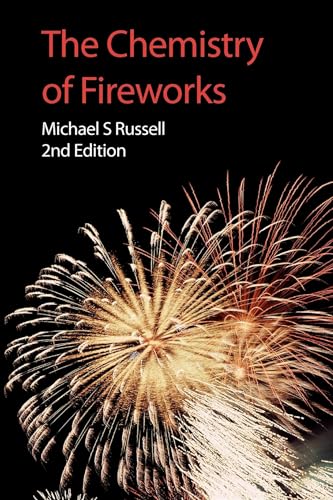
"For centuries fireworks have been a source of delight and amazement in cultures around the world. But what produces their dazzling array of effects? This book takes you behind the scenes to explore the chemistry and physics behind the art of pyrotechnics. Topics covered include history and characteristics of gunpowder; principles behind each of the most popular firework types: rockets, shells, fountains, sparklers, bangers, roman candles and wheels; special effects, including sound effects, coloured smokes and electrical firing; firework safety for private use and displays; and firework legislation. The Chemistry of Fireworks is aimed at students with A level qualifications or equivalent. The style is concise and easy to understand, and the theory of fireworks is discussed in terms of well-known scientific concepts wherever possible. It will also be a useful source of reference for anyone studying pyrotechnics as applied to fireworks. Review Extracts ""a worthwhile addition to the pyrotechnist's library"" Fireworks ""a useful source of information which makes absorbing reading."" Angewandte Chemie, International Edition"
Le informazioni nella sezione "Riassunto" possono far riferimento a edizioni diverse di questo titolo.
Informazioni sull'autore
Michael S Russell is a Chartered Chemist and a member of the RSC. His experience lies in the design of pyrotechnic devices mainly for fire or explosion suppression or military applications. He acts as a Consultant for explosives safety and safety training courses. He has also developed pyrotechnics, smokes, flares, rockets and gas generators.
Dalla quarta di copertina
For centuries fireworks have been a source of delight and amazement in cultures around the world. But what produces their dazzling array of effects? This book, a fully revised, extended and updated second edition explores the chemistry and physics behind the art of pyrotechnics. The objectives of the book are to provide the student with the essential principles behind chemical reactivity, the generation of noise, smoke and flame, which derive from the chemical ingredients and the way in which they are used. It introduces a particularly attractive branch of chemistry that students can easily reproduce (under supervision) in any laboratory equipt with a Bunsen burner and range of metal salts to give coloured flames or sparks. Its scope ranges from the history of gunpowder and fireworks in the UK, to the chemical characteristics of gunpowder, the form and functioning of all the main types of fireworks, special effects, fireworks safety and current fireworks legislation. The book opens with historical material, including unique historical photographs, and is valuable for its technical content. It then advances to a presentation on the characteristics of gunpowder, whose unique properties cause it to be the mainstay of the fireworks industry, even today. Succeeding chapters describe the manufacture and functioning of the most popular fireworks, including rockets, shells, fountains, roman candles, bangers, gerbs and wheels in a stimulating and easy assimilated way for those approaching the subject for the first time. The book covers current developments in the field including more robust and accurately timed fusing systems, the use of synthetic polymers as binders and 'daytime' fireworks. Chapters on fireworks safety, current legislation and a comprehensive glossary completes the book. Whilst this second edition is aimed at students with A level qualifications or equivalent, it is also intended to be useful background material and a source of reference for anybody engaged in the study of pyrotechnics as applied to fireworks. The style is concise and easy to understand and readers will gain a clear understanding of the science of fireworks in terms of recognised scientific principles.
Estratto. © Ristampato con autorizzazione. Tutti i diritti riservati.
The Chemistry of Fireworks
By Michael S. RussellThe Royal Society of Chemistry
Copyright © 2009 Michael S. Russell
All rights reserved.
ISBN: 978-0-85404-127-5All rights reserved.
Contents
Glossary,
Chapter 1 Historical Introduction,
Chapter 2 The Characteristics of Black Powder,
Chapter 3 Rockets,
Chapter 4 Mines and Shells,
Chapter 5 Fountains,
Chapter 6 Sparklers,
Chapter 7 Bangers,
Chapter 8 Roman Candles,
Chapter 9 Gerbs and Wheels,
Chapter 10 Special Effects,
Chapter 11 Fireworks Safety,
Chapter 12 Fireworks Legislation,
Bibliography,
Subject Index,
CHAPTER 1
Historical Introduction
EARLY INCENDIARY DEVICES
Working with fire probably began about half a million years ago when patriarchal cavemen realised that they felt the cold and began rubbing pieces of wood together until the friction caused an ignition. In fact, it is none too easy to generate fire in this way but we have all seen contrivances driven by coils of leather that spin a pointed stick against a wooden notch until it smokes and eventually bursts into flame.
Now it was originally thought that fire was a kind of substance and that this substance generated flames when it met the air. It is only within the last 200 years or so that fire was correctly interpreted as being a form of energy where the flames are defined as regions of luminous hot gas.
To find evidence of the first application of fire in the creation of 'special effects' it is necessary to go back some 1400 years when the naturally-occurring substances petroleum and naphtha were employed by the Greeks as an early form of napalm. In the characteristically unfriendly practices of those times, one Kallinikos from Heliopolis of Syria set forth in armed conflict against the Arabs. He had equipped fast-sailing galleys with cauldrons of what amounted to burning crude oil and proceeded to set the boats of the enemy ablaze, with the men still aboard. The incendiary was called 'Greek Fire'.
The ploy must have worked because the subsequent narrative tells us that the Byzantines then capitalised on their secret weapon by the wholesale destruction of the Moslem fleet at Cyzicus and continued to win naval battles in this way for several centuries afterwards.
DEVELOPMENT OF BLACK POWDER
By about the eighth century AD, Chinese alchemists, amongst others, were preoccupied with discovering the elixir of life. Concoctions were made containing all manner of substances including oils, honey and beeswax, but among the most significant, so far as future firework makers were concerned, were the ingredients sulfur and saltpetre. Unbeknown to the ancients, their brew of honey, sulfur and saltpetre (potassium nitrate) was special in that, on evaporation over heat, the contents would suddenly erupt into a wall of flame. By chance, the experimenters had produced the exact proportions by which the molten sulfur and what was left of the honey were acting as fuels that were subsequently oxidised by the oxygen from the potassium nitrate in what is now known as an 'exothermic chemical reaction', and a fairly vigorous one at that! In purified form, the chemicals sulfur and saltpetre are used to this day in what is without doubt the most important tool of the firework makers, i.e. gunpowder.
These dangerous early experiments led to many secret or banned recipes, but enough information was disseminated to enable the details of the discovery to be brought to Europe. However, the place and date of the invention of true gunpowder are still unknown and have been the subject of extensive bu
Le informazioni nella sezione "Su questo libro" possono far riferimento a edizioni diverse di questo titolo.
Risultati della ricerca per Chemistry of Fireworks

Immagini fornite dal venditore
Chemistry of Fireworks
Editore:
Royal Society of Chemistry, 2008
ISBN 10: 0854041273
ISBN 13: 9780854041275
Antico o usato
Brossura
Da: GreatBookPrices, Columbia, MD, U.S.A.
Valutazione del venditore 5 su 5 stelle

Condizione: As New. Unread book in perfect condition. Codice articolo 5879004
Compra usato
EUR 33,83
Spedizione EUR 2,28
Spedito in U.S.A.
Spedito in U.S.A.
Quantità: 1 disponibili
Immagini fornite dal venditore
Chemistry of Fireworks
Da: GreatBookPrices, Columbia, MD, U.S.A.
Valutazione del venditore 5 su 5 stelle
Condizione: New. Codice articolo 5879004-n
Compra nuovo
EUR 34,82
Spedizione EUR 2,28
Spedito in U.S.A.
Spedito in U.S.A.
Quantità: 1 disponibili
Foto dell'editore
Chemistry of Fireworks (Paperback)
Editore:
Royal Society of Chemistry, Cambridge, 2008
ISBN 10: 0854041273
ISBN 13: 9780854041275
Nuovo
Paperback
Da: Grand Eagle Retail, Bensenville, IL, U.S.A.
Valutazione del venditore 5 su 5 stelle
Paperback. Condizione: new. Paperback. For centuries fireworks have been a source of delight and amazement in cultures around the world. But what produces their dazzling array of effects? This book takes you behind the scenes to explore the chemistry and physics behind the art of pyrotechnics. Topics covered include history and characteristics of gunpowder; principles behind each of the most popular firework types: rockets, shells, fountains, sparklers, bangers, roman candles and wheels; special effects, including sound effects, coloured smokes and electrical firing; firework safety for private use and displays; and firework legislation. The Chemistry of Fireworks is aimed at students with A level qualifications or equivalent. The style is concise and easy to understand, and the theory of fireworks is discussed in terms of well-known scientific concepts wherever possible. It will also be a useful source of reference for anyone studying pyrotechnics as applied to fireworks. Aimed A level students, this book discusses the theory of fireworks in terms of well-known scientific concepts wherever possible, in a concise and easy to understand style. Shipping may be from multiple locations in the US or from the UK, depending on stock availability. Codice articolo 9780854041275
Compra nuovo
EUR 37,18
Spedizione gratuita
Spedito in U.S.A.
Spedito in U.S.A.
Quantità: 1 disponibili
Immagini fornite dal venditore
Chemistry of Fireworks
Editore:
Royal Society of Chemistry, GB, 2008
ISBN 10: 0854041273
ISBN 13: 9780854041275
Nuovo
Paperback
Da: Rarewaves.com USA, London, LONDO, Regno Unito
Valutazione del venditore 5 su 5 stelle
Paperback. Condizione: New. For centuries fireworks have been a source of delight and amazement in cultures around the world. But what produces their dazzling array of effects? This book takes you behind the scenes to explore the chemistry and physics behind the art of pyrotechnics. Topics covered include history and characteristics of gunpowder; principles behind each of the most popular firework types: rockets, shells, fountains, sparklers, bangers, roman candles and wheels; special effects, including sound effects, coloured smokes and electrical firing; firework safety for private use and displays; and firework legislation. The Chemistry of Fireworks is aimed at students with A level qualifications or equivalent. The style is concise and easy to understand, and the theory of fireworks is discussed in terms of well-known scientific concepts wherever possible. It will also be a useful source of reference for anyone studying pyrotechnics as applied to fireworks. Codice articolo LU-9780854041275
Compra nuovo
EUR 37,47
Spedizione gratuita
Spedito da Regno Unito a U.S.A.
Spedito da Regno Unito a U.S.A.
Quantità: 2 disponibili
Foto dell'editore
Chemistry of Fireworks
Da: PBShop.store UK, Fairford, GLOS, Regno Unito
Valutazione del venditore 5 su 5 stelle
PAP. Condizione: New. New Book. Shipped from UK. Established seller since 2000. Codice articolo GB-9780854041275
Compra nuovo
EUR 33,35
Spedizione EUR 4,86
Spedito da Regno Unito a U.S.A.
Spedito da Regno Unito a U.S.A.
Quantità: 3 disponibili
Immagini fornite dal venditore
Chemistry of Fireworks
Editore:
Royal Society of Chemistry, GB, 2008
ISBN 10: 0854041273
ISBN 13: 9780854041275
Nuovo
Paperback
Da: Rarewaves USA, HEBRON, KY, U.S.A.
Valutazione del venditore 5 su 5 stelle
Paperback. Condizione: New. For centuries fireworks have been a source of delight and amazement in cultures around the world. But what produces their dazzling array of effects? This book takes you behind the scenes to explore the chemistry and physics behind the art of pyrotechnics. Topics covered include history and characteristics of gunpowder; principles behind each of the most popular firework types: rockets, shells, fountains, sparklers, bangers, roman candles and wheels; special effects, including sound effects, coloured smokes and electrical firing; firework safety for private use and displays; and firework legislation. The Chemistry of Fireworks is aimed at students with A level qualifications or equivalent. The style is concise and easy to understand, and the theory of fireworks is discussed in terms of well-known scientific concepts wherever possible. It will also be a useful source of reference for anyone studying pyrotechnics as applied to fireworks. Codice articolo LU-9780854041275
Compra nuovo
EUR 39,68
Spedizione gratuita
Spedito in U.S.A.
Spedito in U.S.A.
Quantità: 2 disponibili
Foto dell'editore
Chemistry of Fireworks, 2nd edn
Da: Majestic Books, Hounslow, Regno Unito
Valutazione del venditore 4 su 5 stelle

Condizione: New. pp. 192 Illus. Codice articolo 7348887
Compra nuovo
EUR 36,97
Spedizione EUR 7,60
Spedito da Regno Unito a U.S.A.
Spedito da Regno Unito a U.S.A.
Quantità: 3 disponibili
Foto dell'editore
The Chemistry of Fireworks (RSC Paperbacks)
Da: Kennys Bookshop and Art Galleries Ltd., Galway, GY, Irlanda
Valutazione del venditore 5 su 5 stelle
Condizione: New. 2008. 2nd Edition. Paperback. "Aimed A level students, this book discusses the theory of fireworks in terms of well-known scientific concepts wherever possible, in a concise and easy to understand style." Num Pages: 192 pages, 1, black & white illustrations. BIC Classification: PNR; TC; TDCB. Category: (P) Professional & Vocational; (U) Tertiary Education (US: College). Dimension: 228 x 152 x 11. Weight in Grams: 282. . . . . . Codice articolo V9780854041275
Compra nuovo
EUR 39,12
Spedizione EUR 9,50
Spedito da Irlanda a U.S.A.
Spedito da Irlanda a U.S.A.
Quantità: 3 disponibili
Foto dell'editore
The Chemistry of Fireworks (Rsc Paperbacks)
Editore:
Royal Society of Chemistry 2008-11-13, 2008
ISBN 10: 0854041273
ISBN 13: 9780854041275
Nuovo
Paperback
Da: Chiron Media, Wallingford, Regno Unito
Valutazione del venditore 5 su 5 stelle
Paperback. Condizione: New. Codice articolo 6666-GRD-9780854041275
Compra nuovo
EUR 30,90
Spedizione EUR 18,10
Spedito da Regno Unito a U.S.A.
Spedito da Regno Unito a U.S.A.
Quantità: 3 disponibili
Foto dell'editore
The Chemistry of Fireworks
Editore:
Royal Society of Chemistry, 2008
ISBN 10: 0854041273
ISBN 13: 9780854041275
Nuovo
Paperback / softback
Da: THE SAINT BOOKSTORE, Southport, Regno Unito
Valutazione del venditore 5 su 5 stelle
Paperback / softback. Condizione: New. New copy - Usually dispatched within 4 working days. Codice articolo B9780854041275
Compra nuovo
EUR 32,85
Spedizione EUR 16,33
Spedito da Regno Unito a U.S.A.
Spedito da Regno Unito a U.S.A.
Quantità: 10 disponibili