
Articoli correlati a The Emperor and Rome: Space, Representation, and Ritual
Sinossi
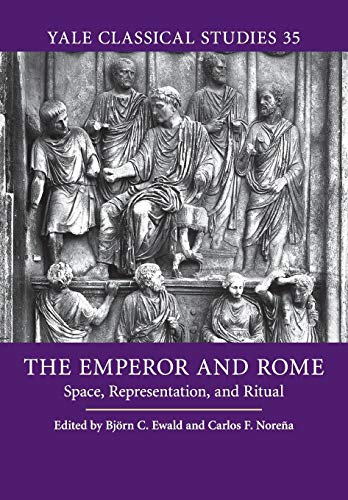
This book explores ancient Rome under the impact of monarchy and as one of the structures which shaped the monarchy itself.
Le informazioni nella sezione "Riassunto" possono far riferimento a edizioni diverse di questo titolo.
Informazioni sugli autori
Björn C. Ewald is an Assistant Professor in the Department of Art at the University of Toronto. His previous publications include Der Philosoph als Leitbild. Ikonographische Untersuchungen an römischen Sarkophagreliefs (1999) and (with Paul Zanker) Mit Mythen leben. Die Bilderwelt der roemischen Sarkophagreliefs (2004).
Carlos F. Noreña is an Assistant Professor in the Department of History at the University of California, Berkeley. He is the author of a number of articles on aspects of Roman imperial history.
Le informazioni nella sezione "Su questo libro" possono far riferimento a edizioni diverse di questo titolo.
Risultati della ricerca per The Emperor and Rome: Space, Representation, and Ritual

Foto dell'editore
The Emperor and Rome: Space, Representation, and Ritual (Yale Classical Studies Vol. 35)
Editore:
Cambridge University Press, Cambridge, 2015
ISBN 10: 1107519063
ISBN 13: 9781107519060
Antico o usato
Soft cover
Da: Edinburgh Books, Edinburgh, Regno Unito
Valutazione del venditore 5 su 5 stelle

Soft cover. Condizione: Near Fine. Reprint. 2015, reprinted with corrections. xviii, 365pp. B&W illustrations. "The transition from republic to monarchy with the accession of Augustus heralded the transformation not just of the Roman political system but of the city of Rome itself. This volume, written by some of the foremost scholars from around the world, addresses three main topics: the impact of imperial building programs on the configuration of space within the city and on the evolution of Rome's urban image; the various ways in which the figure of the emperor himself was represented, both visually and symbolically, in the city's urban fabric; and the performance of rituals and ceremonies that expressed key imperial ideals and values and enabled communications between the emperor and important collectivities in the city. The contributors build on important recent developments in research: increased archaeological excavation and restoration, the proliferation of digital technologies, and the greater attention paid by scholars to the centuries after Augustus." The book is in excellent condition. There are no inscriptions and all contents are tight and clean. Codice articolo AncientRome165
Compra usato
EUR 31,74
Spedizione EUR 23,25
Spedito da Regno Unito a U.S.A.
Spedito da Regno Unito a U.S.A.
Quantità: 1 disponibili
Foto dell'editore
The Emperor and Rome: Space, Representation, and Ritual (Yale Classical Studies, Series Number 35)
Da: California Books, Miami, FL, U.S.A.
Valutazione del venditore 4 su 5 stelle

Condizione: New. Codice articolo I-9781107519060
Compra nuovo
EUR 56,12
Spedizione gratuita
Spedito in U.S.A.
Spedito in U.S.A.
Quantità: Più di 20 disponibili
Foto dell'editore
The Emperor and Rome: Space, Representation, and Ritual: 35 (Yale Classical Studies, Series Number 35)
Editore:
Cambridge University Press, 2015
ISBN 10: 1107519063
ISBN 13: 9781107519060
Antico o usato
Paperback
Prima edizione
Da: Prior Books Ltd, Cheltenham, Regno Unito
Valutazione del venditore 5 su 5 stelle
Paperback. Condizione: Like New. First Edition. In nearly new condition: firm and square with strong joints, no creases. Just a few hardly noticeable rubs. Hence a non-text page shows a small 'damaged' stamp. Despite such this book looks and feels unread. Thus the contents are crisp, fresh and tight. And so a very nice book in great condition, now offered for sale at a reasonable price. Codice articolo 211896
Compra usato
EUR 32,33
Spedizione EUR 25,58
Spedito da Regno Unito a U.S.A.
Spedito da Regno Unito a U.S.A.
Quantità: 1 disponibili
Immagini fornite dal venditore
The Emperor and Rome
Editore:
Cambridge University Press, GB, 2015
ISBN 10: 1107519063
ISBN 13: 9781107519060
Nuovo
Paperback
Da: Rarewaves.com USA, London, LONDO, Regno Unito
Valutazione del venditore 5 su 5 stelle
Paperback. Condizione: New. The transition from republic to monarchy with the accession of Augustus heralded the transformation not just of the Roman political system but of the city of Rome itself. This volume, written by some of the foremost scholars from around the world, addresses three main topics: the impact of imperial building programs on the configuration of space within the city and on the evolution of Rome's urban image; the various ways in which the figure of the emperor himself was represented, both visually and symbolically, in the city's urban fabric; and the performance of rituals and ceremonies that expressed key imperial ideals and values and enabled communications between the emperor and important collectivities in the city. The contributors build on important recent developments in research: increased archaeological excavation and restoration, the proliferation of digital technologies, and the greater attention paid by scholars to the centuries after Augustus. Codice articolo LU-9781107519060
Compra nuovo
EUR 62,25
Spedizione gratuita
Spedito da Regno Unito a U.S.A.
Spedito da Regno Unito a U.S.A.
Quantità: Più di 20 disponibili
Immagini fornite dal venditore
The Emperor and Rome. Space, Representation, and Ritual.
Editore:
Cambridge University Press, 2015
ISBN 10: 1107519063
ISBN 13: 9781107519060
Antico o usato
Brossura
Da: Scrinium Classical Antiquity, Aalten, Paesi Bassi
Valutazione del venditore 5 su 5 stelle
Cambridge University Press, Cambridge, 2015. 1st paperback ed. XXI,365p. Paperback. Codice articolo 43840
Compra usato
EUR 36,50
Spedizione EUR 27,50
Spedito da Paesi Bassi a U.S.A.
Spedito da Paesi Bassi a U.S.A.
Quantità: 1 disponibili
Foto dell'editore
The Emperor and Rome. Space, Representation, and Ritual.
Editore:
Cambridge University Press, 2015
ISBN 10: 1107519063
ISBN 13: 9781107519060
Antico o usato
Brossura
Da: Scrinium Classical Antiquity, Aalten, Paesi Bassi
Valutazione del venditore 5 su 5 stelle
Cambridge University Press, 2015. First paperback ed. XXI,365p. Paperback. Series: Yale Classical Studies, 35. 'The themes of this book are well chosen for exploring the complex and changing relationship of the Roman Emperor with the Imperial city. The themes of course overlap: ritual and representation both have a spatial dimension, and buildings through which urban space was transformed were often decorated with representational sculpture and intended to accommodate public rituals. In tune with recent developments in ancient history and archaeology, the themes invite approaches that cross the barriers between these disciplines and combine literary, epigraphic and archaeological evidence. Interdisciplinarity indeed characterises many of the papers here, which cast important new light on the realities of imperial power and the ancient urban experience. The focus is on the period from the reign of Augustus to that of Constantine. The majority of the articles began as papers presented at a conference at Yale University in 2005. The exceptions are Paul Zanker?s contribution, which is a translation of an article previously published in German with a revised and updated bibliography, and the article by Klaus Fittschen, who did not participate in the conference but was invited by the editors to contribute to the publication. The list of authors gathered here is a roll call of eminent scholars in Roman history and archaeology. The standard of scholarship throughout is as high as would be expected and the papers all connect well with the themes and provide much food for thought. The introductory chapter by the editors is a tour de force. It makes a strong case for the importance of the lines of enquiry pursued here and provides a sophisticated and up-to-date survey of scholarship in these areas, with extensive references. It also lucidly charts the theoretical terrain that has informed this research. More than simply an introduction to this book, it is a useful introduction to the current state of scholarship on Roman urbanism, art, ritual and imperial power. These issues have broader relevance for students of other parts of the Roman Empire and other periods of ancient history and the chapter, as such, deserves to be widely read. (.) The last two articles are the closest in subject matter of any in the volume and are among the highlights of this book. Both have to do with the significance of imperial funerals. Here we move away from the (semi) permanent impact of buildings and statues in shaping space and representing power and into the ephemeral world of pyres (Eve D?Ambra) and effigies (Javier Arce). Such temporary structures and monuments are shown to have had a powerful effect in shaping the experience of the crowds who gathered at Imperial funerals. The one-off use of pyres and effigies in these highly charged public ritual events is persuasively argued to have played an important role in cementing and reproducing cultural values and imperial power. Ephemeral architecture and monuments, as argued in these chapters and in the introduction, are a promising area for further research.' (CHRISTOPHER DICKENSON in Bryn Mawr Classical Review 2012.05.41). Codice articolo 44028
Compra usato
EUR 37,50
Spedizione EUR 27,50
Spedito da Paesi Bassi a U.S.A.
Spedito da Paesi Bassi a U.S.A.
Quantità: 1 disponibili
Foto dell'editore
The Emperor and Rome (Yale Classical Studies)
Editore:
Cambridge University Press 2015-07-02, 2015
ISBN 10: 1107519063
ISBN 13: 9781107519060
Nuovo
Paperback
Da: Chiron Media, Wallingford, Regno Unito
Valutazione del venditore 5 su 5 stelle
Paperback. Condizione: New. Codice articolo 6666-IUK-9781107519060
Compra nuovo
EUR 48,61
Spedizione EUR 18,01
Spedito da Regno Unito a U.S.A.
Spedito da Regno Unito a U.S.A.
Quantità: 10 disponibili
Foto dell'editore
The Emperor and Rome: Space, Representation, and Ritual: 35 (Yale Classical Studies, Series Number 35)
Da: Kennys Bookshop and Art Galleries Ltd., Galway, GY, Irlanda
Valutazione del venditore 5 su 5 stelle
Condizione: New. This book explores ancient Rome under the impact of monarchy and as one of the structures which shaped the monarchy itself. Editor(s): Ewald, Bjorn C.; Norena, Carlos F. Series: Yale Classical Studies. Num Pages: 388 pages, 128 b/w illus. 4 maps. BIC Classification: 1QDAR; 3D; HBJD; HBLA1. Category: (P) Professional & Vocational; (U) Tertiary Education (US: College). Dimension: 245 x 232 x 25. Weight in Grams: 650. . 2015. Illustrated. paperback. . . . . Codice articolo V9781107519060
Compra nuovo
EUR 60,61
Spedizione EUR 9,50
Spedito da Irlanda a U.S.A.
Spedito da Irlanda a U.S.A.
Quantità: Più di 20 disponibili
Foto dell'editore
The Emperor and Rome: Space, Representation, and Ritual (Yale Classical Studies, Series Number 35)
Da: Ria Christie Collections, Uxbridge, Regno Unito
Valutazione del venditore 5 su 5 stelle
Condizione: New. In English. Codice articolo ria9781107519060_new
Compra nuovo
EUR 60,26
Spedizione EUR 13,13
Spedito da Regno Unito a U.S.A.
Spedito da Regno Unito a U.S.A.
Quantità: Più di 20 disponibili
Foto dell'editore
The Emperor and Rome: Space, Representation, and Ritual
Editore:
Cambridge University Press, 2015
ISBN 10: 1107519063
ISBN 13: 9781107519060
Nuovo
Paperback / softback
Da: THE SAINT BOOKSTORE, Southport, Regno Unito
Valutazione del venditore 5 su 5 stelle
Paperback / softback. Condizione: New. This item is printed on demand. New copy - Usually dispatched within 5-9 working days. Codice articolo C9781107519060
Compra nuovo
EUR 57,06
Spedizione EUR 20,99
Spedito da Regno Unito a U.S.A.
Spedito da Regno Unito a U.S.A.
Quantità: Più di 20 disponibili