Hermann von Helmholtz's Mechanism: A Study on the Transition: A Study on the Transition from Classical to Modern Philosophy of Nature: 17 - Rilegato
Libro 6 di 43: Archimedes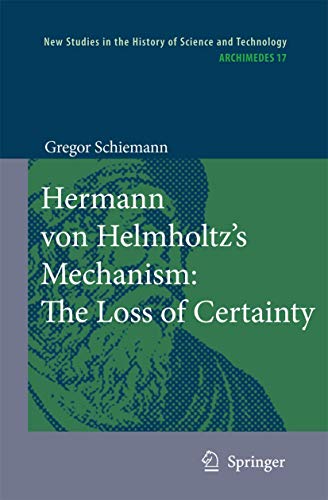
Sinossi
Focusing on Hermann von Helmholtz, this study addresses one of the nineteenth century s most important German natural scientists. Among his most well-known contributions to science are the invention of the ophthalmoscope and grou- breaking work towards formulating the law of the conservation of energy. The volume of his work, reaching from medicine to physiology to physics and epis- mology, his impact on the development of the sciences far beyond German borders, and the contribution he made to the organization and popularization of research, all established Helmholtz s prominence both in the academic world and in public cultural life. Helmholtz was also one of the last representatives of a conception of nature that strove to reduce all phenomena to matter in motion. In reaction to the increasingly insurmountable difficulties that program had in fulfilling its own standards for s- entific explanation, he developed elements of a modern understanding of science that have remained of fundamental importance to this day.
Le informazioni nella sezione "Riassunto" possono far riferimento a edizioni diverse di questo titolo.
Dalla quarta di copertina
Two seemingly contradictory tendencies have accompanied the development of the natural sciences in the past 150 years. On the one hand, the natural sciences have been instrumental in effecting a thoroughgoing transformation of social structures and have made a permanent impact on the conceptual world of human beings. This historical period has, on the other hand, also brought to light the merely hypothetical validity of scientific knowledge. As late as the middle of the 19th century the truth-pathos in the natural sciences was still unbroken. Yet in the succeeding years these claims to certain knowledge underwent a fundamental crisis. For scientists today, of course, the fact that their knowledge can possess only relative validity is a matter of self-evidence.
The present analysis investigates the early phase of this fundamental change in the concept of science through an examination of Hermann von Helmholtz's conception of science and his mechanistic interpretation of nature. Helmholtz (1821-1894) was one of the most important natural scientists in Germany. The development of this thought offers an impressive but, until now, relatively little considered report from the field of the experimental sciences chronicling the erosion of certainty.
Le informazioni nella sezione "Su questo libro" possono far riferimento a edizioni diverse di questo titolo.
Altre edizioni note dello stesso titolo

Risultati della ricerca per Hermann von Helmholtz's Mechanism: A Study on the...

Foto dell'editore
Hermann von Helmholtzâs Mechanism: The Loss of Certainty: A Study on the Transition from Classical to Modern Philosophy of Nature (Archimedes, 17)
Da: HPB-Red, Dallas, TX, U.S.A.
Valutazione del venditore 5 su 5 stelle

hardcover. Condizione: Good. Connecting readers with great books since 1972! Used textbooks may not include companion materials such as access codes, etc. May have some wear or writing/highlighting. We ship orders daily and Customer Service is our top priority! Codice articolo S_450621861
Compra usato
EUR 57,03
EUR 3,22 shipping
Spedito in U.S.A.
Spedito in U.S.A.
Quantità: 1 disponibili
Foto dell'editore
Hermann von Helmholtz's Mechanism: The Loss of Certainty: A Study on the Transition from Classical to Modern Philosophy of Nature (Archimedes, 17)
Da: Wonder Book, Frederick, MD, U.S.A.
Valutazione del venditore 5 su 5 stelle
Condizione: Very Good. Very Good condition. No Dust Jacket Volume 17. A copy that may have a few cosmetic defects. May also contain light spine creasing or a few markings such as an owner's name, short gifter's inscription or light stamp. Codice articolo N19OS-00487
Compra usato
EUR 97,42
Spedizione gratuita
Spedito in U.S.A.
Spedito in U.S.A.
Quantità: 1 disponibili
Foto dell'editore
Hermann von Helmholtz's Mechanism: The Loss of Certainty: A Study on the Transition from Classical to Modern Philosophy of Nature (Archimedes, 17)
Da: Lucky's Textbooks, Dallas, TX, U.S.A.
Valutazione del venditore 5 su 5 stelle
Condizione: New. Codice articolo ABLIING23Mar2411530143753
Compra nuovo
EUR 103,55
EUR 3,43 shipping
Spedito in U.S.A.
Spedito in U.S.A.
Quantità: Più di 20 disponibili
Immagini fornite dal venditore
Hermann von Helmholtz's Mechanism: A Study on the Transition : A Study on the Transition from Classical to Modern Philosophy of Nature
Da: GreatBookPrices, Columbia, MD, U.S.A.
Valutazione del venditore 5 su 5 stelle
Condizione: New. Codice articolo 5619676-n
Compra nuovo
EUR 104,74
EUR 2,27 shipping
Spedito in U.S.A.
Spedito in U.S.A.
Quantità: 15 disponibili
Foto dell'editore
Hermann von Helmholtz's Mechanism: The Loss of Certainty: A Study on the Transition from Classical to Modern Philosophy of Nature (Archimedes, 17)
Da: California Books, Miami, FL, U.S.A.
Valutazione del venditore 5 su 5 stelle
Condizione: New. Codice articolo I-9781402056291
Compra nuovo
EUR 116,92
Spedizione gratuita
Spedito in U.S.A.
Spedito in U.S.A.
Quantità: Più di 20 disponibili
Immagini fornite dal venditore
Hermann Von Helmholtz's Mechanism: The Loss of Certainty: A Study on the Transition from Classical to Modern Philosophy of Nature
Print on DemandDa: BuchWeltWeit Ludwig Meier e.K., Bergisch Gladbach, Germania
Valutazione del venditore 5 su 5 stelle
Buch. Condizione: Neu. This item is printed on demand - it takes 3-4 days longer - Neuware -Focusing on Hermann von Helmholtz, this study addresses one of the nineteenth century's most important German natural scientists. Among his most well-known contributions to science are the invention of the ophthalmoscope and grou- breaking work towards formulating the law of the conservation of energy. The volume of his work, reaching from medicine to physiology to physics and epis- mology, his impact on the development of the sciences far beyond German borders, and the contribution he made to the organization and popularization of research, all established Helmholtz's prominence both in the academic world and in public cultural life. Helmholtz was also one of the last representatives of a conception of nature that strove to reduce all phenomena to matter in motion. In reaction to the increasingly insurmountable difficulties that program had in fulfilling its own standards for s- entific explanation, he developed elements of a modern understanding of science that have remained of fundamental importance to this day. 284 pp. Englisch. Codice articolo 9781402056291
Compra nuovo
EUR 106,99
EUR 23,00 shipping
Spedito da Germania a U.S.A.
Spedito da Germania a U.S.A.
Quantità: 2 disponibili
Immagini fornite dal venditore
Hermann von Helmholtz's Mechanism: A Study on the Transition : A Study on the Transition from Classical to Modern Philosophy of Nature
Da: GreatBookPricesUK, Woodford Green, Regno Unito
Valutazione del venditore 5 su 5 stelle
Condizione: New. Codice articolo 5619676-n
Compra nuovo
EUR 124,30
EUR 17,16 shipping
Spedito da Regno Unito a U.S.A.
Spedito da Regno Unito a U.S.A.
Quantità: Più di 20 disponibili
Immagini fornite dal venditore
Hermann von Helmholtz\ s Mechanism: The Loss of Certainty
Print on DemandDa: moluna, Greven, Germania
Valutazione del venditore 4 su 5 stelle

Condizione: New. Dieser Artikel ist ein Print on Demand Artikel und wird nach Ihrer Bestellung fuer Sie gedruckt. First English comprehensive contribution to one of the leading German physicists in the 19th centuryAn informative account of a highly important part of the history of science and a reconstruction of a conception of science that is greatly widespr. Codice articolo 329704794
Compra nuovo
EUR 93,00
EUR 48,99 shipping
Spedito da Germania a U.S.A.
Spedito da Germania a U.S.A.
Quantità: Più di 20 disponibili
Foto dell'editore
Hermann Von Helmholtza Mechanism
Da: Books Puddle, New York, NY, U.S.A.
Valutazione del venditore 4 su 5 stelle
Condizione: New. pp. 296. Codice articolo 26441118
Compra nuovo
EUR 140,88
EUR 3,43 shipping
Spedito in U.S.A.
Spedito in U.S.A.
Quantità: 4 disponibili
Foto dell'editore
Hermann von Helmholtz's Mechanism: The Loss of Certainty: A Study on the Transition from Classical to Modern Philosophy of Nature
Editore:
Springer-Verlag New York Inc., 2008
ISBN 10: 140205629X
ISBN 13: 9781402056291
Nuovo
Rilegato
Da: THE SAINT BOOKSTORE, Southport, Regno Unito
Valutazione del venditore 5 su 5 stelle
Hardback. Condizione: New. This item is printed on demand. New copy - Usually dispatched within 5-9 working days 620. Codice articolo C9781402056291
Compra nuovo
EUR 135,12
EUR 19,39 shipping
Spedito da Regno Unito a U.S.A.
Spedito da Regno Unito a U.S.A.
Quantità: Più di 20 disponibili