
Articoli correlati a Team Building: A Structured Learning Approach
Sinossi
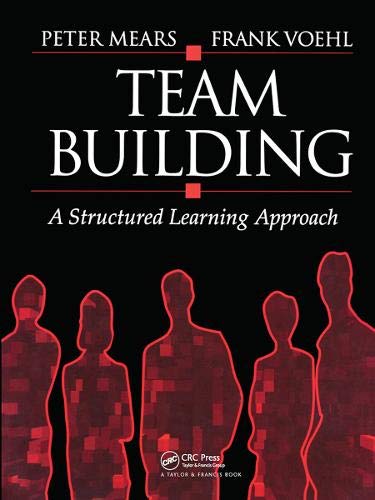
Team Building: A Structured Learning Approach provides a thorough understanding of team building concepts; what it means to be a member of a team, empowerment, and how teams contribute to continuous quality improvement. Your students will apply these concepts in various exercises throughout the book. A structured learning approach is used where team members rotate roles. Students take turns as leaders and observers. The observer records the interactions which occur in solving an exercise, and reports findings to the team at the end of the exercise. These findings are analyzed by the team thus creating an atmosphere whereby teams learn how to learn. There are numerous exercises so the student is exposed to a diversity of problems. Team concepts such as empowerment, cohesiveness, handling difficult members, and team effectiveness are explained and there are exercises that help students learn more about these concepts, while building their team skills.
Le informazioni nella sezione "Riassunto" possono far riferimento a edizioni diverse di questo titolo.
Contenuti
TEAMWORK AND SYNERGY
Synergy
Major elements of team synergy
Do you need a team?
Team size
Characteristics of an effective team
Should team membership be voluntary?
Achieving positive team synergy
What have I gotten into?
Exercise 1, Knowing your team members
CONTRIBUTORS TO CONTINUOUS QUALITY IMPROVEMENT
Deming's guide to quality improvement
Exercise 2, Deming audit
Crosby's guide to quality improvement
Exercise 3, Crosby audit
Juran's guide to quality improvement
Exercise 4, Juran audit
EMPOWERMENT
Knowing your team members
Exercise 5, What is empowerment?
Exercise 6, Team process control
SUPPORTIVE TEAM CULTURE
A variety of team-player styles
Sample team rules
Reaching a consensus
Exercise 7, Salesman problem
Exercise 8, Secretary problem
TEAM BUILDING PHASES
Exercise 9, Written team rules
Exercise 10, Team assessment
Peer feedback
Do's and Don'ts when giving feedback
Exercise 11, General peer feedback
Exercise 12, Detailed peer evaluation
Exercise 13, Self-assessment
UNDERSTANDING HOW WE THINK
Developing trust
Colored hat thinking
Exercise 14, Norm violation
Exercise 15, Future workplace
Exercise 16, University President
MEMBER SERVICE ROLES
Exercise 17, Declining enrollments
Exercise 18, QI project
Exercise 19, Community leader
Exercise 20, Teenage nightowl
EXPANDED TEAM MEMBER ROLES
Group task functions
Exercise 21, Improving schools
Exercise 22, Improving services
Exercise 23, Good teacher
EXPANDING TEAM SKILLS
Phases of a meeting
Improving performance
Exercise 24, General Wainwright
Exercise 25, Team assessment
Exercise 26, Now what?
TYPES, TEAMS AND MORE TEAMS
Reason for specialized teams
Quality circles
Task reams
Cross-functional project teams
Functional teams
Self-directed (self-managed) teams
Design teams
Quality circles
Sustaining continuous quality improvement
Index
Product Description
Book by Mears Peter Voehl Frank
Le informazioni nella sezione "Su questo libro" possono far riferimento a edizioni diverse di questo titolo.
Risultati della ricerca per Team Building: A Structured Learning Approach

Immagini fornite dal venditore
TEAM BUILDING: A Structured Learning Approach
Editore:
St. Lucie Press, Delray Beach, FL, 1994
ISBN 10: 1884015158
ISBN 13: 9781884015151
Antico o usato
Paperback
Da: Kubik Fine Books Ltd., ABAA, Dayton, OH, U.S.A.
Valutazione del venditore 5 su 5 stelle

Paperback. Condizione: As New. 178p. A large paperback book in fine condition. Measures approx. 11" x 8.5". Codice articolo 318508
Compra usato
EUR 13,46
Spedizione EUR 6,54
Spedito in U.S.A.
Spedito in U.S.A.
Quantità: 1 disponibili
Foto dell'editore
Team Building: A Structured Learning Approach
Editore:
Saint Lucie Pr, Delray Beach, FL, 1994
ISBN 10: 1884015158
ISBN 13: 9781884015151
Nuovo
Softcover
Da: a2zbooks, Burgin, KY, U.S.A.
Valutazione del venditore 5 su 5 stelle
Softcover. Condizione: New. Brand New Quantity Available: 1. ISBN: 1884015158. ISBN/EAN: 9781884015151. Pictures of this item not already displayed here available upon request. Inventory No: 1560738062. Codice articolo 1560738062
Compra nuovo
EUR 31,42
Spedizione EUR 7,18
Spedito in U.S.A.
Spedito in U.S.A.
Quantità: 1 disponibili