
Articoli correlati a The Ideas of English Grammar
Sinossi
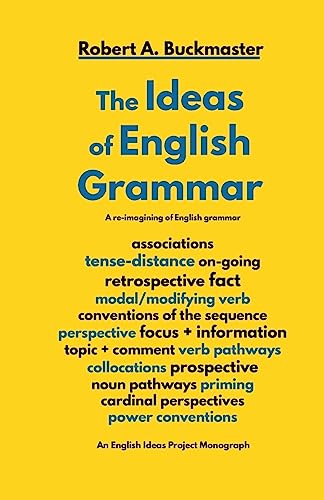
In this groundbreaking book, independent language researcher and teacher trainer Robert Buckmaster tackles the problems of English pedagogical grammar by re-imagining English grammar as a system of distance, meaning and conventions: G[DMC]. Current pedagogical grammar is marred by exceptions and special uses: past forms are used in present time; short cut rules avoid focusing on word and form meaning; and grammar rules are imprecise and difficult to operationalize. It is a retrospective grammar of language analysis, not one of language in use. Learners struggle to understand the complexities of English grammar and fail to use the language to the full potential. The usual excuse has been that the forms (e.g. the present perfect) are difficult and need to be taught and retaught. But what if the interpretation of grammar which has been taught is at fault? What if we have, in fact, made the task difficult because of the analysis which is presented to learners? What if there were a different, more internally consistent view of English grammar which could be taught instead?In fact there is: it is a prospective grammar to use to understand language as it happens. This new grammar sees tense as not being about time but about distance: time distance, reality distance and formality distance. All words have meanings but some also have form meanings, and these form meanings combine and add to our understanding of speaker meaning. And language conventions govern much of English grammar - like word order and collocations. The Ideas of English Grammar introduces the five key distance ideas, eight form meanings, the key modal/modifying verb meanings, the concepts of distance between words and in sentences and utterances, the conventional pathways of verbs and nouns, the conventions of questions and time phrases, and includes an analysis of conditionals (seven of them) and reported speech. The book also touches on a new model of language – the Associative Model - and considers some key principles from that model: the Placement and Start Here principles. All this is supported by hundreds of clear example sentences, tables and diagrams.This is a completely new, wholly coherent and internally consistent, and teachable system of English grammar which avoids the problems and pitfalls of traditional grammar. All teachers, trainers and coursebook writers will benefit from re-examining English grammar with the help of this re-imagining of English grammar.
Le informazioni nella sezione "Riassunto" possono far riferimento a edizioni diverse di questo titolo.
Informazioni sull'autore
Rob Buckmaster is an independent language researcher, teacher, teacher trainer, consultant, and writer. He has been working in English language teaching since 1991, and has taught and trained widely in central and eastern Europe, central Asia, northern and southern Africa. He first taught in Warsaw for ten years: at private language schools, and for the British Council. While in Poland, he completed his Certificate, Cambridge RSA Diploma, and Advanced Diploma in Language Teaching Management. He then moved to Estonia to manage the Justice and Home Affairs Peacekeeping English Project for the British Council. While there, he trained police and border guard teachers from all over the region, and completed his Masters in Education in E-Learning with a Distinction. After closing all the Peacekeeping projects in Estonia and Latvia in 2006, he moved to Latvia and taught for International House Riga before becoming Director of Studies for five years. He now works freelance for Buckmaster Consulting and McIlwraith Education. Rob Buckmaster is the author of 'Teaching English: Being the best' (with Emma Valahu), and of numerous article on teaching English. His work can be seen at www.rbuckmaster.com. He is the founder of the English Ideas Project: www.englishideas.org. He currently lives in Latvia with his family.
Le informazioni nella sezione "Su questo libro" possono far riferimento a edizioni diverse di questo titolo.
Risultati della ricerca per The Ideas of English Grammar

Immagini fornite dal venditore
The Ideas of English Grammar
Editore:
CreateSpace Independent Publishing Platform, 2017
ISBN 10: 1974088715
ISBN 13: 9781974088713
Antico o usato
Brossura
Da: GreatBookPrices, Columbia, MD, U.S.A.
Valutazione del venditore 5 su 5 stelle

Condizione: As New. Unread book in perfect condition. Codice articolo 39835532
Compra usato
EUR 15,29
Spedizione EUR 2,30
Spedito in U.S.A.
Spedito in U.S.A.
Quantità: Più di 20 disponibili
Immagini fornite dal venditore
The Ideas of English Grammar
Editore:
CreateSpace Independent Publishing Platform, 2017
ISBN 10: 1974088715
ISBN 13: 9781974088713
Nuovo
Brossura
Da: GreatBookPrices, Columbia, MD, U.S.A.
Valutazione del venditore 5 su 5 stelle
Condizione: New. Codice articolo 39835532-n
Compra nuovo
EUR 16,49
Spedizione EUR 2,30
Spedito in U.S.A.
Spedito in U.S.A.
Quantità: Più di 20 disponibili
Foto dell'editore
The Ideas of English Grammar
Editore:
CreateSpace Independent Publishing Platform, 2017
ISBN 10: 1974088715
ISBN 13: 9781974088713
Nuovo
Brossura
Da: California Books, Miami, FL, U.S.A.
Valutazione del venditore 4 su 5 stelle

Condizione: New. Print on Demand. Codice articolo I-9781974088713
Compra nuovo
EUR 18,87
Spedizione gratuita
Spedito in U.S.A.
Spedito in U.S.A.
Quantità: Più di 20 disponibili
Foto dell'editore
The Ideas of English Grammar
Editore:
Createspace Independent Publishing Platform, 2017
ISBN 10: 1974088715
ISBN 13: 9781974088713
Nuovo
PAP
Da: PBShop.store US, Wood Dale, IL, U.S.A.
Valutazione del venditore 5 su 5 stelle
PAP. Condizione: New. New Book. Shipped from UK. THIS BOOK IS PRINTED ON DEMAND. Established seller since 2000. Codice articolo L0-9781974088713
Compra nuovo
EUR 19,86
Spedizione gratuita
Spedito in U.S.A.
Spedito in U.S.A.
Quantità: Più di 20 disponibili
Foto dell'editore
The Ideas of English Grammar
Editore:
Createspace Independent Publishing Platform, 2017
ISBN 10: 1974088715
ISBN 13: 9781974088713
Nuovo
PAP
Da: PBShop.store UK, Fairford, GLOS, Regno Unito
Valutazione del venditore 5 su 5 stelle
PAP. Condizione: New. New Book. Delivered from our UK warehouse in 4 to 14 business days. THIS BOOK IS PRINTED ON DEMAND. Established seller since 2000. Codice articolo L0-9781974088713
Compra nuovo
EUR 18,16
Spedizione EUR 4,85
Spedito da Regno Unito a U.S.A.
Spedito da Regno Unito a U.S.A.
Quantità: Più di 20 disponibili
Foto dell'editore
The Ideas of English Grammar
Editore:
CreateSpace Independent Publishing Platform, 2017
ISBN 10: 1974088715
ISBN 13: 9781974088713
Nuovo
Brossura
Da: Ria Christie Collections, Uxbridge, Regno Unito
Valutazione del venditore 5 su 5 stelle
Condizione: New. In English. Codice articolo ria9781974088713_new
Compra nuovo
EUR 18,33
Spedizione EUR 10,93
Spedito da Regno Unito a U.S.A.
Spedito da Regno Unito a U.S.A.
Quantità: Più di 20 disponibili
Foto dell'editore
The Ideas of English Grammar
Editore:
Createspace Independent Publishing Platform, 2017
ISBN 10: 1974088715
ISBN 13: 9781974088713
Nuovo
Paperback / softback
Da: THE SAINT BOOKSTORE, Southport, Regno Unito
Valutazione del venditore 5 su 5 stelle
Paperback / softback. Condizione: New. This item is printed on demand. New copy - Usually dispatched within 5-9 working days. Codice articolo C9781974088713
Compra nuovo
EUR 19,53
Spedizione EUR 14,50
Spedito da Regno Unito a U.S.A.
Spedito da Regno Unito a U.S.A.
Quantità: Più di 20 disponibili
Immagini fornite dal venditore
The Ideas of English Grammar
Editore:
CreateSpace Independent Publishing Platform, 2017
ISBN 10: 1974088715
ISBN 13: 9781974088713
Nuovo
Brossura
Da: GreatBookPricesUK, Woodford Green, Regno Unito
Valutazione del venditore 5 su 5 stelle
Condizione: New. Codice articolo 39835532-n
Compra nuovo
EUR 18,15
Spedizione EUR 17,49
Spedito da Regno Unito a U.S.A.
Spedito da Regno Unito a U.S.A.
Quantità: Più di 20 disponibili
Immagini fornite dal venditore
The Ideas of English Grammar
Editore:
CreateSpace Independent Publishing Platform, 2017
ISBN 10: 1974088715
ISBN 13: 9781974088713
Antico o usato
Brossura
Da: GreatBookPricesUK, Woodford Green, Regno Unito
Valutazione del venditore 5 su 5 stelle
Condizione: As New. Unread book in perfect condition. Codice articolo 39835532
Compra usato
EUR 19,05
Spedizione EUR 17,49
Spedito da Regno Unito a U.S.A.
Spedito da Regno Unito a U.S.A.
Quantità: Più di 20 disponibili
Foto dell'editore
The Ideas of English Grammar
Editore:
Createspace Independent Publishing Platform Nov 2017, 2017
ISBN 10: 1974088715
ISBN 13: 9781974088713
Nuovo
Taschenbuch
Da: AHA-BUCH GmbH, Einbeck, Germania
Valutazione del venditore 5 su 5 stelle
Taschenbuch. Condizione: Neu. Neuware. Codice articolo 9781974088713
Compra nuovo
EUR 28,13
Spedizione EUR 30,50
Spedito da Germania a U.S.A.
Spedito da Germania a U.S.A.
Quantità: 2 disponibili