
Articoli correlati a Array Processing: Kronecker Product Beamforming: 18
Array Processing: Kronecker Product Beamforming: 18 - Rilegato
Libro 13 di 16: Springer Topics in Signal Processing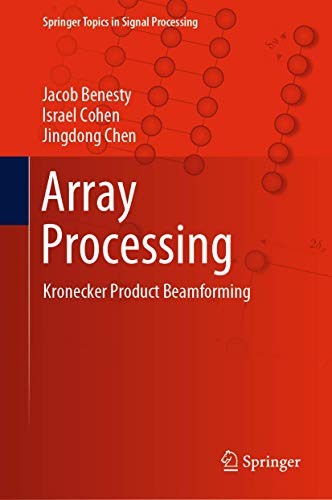
Sinossi
The focus of this book is on array processing and beamforming with Kronecker products. It considers a large family of sensor arrays that allow the steering vector to be decomposed as a Kronecker product of two steering vectors of smaller virtual arrays. Instead of directly designing a global beamformer for the original array, once the steering vector has been decomposed, smaller virtual beamformers are designed and separately optimized for each virtual array. This means the matrices that need to be inverted are smaller, which increases the robustness of the beamformers, and reduces the size of the observations.
The book explains how to perform beamforming with Kronecker product filters using an unconventional approach. It shows how the Kronecker product formulation can be used to derive fixed, adaptive, and differential beamformers with remarkable flexibility. Furthermore, it demonstrates how fixed and adaptive beamformers can be intelligently combined, optimally exploiting the advantages of both. The problem of spatiotemporal signal enhancement is also addressed, and readers will learn how to perform Kronecker product filtering in this context.Le informazioni nella sezione "Riassunto" possono far riferimento a edizioni diverse di questo titolo.
Informazioni sull'autore
Jacob Benesty received a master's degree in microwaves from Pierre & Marie Curie University, France, in 1987, and a Ph.D. degree in control and signal processing from Paris-Saclay University, France, in April 1991. During his Ph.D. (from Nov. 1989 to Apr. 1991), he worked on adaptive filters and fast algorithms at the Centre National d'Etudes des Telecommunications (CNET), Paris, France. From January 1994 to July 1995, he worked at Telecom Paris University on multichannel adaptive filters and acoustic echo cancellation. From October 1995 to May 2003, he was first a consultant and then a Member of the Technical Staff at Bell Laboratories, Murray Hill, NJ, USA. In May 2003, he joined the University of Quebec, INRS-EMT, in Montreal, Quebec, Canada, as a professor. He is also an adjunct professor with Aalborg University, Denmark, and a guest professor with Northwestern Polytechnical University, Xi'an, China. His research interests are in signal processing, acoustic signal processing, and multimedia communications. He is the inventor of many important technologies. In particular, he was the lead researcher at Bell Labs who conceived and designed the world-first real-time hands-free full-duplex stereophonic teleconferencing system. Also, he conceived and designed the world-first PC-based multi-party hands-free full-duplex stereo conferencing system over IP networks. He is the editor of the book series Springer Topics in Signal Processing. He was the general chair and technical chair of many international conferences and a member of several IEEE technical committees. Four of his journal papers were awarded by the IEEE Signal Processing Society, in 2010 he received the Gheorghe Cartianu Award from the Romanian Academy, and in 2023 he received an Honorary Doctorate (Doctor Technices Honoris Causa) from Aalborg University, Denmark, for his distinguished efforts in audio and acoustic signal processing. He has co-authored and co-edited/co-authored numerous books in the areaof acoustic signal processing. Gongping Huang received his bachelor's degree in Electronics and Information Engineering and his Ph.D. degree in Information and Communication Engineering from Northwestern Polytechnical University (NPU) in Xian, China, in 2012 and 2019, respectively. Between 2015 and 2017, he worked as a visiting researcher at University of Quebec, INRS-EMT, Montreal, Quebec, Canada. Following this, he worked as a postdoctoral research fellow at the Technion-Israel Institute of Technology in Haifa, Israel, from 2019 to 2021. He was a Humboldt Research Fellow at the University of Erlangen-Nuremberg in Germany, supported by the Alexander von Humboldt Foundation. He is now a professor at Wuhan University. His research interests include microphone arrays, acoustic signal processing, and speech enhancement. Dr. Huang received the Humboldt Research Fellowship (2021), the Andrew and Erna Finci Viterbi Post-Doctoral Fellowship award (2019), the Best Ph.D. Thesis Award from the Chinese Institute of Electronics (2021), and the Best Ph.D. Thesis Award of Shanxi Province (2021). He is currently serving as an Associate Editor for the Circuits Systems and Signal Processing Journal and a Consulting Associate Editors for the IEEE Open Journal of Signal Processing. He also serves as an active reviewer for more than 30 scientific journals and international conferences. Jingdong Chen received the Ph.D. degree in pattern recognition and intelligence control from the Chinese Academy of Sciences in 1998. From 1998 to 1999, he was with ATR Interpreting Telecommunications Research Laboratories, Kyoto, Japan, where he conducted research on speech synthesis, speech analysis, as well as objective measurements for evaluating speech synthesis. He then joined the Griffith University, Brisbane, Australia, where he engaged in research on robust speech recognition and signal processing. From 2000 to 2001, he worked at ATR Spoken Language Translation Research Laboratories on robust sp
Dalla quarta di copertina
The focus of this book is on array processing and beamforming with Kronecker products. It considers a large family of sensor arrays that allow the steering vector to be decomposed as a Kronecker product of two steering vectors of smaller virtual arrays. Instead of directly designing a global beamformer for the original array, once the steering vector has been decomposed, smaller virtual beamformers are designed and separately optimized for each virtual array. This means the matrices that need to be inverted are smaller, which increases the robustness of the beamformers, and reduces the size of the observations.
The book explains how to perform beamforming with Kronecker product filters using an unconventional approach. It shows how the Kronecker product formulation can be used to derive fixed, adaptive, and differential beamformers with remarkable flexibility. Furthermore, it demonstrates how fixed and adaptive beamformers can be intelligently combined, optimally exploiting the advantages of both. The problem of spatiotemporal signal enhancement is also addressed, and readers will learn how to perform Kronecker product filtering in this context.Le informazioni nella sezione "Su questo libro" possono far riferimento a edizioni diverse di questo titolo.
Risultati della ricerca per Array Processing: Kronecker Product Beamforming: 18

Foto dell'editore
Array Processing (eng)
Print on DemandDa: Brook Bookstore On Demand, Napoli, NA, Italia
Valutazione del venditore 5 su 5 stelle

Condizione: new. Questo è un articolo print on demand. Codice articolo 1598d98298387fba9ea87d275a4c5f8b
Compra nuovo
EUR 102,25
Spedizione EUR 6,80
Spedito da Italia a U.S.A.
Spedito da Italia a U.S.A.
Quantità: Più di 20 disponibili
Foto dell'editore
Array Processing
Da: Kuba Libri, Prague, Repubblica Ceca
Valutazione del venditore 5 su 5 stelle
Hardcover. Condizione: New. 1st Edition. Codice articolo 004687
Compra nuovo
EUR 105,73
Spedizione EUR 26,00
Spedito da Repubblica Ceca a U.S.A.
Spedito da Repubblica Ceca a U.S.A.
Quantità: 1 disponibili
Foto dell'editore
Array Processing : Kronecker Product Beamforming
Da: GreatBookPrices, Columbia, MD, U.S.A.
Valutazione del venditore 5 su 5 stelle
Condizione: New. Codice articolo 35194809-n
Compra nuovo
EUR 130,07
Spedizione EUR 2,36
Spedito in U.S.A.
Spedito in U.S.A.
Quantità: 15 disponibili
Foto dell'editore
Array Processing : Kronecker Product Beamforming
Da: GreatBookPrices, Columbia, MD, U.S.A.
Valutazione del venditore 5 su 5 stelle
Condizione: As New. Unread book in perfect condition. Codice articolo 35194809
Compra usato
EUR 148,90
Spedizione EUR 2,36
Spedito in U.S.A.
Spedito in U.S.A.
Quantità: 15 disponibili
Immagini fornite dal venditore
Array Processing
Editore:
Springer International Publishing Mrz 2019, 2019
ISBN 10: 3030155994
ISBN 13: 9783030155995
Nuovo
Rilegato
Da: BuchWeltWeit Ludwig Meier e.K., Bergisch Gladbach, Germania
Valutazione del venditore 5 su 5 stelle
Buch. Condizione: Neu. This item is printed on demand - it takes 3-4 days longer - Neuware -The focus of this book is on array processing and beamforming with Kronecker products. It considers a large family of sensor arrays that allow the steering vector to be decomposed as a Kronecker product of two steering vectors of smaller virtual arrays. Instead of directly designing a global beamformer for the original array, once the steering vector has been decomposed, smaller virtual beamformers are designed and separately optimized for each virtual array. This means the matrices that need to be inverted are smaller, which increases the robustness of the beamformers, and reduces the size of the observations.The book explains how to perform beamforming with Kronecker product filters using an unconventional approach. It shows how the Kronecker product formulation can be used to derive fixed, adaptive, and differential beamformers with remarkable flexibility. Furthermore, it demonstrates how fixed and adaptive beamformers can be intelligently combined, optimally exploiting theadvantages of both. The problem of spatiotemporal signal enhancement is also addressed, and readers will learn how to perform Kronecker product filtering in this context. 204 pp. Englisch. Codice articolo 9783030155995
Compra nuovo
EUR 128,39
Spedizione EUR 23,00
Spedito da Germania a U.S.A.
Spedito da Germania a U.S.A.
Quantità: 2 disponibili
Foto dell'editore
Array Processing: Kronecker Product Beamforming (Springer Topics in Signal Processing, 18)
Da: California Books, Miami, FL, U.S.A.
Valutazione del venditore 5 su 5 stelle
Condizione: New. Codice articolo I-9783030155995
Compra nuovo
EUR 152,62
Spedizione EUR 2,68
Spedito in U.S.A.
Spedito in U.S.A.
Quantità: Più di 20 disponibili
Immagini fornite dal venditore
Array Processing
Editore:
Springer International Publishing, 2019
ISBN 10: 3030155994
ISBN 13: 9783030155995
Nuovo
Rilegato
Da: moluna, Greven, Germania
Valutazione del venditore 5 su 5 stelle
Gebunden. Condizione: New. Dieser Artikel ist ein Print on Demand Artikel und wird nach Ihrer Bestellung fuer Sie gedruckt. Explains how to perform beamforming with Kronecker product filters Shows how to derive fixed, adaptive, and differential beamformers with remarkable flexibility Helps overcome the problem of spatiotemporal signal enhancement using Kroneck. Codice articolo 271866385
Compra nuovo
EUR 109,83
Spedizione EUR 48,99
Spedito da Germania a U.S.A.
Spedito da Germania a U.S.A.
Quantità: Più di 20 disponibili
Foto dell'editore
Array Processing : Kronecker Product Bea
Da: Kennys Bookshop and Art Galleries Ltd., Galway, GY, Irlanda
Valutazione del venditore 5 su 5 stelle
Condizione: New. Codice articolo V9783030155995
Compra nuovo
EUR 152,07
Spedizione EUR 9,50
Spedito da Irlanda a U.S.A.
Spedito da Irlanda a U.S.A.
Quantità: 15 disponibili
Foto dell'editore
Array Processing: Kronecker Product Beamforming (Springer Topics in Signal Processing, 18)
Da: Ria Christie Collections, Uxbridge, Regno Unito
Valutazione del venditore 5 su 5 stelle
Condizione: New. In English. Codice articolo ria9783030155995_new
Compra nuovo
EUR 158,98
Spedizione EUR 13,48
Spedito da Regno Unito a U.S.A.
Spedito da Regno Unito a U.S.A.
Quantità: Più di 20 disponibili
Immagini fornite dal venditore
Array Processing : Kronecker Product Beamforming
Editore:
Springer International Publishing, 2019
ISBN 10: 3030155994
ISBN 13: 9783030155995
Nuovo
Rilegato
Da: AHA-BUCH GmbH, Einbeck, Germania
Valutazione del venditore 5 su 5 stelle
Buch. Condizione: Neu. Druck auf Anfrage Neuware - Printed after ordering - The focus of this book is on array processing and beamforming with Kronecker products. It considers a large family of sensor arrays that allow the steering vector to be decomposed as a Kronecker product of two steering vectors of smaller virtual arrays. Instead of directly designing a global beamformer for the original array, once the steering vector has been decomposed, smaller virtual beamformers are designed and separately optimized for each virtual array. This means the matrices that need to be inverted are smaller, which increases the robustness of the beamformers, and reduces the size of the observations.The book explains how to perform beamforming with Kronecker product filters using an unconventional approach. It shows how the Kronecker product formulation can be used to derive fixed, adaptive, and differential beamformers with remarkable flexibility. Furthermore, it demonstrates how fixed and adaptive beamformers can be intelligently combined, optimally exploiting theadvantages of both. The problem of spatiotemporal signal enhancement is also addressed, and readers will learn how to perform Kronecker product filtering in this context. Codice articolo 9783030155995
Compra nuovo
EUR 148,23
Spedizione EUR 35,00
Spedito da Germania a U.S.A.
Spedito da Germania a U.S.A.
Quantità: 1 disponibili