
Articoli correlati a PID Trajectory Tracking Control for Mechanical Systems:...
Sinossi
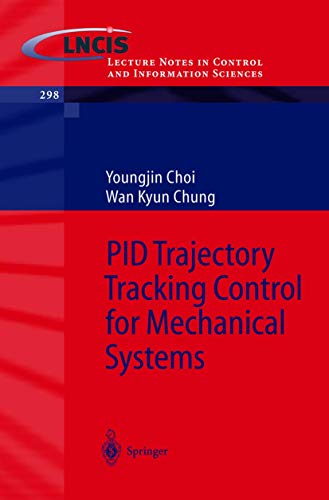
Though PID control has a long history as much as its life force since Ziegler and Nichols published the empirical tuning rules in 1942, surprisingly, it has never been changed in the structure itself. The strength of PID control lies in the simplicity, lucid meaning, and clear e?ect. Though it must be a widely - cepted controller for mechanical control systems, it is still short of theoretical bases,e.g., optimality, performance tuning rules, automatic performance t- ing method, and output feedback PID control have not been clearly presented formechanicalcontrolsystems.Thesesubjectswillbethoroughlydiscussedin this book. There are many books of PID controller for the purpose of process control, but it is hard to ?nd a book on the characteristics of PID control for mechanical systems. In the ?rst place, when nonlinear optimal control theory is applied to mechanical systems, a class of Hamilton-Jacobi (HJ) equations is derived as a result of optimization. There are two methods to solve a class of HJ eq- tions: a direct method using an approximation and inverse method ?nding the performance index from a class of HJ equations. Also, there are two control methods according to the objective: the set-point regulation control and t- jectory tracking control. The trajectory tracking control is basically di?erent from set-point regulation one in that the desired con?guration, velocity and acceleration pro?les according to time progress are added to the motion of mechanical system. This book is focusing on an inverse optimization method and the trajectory tracking control system.
Le informazioni nella sezione "Riassunto" possono far riferimento a edizioni diverse di questo titolo.
Contenuti
1 Introduction.- 2 Robust and Optimal Control for Mechanical Systems.- 3 Optimality of PID Control.- 4 Performance Limitation and Tuning.- 5 Automatic Performance Tuning.- 6 Output Feedback PID Control.- 7 Concluding Remarks.
Product Description
Book by Choi Youngjin Chung Wan Kyun
Le informazioni nella sezione "Su questo libro" possono far riferimento a edizioni diverse di questo titolo.
Risultati della ricerca per PID Trajectory Tracking Control for Mechanical Systems:...

Foto dell'editore
PID Trajectory Tracking Control for Mechanical Systems
Da: BookOrders, Russell, IA, U.S.A.
Valutazione del venditore 5 su 5 stelle

Soft Cover. Condizione: Good. Usual ex-library features. The interior is clean and tight. Binding is good. Cover shows light wear. 108 pages. "Lecture Notes in Control and Information Sciences, 298". Ex-Library. Codice articolo 118904g
Compra usato
EUR 68,76
Spedizione EUR 3,56
Spedito in U.S.A.
Spedito in U.S.A.
Quantità: 1 disponibili
Foto dell'editore
Pid Trajectory Tracking Control for Mechanical Systems: 298 (Lecture Notes in Control and Information Sciences, 298) [Paperback] [Jan 23, 2004] Choi, Youngjin and Chung, Wan Kyun
Da: StainesBookhub, Weybridge, SURRE, Regno Unito
Valutazione del venditore 2 su 5 stelle

Condizione: New. A brand new book in pristine condition. Showing zero signs of shelf wear, creases, or damage. Codice articolo SPRLISTINGBYSHB10122
Compra nuovo
EUR 90,77
Spedizione EUR 35,77
Spedito da Regno Unito a U.S.A.
Spedito da Regno Unito a U.S.A.
Quantità: 1 disponibili
Foto dell'editore
Pid Trajectory Tracking Control for Mechanical Systems
Da: GreatBookPrices, Columbia, MD, U.S.A.
Valutazione del venditore 5 su 5 stelle
Condizione: New. Codice articolo 4244485-n
Compra nuovo
EUR 125,02
Spedizione EUR 2,35
Spedito in U.S.A.
Spedito in U.S.A.
Quantità: 15 disponibili
Foto dell'editore
Pid Trajectory Tracking Control for Mechanical Systems
Da: GreatBookPrices, Columbia, MD, U.S.A.
Valutazione del venditore 5 su 5 stelle
Condizione: As New. Unread book in perfect condition. Codice articolo 4244485
Compra usato
EUR 126,21
Spedizione EUR 2,35
Spedito in U.S.A.
Spedito in U.S.A.
Quantità: 15 disponibili
Immagini fornite dal venditore
PID Trajectory Tracking Control for Mechanical Systems
Print on DemandDa: BuchWeltWeit Ludwig Meier e.K., Bergisch Gladbach, Germania
Valutazione del venditore 5 su 5 stelle
Taschenbuch. Condizione: Neu. This item is printed on demand - it takes 3-4 days longer - Neuware -Though PID control has a long history as much as its life force since Ziegler and Nichols published the empirical tuning rules in 1942, surprisingly, it has never been changed in the structure itself. The strength of PID control lies in the simplicity, lucid meaning, and clear e ect. Though it must be a widely - cepted controller for mechanical control systems, it is still short of theoretical bases,e.g., optimality, performance tuning rules, automatic performance t- ing method, and output feedback PID control have not been clearly presented formechanicalcontrolsystems.Thesesubjectswillbethoroughlydiscussedin this book. There are many books of PID controller for the purpose of process control, but it is hard to nd a book on the characteristics of PID control for mechanical systems. In the rst place, when nonlinear optimal control theory is applied to mechanical systems, a class of Hamilton-Jacobi (HJ) equations is derived as a result of optimization. There are two methods to solve a class of HJ eq- tions: a direct method using an approximation and inverse method nding the performance index from a class of HJ equations. Also, there are two control methods according to the objective: the set-point regulation control and t- jectory tracking control. The trajectory tracking control is basically di erent from set-point regulation one in that the desired con guration, velocity and acceleration pro les according to time progress are added to the motion of mechanical system. This book is focusing on an inverse optimization method and the trajectory tracking control system. 128 pp. Englisch. Codice articolo 9783540205678
Compra nuovo
EUR 106,99
Spedizione EUR 23,00
Spedito da Germania a U.S.A.
Spedito da Germania a U.S.A.
Quantità: 1 disponibili
Foto dell'editore
PID Trajectory Tracking Control for Mechanical Systems (Lecture Notes in Control and Information Sciences, 298)
Da: Ria Christie Collections, Uxbridge, Regno Unito
Valutazione del venditore 5 su 5 stelle
Condizione: New. In English. Codice articolo ria9783540205678_new
Compra nuovo
EUR 129,08
Spedizione EUR 11,17
Spedito da Regno Unito a U.S.A.
Spedito da Regno Unito a U.S.A.
Quantità: Più di 20 disponibili
Immagini fornite dal venditore
PID Trajectory Tracking Control for Mechanical Systems
Editore:
Springer Berlin Heidelberg, 2004
ISBN 10: 3540205675
ISBN 13: 9783540205678
Nuovo
Kartoniert / Broschiert
Da: moluna, Greven, Germania
Valutazione del venditore 5 su 5 stelle
Kartoniert / Broschiert. Condizione: New. Important, well structured book on PID control for mechanical systemsThough PID control has a long history as much as its life force since Ziegler and Nichols published the empirical tuning rules in 1942, surprisingly, it has never been chang. Codice articolo 4884712
Compra nuovo
EUR 100,59
Spedizione EUR 48,99
Spedito da Germania a U.S.A.
Spedito da Germania a U.S.A.
Quantità: 1 disponibili
Immagini fornite dal venditore
PID Trajectory Tracking Control for Mechanical Systems
Da: AHA-BUCH GmbH, Einbeck, Germania
Valutazione del venditore 5 su 5 stelle
Taschenbuch. Condizione: Neu. Druck auf Anfrage Neuware - Printed after ordering - Though PID control has a long history as much as its life force since Ziegler and Nichols published the empirical tuning rules in 1942, surprisingly, it has never been changed in the structure itself. The strength of PID control lies in the simplicity, lucid meaning, and clear e ect. Though it must be a widely - cepted controller for mechanical control systems, it is still short of theoretical bases,e.g., optimality, performance tuning rules, automatic performance t- ing method, and output feedback PID control have not been clearly presented formechanicalcontrolsystems.Thesesubjectswillbethoroughlydiscussedin this book. There are many books of PID controller for the purpose of process control, but it is hard to nd a book on the characteristics of PID control for mechanical systems. In the rst place, when nonlinear optimal control theory is applied to mechanical systems, a class of Hamilton-Jacobi (HJ) equations is derived as a result of optimization. There are two methods to solve a class of HJ eq- tions: a direct method using an approximation and inverse method nding the performance index from a class of HJ equations. Also, there are two control methods according to the objective: the set-point regulation control and t- jectory tracking control. The trajectory tracking control is basically di erent from set-point regulation one in that the desired con guration, velocity and acceleration pro les according to time progress are added to the motion of mechanical system. This book is focusing on an inverse optimization method and the trajectory tracking control system. Codice articolo 9783540205678
Compra nuovo
EUR 124,85
Spedizione EUR 35,00
Spedito da Germania a U.S.A.
Spedito da Germania a U.S.A.
Quantità: 1 disponibili
Immagini fornite dal venditore
PID Trajectory Tracking Control for Mechanical Systems
Editore:
Springer, Springer Jan 2004, 2004
ISBN 10: 3540205675
ISBN 13: 9783540205678
Nuovo
Taschenbuch
Da: buchversandmimpf2000, Emtmannsberg, BAYE, Germania
Valutazione del venditore 5 su 5 stelle
Taschenbuch. Condizione: Neu. This item is printed on demand - Print on Demand Titel. Neuware -Though PID control has a long history as much as its life force since Ziegler and Nichols published the empirical tuning rules in 1942, surprisingly, it has never been changed in the structure itself. The strength of PID control lies in the simplicity, lucid meaning, and clear e ect. Though it must be a widely - cepted controller for mechanical control systems, it is still short of theoretical bases,e.g., optimality, performance tuning rules, automatic performance t- ing method, and output feedback PID control have not been clearly presented formechanicalcontrolsystems.Thesesubjectswillbethoroughlydiscussedin this book. There are many books of PID controller for the purpose of process control, but it is hard to nd a book on the characteristics of PID control for mechanical systems. In the rst place, when nonlinear optimal control theory is applied to mechanical systems, a class of Hamilton-Jacobi (HJ) equations is derived as a result of optimization. There are two methods to solve a class of HJ eq- tions: a direct method using an approximation and inverse method nding the performance index from a class of HJ equations. Also, there are two control methods according to the objective: the set-point regulation control and t- jectory tracking control. The trajectory tracking control is basically di erent from set-point regulation one in that the desired con guration, velocity and acceleration pro les according to time progress are added to the motion of mechanical system. This book is focusing on an inverse optimization method and the trajectory tracking control system.Springer-Verlag KG, Sachsenplatz 4-6, 1201 Wien 128 pp. Englisch. Codice articolo 9783540205678
Compra nuovo
EUR 106,99
Spedizione EUR 60,00
Spedito da Germania a U.S.A.
Spedito da Germania a U.S.A.
Quantità: 1 disponibili