
Articoli correlati a Quantitative Models for Reverse Logistics: 501
Quantitative Models for Reverse Logistics: 501 - Brossura
Libro 92 di 126: Lecture Notes in Economics and Mathematical Systems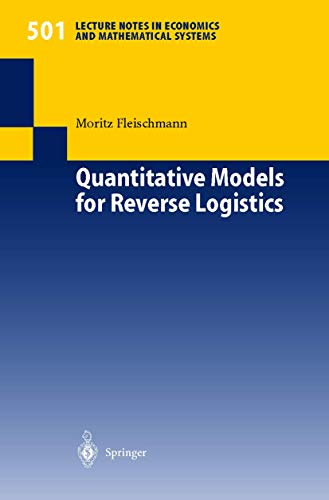
Sinossi
Economic, marketing, and legislative considerations are increasingly leading companies to take back and recover their products after use. From a logistics perspective, these initiatives give rise to new goods flows from the user back to the producer. The management of these goods flows opposite to the traditional supply chain flows is addressed in the recently emerged field of Reverse Logistics. This monograph considers quantitative models that support decision making in Reverse Logistics. To this end, several recent case studies are reviewed. Moreover, first hand insight from a study on used electronic equipment is reported on. On this basis, logistics issues arising in the management of "reverse" goods flows are identified. Moreover, differences between Reverse Logistics and more traditional logistics contexts are highlighted. Finally, attention is paid to capturing the characteristics of Reverse Logistics in appropriate quantitative models.
Le informazioni nella sezione "Riassunto" possono far riferimento a edizioni diverse di questo titolo.
Dalla quarta di copertina
Economic, marketing, and legislative considerations are increasingly leading companies to take back and recover their products after use. From a logistics perspective, these initiatives give rise to new goods flows from the user back to the producer. The management of these goods flows opposite to the traditional supply chain flows is addressed in the recently emerged field of Reverse Logistics. This monograph considers quantitative models that support decision making in Reverse Logistics. To this end, several recent case studies are reviewed. Moreover, first hand insight from a study on used electronic equipment is reported on. On this basis, logistics issues arising in the management of "reverse" goods flows are identified. Moreover, differences between Reverse Logistics and more traditional logistics contexts are highlighted. Finally, attention is paid to capturing the characteristics of Reverse Logistics in appropriate quantitative models.
Le informazioni nella sezione "Su questo libro" possono far riferimento a edizioni diverse di questo titolo.
Risultati della ricerca per Quantitative Models for Reverse Logistics: 501

Immagini fornite dal venditore
Quantitative Models for Reverse Logistics
Editore:
Springer Berlin Heidelberg Mrz 2001, 2001
ISBN 10: 3540417117
ISBN 13: 9783540417118
Nuovo
Taschenbuch
Da: BuchWeltWeit Ludwig Meier e.K., Bergisch Gladbach, Germania
Valutazione del venditore 5 su 5 stelle

Taschenbuch. Condizione: Neu. This item is printed on demand - it takes 3-4 days longer - Neuware -Economic, marketing, and legislative considerations are increasingly leading companies to take back and recover their products after use. From a logistics perspective, these initiatives give rise to new goods flows from the user back to the producer. The management of these goods flows opposite to the traditional supply chain flows is addressed in the recently emerged field of Reverse Logistics. This monograph considers quantitative models that support decision making in Reverse Logistics. To this end, several recent case studies are reviewed. Moreover, first hand insight from a study on used electronic equipment is reported on. On this basis, logistics issues arising in the management of 'reverse' goods flows are identified. Moreover, differences between Reverse Logistics and more traditional logistics contexts are highlighted. Finally, attention is paid to capturing the characteristics of Reverse Logistics in appropriate quantitative models. 200 pp. Englisch. Codice articolo 9783540417118
Compra nuovo
EUR 106,99
Spedizione EUR 23,00
Spedito da Germania a U.S.A.
Spedito da Germania a U.S.A.
Quantità: 2 disponibili
Foto dell'editore
Quantitative Models for Reverse Logistics
Da: GreatBookPrices, Columbia, MD, U.S.A.
Valutazione del venditore 5 su 5 stelle
Condizione: New. Codice articolo 986376-n
Compra nuovo
EUR 133,84
Spedizione EUR 2,35
Spedito in U.S.A.
Spedito in U.S.A.
Quantità: 15 disponibili
Immagini fornite dal venditore
Quantitative Models for Reverse Logistics
Print on DemandDa: moluna, Greven, Germania
Valutazione del venditore 5 su 5 stelle
Condizione: New. Dieser Artikel ist ein Print on Demand Artikel und wird nach Ihrer Bestellung fuer Sie gedruckt. Economic, marketing, and legislative considerations are increasingly leading companies to take back and recover their products after use. From a logistics perspective, these initiatives give rise to new goods flows from the user back to the producer. The ma. Codice articolo 4889399
Compra nuovo
EUR 92,27
Spedizione EUR 48,99
Spedito da Germania a U.S.A.
Spedito da Germania a U.S.A.
Quantità: Più di 20 disponibili
Immagini fornite dal venditore
Quantitative Models for Reverse Logistics
Da: AHA-BUCH GmbH, Einbeck, Germania
Valutazione del venditore 5 su 5 stelle
Taschenbuch. Condizione: Neu. Druck auf Anfrage Neuware - Printed after ordering - Economic, marketing, and legislative considerations are increasingly leading companies to take back and recover their products after use. From a logistics perspective, these initiatives give rise to new goods flows from the user back to the producer. The management of these goods flows opposite to the traditional supply chain flows is addressed in the recently emerged field of Reverse Logistics. This monograph considers quantitative models that support decision making in Reverse Logistics. To this end, several recent case studies are reviewed. Moreover, first hand insight from a study on used electronic equipment is reported on. On this basis, logistics issues arising in the management of 'reverse' goods flows are identified. Moreover, differences between Reverse Logistics and more traditional logistics contexts are highlighted. Finally, attention is paid to capturing the characteristics of Reverse Logistics in appropriate quantitative models. Codice articolo 9783540417118
Compra nuovo
EUR 124,85
Spedizione EUR 35,00
Spedito da Germania a U.S.A.
Spedito da Germania a U.S.A.
Quantità: 1 disponibili
Foto dell'editore
Quantitative Models for Reverse Logistics
Da: Books Puddle, Woodside, NY, U.S.A.
Valutazione del venditore 4 su 5 stelle

Condizione: New. pp. 200. Codice articolo 26345775
Compra nuovo
EUR 157,67
Spedizione EUR 3,56
Spedito in U.S.A.
Spedito in U.S.A.
Quantità: 4 disponibili
Immagini fornite dal venditore
Quantitative Models for Reverse Logistics
Editore:
Springer, J.B. Metzler Mär 2001, 2001
ISBN 10: 3540417117
ISBN 13: 9783540417118
Nuovo
Taschenbuch
Da: buchversandmimpf2000, Emtmannsberg, BAYE, Germania
Valutazione del venditore 5 su 5 stelle
Taschenbuch. Condizione: Neu. This item is printed on demand - Print on Demand Titel. Neuware -Economic, marketing, and legislative considerations are increasingly leading companies to take back and recover their products after use. From a logistics perspective, these initiatives give rise to new goods flows from the user back to the producer. The management of these goods flows opposite to the traditional supply chain flows is addressed in the recently emerged field of Reverse Logistics. This monograph considers quantitative models that support decision making in Reverse Logistics. To this end, several recent case studies are reviewed. Moreover, first hand insight from a study on used electronic equipment is reported on. On this basis, logistics issues arising in the management of 'reverse' goods flows are identified. Moreover, differences between Reverse Logistics and more traditional logistics contexts are highlighted. Finally, attention is paid to capturing the characteristics of Reverse Logistics in appropriate quantitative models.Springer-Verlag KG, Sachsenplatz 4-6, 1201 Wien 200 pp. Englisch. Codice articolo 9783540417118
Compra nuovo
EUR 106,99
Spedizione EUR 60,00
Spedito da Germania a U.S.A.
Spedito da Germania a U.S.A.
Quantità: 1 disponibili
Foto dell'editore
Quantitative Models for Reverse Logistics
Print on DemandDa: Majestic Books, Hounslow, Regno Unito
Valutazione del venditore 4 su 5 stelle
Condizione: New. Print on Demand pp. 200 Illus. Codice articolo 7534960
Compra nuovo
EUR 163,45
Spedizione EUR 7,79
Spedito da Regno Unito a U.S.A.
Spedito da Regno Unito a U.S.A.
Quantità: 4 disponibili
Foto dell'editore
Quantitative Models for Reverse Logistics
Print on DemandDa: Biblios, Frankfurt am main, HESSE, Germania
Valutazione del venditore 4 su 5 stelle
Condizione: New. PRINT ON DEMAND pp. 200. Codice articolo 18345765
Compra nuovo
EUR 166,32
Spedizione EUR 9,95
Spedito da Germania a U.S.A.
Spedito da Germania a U.S.A.
Quantità: 4 disponibili
Foto dell'editore
Quantitative Models for Reverse Logistics (Lecture Notes in Economics and Mathematical Systems)
Da: Mispah books, Redhill, SURRE, Regno Unito
Valutazione del venditore 4 su 5 stelle
Paperback. Condizione: Like New. LIKE NEW. SHIPS FROM MULTIPLE LOCATIONS. book. Codice articolo ERICA77535404171176
Compra usato
EUR 220,82
Spedizione EUR 29,94
Spedito da Regno Unito a U.S.A.
Spedito da Regno Unito a U.S.A.
Quantità: 1 disponibili
Foto dell'editore
Quantitative Models for Reverse Logistics
Da: GreatBookPrices, Columbia, MD, U.S.A.
Valutazione del venditore 5 su 5 stelle
Condizione: As New. Unread book in perfect condition. Codice articolo 986376
Compra usato
EUR 254,30
Spedizione EUR 2,35
Spedito in U.S.A.
Spedito in U.S.A.
Quantità: 15 disponibili