
Articoli correlati a Quantum Theory and Pictures of Reality: Foundations,...
Sinossi
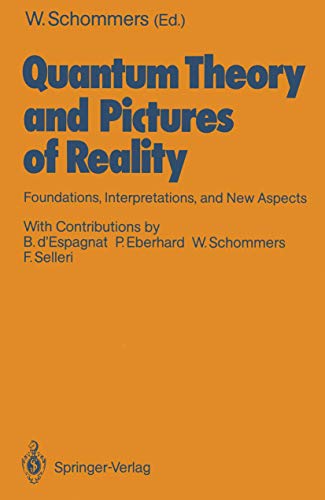
Schommers introduces the foundations, mostly from a histori-cal point of view. Eberhard gives an introductory account ofthe Einstein-Podolsky-Rosen paradox and Bell's celebratedinequalities. D'Espagnat discusses realism andseparabilityand concludes that contemporary physics does not lead to adefinite conception of the world. Eberhard shows how a modelconsistent with Bell's theorem can be constructed by ad-mitting faster-than-light action at a distance. Schommersdiscusses the structure ofspace-time and argues that physi-cally real processes do not take place in but are projectedon space-time. Selleri discusses the idea that objectivelyreal quantum waves exist and could in principle be detected.
Le informazioni nella sezione "Riassunto" possono far riferimento a edizioni diverse di questo titolo.
Contenuti
1. Evolution of Quantum Theory.- 1.1 Classical Pictures of Reality.- 1.1.1 Mythological and Intellectual Pictures.- 1.1.2 Mechanistic View of the World.- 1.2 From Classical to Quantum Mechanics.- 1.2.1 Planck’s Constant.- 1.2.2 Einstein’s Picture of Light.- 1.2.3 The Structure of Atoms.- 1.2.4 Matter Waves, Schrödinger’s Wave Equation, and Matrix Mechanics.- 1.2.5 Bora’s Probability Interpretation.- 1.2.6 Uncertainty.- 1.2.7 The Principle of Complementarity.- 1.3 Theories of Measurement: Brief Remarks.- 1.3.1 Objectivity.- 1.3.2 The Measurement Problem.- 1.3.3 Theories of Measurement: Final Comments.- 1.4 Summary.- Appendix 1.A. Classical Mechanics: Some Basic Remarks.- 1.A.1 The Principle of Least Action and Lagrange’s Equations.- 1.A.2 Newton’s Equations.- 1.A.3 Hamilton’s Equations.- 1.A.4 The Hamilton-Jacobi Equations.- Appendix 1.B. The Relation Between Schrödinger’s Equations and Classical Mechanics.- References.- 2. The EPR Paradox. Roots and Ramifications.- 2.1 A Debate Lasting More Than Fifty Years.- 2.1.1 Are There Faster-Than-Light Effects in Quantum Phenomena?.- 2.1.2 Einstein’s Point of View.- 2.1.3 Dissenting Voices.- 2.1.4 The Verdict of Experiment.- 2.2 A Far-Reaching Argument.- 2.2.1 Example of an EPR-Bohm Experiment.- 2.2.2 How to Compute the Predictions in Quantum Theory.- 2.2.3 Reality and Lorentz Invariance.- 2.2.4 Bell’s Theorem.- 2.2.5 Analogy with a Spy Story.- 2.3 A Sample of Possible Solutions.- 2.3.1 Experimental Loopholes.- 2.3.2 Giving up on Conventional Concepts of Reality.- 2.3.3 Fundamental Space-Time Restframes.- 2.3.4 How a Model with Rudimentary Locality Can Work.- 2.3.5 Conclusions.- References.- 3. Nonseparability and the Tentative Descriptions of Reality.- 3.1 Introduction.- 3.2 Realism and Separability.- 3.2.1 Realism.- 3.2.2 The Principle of Separability.- 3.2.3 Separable “Conception of the World”.- 3.3 Separability and Quantum Physics.- 3.3.1 Separability and Quantum State.- 3.3.2 The Usefulness and Scope of the Statistical Operator Description of States.- 3.3.3 How to Prove Nonseparability.- 3.3.4 A Few Words of Caution.- 3.3.5 Quantum Mechanics Does Not Allow Superluminal Signalling.- 3.4 Disproof of the Principle of Separability.- 3.4.1 Derivation of the Bell-CHSH Inequalities.- 3.4.2 Relativity and the Bell-CHSH Inequalities.- 3.4.3 Other Assumptions Leading to the Bell-CHSH Inequalities.- 3.4.4 The Special Case of Strict Correlations.- 3.4.5 The “Principle of Inductive Causality”, its Motivation and function.- 3.4.6 The Generality of the Bell Inequalities.- 3.5 Counterfactuals and Influences-at-a-Distance.- 3.5.1 Strict Implication and Counterfactuals.- 3.5.2 A Few Applications for These Concepts.- 3.5.3 An Application to the Everett “Relative State” Theory.- 3.5.4 In What Sense Can We Speak of Superluminal Propagation of Influences?.- 3.5.5 A Nonrelativistic Approach.- 3.5.6 What About the Relativistic Case?.- 3.6 Some Problems Bearing on Causality.- 3.6.1 A Remark on Delayed Choice Experiments.- 3.6.2 Remarks on Relativistic Covarianee and its Meaning.- 3.6.3 On Measurement Time Asymmetry and the Nonexistence of Superluminal Signals.- 3.7 Tentative Descriptions of an “Independent Reality”.- 3.7.1 Assumption Q Made.- 3.7.2 Assumption Q Not Made.- 3.8 Conclusion.- Appendix 3.I. Some Disproved Objections to the Bell Theorem.- Added Note.- Appendix 3.II.- References.- 4. A Realistic Model for Quantum Theory With a Locality Property.- 4.1 Introduction.- 4.1.1 Background and Scope.- 4.1.2 Basic Features of the Model.- 4.1.3 Possible Experimental Evidence.- 4.2 Field Theory and Translation-Invariant Operators.- 4.2.1 The Density Matrices for the Universe and for an Isolated Quantum System.- 4.2.2 Measurement Probabilities and Collapses.- 4.2.3 Translation Invariant Operators.- 4.2.4 The Translation-Invariant Formalism.- 4.2.5 Lorentz Invariance.- 4.3 The Model and its Predictions.- 4.3.1 Probabilities of Measurement Results.- 4.3.2 Equations for Time Evolution.- 4.3.3 Collapses of the Quantum Matrix.- 4.3.4 Role of the Spatial-Compatibility Condition in Collapses.- 4.3.5 Collapses Without Observers.- 4.4 Properties Related to Locality.- 4.4.1 Invariances and Locality of the Model.- 4.4.2 Evolution When V is Not Infinite.- 4.4.3 Measurements Well Spaced in Time.- 4.4.4 Measurements Closely Spaced in Time.- 4.4.5 Isolated Systems.- 4.4.6 Superluminous Communication.- 4.5 Impact on Measurement Theory.- 4.5.1 Locality of Measurement Processes.- 4.5.2 Measurements Equated to Acts of Consciousness.- 4.5.3 The Spontaneous Measurements Approach.- 4.6 Conclusion.- Appendix 4.A. A Partial Derivative Equation for C(x,t).- Appendix 4.B. Conservation of the Spatial-Compatibility Condition.- Appendix 4.C. Generating the Spatial-Compatibility Condition.- Appendix 4.D. Collapses Due to Two Measurements Closely Spaced in Time.- References.- 5. Space-Time and Quantum Phenomena.- 5.1 Introduction.- 5.2 Time-Operator Within Usual Quantum Theory.- 5.3 Superoperator Formalism.- 5.3.1 Being and Becoming: General Remarks.- 5.3.2 Liouvillian Formulation of Quantum Mechanics.- 5.3.3 Extension of the Formalism of Classical and Quantum Mechanics.- 5.3.4 Superoperator for the Time.- 5.3.5 “Picture of Reality” Within the Superoperator Formalism.- 5.4 Space-Time and Quantum Theory: A Formulation in Accordance With Mach’s Principle.- 5.4.1 Space-Time and Mach’s Principle.- 5.4.2 Other Spaces.- 5.4.3 The Influence of Planck’s Constant.- 5.4.4 Operators.- 5.4.5 Intermediate Spaces.- 5.4.6 A New Complementarity.- 5.4.7 Determination of ?(r, t) and ?(p,E).- 5.4.8 Meaning of the Wave Functions.- 5.4.9 Eigenvalues.- 5.4.10 The Role of Time.- 5.4.11 Being and Becoming.- 5.4.12 Particles and Waves.- 5.4.13 Wave Function and Measurement.- 5.4.14 Remarks Concerning the Superposition Principle.- 5.4.15 Reality and Basic Reality.- 5.5 Summary and Final Remarks.- Appendix 5.A. On the Second Law of Thermodynamics.- Appendix 5.B. A Non-absolute Space-Time.- Appendix 5.C. On the Uncertainty Relation for Energy and Time.- Appendix 5.D. On the Definition of Being and Becoming.- References.- 6. Wave-Particle Duality: Recent Proposals for the Detection of Empty Waves.- 6.1 Introduction.- 6.2 The Einstein-De Broglie Formulation.- 6.3 The Copenhagen-Göttingen Formulation of Duality.- 6.4 Delayed-Choice Experiments.- 6.5 Noteworthy Experimental Facts.- 6.6 Empty-Wave Stimulation of Photon Emission.- 6.7 Theories of Stimulated Emission.- 6.8 Experimental Discriminations.- 6.9 Further Experiments for the Detection of Empty Waves.- Note Added in Proof.- References.- Additional References.
Product Description
Book by None
Le informazioni nella sezione "Su questo libro" possono far riferimento a edizioni diverse di questo titolo.
Risultati della ricerca per Quantum Theory and Pictures of Reality: Foundations,...

Immagini fornite dal venditore
Quantum Theory and Pictures of Reality: Foundations, Interpretations, and New Aspects
Editore:
Springer-Verlag, 1989
ISBN 10: 3540501525
ISBN 13: 9783540501527
Antico o usato
Paperback
Prima edizione
Da: Southampton Books, Sag Harbor, NY, U.S.A.
Valutazione del venditore 5 su 5 stelle

Paperback. Condizione: Very Good. First Edition. First Edition, First Printing. Published by Springer-Verlag, 1989. Octavo. Paperback. Book is very good with previous owner's underlining and notes throughout, sticker and writing on front flyleaf and light shelf/edgewear. 100% positive feedback. 30 day money back guarantee. NEXT DAY SHIPPING! Excellent customer service. Please email with any questions. All books packed carefully and ship with free delivery confirmation/tracking. All books come with free bookmarks. Ships from Sag Harbor, New York. Codice articolo 422178
Compra usato
EUR 18,11
Spedizione EUR 4,39
Spedito in U.S.A.
Spedito in U.S.A.
Quantità: 1 disponibili
Foto dell'editore
Quantum Theory and Pictures of Reality: Foundations, Interpretations, and New Aspects
Da: J. HOOD, BOOKSELLERS, ABAA/ILAB, Baldwin City, KS, U.S.A.
Valutazione del venditore 5 su 5 stelle
Paperback. 336pp. Some neat highlighting on about 35 pages, otherwise VG+ condition. Codice articolo 194283
Compra usato
EUR 40,75
Spedizione EUR 4,40
Spedito in U.S.A.
Spedito in U.S.A.
Quantità: 1 disponibili
Foto dell'editore
Quantum Theory and Pictures of Reality: Foundations, Interpretations, and New Aspects
Da: Ria Christie Collections, Uxbridge, Regno Unito
Valutazione del venditore 5 su 5 stelle
Condizione: New. In English. Codice articolo ria9783540501527_new
Compra nuovo
EUR 66,93
Spedizione EUR 13,11
Spedito da Regno Unito a U.S.A.
Spedito da Regno Unito a U.S.A.
Quantità: Più di 20 disponibili
Foto dell'editore
Quantum Theory and Pictures of Reality
Da: Books Puddle, Woodside, NY, U.S.A.
Valutazione del venditore 4 su 5 stelle

Condizione: New. pp. 360. Codice articolo 261530251
Compra nuovo
EUR 84,12
Spedizione EUR 3,51
Spedito in U.S.A.
Spedito in U.S.A.
Quantità: 4 disponibili
Foto dell'editore
Quantum Theory and Pictures of Reality
Print on DemandDa: Majestic Books, Hounslow, Regno Unito
Valutazione del venditore 4 su 5 stelle
Condizione: New. Print on Demand pp. 360 49:B&W 6.14 x 9.21 in or 234 x 156 mm (Royal 8vo) Perfect Bound on White w/Gloss Lam. Codice articolo 6350420
Compra nuovo
EUR 82,91
Spedizione EUR 7,55
Spedito da Regno Unito a U.S.A.
Spedito da Regno Unito a U.S.A.
Quantità: 4 disponibili
Foto dell'editore
Quantum Theory and Pictures of Reality
Print on DemandDa: Biblios, Frankfurt am main, HESSE, Germania
Valutazione del venditore 4 su 5 stelle
Condizione: New. PRINT ON DEMAND pp. 360. Codice articolo 181530241
Compra nuovo
EUR 83,20
Spedizione EUR 9,95
Spedito da Germania a U.S.A.
Spedito da Germania a U.S.A.
Quantità: 4 disponibili
Foto dell'editore
Quantum Theory and Pictures of Reality: Foundations, Interpretations, and New Aspects
Da: Revaluation Books, Exeter, Regno Unito
Valutazione del venditore 5 su 5 stelle
Paperback. Condizione: Brand New. 1st edition. 353 pages. 9.25x6.10x0.82 inches. In Stock. Codice articolo x-3540501525
Compra nuovo
EUR 81,19
Spedizione EUR 14,52
Spedito da Regno Unito a U.S.A.
Spedito da Regno Unito a U.S.A.
Quantità: 2 disponibili
Immagini fornite dal venditore
Quantum Theory and Pictures of Reality : Foundations, Interpretations, and New Aspects
Da: AHA-BUCH GmbH, Einbeck, Germania
Valutazione del venditore 5 su 5 stelle
Taschenbuch. Condizione: Neu. Druck auf Anfrage Neuware - Printed after ordering - Schommers introduces the foundations, mostly from a histori-cal point of view. Eberhard gives an introductory account ofthe Einstein-Podolsky-Rosen paradox and Bell's celebratedinequalities. D'Espagnat discusses realism andseparabilityand concludes that contemporary physics does not lead to adefinite conception of the world. Eberhard shows how a modelconsistent with Bell's theorem can be constructed by ad-mitting faster-than-light action at a distance. Schommersdiscusses the structure ofspace-time and argues that physi-cally real processes do not take place in but are projectedon space-time. Selleri discusses the idea that objectivelyreal quantum waves exist and could in principle be detected.; Although the mathematical formalism of quantum mechanics was established by Heisenberg und Schrödinger as early as 1925/26 and soon led to dramatic progress in atomic, molecular and solid-state physics, the interpretation of the theory remains to this day by far the most controversial problem in the foundations of physics. This book deals with the more philosophical question of how the formalism of quantum theory should be interpreted. The book has two parts. Part 1 is concerned with the usual view of quantum theory. Schommers introduces the foundations, mostly from a historical point of view. Eberhard gives an introductory account of the Einstein-Podolsky-Rosen paradox and Bell's celebrated inequalities. D'Espagnat discusses realism and separability and concludes that contemporary physics does not lead to a definite conception of the world. Part 2 deals with the new aspects of quantum theory. Eberhard shows how a modell consistent with Bell's theorem can be constructed by admitting faster-than-light action at a distance. Schommers discusses the structure of space-time and argues that physically real processes do not take place in but are projected on space-time. Selleri discusses the idea that objectively real quantum waves exist and could in principle be detected. Codice articolo 9783540501527
Compra nuovo
EUR 61,97
Spedizione EUR 35,00
Spedito da Germania a U.S.A.
Spedito da Germania a U.S.A.
Quantità: 1 disponibili
Immagini fornite dal venditore
Quantum Theory and Pictures of Reality
Da: moluna, Greven, Germania
Valutazione del venditore 5 su 5 stelle
Condizione: New. Codice articolo 4891467
Compra nuovo
EUR 48,37
Spedizione EUR 48,99
Spedito da Germania a U.S.A.
Spedito da Germania a U.S.A.
Quantità: Più di 20 disponibili
Immagini fornite dal venditore
Quantum Theory and Pictures of Reality
Editore:
Springer, Springer Mai 1989, 1989
ISBN 10: 3540501525
ISBN 13: 9783540501527
Nuovo
Taschenbuch
Da: buchversandmimpf2000, Emtmannsberg, BAYE, Germania
Valutazione del venditore 5 su 5 stelle
Taschenbuch. Condizione: Neu. This item is printed on demand - Print on Demand Titel. Neuware -1. Evolution of Quantum Theory.- 1.1 Classical Pictures of Reality.- 1.2 From Classical to Quantum Mechanics.- 1.3 Theories of Measurement: Brief Remarks.- 1.4 Summary.- Appendix 1.A. Classical Mechanics: Some Basic Remarks.- Appendix 1.B. The Relation Between Schrödinger's Equations and Classical Mechanics.- References.- 2. The EPR Paradox. Roots and Ramifications.- 2.1 A Debate Lasting More Than Fifty Years.- 2.2 A Far-Reaching Argument.- 2.3 A Sample of Possible Solutions.- References.- 3. Nonseparability and the Tentative Descriptions of Reality.- 3.1 Introduction.- 3.2 Realism and Separability.- 3.3 Separability and Quantum Physics.- 3.4 Disproof of the Principle of Separability.- 3.5 Counterfactuals and Influences-at-a-Distance.- 3.6 Some Problems Bearing on Causality.- 3.7 Tentative Descriptions of an 'Independent Reality'.- 3.8 Conclusion.- Appendix 3.I. Some Disproved Objections to the Bell Theorem.- Added Note.- Appendix 3.II.- References.- 4. A Realistic Model for Quantum Theory With a Locality Property.- 4.1 Introduction.- 4.2 Field Theory and Translation-Invariant Operators.- 4.3 The Model and its Predictions.- 4.4 Properties Related to Locality.- 4.5 Impact on Measurement Theory.- 4.6 Conclusion.- Appendix 4.A. A Partial Derivative Equation for C(x,t).- Appendix 4.B. Conservation of the Spatial-Compatibility Condition.- Appendix 4.C. Generating the Spatial-Compatibility Condition.- Appendix 4.D. Collapses Due to Two Measurements Closely Spaced in Time.- References.- 5. Space-Time and Quantum Phenomena.- 5.1 Introduction.- 5.2 Time-Operator Within Usual Quantum Theory.- 5.3 Superoperator Formalism.- 5.4 Space-Time and Quantum Theory: A Formulation in Accordance With Mach's Principle.- 5.5 Summary and Final Remarks.- Appendix 5.A. On the Second Lawof Thermodynamics.- Appendix 5.B. A Non-absolute Space-Time.- Appendix 5.C. On the Uncertainty Relation for Energy and Time.- Appendix 5.D. On the Definition of Being and Becoming.- References.- 6. Wave-Particle Duality: Recent Proposals for the Detection of Empty Waves.- 6.1 Introduction.- 6.2 The Einstein-De Broglie Formulation.- 6.3 The Copenhagen-Göttingen Formulation of Duality.- 6.4 Delayed-Choice Experiments.- 6.5 Noteworthy Experimental Facts.- 6.6 Empty-Wave Stimulation of Photon Emission.- 6.7 Theories of Stimulated Emission.- 6.8 Experimental Discriminations.- 6.9 Further Experiments for the Detection of Empty Waves.- Note Added in Proof.- References.- Additional References.Springer-Verlag GmbH, Tiergartenstr. 17, 69121 Heidelberg 360 pp. Englisch. Codice articolo 9783540501527
Compra nuovo
EUR 53,49
Spedizione EUR 60,00
Spedito da Germania a U.S.A.
Spedito da Germania a U.S.A.
Quantità: 1 disponibili