
Articoli correlati a Probabilistic Inductive Logic Programming (Lecture...
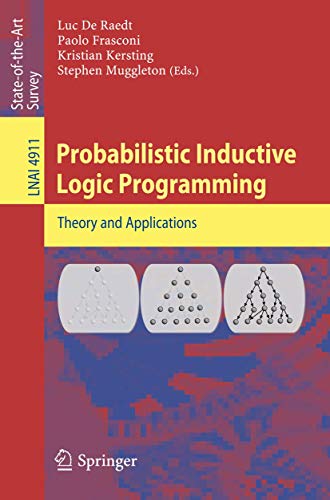
Probabilistic Inductive Logic Programming (Lecture Notes in Computer Science / Lecture Notes in Artificial Intelligence): Theory and Applications: 4911 - Brossura
Sinossi
Inductive LogicProgramming byDeRaedtandKersting.Inasecondpart,itprovidesa detailedoverviewofthemostimportantprobabilisticlogiclearningformalisms and systems. We are very pleased and proud that the scientists behind the key probabilistic inductive logic programming systems (also those developed outside the APRIL project) have kindly contributed a chapter providing an overviewoftheircontributions.Thisincludes:relationalsequencelearningte- niques (Kersting et al.), using kernels with logical representations (Frasconi andPasserini),MarkovLogic(Domingosetal.), the PRISMsystem (Satoand Kameya),CLP(BN)(SantosCostaetal.),BayesianLogicPrograms(Kersting andDeRaedt),andtheIndependentChoiceLogic(Poole).Thethirdpartthen provides a detailed account of some show-caseapplications of probabilistic - ductive logic programming, more speci?cally: in protein fold discovery (Chen et al.), haplotyping (Landwehr and Mielik¨ ainen) and systems biology (Fages andSoliman). The ?nal parttouchesupon sometheoreticalinvestigationsand VI Preface includes chaptersonbehavioralcomparisonof probabilisticlogicprogramming representations(MuggletonandChen)andamodel-theoreticexpressivityan- ysis(Jaeger).
Le informazioni nella sezione "Riassunto" possono far riferimento a edizioni diverse di questo titolo.
Dalla quarta di copertina
Inductive LogicProgramming¿byDeRaedtandKersting.Inasecondpart,itprovidesa detailedoverviewofthemostimportantprobabilisticlogiclearningformalisms and systems. We are very pleased and proud that the scientists behind the key probabilistic inductive logic programming systems (also those developed outside the APRIL project) have kindly contributed a chapter providing an overviewoftheircontributions.Thisincludes:relationalsequencelearningte- niques (Kersting et al.), using kernels with logical representations (Frasconi andPasserini),MarkovLogic(Domingosetal.), the PRISMsystem (Satoand Kameya),CLP(BN)(SantosCostaetal.),BayesianLogicPrograms(Kersting andDeRaedt),andtheIndependentChoiceLogic(Poole).Thethirdpartthen provides a detailed account of some show-caseapplications of probabilistic - ductive logic programming, more speci?cally: in protein fold discovery (Chen et al.), haplotyping (Landwehr and Mielik¿ ainen) and systems biology (Fages andSoliman). The ?nal parttouchesupon sometheoreticalinvestigationsand VI Preface includes chaptersonbehavioralcomparisonof probabilisticlogicprogramming representations(MuggletonandChen)andamodel-theoreticexpressivityan- ysis(Jaeger).
Le informazioni nella sezione "Su questo libro" possono far riferimento a edizioni diverse di questo titolo.
Risultati della ricerca per Probabilistic Inductive Logic Programming (Lecture...

Immagini fornite dal venditore
Probabilistic Inductive Logic Programming: 4911 (Lecture Notes in Computer Science, 4911)
Da: WeBuyBooks, Rossendale, LANCS, Regno Unito
Valutazione del venditore 5 su 5 stelle

paperback. Condizione: Good. Most items will be dispatched the same or the next working day. A copy that has been read but remains in clean condition. All of the pages are intact and the cover is intact and the spine may show signs of wear. The book may have minor markings which are not specifically mentioned. Codice articolo rev2639059057
Compra usato
EUR 35,22
Spedizione EUR 9,00
Spedito da Regno Unito a U.S.A.
Spedito da Regno Unito a U.S.A.
Quantità: 1 disponibili
Foto dell'editore
Probabilistic Inductive Logic Programming
Print on DemandDa: Chiron Media, Wallingford, Regno Unito
Valutazione del venditore 5 su 5 stelle
PF. Condizione: New. This item is printed on demand. Brand new book, sourced directly from publisher. Dispatch time is 6-7 days from our warehouse. Book will be sent in robust, secure packaging to ensure it reaches you securely. Codice articolo 6666-IUK-9783540786511
Compra nuovo
EUR 58,80
Spedizione EUR 5,96
Spedito da Regno Unito a U.S.A.
Spedito da Regno Unito a U.S.A.
Quantità: 20 disponibili
Foto dell'editore
Probabilistic Inductive Logic Programming
Da: GreatBookPrices, Columbia, MD, U.S.A.
Valutazione del venditore 5 su 5 stelle
Condizione: As New. Unread book in perfect condition. Codice articolo 5599723
Compra usato
EUR 64,29
Spedizione EUR 2,36
Spedito in U.S.A.
Spedito in U.S.A.
Quantità: 15 disponibili
Foto dell'editore
Probabilistic Inductive Logic Programming
Da: GreatBookPrices, Columbia, MD, U.S.A.
Valutazione del venditore 5 su 5 stelle
Condizione: New. Codice articolo 5599723-n
Compra nuovo
EUR 64,32
Spedizione EUR 2,36
Spedito in U.S.A.
Spedito in U.S.A.
Quantità: 15 disponibili
Immagini fornite dal venditore
Probabilistic Inductive Logic Programming
Editore:
Springer Berlin Heidelberg Mrz 2008, 2008
ISBN 10: 3540786511
ISBN 13: 9783540786511
Nuovo
Taschenbuch
Da: BuchWeltWeit Ludwig Meier e.K., Bergisch Gladbach, Germania
Valutazione del venditore 5 su 5 stelle
Taschenbuch. Condizione: Neu. This item is printed on demand - it takes 3-4 days longer - Neuware -One of the key open questions within arti cial intelligence is how to combine probability and logic with learning. This question is getting an increased - tentioninseveraldisciplinessuchasknowledgerepresentation,reasoningabout uncertainty, data mining, and machine learning simulateously, resulting in the newlyemergingsub eldknownasstatisticalrelationallearningandprobabil- ticinductivelogicprogramming.Amajordriving forceisthe explosivegrowth in the amount of heterogeneous data that is being collected in the business and scienti c world. Example domains include bioinformatics, chemoinform- ics, transportation systems, communication networks, social network analysis, linkanalysis,robotics,amongothers.Thestructuresencounteredcanbeass- pleassequencesandtrees(suchasthosearisinginproteinsecondarystructure predictionandnaturallanguageparsing)orascomplexascitationgraphs,the WorldWideWeb,andrelationaldatabases. This book providesan introduction to this eld with an emphasison those methods based on logic programming principles. The book is also the main resultofthesuccessfulEuropeanISTFETprojectno.FP6-508861onAppli- tionofProbabilisticInductiveLogicProgramming(APRILII,2004-2007).This projectwascoordinatedbytheAlbertLudwigsUniversityofFreiburg(Germany, Luc De Raedt) and the partners were Imperial College London (UK, Stephen MuggletonandMichaelSternberg),theHelsinkiInstituteofInformationTe- nology(Finland,HeikkiMannila),theUniversit` adegliStudidiFlorence(Italy, PaoloFrasconi),andtheInstitutNationaldeRechercheenInformatiqueet- tomatiqueRocquencourt(France,FrancoisFages).Itwasconcernedwiththeory, implementationsandapplicationsofprobabilisticinductivelogicpr ogramming. Thisstructureisalsore ectedinthebook. The book starts with an introductory chapter to Probabilistic Inductive LogicProgramming byDeRaedtandKersting.Inasecondpart,itprovidesa detailedoverviewofthemostimportantprobabilisticlogiclearningformalisms and systems. We are very pleased and proud that the scientists behind the key probabilistic inductive logic programming systems (also those developed outside the APRIL project) have kindly contributed a chapter providing an overviewoftheircontributions.Thisincludes:relationalsequence learningte- niques (Kersting et al.), using kernels with logical representations (Frasconi andPasserini),MarkovLogic(Domingosetal.), the PRISMsystem (Satoand Kameya),CLP(BN)(SantosCostaetal.),BayesianLogicPrograms(Kersting andDeRaedt),andtheIndependentChoiceLogic(Poole).Thethirdpartthen provides a detailed account of some show-caseapplications of probabilistic - ductive logic programming, more speci cally: in protein fold discovery (Chen et al.), haplotyping (Landwehr and Mielik ainen) and systems biology (Fages andSoliman). The nal parttouchesupon sometheoreticalinvestigationsand VI Preface includes chaptersonbehavioralcomparisonof probabilisticlogicprogramming representations(MuggletonandChen)andamodel-theoreticexpressivityan- ysis(Jaeger). 356 pp. Englisch. Codice articolo 9783540786511
Compra nuovo
EUR 53,49
Spedizione EUR 23,00
Spedito da Germania a U.S.A.
Spedito da Germania a U.S.A.
Quantità: 2 disponibili
Foto dell'editore
Probabilistic Inductive Logic Programming
Da: Books Puddle, Woodside, NY, U.S.A.
Valutazione del venditore 4 su 5 stelle

Condizione: New. pp. 356. Codice articolo 26284781
Compra nuovo
EUR 88,93
Spedizione EUR 3,57
Spedito in U.S.A.
Spedito in U.S.A.
Quantità: 4 disponibili
Foto dell'editore
Probabilistic Inductive Logic Programming
Print on DemandDa: Majestic Books, Hounslow, Regno Unito
Valutazione del venditore 4 su 5 stelle
Condizione: New. Print on Demand pp. 356 Illus. Codice articolo 7595954
Compra nuovo
EUR 88,27
Spedizione EUR 7,77
Spedito da Regno Unito a U.S.A.
Spedito da Regno Unito a U.S.A.
Quantità: 4 disponibili
Immagini fornite dal venditore
Probabilistic Inductive Logic Programming
Editore:
Springer Berlin Heidelberg, 2008
ISBN 10: 3540786511
ISBN 13: 9783540786511
Nuovo
Kartoniert / Broschiert
Da: moluna, Greven, Germania
Valutazione del venditore 5 su 5 stelle
Kartoniert / Broschiert. Condizione: New. Dieser Artikel ist ein Print on Demand Artikel und wird nach Ihrer Bestellung fuer Sie gedruckt. Probabilistic Inductive Logic Programming.- Formalisms and Systems.- Relational Sequence Learning.- Learning with Kernels and Logical Representations.- Markov Logic.- New Advances in Logic-Based Probabilistic Modeling by PRISM.- CLP( ): Constraint Logic . Codice articolo 4901001
Compra nuovo
EUR 48,37
Spedizione EUR 48,99
Spedito da Germania a U.S.A.
Spedito da Germania a U.S.A.
Quantità: Più di 20 disponibili
Foto dell'editore
Probabilistic Inductive Logic Programming
Editore:
Springer-Verlag New York Inc, 2008
ISBN 10: 3540786511
ISBN 13: 9783540786511
Nuovo
Paperback
Da: Revaluation Books, Exeter, Regno Unito
Valutazione del venditore 5 su 5 stelle
Paperback. Condizione: Brand New. 1st edition. 339 pages. 9.00x6.00x1.00 inches. In Stock. Codice articolo x-3540786511
Compra nuovo
EUR 83,03
Spedizione EUR 14,94
Spedito da Regno Unito a U.S.A.
Spedito da Regno Unito a U.S.A.
Quantità: 2 disponibili
Foto dell'editore
Probabilistic Inductive Logic Programming
Print on DemandDa: Biblios, Frankfurt am main, HESSE, Germania
Valutazione del venditore 4 su 5 stelle
Condizione: New. PRINT ON DEMAND pp. 356. Codice articolo 18284775
Compra nuovo
EUR 89,39
Spedizione EUR 9,95
Spedito da Germania a U.S.A.
Spedito da Germania a U.S.A.
Quantità: 4 disponibili