
Articoli correlati a The Rotation of Sun and Stars: 765
Sinossi
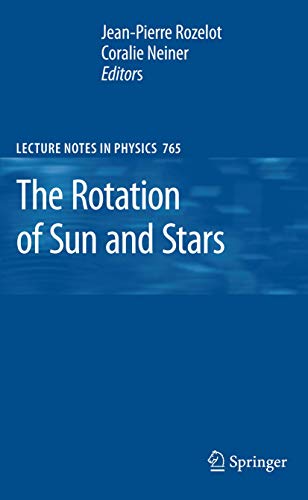
The Sun and stars rotate in di?erent ways and at di?erent velocity rates. The knowledge of how they rotate is important in understanding the formation and evolution of stars and their structure. The closest star to our Earth, the Sun, is a good laboratory to study in detail the rotation of a G star and allows to test new ideas and develop new techniques to study stellar rotation. More or less massive, more or lessevolved objects, however, can have averydi?erent rotation rate, structure and history. In recent years our understanding of the rotation of the Sun has greatly improved. The Sun has a well-known large-scale rotation, which can be m- sured thanks to visible features across the solar disk, such as sunspots, or via spectroscopy. In addition, several studies cast light on di?erential rotation in the convective zone and on meridional circulation in the radiative zone of the Sun. Even the rotation of the core of the Sun can now be studied thanks to various methods, such as dynamics of the gravitational moments and of course, helioseismology, through g-modes analysis. Moreover, the magnetic ?eld is strongly linked to the matter motions in the solar plasma. The solar magnetic ?eld can be measured only at the surface or in theupperlayers.Itistheproductoftheinternaldynamoorofthelocaldynamos if they exist in any case magnetic ?eld and rotation cannot thus be separated.
Le informazioni nella sezione "Riassunto" possono far riferimento a edizioni diverse di questo titolo.
Dalla quarta di copertina
The Sun and stars rotate in different ways and at different rates of velocity, and knowledge of how they rotate is important in understanding the formation and evolution of stars and their structure.
The wide variety of stars offers an equally wide variety of rotation rates and rotational evolution. From the slowly rotating stars to stars rotating close to their breakup velocities, different techniques and models have to be developed to study rotation and its effects on physical aspects of stars. In fact, one currently witnesses a complete renewal of astrophysical ideas about stellar rotation, mainly due to the development of new models including high-order effects of rotation and magnetism.
This book, while not attempting to answer all questions about rotation, given that many issues still have to be further investigated, focuses on the basics and some particular aspects while aiming to show why it is important, from a physical point of view, to study stellar rotation.
Based on courses given at a graduate school, these tutorial lectures will be of interest and useful to a rather broad audience of scientists and students.
Le informazioni nella sezione "Su questo libro" possono far riferimento a edizioni diverse di questo titolo.
Risultati della ricerca per The Rotation of Sun and Stars: 765

Immagini fornite dal venditore
Rotation of Sun and Stars
Da: GreatBookPrices, Columbia, MD, U.S.A.
Valutazione del venditore 5 su 5 stelle

Condizione: As New. Unread book in perfect condition. Codice articolo 5844345
Compra usato
EUR 60,91
Spedizione EUR 2,32
Spedito in U.S.A.
Spedito in U.S.A.
Quantità: 1 disponibili
Immagini fornite dal venditore
The Rotation of Sun and Stars
Editore:
Springer Berlin Heidelberg Jan 2009, 2009
ISBN 10: 3540878300
ISBN 13: 9783540878308
Nuovo
Rilegato
Da: BuchWeltWeit Ludwig Meier e.K., Bergisch Gladbach, Germania
Valutazione del venditore 5 su 5 stelle
Buch. Condizione: Neu. This item is printed on demand - it takes 3-4 days longer - Neuware -The Sun and stars rotate in di erent ways and at di erent velocity rates. The knowledge of how they rotate is important in understanding the formation and evolution of stars and their structure. The closest star to our Earth, the Sun, is a good laboratory to study in detail the rotation of a G star and allows to test new ideas and develop new techniques to study stellar rotation. More or less massive, more or lessevolved objects, however, can have averydi erent rotation rate, structure and history. In recent years our understanding of the rotation of the Sun has greatly improved. The Sun has a well-known large-scale rotation, which can be m- sured thanks to visible features across the solar disk, such as sunspots, or via spectroscopy. In addition, several studies cast light on di erential rotation in the convective zone and on meridional circulation in the radiative zone of the Sun. Even the rotation of the core of the Sun can now be studied thanks to various methods, such as dynamics of the gravitational moments and of course, helioseismology, through g-modes analysis. Moreover, the magnetic eld is strongly linked to the matter motions in the solar plasma. The solar magnetic eld can be measured only at the surface or in theupperlayers.Itistheproductoftheinternaldynamoorofthelocaldynamos if they exist - in any case magnetic eld and rotation cannot thus be separated. 276 pp. Englisch. Codice articolo 9783540878308
Compra nuovo
EUR 53,49
Spedizione EUR 23,00
Spedito da Germania a U.S.A.
Spedito da Germania a U.S.A.
Quantità: 2 disponibili
Foto dell'editore
The Rotation of Sun and Stars (Lecture Notes in Physics, 765)
Da: Ria Christie Collections, Uxbridge, Regno Unito
Valutazione del venditore 5 su 5 stelle
Condizione: New. In English. Codice articolo ria9783540878308_new
Compra nuovo
EUR 66,93
Spedizione EUR 13,11
Spedito da Regno Unito a U.S.A.
Spedito da Regno Unito a U.S.A.
Quantità: Più di 20 disponibili
Immagini fornite dal venditore
Rotation of Sun and Stars
Da: GreatBookPrices, Columbia, MD, U.S.A.
Valutazione del venditore 5 su 5 stelle
Condizione: New. Codice articolo 5844345-n
Compra nuovo
EUR 78,56
Spedizione EUR 2,32
Spedito in U.S.A.
Spedito in U.S.A.
Quantità: 1 disponibili
Immagini fornite dal venditore
Rotation of Sun and Stars
Da: GreatBookPricesUK, Woodford Green, Regno Unito
Valutazione del venditore 5 su 5 stelle
Condizione: As New. Unread book in perfect condition. Codice articolo 5844345
Compra usato
EUR 66,90
Spedizione EUR 17,42
Spedito da Regno Unito a U.S.A.
Spedito da Regno Unito a U.S.A.
Quantità: Più di 20 disponibili
Foto dell'editore
Rotation of Sun and Stars
Da: GreatBookPricesUK, Woodford Green, Regno Unito
Valutazione del venditore 5 su 5 stelle
Condizione: New. Codice articolo 5844345-n
Compra nuovo
EUR 66,92
Spedizione EUR 17,42
Spedito da Regno Unito a U.S.A.
Spedito da Regno Unito a U.S.A.
Quantità: Più di 20 disponibili
Foto dell'editore
The Rotation of Sun and Stars
Da: Books Puddle, Woodside, NY, U.S.A.
Valutazione del venditore 4 su 5 stelle

Condizione: New. pp. 276. Codice articolo 26438555
Compra nuovo
EUR 82,51
Spedizione EUR 3,51
Spedito in U.S.A.
Spedito in U.S.A.
Quantità: 4 disponibili
Foto dell'editore
The Rotation of Sun and Stars
Print on DemandDa: Majestic Books, Hounslow, Regno Unito
Valutazione del venditore 4 su 5 stelle
Condizione: New. Print on Demand pp. 276. Codice articolo 7409348
Compra nuovo
EUR 81,07
Spedizione EUR 7,55
Spedito da Regno Unito a U.S.A.
Spedito da Regno Unito a U.S.A.
Quantità: 4 disponibili
Foto dell'editore
The Rotation of Sun and Stars
Print on DemandDa: Biblios, Frankfurt am main, HESSE, Germania
Valutazione del venditore 4 su 5 stelle
Condizione: New. PRINT ON DEMAND pp. 276. Codice articolo 18438545
Compra nuovo
EUR 81,36
Spedizione EUR 9,95
Spedito da Germania a U.S.A.
Spedito da Germania a U.S.A.
Quantità: 4 disponibili
Foto dell'editore
The Rotation of Sun and Stars
Da: Revaluation Books, Exeter, Regno Unito
Valutazione del venditore 5 su 5 stelle
Hardcover. Condizione: Brand New. 1st edition. 263 pages. 9.25x6.25x0.50 inches. In Stock. Codice articolo x-3540878300
Compra nuovo
EUR 81,38
Spedizione EUR 14,52
Spedito da Regno Unito a U.S.A.
Spedito da Regno Unito a U.S.A.
Quantità: 2 disponibili