
Articoli correlati a Automatic Algorithm Selection for Complex Simulation...
Sinossi
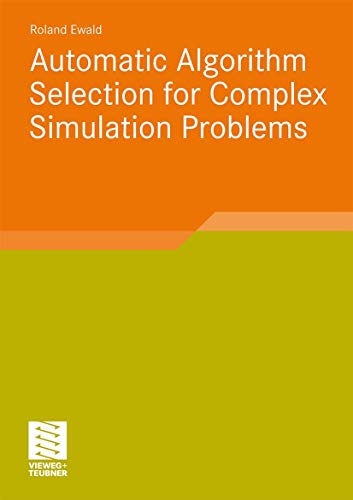
To select the most suitable simulation algorithm for a given task is often difficult. This is due to intricate interactions between model features, implementation details, and runtime environment, which may strongly affect the overall performance. An automated selection of simulation algorithms supports users in setting up simulation experiments without demanding expert knowledge on simulation.
Roland Ewald analyzes and discusses existing approaches to solve the algorithm selection problem in the context of simulation. He introduces a framework for automatic simulation algorithm selection and describes its integration into the open-source modelling and simulation framework James II. Its selection mechanisms are able to cope with three situations: no prior knowledge is available, the impact of problem features on simulator performance is unknown, and a relationship between problem features and algorithm performance can be established empirically. The author concludes with an experimental evaluation of the developed methods.
Le informazioni nella sezione "Riassunto" possono far riferimento a edizioni diverse di questo titolo.
Dalla quarta di copertina
To select the most suitable simulation algorithm for a given task is often difficult. This is due to intricate interactions between model features, implementation details, and runtime environment, which may strongly affect the overall performance. An automated selection of simulation algorithms supports users in setting up simulation experiments without demanding expert knowledge on simulation.
Roland Ewald analyzes and discusses existing approaches to solve the algorithm selection problem in the context of simulation. He introduces a framework for automatic simulation algorithm selection and describes its integration into the open-source modelling and simulation framework James II. Its selection mechanisms are able to cope with three situations: no prior knowledge is available, the impact of problem features on simulator performance is unknown, and a relationship between problem features and algorithm performance can be established empirically. The author concludes with an experimental evaluation of the developed methods.
Le informazioni nella sezione "Su questo libro" possono far riferimento a edizioni diverse di questo titolo.
Risultati della ricerca per Automatic Algorithm Selection for Complex Simulation...

Foto dell'editore
Automatic Algorithm Selection for Complex Simulation Problems (eng)
Print on DemandDa: Brook Bookstore On Demand, Napoli, NA, Italia
Valutazione del venditore 5 su 5 stelle

Condizione: new. Questo è un articolo print on demand. Codice articolo eddec4208af5c43322faca86201a0527
Compra nuovo
EUR 86,24
Spedizione EUR 6,80
Spedito da Italia a U.S.A.
Spedito da Italia a U.S.A.
Quantità: Più di 20 disponibili
Immagini fornite dal venditore
Automatic Algorithm Selection for Complex Simulation Problems
Editore:
Vieweg+Teubner Verlag, 2011
ISBN 10: 383481542X
ISBN 13: 9783834815422
Antico o usato
paperback
Da: Studibuch, Stuttgart, Germania
Valutazione del venditore 5 su 5 stelle
paperback. Condizione: Sehr gut. 404 Seiten; 9783834815422.2 Gewicht in Gramm: 1. Codice articolo 1181743
Compra usato
EUR 44,18
Spedizione EUR 62,30
Spedito da Germania a U.S.A.
Spedito da Germania a U.S.A.
Quantità: 1 disponibili
Immagini fornite dal venditore
Automatic Algorithm Selection for Complex Simulation Problems
Da: GreatBookPrices, Columbia, MD, U.S.A.
Valutazione del venditore 5 su 5 stelle
Condizione: New. Codice articolo 14292079-n
Compra nuovo
EUR 127,18
Spedizione EUR 2,36
Spedito in U.S.A.
Spedito in U.S.A.
Quantità: 15 disponibili
Foto dell'editore
Automatic Algorithm Selection for Complex Simulation Problems
Da: California Books, Miami, FL, U.S.A.
Valutazione del venditore 5 su 5 stelle
Condizione: New. Codice articolo I-9783834815422
Compra nuovo
EUR 129,62
Spedizione gratuita
Spedito in U.S.A.
Spedito in U.S.A.
Quantità: Più di 20 disponibili
Immagini fornite dal venditore
Automatic Algorithm Selection for Complex Simulation Problems
Print on DemandDa: BuchWeltWeit Ludwig Meier e.K., Bergisch Gladbach, Germania
Valutazione del venditore 5 su 5 stelle
Taschenbuch. Condizione: Neu. This item is printed on demand - it takes 3-4 days longer - Neuware -To select the most suitable simulation algorithm for a given task is often difficult. This is due to intricate interactions between model features, implementation details, and runtime environment, which may strongly affect the overall performance. An automated selection of simulation algorithms supports users in setting up simulation experiments without demanding expert knowledge on simulation. Roland Ewald analyzes and discusses existing approaches to solve the algorithm selection problem in the context of simulation. He introduces a framework for automatic simulation algorithm selection and describes its integration into the open-source modelling and simulation framework James II. Its selection mechanisms are able to cope with three situations: no prior knowledge is available, the impact of problem features on simulator performance is unknown, and a relationship between problem features and algorithm performance can be established empirically. The author concludes with an experimental evaluation of the developed methods. 382 pp. Englisch. Codice articolo 9783834815422
Compra nuovo
EUR 106,99
Spedizione EUR 23,00
Spedito da Germania a U.S.A.
Spedito da Germania a U.S.A.
Quantità: 2 disponibili
Foto dell'editore
Automatic Algorithm Selection for Complex Simulation Problems
Editore:
Vieweg+Teubner Verlag 2011-11-14, 2011
ISBN 10: 383481542X
ISBN 13: 9783834815422
Nuovo
Paperback
Da: Chiron Media, Wallingford, Regno Unito
Valutazione del venditore 5 su 5 stelle
Paperback. Condizione: New. Codice articolo 6666-IUK-9783834815422
Compra nuovo
EUR 115,46
Spedizione EUR 18,30
Spedito da Regno Unito a U.S.A.
Spedito da Regno Unito a U.S.A.
Quantità: Più di 20 disponibili
Immagini fornite dal venditore
Automatic Algorithm Selection for Complex Simulation Problems
Editore:
Vieweg+Teubner Verlag, 2011
ISBN 10: 383481542X
ISBN 13: 9783834815422
Nuovo
Kartoniert / Broschiert
Da: moluna, Greven, Germania
Valutazione del venditore 5 su 5 stelle
Kartoniert / Broschiert. Condizione: New. Dieser Artikel ist ein Print on Demand Artikel und wird nach Ihrer Bestellung fuer Sie gedruckt. To select the most suitable simulation algorithm for a given task is often difficult. This is due to intricate interactions between model features, implementation details, and runtime environment, which may strongly affect the overall performance. An aut. Codice articolo 5379589
Compra nuovo
EUR 92,27
Spedizione EUR 48,99
Spedito da Germania a U.S.A.
Spedito da Germania a U.S.A.
Quantità: Più di 20 disponibili
Foto dell'editore
Automatic Algorithm Selection for Complex Simulation Problems
Da: Ria Christie Collections, Uxbridge, Regno Unito
Valutazione del venditore 5 su 5 stelle
Condizione: New. In English. Codice articolo ria9783834815422_new
Compra nuovo
EUR 129,81
Spedizione EUR 13,34
Spedito da Regno Unito a U.S.A.
Spedito da Regno Unito a U.S.A.
Quantità: Più di 20 disponibili
Immagini fornite dal venditore
Automatic Algorithm Selection for Complex Simulation Problems
Da: AHA-BUCH GmbH, Einbeck, Germania
Valutazione del venditore 5 su 5 stelle
Taschenbuch. Condizione: Neu. Druck auf Anfrage Neuware - Printed after ordering - To select the most suitable simulation algorithm for a given task is often difficult. This is due to intricate interactions between model features, implementation details, and runtime environment, which may strongly affect the overall performance. An automated selection of simulation algorithms supports users in setting up simulation experiments without demanding expert knowledge on simulation. Roland Ewald analyzes and discusses existing approaches to solve the algorithm selection problem in the context of simulation. He introduces a framework for automatic simulation algorithm selection and describes its integration into the open-source modelling and simulation framework James II. Its selection mechanisms are able to cope with three situations: no prior knowledge is available, the impact of problem features on simulator performance is unknown, and a relationship between problem features and algorithm performance can be established empirically. The author concludes with an experimental evaluation of the developed methods. Codice articolo 9783834815422
Compra nuovo
EUR 122,94
Spedizione EUR 35,00
Spedito da Germania a U.S.A.
Spedito da Germania a U.S.A.
Quantità: 1 disponibili
Foto dell'editore
Automatic Algorithm Selection for Complex Simulation Problems
Da: Books Puddle, Woodside, NY, U.S.A.
Valutazione del venditore 4 su 5 stelle

Condizione: New. pp. 406. Codice articolo 2697390337
Compra nuovo
EUR 158,07
Spedizione EUR 3,56
Spedito in U.S.A.
Spedito in U.S.A.
Quantità: 4 disponibili