
Articoli correlati a Effects of Climate Variation on the Breeding Ecology...
Sinossi
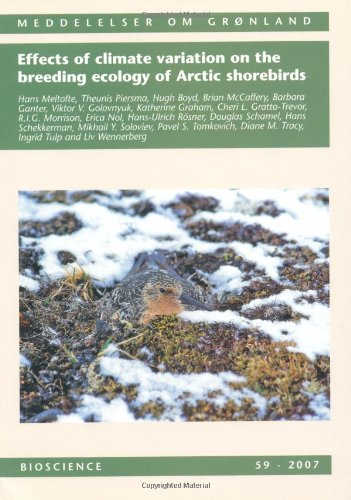
About 50 species of shorebirds breed in the Arctic, where they constitute the most characteristic component of the tundra avifauna. Here, we review the impact of weather and climate on the breeding cycle of shorebirds based on extensive studies conducted across the Arctic. Conditions for breeding shorebirds are highly variable among species, sites and regions, both within and between continents. Weather effects on breeding are most moderate in the Low Arctic of northern Europe and most extreme in the Siberian High Arctic. The decision of whether or not to breed upon arrival on the breeding grounds, the timing of egg-laying and the chick-growth period are most affected by annual variation in weather. In large parts of the Arctic, clutch initiation dates are highly correlated with snowmelt dates and in regions and years where extensive snowmelt occurs before or soon after the arrival of shorebirds, the decision to breed and on the breeding ecology of clutch initiation dates appear to be a function of food availability for laying females. Once incubation is initiated, adult shorebirds appear fairly resilient to variations in temperature with nest abandonment primarily occurring in case of severe weather with new snow covering the ground. Feeding conditions for chicks, a factor highly influenced by weather, affects juvenile production in most regions. Predation has a very strong impact on breeding productivity throughout the Arctic and subarctic, with lemming Dicrostonyx spp. and Lemmus spp. fluctuations strongly influencing predation rates, particularly in the Siberian Arctic. The fate of Arctic shorebirds under projected future climate scenarios is uncertain, but High Arctic species and populations appear particularly at risk. Climatic amelioration may benefit Arctic shorebirds in the short term by increasing both survival and productivity, whereas in the long term habitat changes both on the breeding grounds and on the temperate and tropical non-breeding areas may put them under considerable pressure and may bring some of them near to extinction. Their relatively low genetic diversity, which is thought to be a consequence of survival through past climatically-driven population bottlenecks, may also put them more at risk to anthropogenic-induced climate variation than other avian taxa.
Le informazioni nella sezione "Riassunto" possono far riferimento a edizioni diverse di questo titolo.
Risultati della ricerca per Effects of Climate Variation on the Breeding Ecology...

Immagini fornite dal venditore
Effects of Climate Variation on the Breeding Ecology of Arctic Shorebirds
Editore:
Museum Tusculanum Press, 2007
ISBN 10: 8763512793
ISBN 13: 9788763512794
Antico o usato
Brossura
Da: GreatBookPrices, Columbia, MD, U.S.A.
Valutazione del venditore 5 su 5 stelle

Condizione: As New. Unread book in perfect condition. Codice articolo 6208138
Compra usato
EUR 21,91
Spedizione EUR 2,35
Spedito in U.S.A.
Spedito in U.S.A.
Quantità: 1 disponibili
Foto dell'editore
Effects of Climate Variation on the Breeding Ecology of Arctic Shorebirds
Da: PBShop.store UK, Fairford, GLOS, Regno Unito
Valutazione del venditore 5 su 5 stelle
PAP. Condizione: New. New Book. Shipped from UK. Established seller since 2000. Codice articolo GZ-9788763512794
Compra nuovo
EUR 26,18
Spedizione EUR 3,88
Spedito da Regno Unito a U.S.A.
Spedito da Regno Unito a U.S.A.
Quantità: 1 disponibili
Immagini fornite dal venditore
Effects of Climate Variation on the Breeding Ecology of Arctic Shorebirds
Da: GreatBookPrices, Columbia, MD, U.S.A.
Valutazione del venditore 5 su 5 stelle
Condizione: New. Codice articolo 6208138-n
Compra nuovo
EUR 28,59
Spedizione EUR 2,35
Spedito in U.S.A.
Spedito in U.S.A.
Quantità: 1 disponibili
Foto dell'editore
Effects of Climate Variation on the Breeding Ecology of Arctic Shorebirds
Da: Kennys Bookshop and Art Galleries Ltd., Galway, GY, Irlanda
Valutazione del venditore 5 su 5 stelle
Condizione: New. Editor(s): Meltofte, Hans. Num Pages: 48 pages, colour photos & maps. BIC Classification: 1MTN; WNCB; WNCS1. Category: (G) General (US: Trade). Dimension: 266 x 192 x 5. Weight in Grams: 188. . 2007. Paperback. . . . . Codice articolo V9788763512794
Compra nuovo
EUR 24,92
Spedizione EUR 9,50
Spedito da Irlanda a U.S.A.
Spedito da Irlanda a U.S.A.
Quantità: 1 disponibili
Foto dell'editore
Effects of Climate Variation on the Breeding Ecology of Arctic Shorebirds
Da: Kennys Bookstore, Olney, MD, U.S.A.
Valutazione del venditore 5 su 5 stelle
Condizione: New. Editor(s): Meltofte, Hans. Num Pages: 48 pages, colour photos & maps. BIC Classification: 1MTN; WNCB; WNCS1. Category: (G) General (US: Trade). Dimension: 266 x 192 x 5. Weight in Grams: 188. . 2007. Paperback. . . . . Books ship from the US and Ireland. Codice articolo V9788763512794
Compra nuovo
EUR 30,81
Spedizione EUR 9,36
Spedito in U.S.A.
Spedito in U.S.A.
Quantità: 1 disponibili
Immagini fornite dal venditore
Effects of Climate Variation on the Breeding Ecology of Arctic Shorebirds
Da: GreatBookPricesUK, Woodford Green, Regno Unito
Valutazione del venditore 5 su 5 stelle
Condizione: New. Codice articolo 6208138-n
Compra nuovo
EUR 23,95
Spedizione EUR 17,68
Spedito da Regno Unito a U.S.A.
Spedito da Regno Unito a U.S.A.
Quantità: 1 disponibili
Immagini fornite dal venditore
Effects of Climate Variation on the Breeding Ecology of Arctic Shorebirds
Editore:
Museum Tusculanum Press, 2007
ISBN 10: 8763512793
ISBN 13: 9788763512794
Antico o usato
Brossura
Da: GreatBookPricesUK, Woodford Green, Regno Unito
Valutazione del venditore 5 su 5 stelle
Condizione: As New. Unread book in perfect condition. Codice articolo 6208138
Compra usato
EUR 25,21
Spedizione EUR 17,68
Spedito da Regno Unito a U.S.A.
Spedito da Regno Unito a U.S.A.
Quantità: 1 disponibili
Immagini fornite dal venditore
Effects of Climate Variation on the Breeding Ecology of Arctic Shorebirds
Da: moluna, Greven, Germania
Valutazione del venditore 5 su 5 stelle
Condizione: New. KlappentextrnrnAbout 50 species of shorebirds breed in the Arctic, where they constitute the most characteristic component of the tundra avifauna. Here, we review the impact of weather and climate on the breeding cycle of shorebirds based on ext. Codice articolo 599102253
Compra nuovo
EUR 28,67
Spedizione EUR 48,99
Spedito da Germania a U.S.A.
Spedito da Germania a U.S.A.
Quantità: 1 disponibili
Foto dell'editore
Effects of Climate Variation on the Breeding Ecology of Arctic Shorebirds
Editore:
Museum Tusculanum Press (DK), 2007
ISBN 10: 8763512793
ISBN 13: 9788763512794
Nuovo
Paperback
Da: Gazelle Books, Lancaster, LANCA, Regno Unito
Valutazione del venditore 4 su 5 stelle

Paperback. Condizione: New. New Book, Direct from Publisher. Codice articolo 9788763512794
Compra nuovo
EUR 19,10
Spedizione EUR 64,81
Spedito da Regno Unito a U.S.A.
Spedito da Regno Unito a U.S.A.
Quantità: 1 disponibili