
Articoli correlati a Quantum Causality: Conceptual Issues in the Causal...
Quantum Causality: Conceptual Issues in the Causal Theory of Quantum Mechanics: 23 - Rilegato
Libro 6 di 51: Studies in History and Philosophy of Science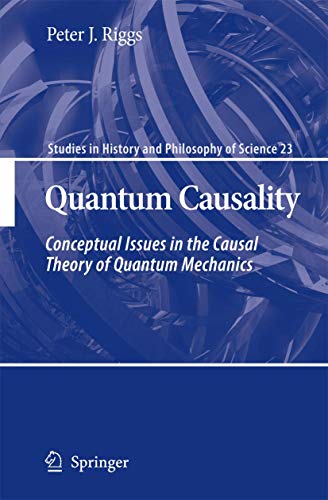
Sinossi
There is no sharp dividing line between the foundations of physics and philosophy of physics. This is especially true for quantum mechanics. The debate on the interpretation of quantum mechanics has raged in both the scientific and philosophical communities since the 1920s and continues to this day. (We shall understand the unqualified term ‘quantum mechanics’ to mean the mathematical formalism, i. e. laws and rules by which empirical predictions and theoretical advances are made. ) There is a popular rendering of quantum mechanics which has been publicly endorsed by some well known physicists which says that quantum mechanics is not only 1 more weird than we imagine but is weirder than we can imagine. Although it is readily granted that quantum mechanics has produced some strange and counter-intuitive results, the case will be presented in this book that quantum mechanics is not as weird as we might have been led to believe! The prevailing theory of quantum mechanics is called Orthodox Quantum Theory (also known as the Copenhagen Interpretation). Orthodox Quantum Theory endows a special status on measurement processes by requiring an intervention of an observer or an observer’s proxy (e. g. a measuring apparatus). The placement of the observer (or proxy) is somewhat arbitrary which introduces a degree of subjectivity. Orthodox Quantum Theory only predicts probabilities for measured values of physical quantities. It is essentially an instrumental theory, i. e.
Le informazioni nella sezione "Riassunto" possono far riferimento a edizioni diverse di questo titolo.
Dalla quarta di copertina
This is a treatise devoted to the foundations of quantum physics and the role that causality plays in the microscopic world governed by the laws of quantum mechanics. There is no sharp dividing line between physics and philosophy of physics. This is especially true for quantum physics where debate on its interpretation and the status of the various entities postulated has raged in both the scientific and philosophical communities since the 1920s and continues to this day. Although it is readily granted that quantum mechanics produces some strange and counter-intuitive results, it is argued in Quantum Causality that quantum mechanics is not as weird as we might have been led to believe.
The dominant theory of quantum mechanics is called Orthodox Quantum Theory (also known as the Copenhagen Interpretation). Orthodox Quantum Theory is a ‘theoretical tool’ for making predictions for the possible results of experiments on quantum systems and requires the intervention of an observer or an observer’s proxy (e.g. a measuring apparatus) in order to produce predictions. Orthodox Quantum Theory does away with the notion of causality and denies the existence of an underlying quantum realm.
The Causal Theory is not well known within the physics community and many physicists who do know of it are generally dismissive in their attitudes. This is a historical legacy inherited by the majority of the physics community from the most influential founders of quantum mechanics, Niels Bohr and Werner Heisenberg. They both denied the independent existence of a quantum level of reality and declared that causality does not apply to quantum events.
Quantum Causality shows that the Causal Theory of Quantum Mechanics is a viable physical theory that provides realistic explanations for quantum phenomena. Much of what is argued for in this book will be controversial but, at the very least, these arguments will likely engender some lively debate on the various issues raised.
Le informazioni nella sezione "Su questo libro" possono far riferimento a edizioni diverse di questo titolo.
Risultati della ricerca per Quantum Causality: Conceptual Issues in the Causal...

Immagini fornite dal venditore
Quantum Causality
Editore:
Springer, 2009
ISBN 10: 9048124026
ISBN 13: 9789048124022
Antico o usato
Rilegato
Prima edizione
Da: avelibro OHG, Dinkelscherben, Germania
Valutazione del venditore 5 su 5 stelle

24 x 16,5 cm. Condizione: Gut. 1. Auflage. 230 Seiten Conceptual Issues in the Causal Theory of Quantum Mechanics. Innen sauberer, guter Zustand. Hardcover, Pappeinband, mit den üblichen Bibliotheks-Markierungen, Stempeln und Einträgen, innen wie außen, siehe Bilder. (Evtl. auch Kleber- und/oder Etikettenreste, sowie -abdrücke durch abgelöste Bibliotheksschilder). Reihe: Studies in History and Philosophy of Science 23 DH-30-11B Sprache: Englisch Gewicht in Gramm: 532. Codice articolo 2050273
Compra usato
EUR 64,00
Spedizione EUR 10,00
Spedito da Germania a U.S.A.
Spedito da Germania a U.S.A.
Quantità: 1 disponibili
Foto dell'editore
Quantum Causality (Studies in History and Philosophy of Science, 23)
Da: HPB-Red, Dallas, TX, U.S.A.
Valutazione del venditore 5 su 5 stelle
hardcover. Condizione: Good. Connecting readers with great books since 1972! Used textbooks may not include companion materials such as access codes, etc. May have some wear or writing/highlighting. We ship orders daily and Customer Service is our top priority! Codice articolo S_469080489
Compra usato
EUR 77,13
Spedizione EUR 3,34
Spedito in U.S.A.
Spedito in U.S.A.
Quantità: 1 disponibili
Foto dell'editore
Quantum Causality (eng)
Print on DemandDa: Brook Bookstore On Demand, Napoli, NA, Italia
Valutazione del venditore 5 su 5 stelle
Condizione: new. Questo è un articolo print on demand. Codice articolo 6a3a3d7e6e2a4125ce93a78a074570e4
Compra nuovo
EUR 86,24
Spedizione EUR 6,80
Spedito da Italia a U.S.A.
Spedito da Italia a U.S.A.
Quantità: Più di 20 disponibili
Foto dell'editore
Quantum Causality : Conceptual Issues in the Causal Theory of Quantum Mechanics
Da: GreatBookPrices, Columbia, MD, U.S.A.
Valutazione del venditore 5 su 5 stelle
Condizione: New. Codice articolo 6310572-n
Compra nuovo
EUR 127,09
Spedizione EUR 2,35
Spedito in U.S.A.
Spedito in U.S.A.
Quantità: 15 disponibili
Foto dell'editore
Quantum Causality: Conceptual Issues in the Causal Theory of Quantum Mechanics (Studies in History and Philosophy of Science, 23)
Da: California Books, Miami, FL, U.S.A.
Valutazione del venditore 5 su 5 stelle
Condizione: New. Codice articolo I-9789048124022
Compra nuovo
EUR 129,52
Spedizione gratuita
Spedito in U.S.A.
Spedito in U.S.A.
Quantità: Più di 20 disponibili
Immagini fornite dal venditore
Quantum Causality: Conceptual Issues in the Causal Theory of Quantum Mechanics
Print on DemandDa: BuchWeltWeit Ludwig Meier e.K., Bergisch Gladbach, Germania
Valutazione del venditore 5 su 5 stelle
Buch. Condizione: Neu. This item is printed on demand - it takes 3-4 days longer - Neuware -There is no sharp dividing line between the foundations of physics and philosophy of physics. This is especially true for quantum mechanics. The debate on the interpretation of quantum mechanics has raged in both the scientific and philosophical communities since the 1920s and continues to this day. (We shall understand the unqualified term 'quantum mechanics' to mean the mathematical formalism, i. e. laws and rules by which empirical predictions and theoretical advances are made. ) There is a popular rendering of quantum mechanics which has been publicly endorsed by some well known physicists which says that quantum mechanics is not only 1 more weird than we imagine but is weirder than we can imagine. Although it is readily granted that quantum mechanics has produced some strange and counter-intuitive results, the case will be presented in this book that quantum mechanics is not as weird as we might have been led to believe! The prevailing theory of quantum mechanics is called Orthodox Quantum Theory (also known as the Copenhagen Interpretation). Orthodox Quantum Theory endows a special status on measurement processes by requiring an intervention of an observer or an observer's proxy (e. g. a measuring apparatus). The placement of the observer (or proxy) is somewhat arbitrary which introduces a degree of subjectivity. Orthodox Quantum Theory only predicts probabilities for measured values of physical quantities. It is essentially an instrumental theory, i. e. 230 pp. Englisch. Codice articolo 9789048124022
Compra nuovo
EUR 106,99
Spedizione EUR 23,00
Spedito da Germania a U.S.A.
Spedito da Germania a U.S.A.
Quantità: 2 disponibili
Immagini fornite dal venditore
Quantum Causality
Print on DemandDa: moluna, Greven, Germania
Valutazione del venditore 5 su 5 stelle
Condizione: New. Dieser Artikel ist ein Print on Demand Artikel und wird nach Ihrer Bestellung fuer Sie gedruckt. Quantum Causality is a philosophical account of the place of causality in the quantum realmQuantum phenomena is described in terms of entities and processes in space and timeAn explanation of the foundations of quantum physics is provided w. Codice articolo 329714340
Compra nuovo
EUR 93,00
Spedizione EUR 48,99
Spedito da Germania a U.S.A.
Spedito da Germania a U.S.A.
Quantità: Più di 20 disponibili
Foto dell'editore
Quantum Causality: Conceptual Issues in the Causal Theory of Quantum Mechanics (Studies in History and Philosophy of Science, 23)
Da: Ria Christie Collections, Uxbridge, Regno Unito
Valutazione del venditore 5 su 5 stelle
Condizione: New. In English. Codice articolo ria9789048124022_new
Compra nuovo
EUR 130,03
Spedizione EUR 13,36
Spedito da Regno Unito a U.S.A.
Spedito da Regno Unito a U.S.A.
Quantità: Più di 20 disponibili
Immagini fornite dal venditore
Quantum Causality : Conceptual Issues in the Causal Theory of Quantum Mechanics
Da: AHA-BUCH GmbH, Einbeck, Germania
Valutazione del venditore 5 su 5 stelle
Buch. Condizione: Neu. Druck auf Anfrage Neuware - Printed after ordering - There is no sharp dividing line between the foundations of physics and philosophy of physics. This is especially true for quantum mechanics. The debate on the interpretation of quantum mechanics has raged in both the scientific and philosophical communities since the 1920s and continues to this day. (We shall understand the unqualified term 'quantum mechanics' to mean the mathematical formalism, i. e. laws and rules by which empirical predictions and theoretical advances are made. ) There is a popular rendering of quantum mechanics which has been publicly endorsed by some well known physicists which says that quantum mechanics is not only 1 more weird than we imagine but is weirder than we can imagine. Although it is readily granted that quantum mechanics has produced some strange and counter-intuitive results, the case will be presented in this book that quantum mechanics is not as weird as we might have been led to believe! The prevailing theory of quantum mechanics is called Orthodox Quantum Theory (also known as the Copenhagen Interpretation). Orthodox Quantum Theory endows a special status on measurement processes by requiring an intervention of an observer or an observer's proxy (e. g. a measuring apparatus). The placement of the observer (or proxy) is somewhat arbitrary which introduces a degree of subjectivity. Orthodox Quantum Theory only predicts probabilities for measured values of physical quantities. It is essentially an instrumental theory, i. e. Codice articolo 9789048124022
Compra nuovo
EUR 124,85
Spedizione EUR 35,00
Spedito da Germania a U.S.A.
Spedito da Germania a U.S.A.
Quantità: 2 disponibili
Foto dell'editore
Quantum Causality
Da: Books Puddle, Woodside, NY, U.S.A.
Valutazione del venditore 4 su 5 stelle

Condizione: New. pp. 244. Codice articolo 261401549
Compra nuovo
EUR 159,15
Spedizione EUR 3,56
Spedito in U.S.A.
Spedito in U.S.A.
Quantità: 4 disponibili